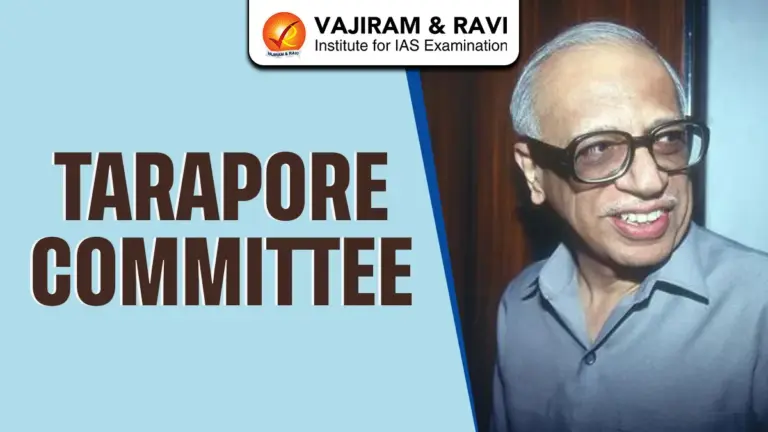
The Tarapore Committee was constituted by the Reserve Bank of India in 1997 under the chairmanship of S.S. Tarapore, a former Deputy Governor of the RBI to examine the feasibility of introducing Capital Account Convertibility (CAC) in India.
Capital Account Convertibility Meaning
Capital account convertibility means the freedom to convert rupee into any foreign currency and foreign currency back into rupee for capital account transactions.
It enables residents and non-residents to move capital freely across borders for investment, borrowing, and lending purposes.
While it enhances capital inflows and financial integration, it also exposes the economy to volatility and sudden capital reversals.
Tarapore Committee Recommendations
The Tarapore Committee recommended a three-phase roadmap for achieving full Capital Account Convertibility by the year 1999-2000 and it had listed several preconditions such as fiscal consolidation, inflation control, low level of non-performing assets, low current account deficit and strengthening of financial markets for achieving capital account liberalisation.
Preconditions for Capital Account Convertibility
- The Tarapore Committee emphasised that strong fiscal discipline is essential before adopting full Capital Account Convertibility. It recommended reducing the gross fiscal deficit of the Centre to around 3.5 percent of GDP and completely eliminating the revenue deficit to ensure macroeconomic stability.
- The committee recommended maintaining a low and stable inflation rate in the range of 3 to 5 percent, as high inflation erodes investor confidence.
- Capital Account Convertibility should be preceded by banking sector reforms, including reduction of Non-Performing Assets to international standards, improvement in capital adequacy, and enhancement of risk-management practices.
- The committee recommended strengthening prudential norms, regulatory oversight, and supervisory mechanisms to ensure that financial institutions can withstand volatile capital flows and prevent systemic risks.
- The committee highlighted the need for a stable and market-determined exchange rate system. Excessive exchange rate volatility under free capital flows could encourage speculative attacks and weaken monetary policy effectiveness.
- Restrictions on short-term external borrowings, as they are highly volatile and can quickly reverse during periods of global financial stress, posing serious balance of payments risks.
- Need to maintain adequate foreign exchange reserves as a buffer against sudden capital outflows and external shocks.
Despite its detailed roadmap, the recommendations of the First Tarapore Committee were not implemented. The Asian Financial Crisis of 1997–98 exposed the dangers of premature capital account liberalisation, particularly for emerging economies with fragile financial systems. Additionally, India’s high fiscal deficit, weak banking sector, and regulatory limitations made full CAC risky.





Second Tarapore Committee (2006)
In 2006, the Reserve Bank of India re-examined the issue of Capital Account Convertibility in a changed economic environment marked by high foreign exchange reserves, robust growth, and improved financial institutions. A second committee, again chaired by S.S. Tarapore was constituted to reassess the feasibility of CAC.
The Second Tarapore Committee (2006) largely reiterated the philosophy of the 1997 Committee, while making certain modifications in line with the changed economic and global context.
- Unlike the 1997 committee, which proposed a time-bound roadmap, the 2006 committee rejected fixed deadlines and argued that Capital Account Convertibility should depend on evolving domestic and global conditions.
- For the first time, the committee clearly acknowledged the risks of sudden capital reversals, speculative attacks, and contagion effects, drawing lessons from the Asian Financial Crisis (1997) and other emerging market crises.
- While the earlier committee aimed at full CAC, the second committee accepted that partial capital account convertibility could be a long-term equilibrium for India, rather than merely a transitional phase.
- The committee stressed that capital account liberalisation should be reversible, allowing the government and RBI to reintroduce controls if financial stability is threatened.
Capital Account Convertibility in India
In India, the rupee is partially convertible to capital account. RBI does not allow full conversion of Rupee into foreign currencies and foreign currencies into Rupee for transactions falling under the capital account of BoP. RBI has placed restrictions on the value of transactions that anybody can do under a capital account.
Rupee will move to full capital account convertibility once the macroeconomic parameters like current account deficit, fiscal deficit, external debt, inflation become stable at low range and there is resilience to absorb shocks related to capital outflows.
UPSC CSE Prelims PYQs
- Convertibility of rupee implies [2015]
- being able to convert rupee notes into gold
- allowing the value of rupee to be fixed by market forces
- freely permitting the conversion of rupee to other currencies and vice versa
- developing an international market for currencies in India.
Answer: (c) freely permitting the conversion of rupee to other currencies and vice versa

 Last updated on April, 2026
→ UPSC Final Result 2025 is now out.
→ UPSC has released UPSC Toppers List 2025 with the Civil Services final result on its official website.
→ Anuj Agnihotri secured AIR 1 in the UPSC Civil Services Examination 2025.
→ UPSC Marksheet 2025 is now out.
→ UPSC Notification 2026 & UPSC IFoS Notification 2026 is now out on the official website at upsconline.nic.in.
→ UPSC Calendar 2026 has been released.
→ Check out the latest UPSC Syllabus 2026 here.
→ UPSC Prelims 2026 will be conducted on 24th May, 2026 & UPSC Mains 2026 will be conducted on 21st August 2026.
→ The UPSC Selection Process is of 3 stages-Prelims, Mains and Interview.
→ Prepare effectively with Vajiram & Ravi’s UPSC Prelims Test Series 2026 featuring full-length mock tests, detailed solutions, and performance analysis.
→ Enroll in Vajiram & Ravi’s UPSC Mains Test Series 2026 for structured answer writing practice, expert evaluation, and exam-oriented feedback.
→ Join Vajiram & Ravi’s Best UPSC Mentorship Program for personalized guidance, strategy planning, and one-to-one support from experienced mentors.
→ Shakti Dubey secures AIR 1 in UPSC CSE Exam 2024.
→ Also check Best UPSC Coaching in India
Tarapore Committee FAQs
Q1. What was the Tarapore Committee?+
Q2. What is Capital Account Convertibility (CAC)?+
Q3. Why is Capital Account Convertibility important?+
Q4. What was the main recommendation of the First Tarapore Committee (1997)?+
Q5. What is India’s current status on CAC?+
Tags: tarapore committee