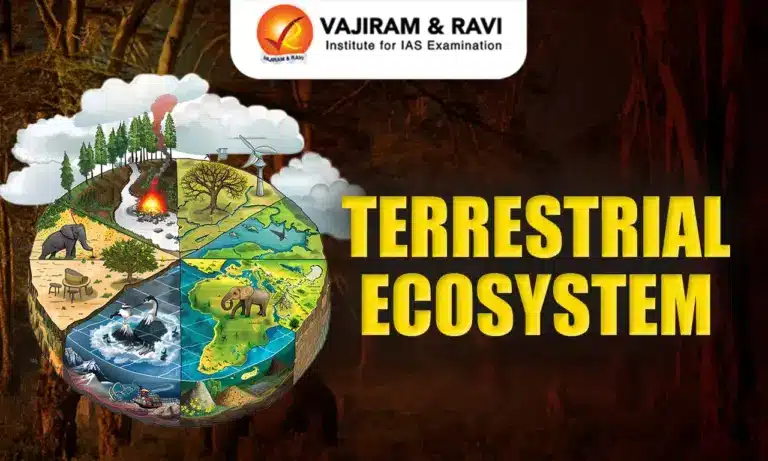
Terrestrial ecosystems are important for the sustenance of life on Earth. Having an understanding of this ecosystem, helps in understanding the ecological concepts and tackling environmental challenges. In this article, we are going to cover the meaning of a terrestrial ecosystem, its categories including forest ecosystems, grassland ecosystems, desert ecosystems, tundra ecosystems, mountain ecosystems and ghats ecosystems.
Ecosystem
An ecosystem is a functional unit of nature where living organisms coexist, interact with each other and engage with their surrounding physical environment. Ecosystems exists in different sizes including oceans, forests or a small pond or puddle that sustains aquatic plants, insects and microorganisms.
Terrestrial Ecosystem
A terrestrial ecosystem is one that exists on land, where the interactions between the biotic (living) and abiotic (non-living) components occur across land surfaces rather than aquatic zones.





Terrestrial Ecosystems Types
Broadly, terrestrial ecosystems can be classified into four main categories:
- Forest Ecosystem
- Grassland Ecosystem
- Desert Ecosystem
- Tundra Ecosystem
In India, Mountain Ecosystems and Ghats Ecosystems are also considered important subtypes of terrestrial ecosystems due to their distinct geographical and ecological significance.
Forest Ecosystem
- A forest refers to a land covered predominantly with trees, undergrowth, shrubs, and associated vegetation.
- As a terrestrial ecosystem, forests sustain dense growth of trees and serve as habitats for a wide range of fauna.
- Based on tree density, forests are broadly divided into dense forests and open forests.
- Forests collectively cover nearly 30% of the Earth’s land area.
Examples: Tropical rainforests, deciduous forests, coniferous forests, etc.
Grassland Ecosystem
- Grasslands are terrestrial ecosystems dominated by grasses and herbaceous plants, with very few or no trees.
- They occur in regions that receive moderate rainfall and not enough to support forests but sufficient to sustain grasses and shrubs.
- Grasslands often represent intermediate stages of ecological succession, which ultimately culminates into forests.
Grasslands Types
- Tropical Grasslands (Savannahs): Located in tropical regions that lack enough rainfall for dense forests. Example regions include the Sahel (Africa), East Africa, and northern Australia.
- Temperate Grasslands: Found in mid-latitudes, characterized by hot summers, cold winters, and low to moderate rainfall. They are named differently across the world like Pampas (Argentina), Prairies (North America), Steppes (Russia), Downs (Australia), Velds (South Africa), Pustaz (Hungary).
Desert Ecosystem
Deserts are terrestrial ecosystems characterized by extremely low rainfall (below 25 cm annually), sparse vegetation, and large temperature variations.
Deserts Types
- Hot Deserts: These have sandy plains, low rainfall, and coarse, well-drained soils. Examples include the Sahara (North Africa), Kalahari (Southern Africa), Monte (Argentina), and Thar Desert (India).
- Cold Deserts: Found in higher latitudes or high-altitude regions. They have dry conditions due to isolation from coasts or mountain barriers. In India, cold deserts exist in the Western Himalayas, stretching from Ladakh to Kinnaur in Himachal Pradesh.
Tundra Ecosystem
- The Tundra ecosystem is marked by extreme cold conditions, long harsh winters, and short cool summers. The word “tundra” literally means “barren land.”
- Annual precipitation is usually less than 25 cm, mostly in the form of snow.
Tundra Types
- Arctic Tundra: Found near the Arctic Circle, with permafrost soil that remains frozen throughout the year except for a thin surface layer that thaws in summer.
- Alpine Tundra: Found in high mountain regions above the treeline across the world. These areas are cold, windy, and unsuitable for tree growth.
- In India, tundra ecosystems are found in the upper reaches of the Himalayas (above 3600 meters). Vegetation includes silver fir, juniper, birch, mosses, and lichens.
Mountain Ecosystem
- Mountain ecosystems are unique terrestrial ecosystems found in elevated regions with steep slopes and rugged terrain.
- They are defined by harsh conditions like cold temperatures, reduced oxygen, and heavy winds at higher altitudes.
- The Himalayan mountain system in India is of immense ecological, climatic, and cultural importance. It shapes monsoon rainfall patterns, sustains glaciers and rivers, and houses rich biodiversity.
Ghats Ecosystem
The Ghats of India consists of two mountain ranges running along the edges of the Deccan Plateau that are the Western Ghats and the Eastern Ghats.
- Western Ghats: Stretch from the Tapti River to Kanyakumari. Known as Sahyadri ranges, they receive high orographic rainfall (100–500 cm). Recognized as one of the 36 global biodiversity hotspots.
- Eastern Ghats: Discontinuous hills running parallel to India’s east coast, cut by rivers like Mahanadi, Godavari, and Krishna. Vegetation ranges from dry savannas to evergreen forests. Rich in medicinal plants such as Aegle marmelos and Acorus calamus.
| Also Check Other Posts | |
| Climate Change | Coastal Regulation Zone |
| Global Plastic Treaty | Nitrogen Cycle |
| Carbon Cycle | |

 Last updated on March, 2026
→ UPSC Final Result 2025 is now out.
→ UPSC has released UPSC Toppers List 2025 with the Civil Services final result on its official website.
→ Anuj Agnihotri secured AIR 1 in the UPSC Civil Services Examination 2025.
→ UPSC Marksheet 2025 is now out.
→ UPSC Notification 2026 & UPSC IFoS Notification 2026 is now out on the official website at upsconline.nic.in.
→ UPSC Calendar 2026 has been released.
→ Check out the latest UPSC Syllabus 2026 here.
→ UPSC Prelims 2026 will be conducted on 24th May, 2026 & UPSC Mains 2026 will be conducted on 21st August 2026.
→ The UPSC Selection Process is of 3 stages-Prelims, Mains and Interview.
→ Prepare effectively with Vajiram & Ravi’s UPSC Prelims Test Series 2026 featuring full-length mock tests, detailed solutions, and performance analysis.
→ Enroll in Vajiram & Ravi’s UPSC Mains Test Series 2026 for structured answer writing practice, expert evaluation, and exam-oriented feedback.
→ Join Vajiram & Ravi’s Best UPSC Mentorship Program for personalized guidance, strategy planning, and one-to-one support from experienced mentors.
→ Shakti Dubey secures AIR 1 in UPSC CSE Exam 2024.
→ Also check Best UPSC Coaching in India
Terrestrial Ecosystem FAQs
Q1. What is the terrestrial ecosystem?+
Q2. What are the major types of terrestrial ecosystems?+
Q3. What are the 4 terrestrial habitats?+
Q4. What is the tundra ecosystem?+
Q5. What is grassland ecosystem?+
Tags: terrestrial ecosystem