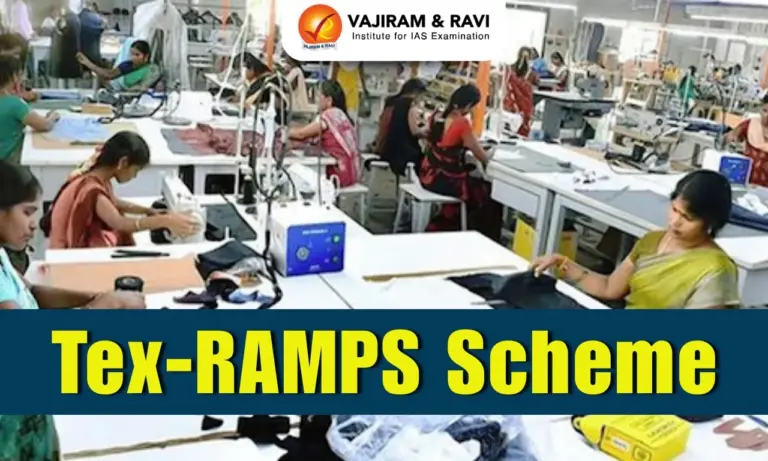
Textile Sector Latest News
- The Union Government has approved the Textiles Focused Research, Assessment, Monitoring, Planning and Start-up (Tex-RAMPS) Scheme.
Textile Sector: A Pillar of Manufacturing and Employment
- India’s textile and apparel sector is one of the country’s oldest and most significant industries, deeply embedded in its cultural and economic landscape.
- It contributes over 2% to India’s GDP, nearly 11% to industrial output, and around 13% to total export earnings.
- With more than 45 million workers, it is the second-largest employer after agriculture.
- The sector’s strength lies in its integrated value chain, from fibre, spinning, weaving, knitting, processing, to apparel and home textiles.
- India is among the world’s largest producers of cotton, jute, silk, polyester, and technical textiles, and is globally competitive in home furnishings and garment manufacturing.





Challenges Faced by the Textile Sector
- Slow adoption of advanced technologies,
- Limited R&D capacity,
- Absence of an integrated data and analytics ecosystem,
- Fragmented supply chains,
- Rising global competition from technologically agile economies like China, Vietnam, and Bangladesh.
News Summary
- The Union Government has approved the Textiles Focused Research, Assessment, Monitoring, Planning and Start-up (Tex-RAMPS) Scheme, with an outlay of Rs. 305 crore, to be implemented between 2025-26 and 2030-31.
- The initiative aims to strengthen innovation capacity, improve data systems, and enhance the global competitiveness of India’s textile and apparel sector.
Aims and Vision of Tex-RAMPS
- Tex-RAMPS is designed as a future-oriented intervention to address critical structural gaps that limit India’s competitiveness in the global textile value chain.
- According to the Textiles Ministry, the scheme will integrate research, data, and innovation to position India as a global leader in sustainability, technology, and competitiveness. The scheme aims to:
- Build a strong national ecosystem for textile research and innovation,
- Strengthen evidence-based policymaking through advanced data systems,
- Promote sustainability and efficiency across the value chain,
- Develop high-value textile start-ups and entrepreneurship,
- Enhance collaboration between States, academia, industry, and government bodies.
Key Components of the Tex-RAMPS Scheme
- Research and Innovation Development
- The scheme promotes advanced research in Smart textiles, Sustainability and circularity, Process efficiency, Emerging and frontier technologies.
- This is expected to significantly boost India’s innovation capabilities and enhance global value chain integration.
- Data, Analytics, and Diagnostic Systems
- Tex-RAMPS places strong emphasis on building a robust, real-time textile data ecosystem, including employment assessments, supply chain mapping, across-India study, and standardized analytics for strategic planning.
- The idea is to enable “evidence-based decision making” across the sector.
- Integrated Textiles Statistical System (ITSS)
- A major innovation is the establishment of the ITSS, a centralised data and analytics platform enabling Continuous monitoring, Centralised diagnostics, and Strategic policy planning.
- This system will support State governments as well as industry bodies in aligning strategies with national goals.
- Capacity Development and Knowledge Ecosystem
- Tex-RAMPS proposes to Strengthen State-level planning units, Share best practices across textile clusters, Organise workshops, training programmes, and sectoral events.
- These efforts aim to enhance human resource development and cultivate a strong “quality culture” within the textile value chain.
- Start-up and Innovation Support
- The scheme actively encourages entrepreneurship through Support for textile incubators, Hackathons, academia-industry collaboration, Innovation challenges and early-stage funding support.
- This is intended to nurture high-value textile start-ups and foster innovations in technical textiles, smart fabrics, and sustainable materials.
Expected Outcomes of Tex-RAMPS
- The scheme is expected to deliver significant long-term gains:
- Enhanced global competitiveness of India’s textile and apparel industries,
- A stronger research and innovation ecosystem,
- Improved quality, productivity, and supply-chain resilience,
- More accurate, data-driven policies and workforce assessments,
- Generation of employment opportunities,
- Deeper collaborations between States, academia, and industry.
- Industry leaders note that the scheme will “strengthen the innovation ecosystem, promote promising start-ups, and deepen the quality culture” in the textile sector.

 Last updated on March, 2026
→ UPSC Final Result 2025 is now out.
→ UPSC has released UPSC Toppers List 2025 with the Civil Services final result on its official website.
→ Anuj Agnihotri secured AIR 1 in the UPSC Civil Services Examination 2025.
→ UPSC Marksheet 2025 is now out.
→ UPSC Notification 2026 & UPSC IFoS Notification 2026 is now out on the official website at upsconline.nic.in.
→ UPSC Calendar 2026 has been released.
→ Check out the latest UPSC Syllabus 2026 here.
→ UPSC Prelims 2026 will be conducted on 24th May, 2026 & UPSC Mains 2026 will be conducted on 21st August 2026.
→ The UPSC Selection Process is of 3 stages-Prelims, Mains and Interview.
→ Prepare effectively with Vajiram & Ravi’s UPSC Prelims Test Series 2026 featuring full-length mock tests, detailed solutions, and performance analysis.
→ Enroll in Vajiram & Ravi’s UPSC Mains Test Series 2026 for structured answer writing practice, expert evaluation, and exam-oriented feedback.
→ Join Vajiram & Ravi’s Best UPSC Mentorship Program for personalized guidance, strategy planning, and one-to-one support from experienced mentors.
→ Shakti Dubey secures AIR 1 in UPSC CSE Exam 2024.
→ Also check Best UPSC Coaching in India
Textile Sector FAQs
Q1. What is the total outlay of the Tex-RAMPS Scheme?+
Q2. What are the key focus areas of Tex-RAMPS?+
Q3. What is ITSS under Tex-RAMPS?+
Q4. Does the scheme support start-ups?+
Q5. What outcome is expected from Tex-RAMPS?+
Tags: mains articles textile sector upsc current affairs upsc mains current affairs