Wind Farms Latest News
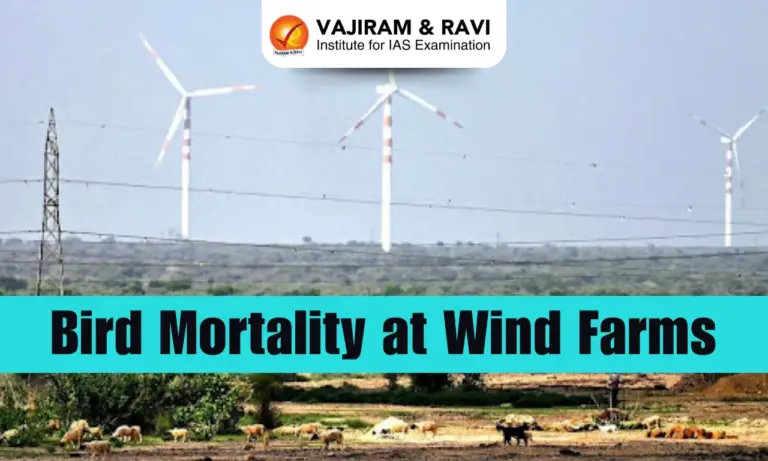
- A new study has found that wind farms in India’s Thar Desert have the world’s highest recorded bird mortality rates, raising concerns over the environmental impact of renewable energy expansion.
Introduction
- As India accelerates its push towards renewable energy to meet growing climate commitments and power demands, an unintended consequence has emerged in the form of large-scale bird deaths.
- A study by the Wildlife Institute of India (WII) reveals that wind farms in the Thar Desert have the highest recorded bird mortality rates in the world, with critically endangered species such as the Great Indian bustard under threat.




Key Findings on Bird Mortality in the Thar Desert
- The study, published in Nature Scientific Reports, was conducted across 3,000 sq. km of desert landscape in Jaisalmer, Rajasthan, which hosts about 900 wind turbines and over 270 bird species.
- Researchers conducted seven multi-season surveys around 90 randomly selected turbines, identifying 124 bird carcasses within a 150-meter radius.
- The annual estimated bird mortality was a staggering 4,464 birds per 1,000 sq. km, after accounting for carcass detection challenges such as scavenging and terrain obstacles.
- By contrast, control sites, located 500 to 2,000 meters away from turbines, showed zero bird deaths, confirming the turbines as the primary cause.
- Notably, the study’s mortality estimate of 1.24 bird deaths per turbine per month is significantly higher than previous findings from Kutch and Davangere, which reported 0.47 deaths per turbine annually.
Species at Risk and Regional Vulnerability
- The Thar Desert forms a crucial segment of the Central Asian Flyway, a major migration route for birds across Eurasia, making it an ecologically sensitive zone.
- The area also serves as a prominent wintering ground, further amplifying the risk of avian fatalities due to wind power infrastructure.
- Among the most vulnerable bird species are raptors, which are long-lived and reproduce slowly.
- Their soaring flight patterns and altitude bring them directly into the rotating blades of wind turbines, making them especially susceptible to collisions.
- These additional mortalities can lead to population-level impacts, particularly for endangered species.
Proposed Mitigation Measures
- Several mitigation strategies have been proposed globally and domestically to address the issue of bird deaths at wind farms:
- Blade painting: Painting one turbine blade black to increase visibility for birds.
- Timed shutdowns: Halting turbine operations during high-risk periods such as migration seasons or early morning hours.
- Site selection: Most crucially, experts recommend careful pre-installation site assessments to avoid high-avian-sensitivity zones.
- One key tool in this regard is the Avian Sensitivity Tool for Energy Planning (AVISTEP), an open-source platform developed by BirdLife International.
- It helps developers identify zones classified into ‘low’, ‘moderate’, ‘high’, and ‘very high’ sensitivity to bird species.
- However, experts stress that AVISTEP must be complemented by detailed ground-level studies.
- Despite the severity of impacts, onshore wind energy projects in India are currently not mandated to conduct environmental impact assessments (EIAs) before installation, a gap that requires urgent regulatory attention.
Offshore Wind Energy: An Emerging Focus
- India is now turning its attention to offshore wind energy, considered a less land-intensive alternative.
- The country plans to install 30 GW of offshore wind capacity by 2030, with the Ministry of New and Renewable Energy already issuing 4 GW of bids in Gujarat and Tamil Nadu.
- With 7,600 km of coastline and 2.3 million sq. km of exclusive economic zones, India has immense potential for offshore wind.
- According to the Council on Energy, Environment and Water (CEEW), the addition of offshore wind capacity in states like Gujarat can help ensure grid reliability during peak loads.
- However, experts caution that marine biodiversity impacts must not be overlooked.
- Offshore wind projects involve complex infrastructure that can disrupt marine habitats, increase noise levels, and degrade water quality.
- The Gulf of Khambhat EIA report documented the presence of sensitive species like dolphins and sharks, with warnings about construction-phase disturbances.
- Although EIAs are mandatory for offshore wind projects, concerns remain about the accuracy and duration of ecological assessments, especially in high-biodiversity zones such as the Gujarat coast, which lies along both the Central Asian and African-Eurasian flyways.
Source : TH

 Last updated on March, 2026
→ UPSC Final Result 2025 is now out.
→ UPSC has released UPSC Toppers List 2025 with the Civil Services final result on its official website.
→ Anuj Agnihotri secured AIR 1 in the UPSC Civil Services Examination 2025.
→ UPSC Marksheet 2025 is now out.
→ UPSC Notification 2026 & UPSC IFoS Notification 2026 is now out on the official website at upsconline.nic.in.
→ UPSC Calendar 2026 has been released.
→ Check out the latest UPSC Syllabus 2026 here.
→ UPSC Prelims 2026 will be conducted on 24th May, 2026 & UPSC Mains 2026 will be conducted on 21st August 2026.
→ The UPSC Selection Process is of 3 stages-Prelims, Mains and Interview.
→ Prepare effectively with Vajiram & Ravi’s UPSC Prelims Test Series 2026 featuring full-length mock tests, detailed solutions, and performance analysis.
→ Enroll in Vajiram & Ravi’s UPSC Mains Test Series 2026 for structured answer writing practice, expert evaluation, and exam-oriented feedback.
→ Join Vajiram & Ravi’s Best UPSC Mentorship Program for personalized guidance, strategy planning, and one-to-one support from experienced mentors.
→ Shakti Dubey secures AIR 1 in UPSC CSE Exam 2024.
→ Also check Best UPSC Coaching in India
Wind Farms MCQs
Q1. Which region has recorded the world’s highest bird death rates at wind farms?+
Q2. Which species are most vulnerable to wind turbine collisions?+
Q3. What mitigation tool helps identify high-risk zones for bird collisions?+
Q4. Are onshore wind energy projects in India required to conduct EIAs?+
Q5. What is India’s offshore wind energy target for 2030?+
Tags: mains articles upsc current affairs upsc mains current affairs wind farms