What’s in Today’s Article?
- The Doctrine of Separation of Power Latest News
- Key Constitutional Principles
- Dissecting the Vice-President’s Remarks
- Judicial Accountability Mechanisms
- Interplay Between Judicial Independence, Popular Sovereignty, and Judicial Activism
- Conclusion
- The Doctrine of Separation of Power FAQs
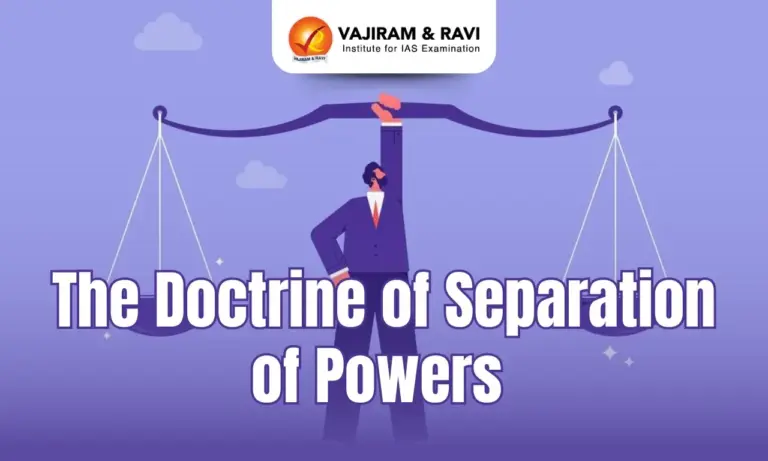
The Doctrine of Separation of Power Latest News
- Recent comments by Vice-President Jagdeep Dhankhar have stirred a constitutional and political debate regarding the role and powers of the judiciary vis-à-vis the executive.
- Concerns arise from his remarks calling judges a “super parliament“, questioning their power to direct the President, and asserting judges are not accountable under the law.




Key Constitutional Principles
- Separation of powers:
- The doctrine of separation of powers is a cornerstone of the Indian Constitution.
- It ensures that the three organs – Legislature, Executive, and Judiciary – function independently.
- Any overreach by one organ into another’s domain undermines constitutional governance.
- Even the independence of the judiciary is fully secured because of the principle of separation of powers [L. Chandra Kumar versus Union of India (1997)].
- If at any time judges try to exercise their powers arbitrarily, it shall be a gross violation of Article 50 of DPSP, and the government may initiate a process for a removal of the judge concerned.
- Supremacy of the Constitution:
- The rule of law and the supremacy of the Constitution are foundational doctrines.
- Even the President, Governors, and judiciary are bound by constitutional provisions.
- No authority is beyond scrutiny if it violates constitutional boundaries.
Dissecting the Vice-President’s Remarks
- The ‘super parliament’ comment:
- The term “super parliament” is misleading and constitutionally unsound.
- Parliament, as a body elected by the people, holds legislative power – but this does not mean that the judiciary’s constitutional review powers encroach upon Parliament’s supremacy.
- The judiciary acts as a guardian of the Constitution, ensuring no law violates constitutional limits.
- Judiciary’s role regarding Presidential assent:
- The President of India, under Article 52, is the constitutional head and must act on the aid and advice of the Council of Ministers (Articles 74, 78).
- S/he is elected according to the provisions contained in Articles 54 and 55 establishing India as a Republic.
- If there is undue delay in granting assent to a bill, the judiciary can intervene to protect popular sovereignty.
Judicial Accountability Mechanisms
- Constitutional limits on judicial power:
- All judicial powers stem from the Constitution and must be exercised within its limits.
- Judges can be removed only on grounds of “proved misbehaviour“, which includes violation of the Constitution.
- Parliament’s role:
- Parliament holds the power to enact laws that can alter or overrule judicial decisions, provided it follows constitutional procedure.
- This reflects the democratic principle of checks and balances.
Interplay Between Judicial Independence, Popular Sovereignty, and Judicial Activism
- Judicial independence:
- Vital for upholding the basic structure doctrine.
- Shielded from arbitrary executive or legislative interference.
- Popular sovereignty: The judiciary’s actions, such as setting deadlines for the President or Governor to assent bills, aim to uphold public interest and constitutional compliance.
- Article 142 and judicial activism:
- Empowers the Supreme Court to pass orders for complete justice.
- Such provisions underscore the Court’s role in filling legislative or executive voids when constitutional mechanisms are silent.
Conclusion
- The constitutional authorities, particularly those in high office, must speak responsibly.
- The statement given by the VP that the law of the land does not apply to judges is not at all rational because he himself, as the second highest constitutional authority, questions the rule of law in India.
- Therefore, it is necessary to uphold the judiciary’s constitutional role and emphasize that the rule of law, accountability, and constitutional supremacy are the guiding lights of Indian democracy.
The Doctrine of Separation of Power FAQs
Q1. What is the constitutional implication of calling the judiciary a ‘super parliament’?
Ans. Calling the judiciary a ‘super parliament’ is constitutionally misleading, as the judiciary functions within the doctrine of separation of powers and cannot override the will of the people represented through Parliament.
Q2. How does the Constitution ensure judicial accountability in India?
Ans. Judicial accountability is ensured through constitutional provisions allowing removal of judges on grounds of proved misbehaviour, including violation of the Constitution.
Q3. Can the judiciary set deadlines for the President or Governors regarding assent to bills? Justify.
Ans. Yes, the judiciary can set deadlines as undue delay in granting assent undermines popular sovereignty, and such directions ensure adherence to constitutional mandates.
Q4. Why is the statement that “law of the land does not apply to judges” constitutionally incorrect?
Ans. It is incorrect because all judicial powers are derived from the Constitution, and judges are bound by its provisions under the doctrine of constitutional supremacy.
Q5. How does Article 142 empower the Supreme Court in maintaining constitutional governance?
Ans. Article 142 empowers the Supreme Court to pass any order necessary to do complete justice, especially when constitutional provisions or laws are silent on a matter.
Source: TH

 Last updated on March, 2026
→ UPSC Final Result 2025 is now out.
→ UPSC has released UPSC Toppers List 2025 with the Civil Services final result on its official website.
→ Anuj Agnihotri secured AIR 1 in the UPSC Civil Services Examination 2025.
→ UPSC Marksheet 2025 is now out.
→ UPSC Notification 2026 & UPSC IFoS Notification 2026 is now out on the official website at upsconline.nic.in.
→ UPSC Calendar 2026 has been released.
→ Check out the latest UPSC Syllabus 2026 here.
→ UPSC Prelims 2026 will be conducted on 24th May, 2026 & UPSC Mains 2026 will be conducted on 21st August 2026.
→ The UPSC Selection Process is of 3 stages-Prelims, Mains and Interview.
→ Prepare effectively with Vajiram & Ravi’s UPSC Prelims Test Series 2026 featuring full-length mock tests, detailed solutions, and performance analysis.
→ Enroll in Vajiram & Ravi’s UPSC Mains Test Series 2026 for structured answer writing practice, expert evaluation, and exam-oriented feedback.
→ Join Vajiram & Ravi’s Best UPSC Mentorship Program for personalized guidance, strategy planning, and one-to-one support from experienced mentors.
→ Shakti Dubey secures AIR 1 in UPSC CSE Exam 2024.
→ Also check Best UPSC Coaching in India