What’s in today’s article?
- Why in news?
- What is the Fujiwhara effect?
- Five different ways in which Fujiwhara Effect can take place
- Associated damages
- How is this related to today’s climate?
Why in news?
- Earlier this year, California witnessed an unusually wet winter, with at least twelve atmospheric river storms battering the state.
- Atmospheric rivers are vast airborne currents carrying dense moisture and hanging low in the atmosphere.
- In one of these storms, two small areas of low pressure were drawn together in a ‘dance’, commonly known as Fujiwhara effect.
What is the Fujiwhara effect?

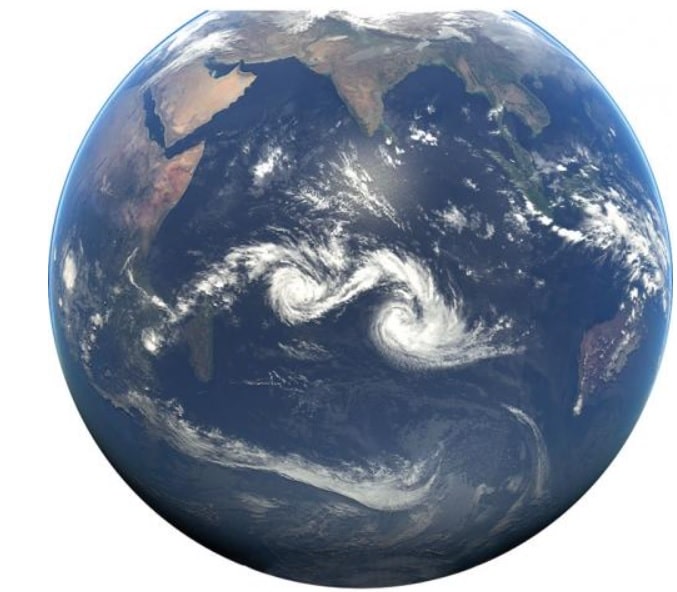
- It is a phenomenon that occurs when two nearby cyclonic storms, such as hurricanes, typhoons, or tropical cyclones, come close enough to each other to interact.
- As per the National Weather Service (NWS), when two hurricanes (or cyclones), spinning in the same direction, are brought close together, they begin an intense dance around their common centre.
- This interaction between two cyclones is called the Fujiwhara effect.
- The interaction could lead to changes in the track and intensity of either or both storms systems.
- In rare cases, the two systems could merge, especially when they are of similar size and intensity, to form a bigger storm.





Five different ways in which Fujiwhara Effect can take place
- Elastic Interaction (EI)
- In these interactions, only the direction of motion of the storms changes and is the most common case.
- These are also the cases that are difficult to assess and need closer examination.
- Partial Straining-Out (PSO)
- In this, a part of the smaller storm is lost to the atmosphere.
- Complete Straining-Out (CSO)
- It takes place in which the smaller storm is completely lost to the atmosphere.
- The straining out does not happen for storms of equal strengths.
- Partial Merger
- In this, the smaller storm merges into the bigger one.
- Complete Merger
- It takes places between two storms of similar or different strength.

Associated damages
- The influx of additional heat, moisture, and positive vorticity during the Fujiwhara effect intensify the primary circulation of a system.
- The occurrence of the Fujiwhara effect also makes cyclonic systems harder to predict, as every interaction between two storm systems is unique and difficult to assess within the present climate models.
How is this related to today’s climate?
- Experts have noted the rising frequency of this unusual effect, attributing it to a rapidly warming world and the subsequent heating of ocean waters.
- A warming climate is giving rise to stronger cyclones, and thus, increasing the possibility of the Fujiwhara effect.
Q1) What are Cyclones?
Cyclones are powerful natural phenomena characterized by strong rotating winds and low-pressure systems. They are also known as hurricanes or typhoons in different parts of the world. Cyclones typically form over warm ocean waters in tropical and subtropical regions.
Q2) What are atmospheric river storms?
Atmospheric river (AR) storms, often referred to simply as “atmospheric rivers,” are relatively narrow, elongated corridors or bands of concentrated moisture in the Earth’s atmosphere. These atmospheric rivers are associated with the transport of large amounts of water vapor from one area to another, typically from warm, moist regions to cooler regions. They play a significant role in the planet’s hydrological cycle and can have substantial impacts on weather and climate.
Source: The Fujiwhara effect: When cyclones ‘dance’ | DownToEarth

 Last updated on March, 2026
→ UPSC Final Result 2025 is now out.
→ UPSC has released UPSC Toppers List 2025 with the Civil Services final result on its official website.
→ Anuj Agnihotri secured AIR 1 in the UPSC Civil Services Examination 2025.
→ UPSC Marksheet 2025 is now out.
→ UPSC Notification 2026 & UPSC IFoS Notification 2026 is now out on the official website at upsconline.nic.in.
→ UPSC Calendar 2026 has been released.
→ Check out the latest UPSC Syllabus 2026 here.
→ UPSC Prelims 2026 will be conducted on 24th May, 2026 & UPSC Mains 2026 will be conducted on 21st August 2026.
→ The UPSC Selection Process is of 3 stages-Prelims, Mains and Interview.
→ Prepare effectively with Vajiram & Ravi’s UPSC Prelims Test Series 2026 featuring full-length mock tests, detailed solutions, and performance analysis.
→ Enroll in Vajiram & Ravi’s UPSC Mains Test Series 2026 for structured answer writing practice, expert evaluation, and exam-oriented feedback.
→ Join Vajiram & Ravi’s Best UPSC Mentorship Program for personalized guidance, strategy planning, and one-to-one support from experienced mentors.
→ Shakti Dubey secures AIR 1 in UPSC CSE Exam 2024.
→ Also check Best UPSC Coaching in India