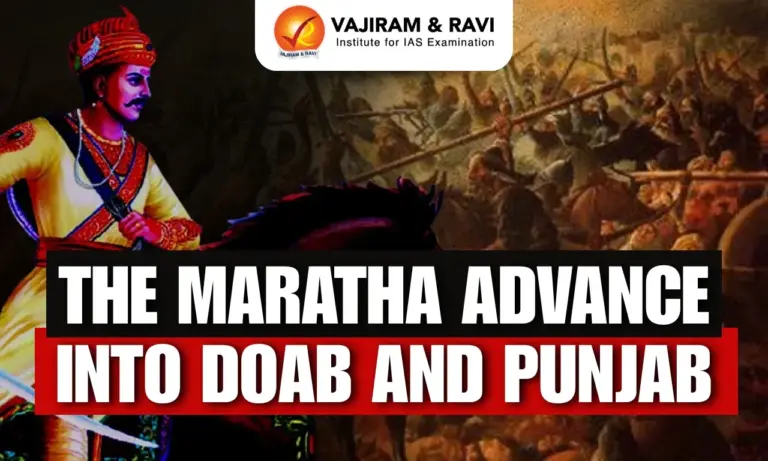
The Maratha Advance into Doab and Punjab between 1741 and 1761 marked a decisive phase in 18th century North Indian politics. It reflected the transformation of the Marathas from a Deccan power into an all India force seeking revenue rights, military influence and political control. This expansion unfolded amid the weakening Mughal authority, regional conflicts and repeated Afghan invasions. The Doab and Punjab became strategic targets due to their agricultural wealth, political centrality and role as gateways to Delhi and Lahore.
The Maratha Advance into Doab and Punjab Phases
The Maratha advance into the Doab and Punjab was divided into two clearly defined phases from 1741 to 1761. These phases were closely linked to the decline of Mughal authority, the ambitions of Maratha leaders and the rise of Ahmad Shah Abdali as a decisive force in Punjab politics.
- First Phase of the Maratha Advance into Doab and Punjab: The first phase focused on securing Chauth from frontier regions and preparing strategic access to North India.
- Second Phase of the Maratha Advance into Doab and Punjab: The second phase involved direct intervention in Mughal politics, military campaigns in the Doab and confrontation with Afghan power.
First Phase of the Maratha Advance into Doab and Punjab
The First Phase focused on frontier revenues, strategic positioning and indirect control, creating conditions for deeper northern expansion without direct administrative takeover.
- Background: After Baji Rao’s death in 1740, Maratha leadership shifted towards consolidating gains through revenue extraction, especially Chauth, rather than immediate territorial annexation in North India.
- Chauth: Between 1741 and 1752, Maratha policy emphasized securing Chauth from frontier regions to finance armies and extend influence without heavy administrative responsibility.
- Raghuji Bhonsle’s Bengal Campaigns: In 1741-42, Raghuji Bhonsle raided Bengal, Bihar and Orissa, targeting rich provinces to extract Chauth and demonstrate Maratha military reach.
- Conflict with Alivardi Khan: Nawab Alivardi Khan strongly resisted Maratha incursions, leading to a decade of conflict that strained Bengal’s finances and military stability.
- Agreement of 1751: In 1751, Alivardi Khan agreed to pay Chauth fixed at Rs.12,00,000 annually and ceded southern Orissa to Raghuji Bhonsle.
- Maratha Control over Orissa: Raghuji Bhonsle gained the authority to appoint the provincial governor, effectively placing Orissa under Maratha dominance without formal annexation.
- Deccan Power Struggles: Simultaneously, Marathas fought Nizam-ul-Mulk and his successor Nasir Jang over Karnataka and Khandesh, reflecting multi-front Maratha expansion.
- Impact of Bengal Engagements: Raghuji’s prolonged involvement in eastern India allowed the Nizam temporary dominance in Karnataka, delaying Maratha consolidation there.
- Treaty of Bhalke 1751: After conflict with French backed Bussy, the Marathas secured Khandesh revenues, western Berar and Baglana through the Treaty of Bhalke.
- Entry into Rajasthan: Rajasthan became a critical zone where Marathas intervened in succession disputes to enforce Chauth and Khandani from Rajput states.
- Role of Holkar and Sindhia: Peshwa’s lieutenants Malhar Rao Holkar and Ranoji Sindhia coerced Jaipur, Jodhpur and other states into regular payments.
- Decline of Mughal Arbitration: Earlier, Mughal emperors mediated Rajput succession, but Maratha intervention reflected the collapse of imperial authority.
- Strategic Importance of Rajasthan: Rajasthan served as a tactical corridor towards Agra, Delhi and Punjab, making it central to Maratha northern ambitions.
- Economic Strain on Rajputs: Many Rajput states depended on jagirs outside Rajasthan, making repeated Maratha demands economically destabilizing.
- Growing Rajput Resentment: Continuous Maratha exactions created deep hostility, undermining any possibility of durable alliance with Rajput rulers.
- Jaipur Incident of 1751: In Jaipur, citizens and followers of Madho Singh killed nearly 5,000 Marathas, reflecting intense popular anger.
- Spread of Violence: After Jaipur, Maratha couriers were attacked in rural areas, disrupting communication and revenue collection networks.
- Earlier Anti-Maratha Incidents: Vijai Singh of Marwar earlier murdered Jayappa Sindhia, indicating repeated violent backlash against Maratha dominance.
- Limits of Maratha Policy: Narrow revenue focused tactics alienated potential allies, weakening long term political control in North India.
- Outcome of First Phase: By 1752, Marathas secured access routes and revenue rights, setting the stage for direct involvement in Doab and Punjab politics.





Second Phase of the Maratha Advance into Doab and Punjab
This phase marked direct political intervention, military campaigns in the Doab and confrontation with Afghan power under Ahmad Shah Abdali.
- Rise of Ahmad Shah Abdali: Abdali’s invasion of India in 1748 and capture of Lahore created a new geopolitical challenge in North India.
- Imperial Appeal to Marathas: The Mughal emperor sought Maratha assistance under Balaji Baji Rao against Abdali, recognizing them as the strongest military power available.
- Dispatch of Sindhia and Holkar: The Peshwa sent Sindhia and Holkar north, reflecting continuity with Baji Rao’s united front policy against foreign invaders.
- Change in Maratha Strategy: The Afghan threat forced Marathas to reconsider their aim of subverting the Mughal Empire outright.
- Appointment of Safdar Jung: After Muhammad Shah’s death in 1748, Ahmad Shah (Mughal) appointed Safdar Jung, governor of Awadh and Allahabad, as wazir.
- Afghan Internal Threats: Ruhela Afghans and Ahmad Khan Bangash expanded control over Rohilkhand and Farrukhabad, weakening Mughal authority in the Doab.
- Safdar Jung’s Defeat: Safdar Jung failed against Ahmad Khan Bangash, exposing Mughal military weakness.
- Appeal to Marathas: Safdar Jung sought Maratha help, promising Rs.25,000 per day for campaign expenses.
- Maratha Military Success: Maratha forces decisively defeated Ahmad Khan Bangash, establishing military credibility in the Doab.
- Abdali’s Renewed Invasion: A fresh Abdali invasion forced a compromise, preventing total Afghan defeat.
- Territorial Gains in Doab: Marathas secured parganas like Etawah, Shikohabad, Phaphund, Kora and Jahanabad under Peshwa’s authority.
- The Maratha-Mughal Treaty of 1752 (Ahadnama): Agreement signed at Kannauj, the Emperor agreed to pay 50 lakhs, grant Agra and Ajmer subahdaris and seek Maratha protection against internal and external enemies.
- Ambitious Maratha Claims: Marathas also claimed Chauth rights over Punjab, Sindh and the Doab, reflecting expansive ambitions.
- Contradictions in Policy: These demands required fighting Jats, Afghans, Rajputs and Awadh rulers, who were also needed as allies against Abdali.
- Safdarjung’s Rebellion of 1753: Conflict erupted between Safdar Jung and Emperor Ahmad Shah, leading to a power struggle.
- Rise of Imad-ul-Mulk: Sixteen year old Imad-ul-Mulk offered one crore rupees and subahs of Awadh and Allahabad to gain Maratha support.
- Maratha Support Choice: Marathas backed Imad-ul-Mulk, believing a weak wazir would facilitate Doab Chauth collection.
- Peak of Maratha Power: From 1753 to 1759, Maratha influence in North India reached its highest level.
- Alienation of Allies: Alliance with Imad-ul-Mulk alienated Awadh, Rajputs, Jats and Afghans, isolating Marathas politically.
- Moral and Political Decline: Assassinations of emperors Ahmad Shah and Alamgir II damaged Mughal prestige and tarnished Maratha reputation.
- Northern Campaigns: Three major expeditions were launched, two under Raghunath Rao and one under Sadashiv Bhau.
- Raghunath Rao’s Demands: He demanded one crore rupees from the Jat ruler and restoration of encroached lands.
- Failure at Kumbher: Lack of siege artillery forced compromise after four months, yielding only partial financial promises.
- Limited Doab Raids: Financial constraints led to weak raids, failing to secure stable revenue.
- Abdali’s Ravages: In Maratha absence, Abdali ravaged Delhi, Mathura, Gokul and Vrindavan during 1756-57.
- Najib-ud-Daula’s Rise: Abdali appointed Najib-ud-Daula as Mir Bakhshi, strengthening Afghan influence in Delhi.
- Outcomes: By 1761, Marathas stood militarily powerful but politically isolated, leading to confrontation at Panipat.
Rulers in the Maratha Advance into Doab and Punjab
Key rulers shaped the Maratha advance through alliances, conflicts and policy decisions that determined the success and failure of expansion.
- Baji Rao I: As the chief architect of Maratha northward expansion, his policies of aggressive expansion and Chauth collection laid the strategic foundation for later Maratha entry into Doab and Punjab.
- Balaji Baji Rao (Nana Saheb Peshwa): He led the Maratha state during the second phase, combining administrative consolidation in the Deccan with forward military policies in North India through trusted generals.
- Raghuji Bhonsle: He spearheaded Maratha campaigns in Bengal, Bihar and Orissa, secured Chauth rights and provided crucial financial resources that sustained Maratha northern expansion.
- Malhar Rao Holkar: A key Maratha commander, he enforced Chauth in Rajasthan, intervened in succession disputes and played an active role in Doab and North Indian military campaigns.
- Ranoji Sindhia: Founder of Sindhia power in North India, he helped establish Maratha dominance in Malwa, Rajasthan and the Doab through sustained military pressure.
- Jayappa Sindhia: A prominent Maratha leader in Rajasthan, his assassination by Rajput rulers symbolized growing resistance against Maratha interference in regional politics.
- Raghunath Rao: Brother of Balaji Baji Rao, he led early northern expeditions, demanded large tributes from Jat rulers and conducted limited Doab operations due to financial and logistical constraints.
- Sadashiv Rao Bhau: A capable general and administrator, he later led the major Maratha force in North India and represented the culmination of Maratha military ambitions in the region.
- Muhammad Shah (Mughal Emperor): His weak rule accelerated Mughal decline, indirectly enabling Maratha intervention in North Indian affairs and alliances against external invasions.
- Ahmad Shah (Mughal Emperor): He appointed Safdar Jung as wazir and presided over critical agreements with the Marathas, reflecting Mughal dependence on Maratha military support.
- Safdar Jung: As wazir of the Mughal Empire and governor of Awadh and Allahabad, he invited Maratha military support against Afghan chiefs, opening the Doab to Maratha entry.
- Ghazi-ud-Din Imad-ul-Mulk: A young and politically weak wazir backed by the Marathas, his alliance marked the peak of Maratha influence but severely damaged Mughal stability.
- Ahmad Shah Abdali: Afghan ruler whose repeated invasions of India transformed Punjab politics and posed the most serious external challenge to Maratha ambitions in North India.
- Najib-ud-Daula (Najib Khan Ruhela): A key Afghan ally of Abdali, he emerged as a powerful figure in Delhi politics and consistently opposed Maratha expansion in the Doab.
- Ahmad Khan Bangash: Afghan chief of Farrukhabad, defeated by Maratha forces, whose conflict with Safdar Jung facilitated Maratha military entry into the Doab.
- Alivardi Khan: Nawab of Bengal who resisted Maratha raids but later agreed to pay Chauth, indirectly financing Maratha expansion toward northern India.
- Madho Singh of Jaipur: Rajput ruler whose followers violently resisted Maratha exactions, highlighting strong regional opposition to Maratha interference in Rajasthan.

 Last updated on March, 2026
→ UPSC Final Result 2025 is now out.
→ UPSC has released UPSC Toppers List 2025 with the Civil Services final result on its official website.
→ Anuj Agnihotri secured AIR 1 in the UPSC Civil Services Examination 2025.
→ UPSC Marksheet 2025 is now out.
→ UPSC Notification 2026 & UPSC IFoS Notification 2026 is now out on the official website at upsconline.nic.in.
→ UPSC Calendar 2026 has been released.
→ Check out the latest UPSC Syllabus 2026 here.
→ UPSC Prelims 2026 will be conducted on 24th May, 2026 & UPSC Mains 2026 will be conducted on 21st August 2026.
→ The UPSC Selection Process is of 3 stages-Prelims, Mains and Interview.
→ Prepare effectively with Vajiram & Ravi’s UPSC Prelims Test Series 2026 featuring full-length mock tests, detailed solutions, and performance analysis.
→ Enroll in Vajiram & Ravi’s UPSC Mains Test Series 2026 for structured answer writing practice, expert evaluation, and exam-oriented feedback.
→ Join Vajiram & Ravi’s Best UPSC Mentorship Program for personalized guidance, strategy planning, and one-to-one support from experienced mentors.
→ Shakti Dubey secures AIR 1 in UPSC CSE Exam 2024.
→ Also check Best UPSC Coaching in India
The Maratha Advance into Doab and Punjab FAQs
Q1. What was the time period of the Maratha advance into Doab and Punjab?+
Q2. Why was the Doab region important for the Marathas?+
Q3. What role did Chauth play in Maratha expansion?+
Q4. Who was the main Afghan rival of the Marathas in North India?+
Q5. Why did Maratha power decline after 1759 despite expansion?+
Tags: modern history the maratha advance into doab and punjab upsc modern history notes