About Third Global High-Level Ministerial Conference on Antimicrobial Resistance:
- Theme: ‘The AMR Pandemic: From Policy to One Health Action’.
- It will enhance international cooperation to tackle AMR and build on the success of the two previous high-level ministerial conferences held in the Netherlands in 2014 and 2019.
- The conference is also expected to pave the way for nations to come out with bold and specific political commitments in the 2024 UN General Assembly High-Level Meeting on AMR.
Antimicrobial Resistance (AMR):
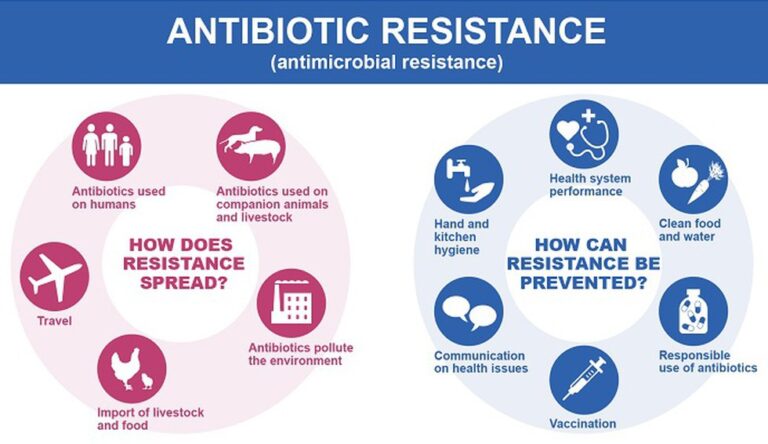
- Antimicrobials – including antibiotics, antivirals, antifungals and antiparasitic – are medicines used to prevent and treat infections in humans, animals and plants.
- Antimicrobial Resistance (AMR) occurs when bacteria, viruses, fungi and parasites change over time and no longer respond to medicines making infections harder to treat and increasing the risk of disease spread, severe illness and death.
- As a result of drug resistance, antibiotics and other antimicrobial medicines become ineffective and infections become increasingly difficult or impossible to treat.
Major initiatives taken by India to combat AMR:
- National Action Plan on Antimicrobial Resistance (NAP-AMR):
- Government of India launched National Action Plan in 2017, two years after the World Health Organisation (WHO) launched its Global Action Plan on AMR.
- National Centre for Disease Control (NCDC), New Delhi is the focal point for implementationand coordination of the NAP-AMR.
- Red Line Campaign:
- Under the Red Line Campaign, the Government of India urges people not to use medicines marked with a red vertical line, without a doctor’s prescription.
- This campaign is aimed at discouraging unnecessary prescription and over-the-counter sale of antibiotics causing drug resistance for several critical diseases including TB, malaria, dengue, etc.
Source : All India Radio






 Last updated on March, 2026
→ UPSC Final Result 2025 is now out.
→ UPSC has released UPSC Toppers List 2025 with the Civil Services final result on its official website.
→ Anuj Agnihotri secured AIR 1 in the UPSC Civil Services Examination 2025.
→ UPSC Marksheet 2025 is now out.
→ UPSC Notification 2026 & UPSC IFoS Notification 2026 is now out on the official website at upsconline.nic.in.
→ UPSC Calendar 2026 has been released.
→ Check out the latest UPSC Syllabus 2026 here.
→ UPSC Prelims 2026 will be conducted on 24th May, 2026 & UPSC Mains 2026 will be conducted on 21st August 2026.
→ The UPSC Selection Process is of 3 stages-Prelims, Mains and Interview.
→ Prepare effectively with Vajiram & Ravi’s UPSC Prelims Test Series 2026 featuring full-length mock tests, detailed solutions, and performance analysis.
→ Enroll in Vajiram & Ravi’s UPSC Mains Test Series 2026 for structured answer writing practice, expert evaluation, and exam-oriented feedback.
→ Join Vajiram & Ravi’s Best UPSC Mentorship Program for personalized guidance, strategy planning, and one-to-one support from experienced mentors.
→ Shakti Dubey secures AIR 1 in UPSC CSE Exam 2024.
→ Also check Best UPSC Coaching in India