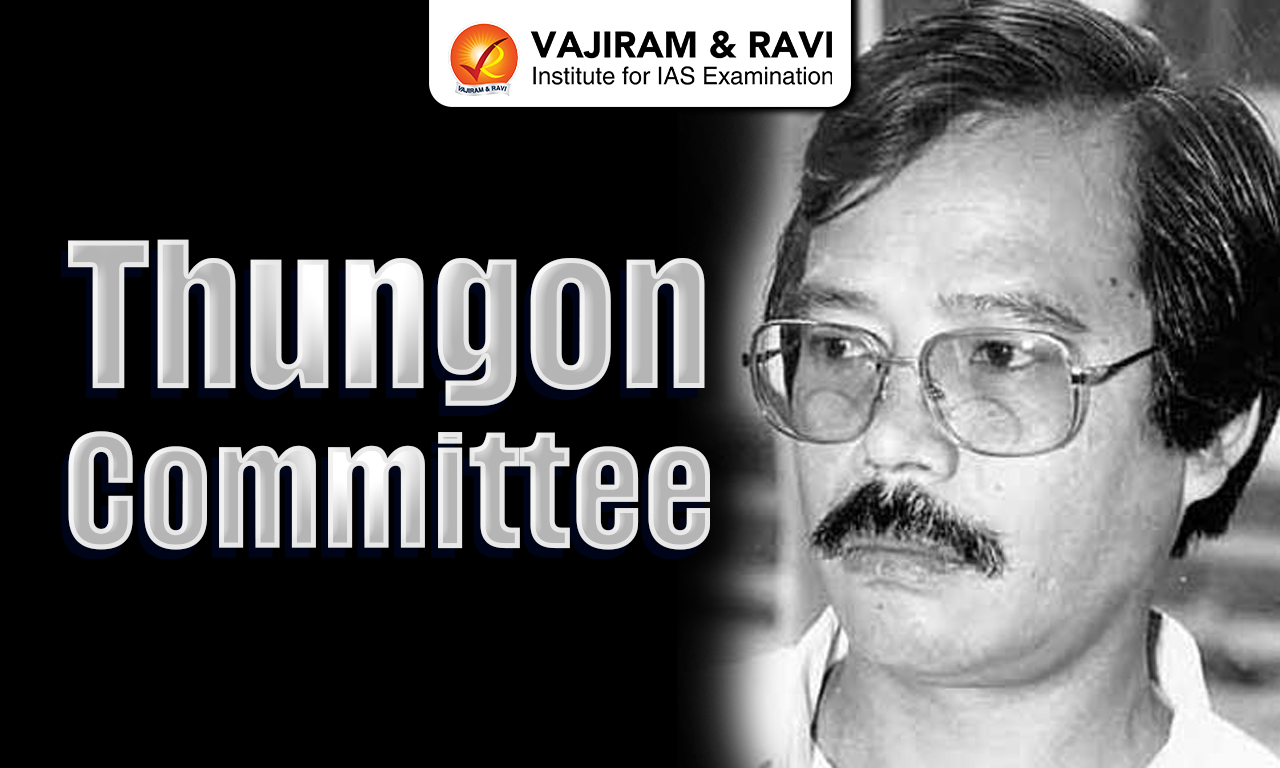
The Thungon Committee (1988) is a significant milestone in India’s decentralisation reforms. It was constituted as a sub-committee of the Consultative Committee of Parliament under the chairmanship of P.K. Thungon. The committee was tasked with examining the political and administrative structure at the district level with a focus on improving district planning and strengthening the Panchayati Raj system.
Background of the Thungon Committee
By the late 1980s, India’s development model was still highly centralised. District-level planning was weak, and Panchayati Raj institutions (PRIs) lacked both authority and financial independence. There was growing concern that rural development programmes were not achieving desired outcomes due to poor coordination between administrative machinery and elected bodies. In this context, the Thungon Committee was formed to suggest structural reforms for making district administration more effective and participatory.
Thungon Committee Objective
The primary objective of the Thungon Committee was to examine the political and administrative structure at the district level for effective district planning. The committee played a significant role in recommending measures to strengthen the Panchayati Raj system, which later influenced constitutional reforms in India.


Thungon Committee Key Recommendations
The Thungon Committee (1988), chaired by P.K. Thungon, laid down a comprehensive framework to strengthen Panchayati Raj institutions and district planning in India.
- Constitutional Status to PRIs: Panchayati Raj institutions should be given constitutional recognition to ensure stability and continuity. This recommendation later influenced the 73rd Constitutional Amendment Act, 1992, which institutionalised PRIs in India.
- Three-Tier Panchayati Raj System: The committee recommended a uniform three-tier system of Panchayati Raj: Gram Panchayat at the village level, Panchayat Samiti at the block level, Zilla Parishad at the district level. This structure aimed to ensure decentralised decision-making at all administrative levels.
- Zilla Parishad as the Nodal Body: The Thungon Committee emphasised that the Zilla Parishad should be the central institution of the Panchayati Raj system. It should act as the main planning and development agency at the district level, making district planning more coordinated and efficient.
- Fixed Five-Year Tenure: All Panchayati Raj bodies should have a definite tenure of five years.
- Limit on Supersession: If a Panchayat is dissolved (superseded), elections must be held within six months.
- State-Level Planning Coordination: The Thungon Committee recommended the creation of a Planning and Coordination Committee at the state level, chaired by the Minister for Planning. Presidents of Zilla Parishads should also be members of this committee.
- Constitutional List of Subjects: A clear list of functional subjects for PRIs should be included in the Constitution.
- Reservation for SCs/STs and Women: The Thungon Committee recommended reservation of seats in all three tiers of Panchayati Raj institutions. Reservation for Scheduled Castes and Scheduled Tribes was to be based on population, and provisions for women’s reservation were also strongly recommended.
- Establishment of State Finance Commission: To address financial constraints faced by PRIs, the committee recommended the establishment of a State Finance Commission (SFC) in every state. The SFC would: lay down principles for financial devolution, ensure proper allocation of funds to local bodies, strengthen fiscal autonomy of PRIs.
- District Collector as CEO: The District Collector should act as the Chief Executive Officer of the Zilla Parishad for administrative coordination.

 Last updated on Oct, 2026
→ UPSC 2027 Notification will be released on 13 January 2027 at upsconline.nic.in.
→ Check Nobel Prize 2026 Winners List here.
→ Download PIB PRiSM Monthly Magazine 2026 here.
→ Check UPSC Monthly Current Affairs Magazine The Recitals here.
→ Check out the latest UPSC Syllabus here.
→ Download UPSC Model Answers for Mains 2026
→ UPSC Mains Question Paper 2026 is out now for Essay & GS Paper 1, 2, 3 & 4.
→ UPSC Calendar 2027 has been released.
→ Enroll in Vajiram & Ravi’s UPSC Mains Test Series 2027 for structured answer writing practice, expert evaluation, and exam-oriented feedback.
→ Join Vajiram & Ravi’s UPSC Mentorship Program 2027 for personalized guidance, strategy planning, and one-to-one support from experienced mentors.
→ Go through the UPSC Mains Previous Year Papers to enhance your preparation.
→ UPSC has released UPSC Toppers List 2025 with the Civil Services final result on its official website.
→ Also check Best UPSC Coaching in India
Thungon Committee FAQs
Q1. What is the Thungon Committee?+
Q2. What was the objective of the Thungon Committee?+
Q3. What is the most important recommendation of the Thungon Committee?+
Q4. What structure did the Thungon Committee suggest for PRIs?+
Q5. What role did the Thungon Committee assign to Zilla Parishad?+
Tags: thungon committee