Tiangong Space Station Latest News
Chinese scientists have discovered a new species of bacteria named Niallia tiangongensis on board the Tiangong Space Station.
About Tiangong Space Station
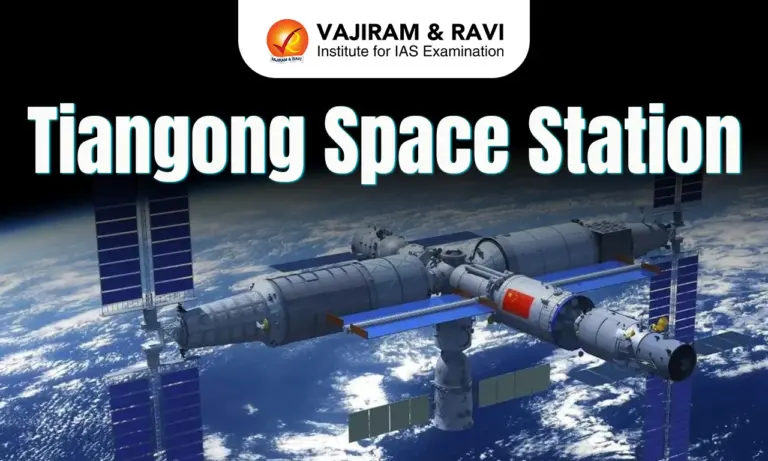
- The Tiangong Space Station, translating to ‘Sky Palace’, is a Chinese-owned and operated permanently crewed space station in Low Earth Orbit (LEO).
- It represents the third and final step of China’s Manned Space Program.
- The first module of the space station was launched in April 2021, following two precursor missions, Tiangong-1 and Tiangong-2.
- The station consists of a core module known as Tianhe, which connects two science modules, Wentian and Mengtian, as well as a planned space telescope module, Xuntian.
- Tiangong is much smaller than the International Space Station (ISS), with only three modules compared with 16 modules on the ISS.
- Tiangong is also considerably lighter than the ISS, which weighs about 400 tons (450 metric tons); the Chinese station is about 20% as massive.
- It can accommodate up to three astronauts at a time for six-month stays. It can also support six astronauts at a time during crew handovers.
- The aims of the Tiangong Space Station are to:
- Build a long-term, reliable space station in orbit.
- Guarantee the long-term health and safety of stationed astronauts.
- Provide conditions for scientific and technological experiments in space.
- The station serves as an in-orbit laboratory with 23 enclosed experiment racks, each covering a different proposed experiment in the fields of:
- Space life sciences and biotechnology
- Microgravity fluid physics and combustion
- Material science in space
- Fundamental physics in microgravity
- The space station also features platforms for exposed and unpressurised external experiments.




Tiangong Space Station FAQs
Q1: What is the name of the core module of the Tiangong Space Station?
Ans: Tianhe
Q2: In which year was the first module of the Tiangong Space Station launched?
Ans: 2021
Q3: How many astronauts can Tiangong accommodate during crew handovers?
Ans: 6
Source: NDTV

 Last updated on March, 2026
→ UPSC Final Result 2025 is now out.
→ UPSC has released UPSC Toppers List 2025 with the Civil Services final result on its official website.
→ Anuj Agnihotri secured AIR 1 in the UPSC Civil Services Examination 2025.
→ UPSC Marksheet 2025 is now out.
→ UPSC Notification 2026 & UPSC IFoS Notification 2026 is now out on the official website at upsconline.nic.in.
→ UPSC Calendar 2026 has been released.
→ Check out the latest UPSC Syllabus 2026 here.
→ UPSC Prelims 2026 will be conducted on 24th May, 2026 & UPSC Mains 2026 will be conducted on 21st August 2026.
→ The UPSC Selection Process is of 3 stages-Prelims, Mains and Interview.
→ Prepare effectively with Vajiram & Ravi’s UPSC Prelims Test Series 2026 featuring full-length mock tests, detailed solutions, and performance analysis.
→ Enroll in Vajiram & Ravi’s UPSC Mains Test Series 2026 for structured answer writing practice, expert evaluation, and exam-oriented feedback.
→ Join Vajiram & Ravi’s Best UPSC Mentorship Program for personalized guidance, strategy planning, and one-to-one support from experienced mentors.
→ Shakti Dubey secures AIR 1 in UPSC CSE Exam 2024.
→ Also check Best UPSC Coaching in India
Tags: prelims pointers tiangong space station upsc current affairs upsc prelims current affairs