Tiger Translocation from Madhya Pradesh Overview:
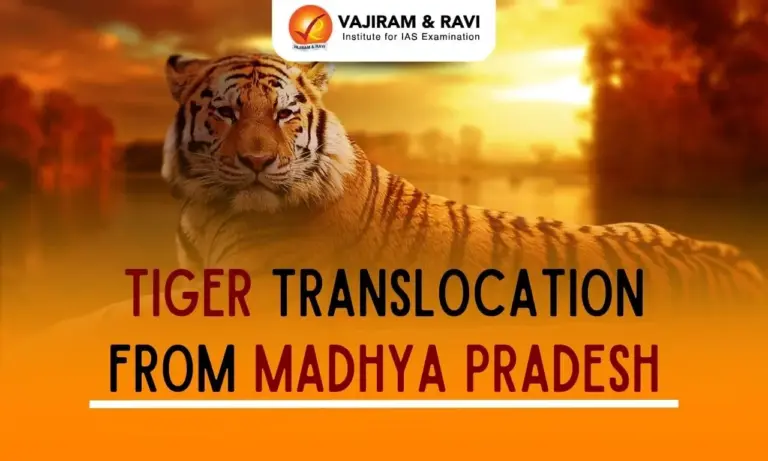
The Madhya Pradesh government has announced the translocation of 15 tigers to the states of Rajasthan, Chhattisgarh, and Odisha.
- This initiative involves 12 tigresses and 3 tigers, subject to approval from the Central Government.
- The tigers will be relocated from the Bandhavgarh, Pench, and Kanha Tiger Reserves.
About Kanha Tiger Reserve (KTR)
Kanha Tiger Reserve, also known as Kanha National Park, is the largest national park in Madhya Pradesh.
- Location: Spread across Mandla and Balaghat districts, nestled in the Maikal range of Satpuras, forming part of the Central Indian Highlands.
- History: It was established as a national park on June 1, 1955, and Declared a Tiger Reserve in 1973.
- Cultural Reference: The reserve inspired Rudyard Kipling’s “The Jungle Book”.
- Mascot: First in India to introduce an official mascot, Bhoorsingh the Barasingha.
- Flora: Lowland Forests are dominated by sal (Shorea robusta) and mixed forest trees interspersed with meadows. Highland Forests consist of tropical moist deciduous trees with bamboo (Dendrocalamus strictus) on slopes.
- Fauna: Significant populations of Royal Bengal Tigers, leopards, sloth bears, and Indian wild dogs. Globally renowned for saving the Barasingha (state animal of Madhya Pradesh) from extinction.
About Bandhavgarh Tiger Reserve
Located in the Umaria district of Madhya Pradesh, Bandhavgarh Tiger Reserve lies between the Vindhyan and Satpura ranges.
- History: It was declared a national park in 1968 and became a Tiger Reserve in 1993.
- Cultural Significance: Home to the Bandhavgarh Fort, said to have been gifted by Lord Rama to his brother Lakshmana, lending the name Bandhavgarh (“Brother’s Fort”).
- Vegetation: Dominated by tropical moist deciduous forests, sal trees, grasslands, and bamboo on lower slopes. Notable species include Saj, Dhaora, Tendu, Arjun, Amla, and Palas.
- Fauna: Known for the highest density of Royal Bengal Tigers in India and the world. Other species like Leopards, wild dogs, wolves, jackals, chital, sambar, barking deer, nilgai, and chowsingha.
About Pench Tiger Reserve
Pench Tiger Reserve spans the Seoni and Chhindwara districts in Madhya Pradesh and extends into the Nagpur district in Maharashtra.
- Named after: The Pench River, flowing north to south through the reserve.
- Components: Includes the Indira Priyadarshini Pench National Park, Pench Mowgli Sanctuary, and a buffer zone.
- Cultural connection: Inspired by Rudyard Kipling’s “The Jungle Book”.
- Terrain: Undulating landscape with small hills and steep slopes.
- Vegetation: Mosaic of vegetation types, from moist valleys to dry deciduous forests.
- Flora: Diverse flora includes teak, saag, mahua, and various grasses and shrubs.
- Fauna: Abundant populations of Chital, Sambar, Nilgai, Gaur (Indian Bison), and wild boar.
- Key predators: Tiger, followed by leopard, wild dogs, and wolf.
- Rich avian diversity with over 325 species of birds, including the Malabar Pied Hornbill, Indian Pitta, and Grey-Headed Fishing Eagle.
Q1: What are Tribunals in India?
Tribunals in India are judicial or quasi-judicial bodies established by law to facilitate faster resolution of disputes compared to conventional courts. They specialize in specific subject matters and perform various functions, such as resolving disputes, determining rights between parties, making administrative decisions, and reviewing existing administrative actions.
Source: PTI






 Last updated on March, 2026
→ UPSC Final Result 2025 is now out.
→ UPSC has released UPSC Toppers List 2025 with the Civil Services final result on its official website.
→ Anuj Agnihotri secured AIR 1 in the UPSC Civil Services Examination 2025.
→ UPSC Marksheet 2025 is now out.
→ UPSC Notification 2026 & UPSC IFoS Notification 2026 is now out on the official website at upsconline.nic.in.
→ UPSC Calendar 2026 has been released.
→ Check out the latest UPSC Syllabus 2026 here.
→ UPSC Prelims 2026 will be conducted on 24th May, 2026 & UPSC Mains 2026 will be conducted on 21st August 2026.
→ The UPSC Selection Process is of 3 stages-Prelims, Mains and Interview.
→ Prepare effectively with Vajiram & Ravi’s UPSC Prelims Test Series 2026 featuring full-length mock tests, detailed solutions, and performance analysis.
→ Enroll in Vajiram & Ravi’s UPSC Mains Test Series 2026 for structured answer writing practice, expert evaluation, and exam-oriented feedback.
→ Join Vajiram & Ravi’s Best UPSC Mentorship Program for personalized guidance, strategy planning, and one-to-one support from experienced mentors.
→ Shakti Dubey secures AIR 1 in UPSC CSE Exam 2024.
→ Also check Best UPSC Coaching in India