Total Allowable Catch (TAC) Latest News
A recent dispute involving the US and Russia highlighted the geopolitical and environmental implications of TAC enforcement.
What is Total Allowable Catch (TAC) ?
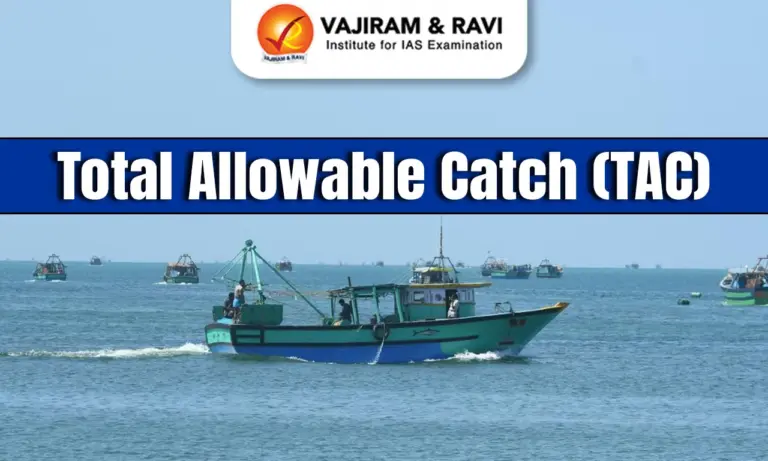
- Total Allowable Catch (TAC) refers to the maximum quantity of a particular fish species that can be legally harvested from a specific water body, such as oceans, seas, or lakes, within a defined period.
- It is a regulatory measure adopted by national governments and international fisheries management agencies to ensure the sustainable exploitation of marine resources.





Why is TAC Important?
- TAC ensures the long-term sustainability of fish stocks by maintaining a minimum viable population size that can replenish naturally each year.
- In the absence of TAC, overfishing can occur, depleting fish populations to the extent that they are unable to recover, thus threatening marine biodiversity, ecosystem balance, and the livelihoods of coastal communities.
- It acts as a scientific tool for preventing resource collapse, especially in commercially valuable species.
Indian Context
- India implements a seasonal fishing ban, which functions as a TAC equivalent of zero for a specified duration to conserve fish stocks during the breeding season.
- The ban is enforced in India’s Exclusive Economic Zone (EEZ) for 61 days annually:
- East Coast: From April 15 to June 14
- West Coast: From June 1 to July 31
- This restriction aims to protect spawning fish and support regeneration of marine life during peak monsoon when fish reproduce in large numbers.
Total Allowable Catch (TAC) FAQs
Q1. What does Total Allowable Catch (TAC) mean?
Ans. TAC is the maximum quantity of a specific fish species that can be legally caught in a given period to prevent overfishing.
Q2. Who sets TAC limits?
Ans. TAC is determined by national fisheries authorities or international bodies like FAO or Regional Fisheries Management Organisations (RFMOs).
Q3. How does TAC help marine ecosystems?
Ans. TAC prevents overexploitation of fish stocks, supporting marine biodiversity and long-term sustainability.
Source: TH

 Last updated on April, 2026
→ UPSC Final Result 2025 is now out.
→ UPSC has released UPSC Toppers List 2025 with the Civil Services final result on its official website.
→ Anuj Agnihotri secured AIR 1 in the UPSC Civil Services Examination 2025.
→ UPSC Marksheet 2025 is now out.
→ UPSC Notification 2026 & UPSC IFoS Notification 2026 is now out on the official website at upsconline.nic.in.
→ UPSC Calendar 2026 has been released.
→ Check out the latest UPSC Syllabus 2026 here.
→ UPSC Prelims 2026 will be conducted on 24th May, 2026 & UPSC Mains 2026 will be conducted on 21st August 2026.
→ The UPSC Selection Process is of 3 stages-Prelims, Mains and Interview.
→ Prepare effectively with Vajiram & Ravi’s UPSC Prelims Test Series 2026 featuring full-length mock tests, detailed solutions, and performance analysis.
→ Enroll in Vajiram & Ravi’s UPSC Mains Test Series 2026 for structured answer writing practice, expert evaluation, and exam-oriented feedback.
→ Join Vajiram & Ravi’s Best UPSC Mentorship Program for personalized guidance, strategy planning, and one-to-one support from experienced mentors.
→ Shakti Dubey secures AIR 1 in UPSC CSE Exam 2024.
→ Also check Best UPSC Coaching in India
Tags: prelims pointers total allowable catch upsc prelims current affairs