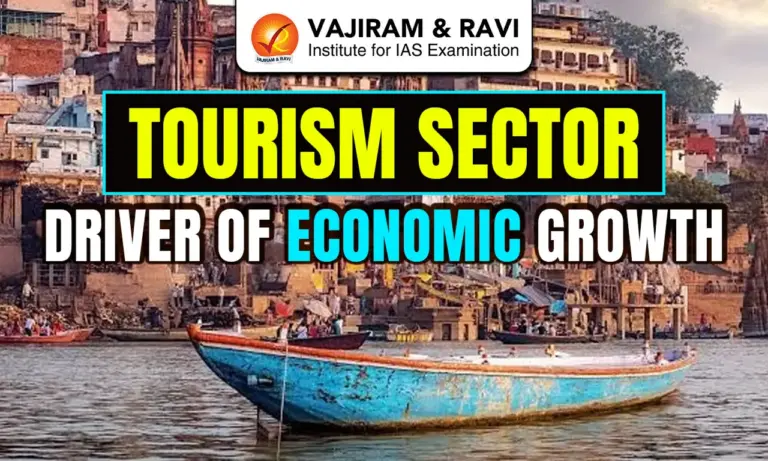
Tourism Sector is one of the fastest-growing service sectors in India. The sector contributes significantly to economic output, employment generation, and cultural promotion.
Tourism Sector Significance
Tourism sector is significant because of following reasons:
- According to the Ministry of Tourism’s India Tourism Data Compendium 2025, tourism contributes 5.22% to India’s GDP (total impact), with 2.72% direct contribution.
- The sector also supports 13.34% of total employment, including 5.82% direct employment. This highlights tourism’s strong multiplier effect across hospitality, transport, handicrafts, and small businesses.
- The sector supports foreign exchange earnings through international tourist arrivals.
- Tourism promotes entrepreneurship in rural and urban areas through homestays, local transport, food services, and handicrafts.
- The sector also strengthens India’s soft power and global cultural presence.
The government has therefore identified tourism as a strategic growth driver in the Union Budget 2026-27.
Major Tourism Sector Initiatives in Union Budget 2026-27
Tourism Sector initiatives in Union Budget 2026-27 mainly focuses on destination-led development, skill enhancement, digital integration, and sustainable tourism models. Special emphasis has been placed on spiritual tourism, nature-based tourism, medical tourism, and heritage conservation.
Destination-Led Tourism Development
- The Budget emphasises ecosystem-based tourism planning instead of isolated infrastructure projects to promote sustainable regional growth and community participation.
Buddhist Circuit Development in North-East India
- It focuses on developing pilgrimage and heritage tourism in states such as Arunachal Pradesh, Assam, Sikkim, Manipur, Mizoram, and Tripura.
- The focus is on conservation of monasteries, creation of pilgrimage interpretation centres, and improvement of connectivity.
- This initiative builds upon tourism infrastructure programmes such as the Swadesh Darshan Scheme and its revamped version Swadesh Darshan 2.0, which promote sustainable and community-based tourism.
Eco-Tourism and Nature Trail Development
- Promotion of sustainable tourism through mountain trails, biodiversity zones, wildlife tourism, and coastal ecological tourism.
- Proposed eco-tourism destinations include Himalayan states, Western Ghats regions, Araku Valley in the Eastern Ghats, and Podhigai Hills.
- Special biodiversity tourism initiatives include turtle nesting tourism in coastal Odisha, Karnataka, and Kerala, and bird-watching tourism near Pulicat Lake in Andhra Pradesh.
Global Big Cat Conservation Leadership
- India will host the first Global Big Cat Summit in 2026 to promote international cooperation in wildlife conservation, habitat protection, and scientific research.
- The initiative is associated with the work of the International Big Cat Alliance, headquartered in India.
Institutional and Human Capital Reforms
- A major proposal is to upgrade the National Council for Hotel Management and Catering Technology into a National Institute of Hospitality. The aim is to provide high-quality professional education with an industry-aligned curriculum, research support, and international collaboration. The Institute is expected to act as a bridge between academia, industry, and the government.
- The Budget also announces a pilot scheme to train 10,000 tourist guides across 20 iconic destinations. Implemented with an Indian Institute of Management, the programme will follow a 12-week hybrid model combining classroom learning, field training, and digital modules. It aims to professionalise guiding services and improve visitor experience.
- These measures complement existing programmes like Capacity Building for Service Providers (CBSP) and Incredible India Tourist Facilitator (IITF), which focus on skill development and certification.
Together, these initiatives aim to create a skilled workforce and improve the overall quality of tourism services in India.
Digital and Heritage Infrastructure
- National Destination Digital Knowledge Grid: This digital platform will document India’s cultural, spiritual, and heritage sites. It will provide useful information for researchers, historians, content creators, and tourism planners. The Grid is expected to support data-based decision-making, increase destination visibility, and strengthen heritage management.
- The Budget also proposes the development of 15 archaeological sites such as Lothal, Dholavira, Rakhigarhi, Sarnath, Hastinapur, and Leh Palace into experiential cultural destinations. These sites will have curated walkways, interpretation centres, better visitor facilities, and improved conservation infrastructure.
Medical and Wellness Tourism Initiatives
- The Union Budget 2026-27 has introduced a Scheme to Support States in establishing five Regional Medical Hubs.
- The objective is to promote India as a global destination for medical and wellness tourism.
- These hubs will integrate advanced healthcare services, AYUSH centres, and medical value tourism facilitation centres.
- They will also include infrastructure for diagnostics, post-treatment care, and rehabilitation, largely through public-private partnerships.
- The initiative builds upon the government’s broader efforts to promote wellness and traditional medicine, including the upgradation of the WHO Global Traditional Medicine Centre in Jamnagar. At the same time, it aims to strengthen local health and hospitality infrastructure to enhance service quality and visitor satisfaction.
Regional Development Push: Purvodaya States
- The Union Budget 2026-27 has given special attention to the Purvodaya states – Bihar, Jharkhand, West Bengal, Odisha, and Andhra Pradesh, as part of a strategy to promote regional development through tourism.
- The Budget proposes the creation of five tourism destinations, one in each of these states, under an integrated development framework. This will be linked with the East Coast Industrial Corridor, including a well-connected node at Durgapur.
- In addition, 4,000 electric buses will be deployed to improve connectivity, promote clean transport, and enhance accessibility for travellers.
- By combining tourism development with better transport and infrastructure, the initiative aims to make eastern India more competitive and attractive for both domestic and international tourists.





Significance of Tourism Sector Initiatives
The tourism sector is increasingly being recognised as a strategic pillar of India’s economic growth and global positioning. The recent tourism sector initiatives reflect a comprehensive approach combining sustainability, skill development, regional inclusion, and cultural promotion.
- Promotes balanced regional development through the Purvodaya Tourism Initiative and integrated destination creation in eastern states.
- Encourages sustainable tourism models under Destination-Led Tourism Development and Swadesh Darshan 2.0.
- Strengthens spiritual and heritage tourism through Buddhist Circuit Development in North-East India and the PRASHAD scheme.
- Boosts eco-tourism and biodiversity conservation via Eco-Tourism and Nature Trail Development initiatives.
- Positions India as a global wildlife leader through the Global Big Cat Summit 2026 and the International Big Cat Alliance.
- Improves service quality and professionalism by upgrading to the National Institute of Hospitality.
- Creates a skilled tourism workforce through the Tourist Guide Upskilling Scheme and programmes like CBSP and IITF.
- Enhances digital governance and planning through the National Destination Digital Knowledge Grid.
- Promotes heritage conservation with experiential tourism through development of 15 Archaeological Sites.
- Expands medical and wellness tourism under the Scheme for Five Regional Medical Hubs.
- Improves connectivity and clean mobility through the Purvodaya initiative and deployment of 4,000 electric buses.
- Supports local entrepreneurship and community participation under Swadesh Darshan 2.0 and destination-based development.
- Strengthens global tourism competitiveness and foreign exchange earnings through integrated, skill-based and sustainable tourism policies.
- Soft Power and Global Image Building – International tourism events, heritage promotion, and conservation diplomacy help strengthen India’s cultural and strategic global presence.
Challenges
Despite strong policy support, the tourism sector faces certain structural and implementation challenges.
- Large tourism projects need good coordination and efficient implementation.
- Eco-tourism expansion must avoid environmental damage.
- Training programmes must ensure quality skill development.
- Remote areas still face connectivity and infrastructure problems.
- Heritage tourism should not harm historical sites.
- PPP-based projects may face financial and management issues.
Way Forward
- Improve coordination between central, state, and local authorities for better implementation.
- Promote sustainable tourism to protect environment and biodiversity.
- Strengthen skill training and tourism education programmes.
- Develop transport, digital, and basic infrastructure in remote areas.
- Ensure community participation in tourism projects.
- Encourage private investment through transparent PPP models.
- Focus on heritage conservation while promoting tourist access.

 Last updated on April, 2026
→ UPSC Final Result 2025 is now out.
→ UPSC has released UPSC Toppers List 2025 with the Civil Services final result on its official website.
→ Anuj Agnihotri secured AIR 1 in the UPSC Civil Services Examination 2025.
→ UPSC Marksheet 2025 is now out.
→ UPSC Notification 2026 & UPSC IFoS Notification 2026 is now out on the official website at upsconline.nic.in.
→ UPSC Calendar 2026 has been released.
→ Check out the latest UPSC Syllabus 2026 here.
→ UPSC Prelims 2026 will be conducted on 24th May, 2026 & UPSC Mains 2026 will be conducted on 21st August 2026.
→ The UPSC Selection Process is of 3 stages-Prelims, Mains and Interview.
→ Prepare effectively with Vajiram & Ravi’s UPSC Prelims Test Series 2026 featuring full-length mock tests, detailed solutions, and performance analysis.
→ Enroll in Vajiram & Ravi’s UPSC Mains Test Series 2026 for structured answer writing practice, expert evaluation, and exam-oriented feedback.
→ Join Vajiram & Ravi’s Best UPSC Mentorship Program for personalized guidance, strategy planning, and one-to-one support from experienced mentors.
→ Shakti Dubey secures AIR 1 in UPSC CSE Exam 2024.
→ Also check Best UPSC Coaching in India
Tourism Sector FAQs
Q1. Why is the tourism sector important for India’s economy?+
Q2. What is the focus of tourism sector initiatives in Union Budget 2026–27?+
Q3. How does the Budget promote regional development through tourism?+
Q4. What steps are taken to improve skills in the tourism sector?+
Q5. What are the key challenges in implementing tourism sector initiatives?+
Tags: tourism sector