Transfer of Officials Latest News
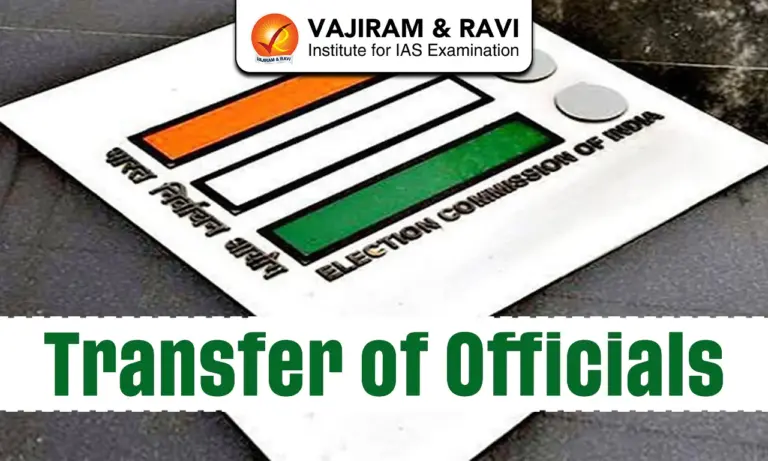
- The Election Commission’s transfer of senior officials during Assembly elections has triggered controversy, with West Bengal Chief Minister raising concerns over “unilateral” actions.
Role of the Election Commission in Conducting Elections
- The Election Commission of India (ECI) is a constitutional body responsible for conducting free and fair elections under Article 324 of the Constitution.
- It has wide-ranging powers to supervise, direct, and control elections to Parliament, State Legislatures, and the offices of President and Vice-President.
- To ensure neutrality in administration, the ECI takes several measures during elections, including:
- Deployment of central forces
- Enforcement of the Model Code of Conduct (MCC)
- Transfer or replacement of officials involved in election duties
- These steps aim to maintain a level playing field for all political parties.





Model Code of Conduct and Administrative Control
- The Model Code of Conduct (MCC) comes into force as soon as the election schedule is announced.
- It lays down guidelines for political parties and candidates
- It restricts the misuse of official machinery
- It ensures that government officials act impartially
- Once the MCC is in effect, the Election Commission increases its oversight over administrative machinery, including civil and police officials.
Legal Basis for Transfer of Officials
- The power of the Election Commission to transfer officials during elections is derived from statutory provisions.
- Section 13CC of the Representation of the People Act, 1950
- This provision states that officials involved in election work are deemed to be on deputation to the Election Commission.
- During this period, they are under the control, superintendence, and discipline of the ECI.
Supreme Court and Institutional Clarification
- There were earlier disputes regarding the extent of ECI’s control over officials. In the 1990s, the issue was taken to the Supreme Court.
- A settlement clarified that the ECI has the authority to transfer officials and replace them in case of perceived bias or dereliction of duty.
- This legal clarity forms the basis for the Commission’s actions during elections.
Practice of Transfers During Elections
- The transfer of officials during elections is not a new practice.
- It is done to remove officers perceived to be close to any political party
- It helps ensure neutrality in election administration
- It is applied across states during both the Assembly and the Lok Sabha elections
- For example, similar actions were taken during the 2024 General Elections, where several senior officials were transferred across states.
News Summary
- Following the announcement of the Assembly election schedules, the Election Commission initiated a series of transfers.
- In West Bengal, at least 21 senior IAS and IPS officers were transferred. This included key positions such as Director General of Police (DGP), Chief Secretary and the Kolkata Police Commissioner.
- Election Commission’s Justification
- The ECI stated that the objective of these actions is to ensure:
- Free and fair elections
- A fear-free environment
- Prevention of inducement and misuse of authority
- The ECI stated that the objective of these actions is to ensure:
Concerns Raised by West Bengal Government
- The West Bengal Chief Minister expressed strong objections to the transfers. Key concerns included:
- Transfers were described as “sweeping” and “unilateral”
- Lack of consultation with the State government
- Absence of specific allegations or misconduct against the officers
- The Chief Minister argued that traditionally, the Commission consults the State and seeks a panel of officers before making such decisions.
Legal Position on Consultation
- While consultation with State governments is often practised, it is not legally mandatory.
- The law gives the ECI overriding authority during elections
- Officers on election duty are directly accountable to the Commission
- Thus, the Commission can act independently if required.
Significance of the Issue
- Ensuring Free and Fair Elections
- Transfers help prevent bias and ensure that officials do not influence electoral outcomes.
- Federal Tensions
- The issue highlights tensions between the Central authority (Election Commission) and the State governments.
- Such conflicts are common during politically sensitive elections.
- Administrative Neutrality
- The neutrality of the bureaucracy is crucial for democratic functioning.
- Frequent transfers, however, may raise concerns about administrative stability.
Source: IE

 Last updated on April, 2026
→ UPSC Final Result 2025 is now out.
→ UPSC has released UPSC Toppers List 2025 with the Civil Services final result on its official website.
→ Anuj Agnihotri secured AIR 1 in the UPSC Civil Services Examination 2025.
→ UPSC Marksheet 2025 is now out.
→ UPSC Notification 2026 & UPSC IFoS Notification 2026 is now out on the official website at upsconline.nic.in.
→ UPSC Calendar 2026 has been released.
→ Check out the latest UPSC Syllabus 2026 here.
→ UPSC Prelims 2026 will be conducted on 24th May, 2026 & UPSC Mains 2026 will be conducted on 21st August 2026.
→ The UPSC Selection Process is of 3 stages-Prelims, Mains and Interview.
→ Prepare effectively with Vajiram & Ravi’s UPSC Prelims Test Series 2026 featuring full-length mock tests, detailed solutions, and performance analysis.
→ Enroll in Vajiram & Ravi’s UPSC Mains Test Series 2026 for structured answer writing practice, expert evaluation, and exam-oriented feedback.
→ Join Vajiram & Ravi’s Best UPSC Mentorship Program for personalized guidance, strategy planning, and one-to-one support from experienced mentors.
→ Shakti Dubey secures AIR 1 in UPSC CSE Exam 2024.
→ Also check Best UPSC Coaching in India
Transfer of Officials FAQs
Q1. What gives the Election Commission power to transfer officials?+
Q2. When do such transfers usually take place?+
Q3. Why does the Election Commission transfer officials?+
Q4. Is consultation with State governments mandatory?+
Q5. Is this practice new?+
Tags: mains articles transfer of officials upsc current affairs upsc mains current affairs