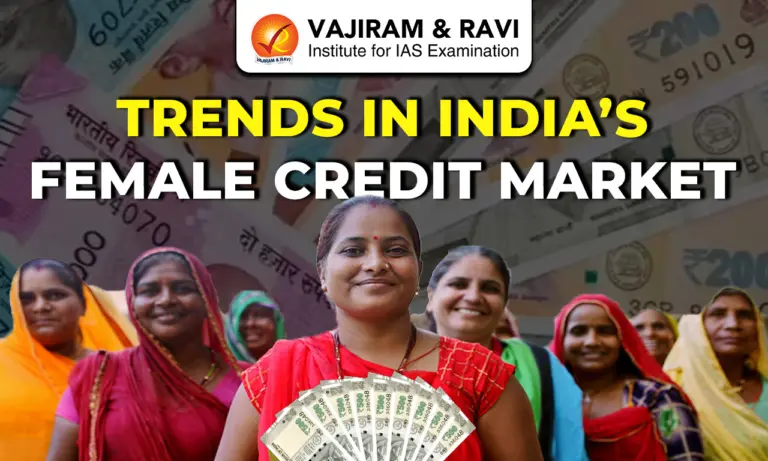
India’s female credit market is witnessing a structural transformation from financial inclusion to entrepreneurial participation. The report “From Borrowers to Builders: Women and India’s Evolving Credit Market”, released by NITI Aayog in collaboration with Women Entrepreneurship Platform (WEP), TransUnion CIBIL and MicroSave Consulting (MSC), highlights how women in India are increasingly moving beyond basic access to credit and becoming active participants in enterprise creation, financial markets, and formal economic systems.
Key Highlights of the Report
The report presents strong evidence of rapid expansion and improved financial integration of women in India’s credit ecosystem.
- Women borrowers now hold a total credit exposure of approximately ₹76 lakh crore, accounting for 26 percent of the overall formal credit system.
- Women’s credit participation has expanded 4.8 times since 2017, reflecting deepening financial inclusion.
- Credit penetration among women has increased from 19 percent in 2017 to 36 percent in 2025.
- The report is based on credit bureau data of approximately 16 crore credit-active women, highlighting the scale of participation.
- Credit to women business borrowers has grown rapidly, registering a CAGR of about 31 percent between 2022 and 2025, indicating a shift towards enterprise-led borrowing.
- Women borrowers demonstrate stronger repayment discipline, with lower default rates compared to the system average.
- Digital Public Infrastructure such as Aadhaar-based e-KYC and UPI has significantly improved access and reduced loan processing friction.
- Northern states such as Bihar and Uttar Pradesh are emerging as high-growth regions in women’s credit expansion.
Key Trends in Women’s Credit Market
The report identifies important structural shifts in how women access and use credit in India.
Shift in Credit Usage Pattern
Women are increasingly moving from consumption-oriented borrowing to productive and enterprise-driven credit usage.
- Women are using credit more for business expansion and income generation rather than only household consumption needs.
- There is increasing adoption of structured financial instruments such as overdraft facilities and cash credit accounts.
- Many borrowers are transitioning from microfinance dependence to formal banking and commercial credit systems.
- This reflects growing financial maturity and stronger participation in productive economic activities.
Digital Transformation in Credit Access
Digitalisation is reshaping how credit is delivered, accessed, and managed.
- Digital identity systems and payment platforms have simplified loan onboarding and verification processes.
- Loan approval timelines have reduced significantly, particularly for small-ticket and consumption-based loans.
- Rural women increasingly use digital payment systems, although shared devices limit full independent access.
- Digital financial systems are improving transparency, efficiency, and traceability in credit transactions.
Geographical and Product-Level Diversification
Women’s credit access is expanding across regions and financial instruments.
- Southern and western India continue to dominate credit volumes, while northern states are witnessing faster growth.
- Gold loans and personal loans remain the most widely used credit products among women borrowers.
- Housing loans are steadily increasing, indicating rising asset ownership and long-term financial planning.
- Women are gradually accessing a wider and more diversified range of formal financial products.





Structural Challenges in Women’s Credit Access
Despite progress, several institutional and behavioural barriers continue to limit full financial empowerment.
- Time Poverty and Care Responsibilities: Time poverty arising from unpaid domestic and caregiving responsibilities reduces women’s ability to actively engage with financial systems and credit decisions.
- Limited Digital Autonomy: Shared mobile devices and restricted independent digital access limit women’s ability to fully use digital financial services and manage credit independently.
- Lack of Financial Decision-Making Control: Many women entrepreneurs do not have complete control over financial decisions related to credit usage, business expansion, and investment planning.
- Delays in Secured Loan Processing: Secured loans such as housing loans face long processing timelines due to documentation requirements, property valuation processes, and collateral verification challenges.
- Stress in Microfinance Sector: Microfinance institutions are facing financial stress due to rising non-performing assets and increasing levels of borrower over-indebtedness.
- Slow Growth of New Borrowers: Growth in new-to-credit women borrowers has slowed as lenders increasingly prioritise existing customers to maintain portfolio stability and reduce risk exposure.
- Limited Access to Advanced Credit Products: Access to advanced financial instruments such as cash credit facilities and overdraft accounts remains limited among women-owned enterprises, restricting business expansion potential.
Recommendations of the Report
The report suggests targeted reforms to strengthen women’s financial participation and credit quality.
- Use of transaction data from digital platforms should be expanded for flow-based credit assessment.
- Financial literacy initiatives should be strengthened to improve awareness of credit scores and responsible borrowing.
- Credit products should be designed with flexible repayment structures aligned to women-led business cash flows.
- Women’s self-help groups should be leveraged to improve trust and adoption of formal financial systems.
- End-to-end digitisation of loan processes should be accelerated to reduce approval time and improve efficiency.
- Credit bureau data should be used more effectively for targeted policy interventions in under-served regions.
Significance of the Trends in India’s Female Credit Market
The findings highlight a structural transformation in India’s financial system, particularly in the role of women within formal credit markets.
- Transition to Economic Agency: Women are shifting from passive credit recipients to active contributors in entrepreneurship and enterprise development.
- Growth of Women-Led Enterprises: Rising access to credit is enabling the expansion of women-led businesses and supporting income-generating economic activities.
- Role of Digital Financial Infrastructure: Digital infrastructure is facilitating faster, more transparent, and more inclusive participation in formal credit systems.
- Strengthening Financial Independence: The evolving credit landscape reflects increasing economic agency, financial autonomy, and decision-making power among women.

 Last updated on April, 2026
→ UPSC Final Result 2025 is now out.
→ UPSC has released UPSC Toppers List 2025 with the Civil Services final result on its official website.
→ Anuj Agnihotri secured AIR 1 in the UPSC Civil Services Examination 2025.
→ UPSC Marksheet 2025 is now out.
→ UPSC Notification 2026 & UPSC IFoS Notification 2026 is now out on the official website at upsconline.nic.in.
→ UPSC Calendar 2026 has been released.
→ Check out the latest UPSC Syllabus 2026 here.
→ UPSC Prelims 2026 will be conducted on 24th May, 2026 & UPSC Mains 2026 will be conducted on 21st August 2026.
→ The UPSC Selection Process is of 3 stages-Prelims, Mains and Interview.
→ Prepare effectively with Vajiram & Ravi’s UPSC Prelims Test Series 2026 featuring full-length mock tests, detailed solutions, and performance analysis.
→ Enroll in Vajiram & Ravi’s UPSC Mains Test Series 2026 for structured answer writing practice, expert evaluation, and exam-oriented feedback.
→ Join Vajiram & Ravi’s Best UPSC Mentorship Program for personalized guidance, strategy planning, and one-to-one support from experienced mentors.
→ Shakti Dubey secures AIR 1 in UPSC CSE Exam 2024.
→ Also check Best UPSC Coaching in India
India’s Female Credit Market Trends FAQs
Q1. What do the trends in India’s female credit market indicate?+
Q2. How has women’s credit participation changed in India?+
Q3. What is the current size of women’s credit portfolio in India?+
Q4. What role has digitalisation played in India’s female credit market trends?+
Q5. What challenges persist in India’s female credit market trends?+
Tags: trends in indias female credit market