Tribunal Reforms Latest News
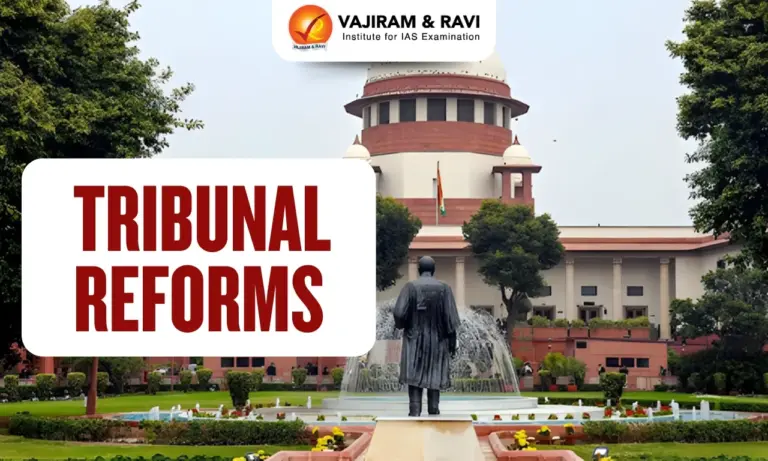
- The Supreme Court has struck down multiple provisions of the Tribunal Reforms Act, 2021, ruling that they violate the principles of judicial independence and separation of powers.
- The Court also directed the Union Government to establish the long-pending National Tribunal Commission within four months to ensure transparency and independence in tribunal appointments and administration.
Overview of the Tribunal Reforms Act, 2021
- The Tribunal Reforms Act, 2021 sought to restructure the functioning of tribunals, alter appointment procedures, and allow the government a greater say in fixing tenure, salary, service conditions, and administrative control over tribunal members.
- Key provisions included:
- Minimum age of 50 years for appointment of tribunal members,
- A four-year tenure, which could be renewed,
- A search-cum-selection committee that included two central government secretaries, whose ministries often appear as litigants before tribunals,
- Powers given to the Centre to frame rules regarding appointments and service conditions.
- These provisions were previously challenged and struck down in a 2021 judgment, yet were reintroduced with minor tweaks in the new legislation.





Supreme Court’s Core Findings
- The Bench of Chief Justice B.R. Gavai and Justice K. Vinod Chandran held that the 2021 Act was an attempt to “repackage” the very provisions earlier invalidated.
- The Court noted that Parliament cannot circumvent judicial directions by re-enacting an unconstitutional provision in slightly modified form. The Court anchored its reasoning in three pillars:
- Judicial Independence
- Tribunals discharge judicial functions, and executive dominance over appointments undermines impartiality. The Court reiterated that executive involvement must be minimal, especially as the government is a litigant in most tribunal cases.
- Separation of Powers
- Any law affecting the structure or functioning of the judiciary must respect the constitutional limits placed on legislative power. Parliament cannot “override” or “contradict” judicial pronouncements.
- Constitutional Supremacy
- The Bench emphasised that the Constitution, not Parliament or the executive, is supreme, and judicial review is a basic feature safeguarding constitutionalism.
- “The Constitution is what the Court says it is, Parliament cannot merely restate or repackage the invalidated provision,” the Court observed.
- The Court found the 2021 Act to be a “legislative override” that consciously defied earlier judgments relating to tribunal autonomy.
Key Provisions Struck Down
- The Supreme Court invalidated provisions that:
- Allowed the Centre to control tenure and age limits of tribunal members,
- Included government secretaries on the selection committee,
- Limited tenure to four years, undermining institutional stability,
- Granted excessive rule-making powers to the executive over tribunals.
- These provisions collectively weakened tribunal independence by giving the government disproportionate control over adjudicatory bodies.
Direction to Establish National Tribunal Commission
- The Court reiterated its earlier order to create a National Tribunal Commission (NTC), an independent body envisioned to:
- Oversee the appointments of tribunal members,
- Regulate service conditions,
- Ensure institutional autonomy,
- Oversee administration and infrastructure,
- Standardise functioning of tribunals across India.
- The Court stressed that the NTC is an “essential structural safeguard”, especially given the government’s repeated attempts to influence tribunal design.
Issues with the 2021 Act Highlighted by Petitioners
- The petitions argued that the Act:
- Attempted a “sly revival” of provisions already struck down,
- Allowed government dominance over tribunals, where the Centre is often the biggest litigant,
- Was passed without adequate parliamentary debate,
- Abolished nine specialised tribunals and transferred their workloads to already overburdened High Courts.
- These arguments were largely accepted by the Supreme Court.
Significance of the Judgment
- The ruling strengthens the architecture of tribunal independence, which has been the subject of multiple landmark decisions since 2010. Its key implications include:
- Reinforcing judicial checks on legislative overreach,
- Ensuring tribunals remain neutral adjudicatory bodies,
- Avoiding conflict of interest arising from executive involvement,
- Protecting citizens’ access to independent and efficient justice.
- The judgment also sends a strong message to Parliament that non-compliance with constitutional judgments is unacceptable.
Challenges Ahead
- Even as the judgment lays down clear constitutional limits, several challenges remain:
- Establishing the National Tribunal Commission may require extensive coordination between ministries,
- High Courts may face increasing burdens until tribunal vacancies are filled through a constitutionally valid process,
- Ensuring that future amendments align fully with judicial precedent will require strict legislative discipline.
- Nonetheless, the ruling marks a major step toward restoring institutional balance between the three branches of government.

 Last updated on March, 2026
→ UPSC Final Result 2025 is now out.
→ UPSC has released UPSC Toppers List 2025 with the Civil Services final result on its official website.
→ Anuj Agnihotri secured AIR 1 in the UPSC Civil Services Examination 2025.
→ UPSC Marksheet 2025 is now out.
→ UPSC Notification 2026 & UPSC IFoS Notification 2026 is now out on the official website at upsconline.nic.in.
→ UPSC Calendar 2026 has been released.
→ Check out the latest UPSC Syllabus 2026 here.
→ UPSC Prelims 2026 will be conducted on 24th May, 2026 & UPSC Mains 2026 will be conducted on 21st August 2026.
→ The UPSC Selection Process is of 3 stages-Prelims, Mains and Interview.
→ Prepare effectively with Vajiram & Ravi’s UPSC Prelims Test Series 2026 featuring full-length mock tests, detailed solutions, and performance analysis.
→ Enroll in Vajiram & Ravi’s UPSC Mains Test Series 2026 for structured answer writing practice, expert evaluation, and exam-oriented feedback.
→ Join Vajiram & Ravi’s Best UPSC Mentorship Program for personalized guidance, strategy planning, and one-to-one support from experienced mentors.
→ Shakti Dubey secures AIR 1 in UPSC CSE Exam 2024.
→ Also check Best UPSC Coaching in India
Tribunal Reforms FAQs
Q1. What did the Supreme Court strike down in the Tribunal Reforms Act, 2021?+
Q2. Why were these provisions invalidated?+
Q3. What is the National Tribunal Commission?+
Q4. What constitutional principles did the Court emphasise?+
Q5. What deadline has the Court given the Centre?+
Tags: mains articles tribunal reforms upsc current affairs upsc mains current affairs