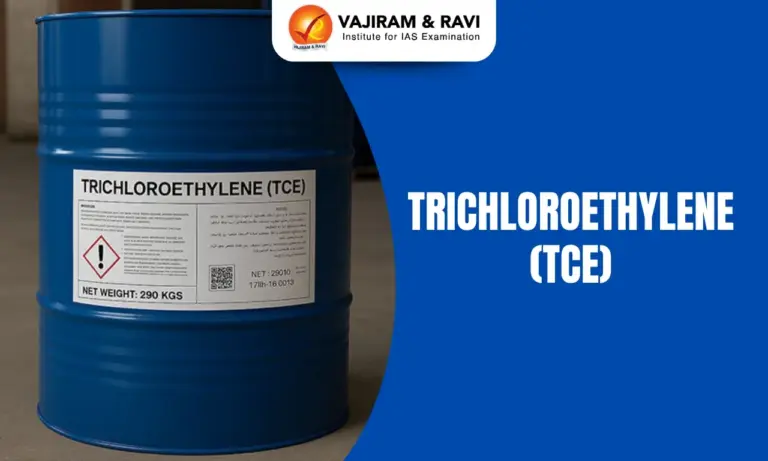
Trichloroethylene Latest News
Long-term exposure to the industrial solvent trichloroethylene (TCE) outdoors may be linked to an increased risk of Parkinson’s disease, according to a recent study.
About Trichloroethylene
- It is a volatile, colorless liquid organic chemical.
- TCE does not occur naturally and is created by chemical synthesis.






Trichloroethylene Applications
- It is used primarily to make refrigerants and other hydrofluorocarbons and as a degreasing solvent for metal equipment.
- TCE is also used in some household products, such as cleaning wipes, aerosol cleaning products, tool cleaners, paint removers, spray adhesives, and carpet cleaners and spot removers.
- Commercial dry cleaners also use trichloroethylene as a spot remover.
How are People Exposed to Trichloroethylene?
- TCE may be found in the air, water, and soil at places where it is produced or used.
- It breaks down slowly and remains in the environment for a long time.
- It readily passes through soil and can accumulate in groundwater.
- People in the general population can be exposed to TCE by inhaling it in indoor and outdoor air, drinking contaminated water, or eating foods that have been washed or processed with contaminated water.
Impact of Trichloroethylene on Human Health
- People with prolonged or repeated exposure to TCE could experience liver problems and may have an increased risk of developing liver or kidney cancer.
- TCE also has genotoxic and immunotoxic potential, and some studies indicate that it may be a teratogen.
- There is also increasing evidence supporting the association between TCE exposure and non-Hodgkin lymphoma, and several reproductive and developmental toxicity endpoints, including infertility in males and females, impaired fetal growth, and cardiac teratogenesis.
Source: MEDE

 Last updated on March, 2026
→ UPSC Final Result 2025 is now out.
→ UPSC has released UPSC Toppers List 2025 with the Civil Services final result on its official website.
→ Anuj Agnihotri secured AIR 1 in the UPSC Civil Services Examination 2025.
→ UPSC Marksheet 2025 is now out.
→ UPSC Notification 2026 & UPSC IFoS Notification 2026 is now out on the official website at upsconline.nic.in.
→ UPSC Calendar 2026 has been released.
→ Check out the latest UPSC Syllabus 2026 here.
→ UPSC Prelims 2026 will be conducted on 24th May, 2026 & UPSC Mains 2026 will be conducted on 21st August 2026.
→ The UPSC Selection Process is of 3 stages-Prelims, Mains and Interview.
→ Prepare effectively with Vajiram & Ravi’s UPSC Prelims Test Series 2026 featuring full-length mock tests, detailed solutions, and performance analysis.
→ Enroll in Vajiram & Ravi’s UPSC Mains Test Series 2026 for structured answer writing practice, expert evaluation, and exam-oriented feedback.
→ Join Vajiram & Ravi’s Best UPSC Mentorship Program for personalized guidance, strategy planning, and one-to-one support from experienced mentors.
→ Shakti Dubey secures AIR 1 in UPSC CSE Exam 2024.
→ Also check Best UPSC Coaching in India
Trichloroethylene FAQs
Q1. What is Trichloroethylene (TCE)?+
Q2. Does Trichloroethylene (TCE) occur naturally in the environment?+
Q3. For what primary purpose is Trichloroethylene (TCE) used in industry?+
Q4. Which type of cancer risk is increased with prolonged Trichloroethylene (TCE) exposure?+
Tags: prelims pointers trichloroethylene (tce) upsc current affairs upsc prelims current affairs