US Exit from Global Bodies Latest News
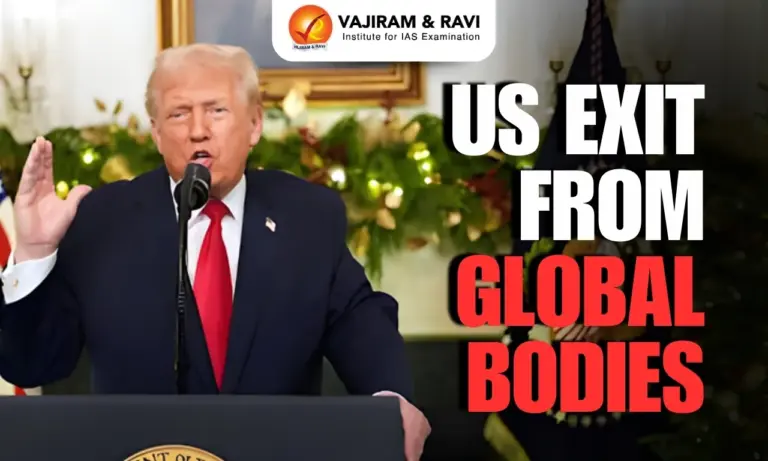
- President Donald Trump has ordered the United States to withdraw from 66 international organisations, including several UN agencies and the International Solar Alliance led by India and France.
- Calling these bodies “redundant” and contrary to US interests, Trump directed immediate action through a formal memorandum to all federal agencies.
- India’s assessment is that the immediate fallout will be reduced funding and weakened leadership across these institutions, from the World Health Organization to UNESCO.
- The resulting vacuum is expected to create space for China, which has the resources and institutional capacity to expand its influence within global governance structures.
Why the US Is Pulling Out of International Organisations
- Trump’s Core Argument: Cost Without Control – Since beginning his second term, Donald Trump has argued that the United States contributes disproportionately to global organisations while having limited influence over their agenda.
- He describes this as “globalist” and misaligned with US interests.
- Allegations of Pro-China Bias – Trump has repeatedly accused international bodies of favouring China, despite Washington being the largest or among the largest financial contributors. He claims US funding indirectly supports institutions that shield or empower Beijing.
- The WHO Exit as a Precedent – This reasoning underpinned the US withdrawal from the World Health Organization in January 2025. The US cited WHO’s failure to reform and its alleged inability to remain independent of political influence from member states.
- Funding Disparities Highlighted – The US pointed to payment imbalances, noting that China—despite having over three times the US population—contributes nearly 90% less to the WHO, reinforcing Trump’s view that the burden-sharing system is unfair.
- Broader Policy Direction – The WHO exit set the template for a wider retreat from international organisations, reflecting Trump’s preference for unilateral action and transactional global engagement over multilateral governance.





US Exit from the Global Climate Framework
- President Donald Trump’s memo lists the UN Framework Convention on Climate Change (UNFCCC) among bodies the US will exit.
- The UNFCCC underpins global climate cooperation and led to later accords such as the Paris Agreement.
- The US would be the first country to leave the UNFCCC, forfeiting influence over negotiations that shape major economic policy and opportunities.
- The move follows a broader retreat: last year, the United States skipped the UN’s annual climate summit for the first time in nearly 30 years, signalling reduced engagement in multilateral climate action.
Withdrawal from UN Women and UNFPA
- The US will also exit UN Women and the UN Population Fund (UNFPA), which supports family planning and maternal and child health in over 150 countries. US funding for UNFPA was cut last year.
Funding Cuts and UN Impact
- Exiting these bodies entails further funding reductions.
- President Trump has already curtailed most voluntary US contributions, diminishing both American involvement and financial support across the United Nations system.
How Trump Seeks to Project Power Outside Global Institutions
- Tariffs and Military Power as Primary Tools – Despite withdrawing from major international organisations, President Donald Trump is unlikely to step back from global influence. His administration continues to rely on tariff threats and military power as key instruments.
- In 2025 alone, the US carried out military actions in Syria, Iraq, Nigeria, Somalia, Yemen, and Iran, signalling readiness to use force when deemed necessary.
- Selective Multilateral Engagement – US officials have indicated that a complete withdrawal from the United Nations is unlikely. Washington wants to remain part of forums that set global standards, especially because China holds veto power at the UN. Staying engaged allows the US to counter Chinese influence from within.
- Strategic Retention of Key Bodies – Trump is expected to maintain ties with technical and regulatory bodies such as the International Telecommunication Union, International Maritime Organization, and International Labour Organization, where standards shape global commerce and technology—and where rivalry with China is intense.
- Diplomacy Backed by Force – Diplomacy is preferred, but military action remains an option—citing Venezuela’s Nicolás Maduro as an example where diplomacy failed.
- NATO and Strategic Posturing – Trump’s push to acquire Greenland has raised concerns within NATO, but he has insisted the US will remain committed to the alliance.
- His broader message underscores a belief that US power—economic and military—remains the ultimate guarantor of influence, even as institutional engagement narrows.

 Last updated on March, 2026
→ UPSC Final Result 2025 is now out.
→ UPSC has released UPSC Toppers List 2025 with the Civil Services final result on its official website.
→ Anuj Agnihotri secured AIR 1 in the UPSC Civil Services Examination 2025.
→ UPSC Marksheet 2025 is now out.
→ UPSC Notification 2026 & UPSC IFoS Notification 2026 is now out on the official website at upsconline.nic.in.
→ UPSC Calendar 2026 has been released.
→ Check out the latest UPSC Syllabus 2026 here.
→ UPSC Prelims 2026 will be conducted on 24th May, 2026 & UPSC Mains 2026 will be conducted on 21st August 2026.
→ The UPSC Selection Process is of 3 stages-Prelims, Mains and Interview.
→ Prepare effectively with Vajiram & Ravi’s UPSC Prelims Test Series 2026 featuring full-length mock tests, detailed solutions, and performance analysis.
→ Enroll in Vajiram & Ravi’s UPSC Mains Test Series 2026 for structured answer writing practice, expert evaluation, and exam-oriented feedback.
→ Join Vajiram & Ravi’s Best UPSC Mentorship Program for personalized guidance, strategy planning, and one-to-one support from experienced mentors.
→ Shakti Dubey secures AIR 1 in UPSC CSE Exam 2024.
→ Also check Best UPSC Coaching in India
US Exit from Global Bodies FAQs
Q1. Why did Trump order a US exit from global bodies?+
Q2. Which major organisations are affected by the US exit from global bodies?+
Q3. How does the US exit from global bodies affect the UN system?+
Q4. Why is China expected to benefit from the US exit from global bodies?+
Q5. Can the US still exert global power despite the US exit from global bodies?+
Tags: mains articles upsc current affairs upsc mains current affairs US exit from global bodies