Trump’s Russia Sanctions Bill Latest News
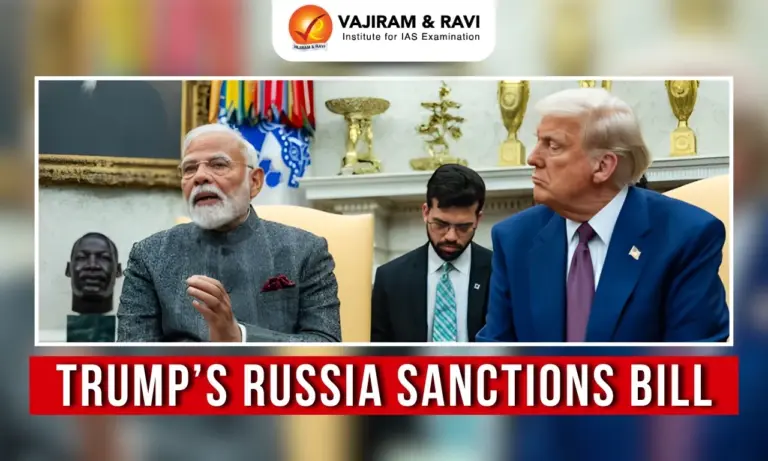
- President Donald Trump has approved a sweeping Russia sanctions Bill that proposes 500% tariffs on all goods and services imported from countries that knowingly trade in Russian-origin uranium and petroleum products.
- The Bill also includes fresh restrictions on Vladimir Putin and certain Russian military commanders, along with 500% tariffs on direct Russian imports into the US.
- For India, the impact could be severe. New Delhi has not yet concluded a trade deal with the US, leaving it exposed to escalating tariff actions.
- India already faces steep duties that threaten exports from labour-intensive sectors such as textiles, footwear, and marine products.
- If the Russia sanctions Bill passes, India’s continued purchases of discounted Russian energy could trigger punitive tariffs that effectively choke Indian exports to the US, compounding existing trade disruptions.
Sanctions Bill Sidesteps Courts, Strengthens Trump’s Tariff Powers
- This announcement comes as the Donald Trump administration faces legal setbacks over its use of the International Emergency Economic Powers Act (IEEPA).
- Three lower courts — the US District Court for the Northern District of Illinois, the US Court of International Trade, and the US Court of Appeals for the Federal Circuit — have ruled against the administration’s reliance on IEEPA for imposing tariffs.
- The proposed Russia Sanctions Bill would bypass these legal vulnerabilities, giving Trump a firmer statutory basis to penalise trade linked to Russian oil and uranium, while sustaining tariff pressure as part of efforts to end the Russia–Ukraine war.
- In parallel, the US has already initiated multiple Section 232 of the Trade Expansion Act investigations, enabling the imposition of 50% tariffs on steel, aluminium, and copper, further strengthening the administration’s trade arsenal.





500% Tariff Threat Could Halt India–US Trade
- A key provision of the Russia Sanctions Bill mandates that the US President raise duties to at least 500% on all goods and services imported from countries that knowingly trade in Russian-origin uranium and petroleum products.
- Trade experts warn that such a levy would effectively shut down India’s exports to the United States, currently valued at over $85 billion annually.
- The bill’s scope remains unclear and potentially expansive, raising concerns that it could extend beyond existing reciprocal tariffs.
- Products so far excluded—such as electronics, pharmaceuticals, coffee, and tea—could also be covered.
- This is critical for India, which has continued exporting fast-growing items like mobile phones despite earlier tariff actions.
China’s Export Diversification Blunts Tariff Shock, India More Exposed
- While proposed US tariffs on countries buying Russian oil could disrupt global trade, India is likely to be hit harder than China due to weaker export diversification.
- Despite US tariffs, China recorded a $1 trillion trade surplus in 2025, driven by dominance in sunrise sectors and control over critical minerals.
- India, though pushing manufacturing reforms and investment, remains vulnerable as many exports are less technology-intensive, making them easier to replace.
- By contrast, China—the largest buyer of Russian oil—has multiple levers to counter tariff pressure, as it has done before.
Russia Sanctions Bill Could Undercut India’s Trade Bargaining Power
- If passed, the Russia sanctions Bill would weaken India’s negotiating leverage by pushing New Delhi to diversify exports away from the United States under pressure.
- This comes as India is in active trade talks with the European Union, ASEAN, and partners including Chile, Peru, Australia, Bahrain, the Gulf Cooperation Council, Eurasian Economic Union, Canada, and the Southern African Customs Union.
- A weaker bargaining position typically invites steeper demands from partners.
- India has consistently held firm red lines on agriculture and dairy, even when counterparts insist on access.
- Notably, Australia and New Zealand did not receive deep access in these sectors during negotiations—an approach that could become harder to sustain if external pressures intensify.
US Tariff Threat Deepens Investment Uncertainty for India
- Beyond goods trade, escalating US tariff risks are hurting investment sentiment in India.
- Investors are holding back amid the unresolved United States–India trade rift, and a potential 500% tariff linked to Russian oil purchases could further deter capital inflows.
- A 2025 note by Bank of America highlights stalled capital flows across FDI, FPI, and debt.
- The Reserve Bank of India has sold $65 billion in the spot market and holds a large $63.6 billion short forward position, reflecting pressure on the rupee.
- The rupee has weakened nearly 7% over the past year, underperforming peers and leading to a real effective exchange rate depreciation of over 9%.
- Persisting uncertainty around the US–India trade deal could amplify macroeconomic risks if capital pressures continue.
Source: IE

 Last updated on April, 2026
→ UPSC Final Result 2025 is now out.
→ UPSC has released UPSC Toppers List 2025 with the Civil Services final result on its official website.
→ Anuj Agnihotri secured AIR 1 in the UPSC Civil Services Examination 2025.
→ UPSC Marksheet 2025 is now out.
→ UPSC Notification 2026 & UPSC IFoS Notification 2026 is now out on the official website at upsconline.nic.in.
→ UPSC Calendar 2026 has been released.
→ Check out the latest UPSC Syllabus 2026 here.
→ UPSC Prelims 2026 will be conducted on 24th May, 2026 & UPSC Mains 2026 will be conducted on 21st August 2026.
→ The UPSC Selection Process is of 3 stages-Prelims, Mains and Interview.
→ Prepare effectively with Vajiram & Ravi’s UPSC Prelims Test Series 2026 featuring full-length mock tests, detailed solutions, and performance analysis.
→ Enroll in Vajiram & Ravi’s UPSC Mains Test Series 2026 for structured answer writing practice, expert evaluation, and exam-oriented feedback.
→ Join Vajiram & Ravi’s Best UPSC Mentorship Program for personalized guidance, strategy planning, and one-to-one support from experienced mentors.
→ Shakti Dubey secures AIR 1 in UPSC CSE Exam 2024.
→ Also check Best UPSC Coaching in India
Trump’s Russia Sanctions Bill FAQs
Q1. What is Trump’s Russia sanctions bill and why is it significant for India?+
Q2. How would Trump’s Russia sanctions bill impact Indian exports to the US?+
Q3. Why does Trump’s Russia sanctions bill bypass legal challenges in the US?+
Q4. Why is India more vulnerable to Trump’s Russia sanctions bill than China?+
Q5. How does Trump’s Russia sanctions bill affect India’s investment climate?+
Tags: mains articles Trump’s Russia sanctions bill upsc current affairs upsc mains current affairs