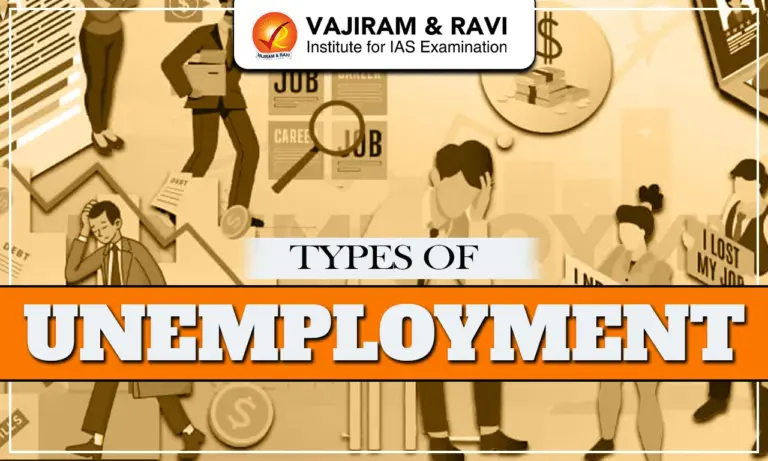
What is Unemployment?
Unemployment, according to the International Labour Organization (ILO), is when people of working age are ready and able to work but cannot find employment. They must be actively seeking jobs and available to start work. In simple terms, it happens when people want to work but have no job opportunities. It reflects the overall condition of the labour market and the economy.
Types of Unemployment
The main Types of Unemployment include Frictional, which occurs when individuals are temporarily between jobs while searching for new opportunities; Structural, arising from a mismatch between workers’ skills and job requirements or changes in industries; and Cyclical, which happens due to economic slowdowns or recessions.
Here we have shared all the important types of unemployment along with one example for each type.
1. Cyclical Unemployment
Cyclical unemployment happens due to fluctuations in the business cycle. During economic downturns or recessions, production and demand fall, leading companies to lay off workers temporarily. It is usually short-term and linked to economic cycles.
Example: Auto workers losing jobs during a recession when car sales drop.




2. Disguised Unemployment
Disguised unemployment happens when more people are working than is actually required. Even if some workers are removed, production remains the same, and extra labour adds no real value. This is common in agriculture and the informal sector in India.
Example: Several family members working on a small farm where only a few are needed.
3. Seasonal Unemployment
Seasonal unemployment occurs when work is available only during certain periods of the year. Many industries like agriculture, tourism, and ice production operate seasonally, leaving workers idle during off-seasons.
Example: Farm labourers who are employed during sowing and harvest but remain unemployed during the rest of the year.
4. Structural Unemployment
Structural unemployment arises when there are long-term changes in the economy that reduce demand for certain skills or occupations. Rapid technological progress, industrial growth, or changes in production methods can make existing skills obsolete.
Example: A typewriter mechanic unable to find work after computers replaced typewriters.
5. Frictional Unemployment
Frictional unemployment occurs when people are temporarily unemployed while transitioning between jobs or searching for better opportunities. It is often voluntary and arises due to delays in matching workers with jobs.
Example: A software engineer quitting a job and taking a few months to find a better position.
6. Underemployment
Underemployment occurs when people work in jobs that do not utilize their full potential or skills. Individuals settle for lower-skilled or part-time work due to limited opportunities, leaving their capabilities untapped.
Example: A postgraduate working in a small retail shop because suitable jobs are not available.
7. Chronic Unemployment
Chronic unemployment refers to long-term, persistent joblessness. It is caused by population growth, low economic development, and structural poverty, making certain groups unemployed for extended periods.
Example: Rural workers who remain jobless for several years due to lack of industries in the region.
8. Casual Unemployment
Casual unemployment happens when people lose work on a short-term or daily basis due to temporary contracts, reduced demand, or seasonal changes. It affects labourers in unorganized sectors the most.
Example: Construction workers who become unemployed when a project ends or raw materials are unavailable.
9. Educated Unemployment
Educated unemployment occurs when individuals with qualifications are unable to find jobs matching their education or skills. Poor education systems, lack of employable skills, and high competition contribute to this problem.
Example: Engineering graduates working as delivery executives because no suitable jobs are available.
10. Voluntary Unemployment
Voluntary Unemployment occurs when individuals choose not to work despite available job opportunities. People may remain unemployed to pursue higher education, wait for better-paying jobs, or take time off for personal reasons. This type of unemployment reflects personal choice rather than a shortage of jobs.
unemployed despite job availability
Example: A person rejecting current job offers to wait for a higher-paying position
Causes of Unemplyoment
- Rapid Population Growth: The labour force grows faster than the number of available jobs.
- Slow Economic Development: Low industrialization and limited economic activities create fewer employment opportunities.
- Lack of Skill and Education: Mismatch between workers’ skills and job requirements leads to unemployment.
- Technological Changes: Automation and modern technology reduce the need for human labour.
- Seasonal Nature of Work: Jobs available only in certain seasons, especially in agriculture and tourism.
- Rural-Urban Migration: Movement to cities increases competition for limited urban jobs.
- Poor Infrastructure: Lack of industries, transport, and communication in certain regions reduces job creation.
- Underdeveloped Industrial Sector: Limited industries in rural and semi-urban areas lead to unemployment.
- Economic Recession or Slowdown: Reduced demand for goods and services causes layoffs.
- Voluntary Choices: Some individuals choose not to work, waiting for better opportunities.
Government Initiatives
The government of India has launched several schemes and programs to provide employment opportunities, skill development, and support for entrepreneurship. These initiatives aim to reduce both rural and urban unemployment and promote inclusive economic growth.
1. Mahatma Gandhi National Rural Employment Guarantee Act (MGNREGA), 2005
MGNREGA guarantees at least 100 days of wage employment per year to rural households. It provides a social safety net for rural workers while promoting the creation of durable assets and infrastructure in villages. This program mainly targets seasonal and rural unemployment.
2. Skill India Mission / Pradhan Mantri Kaushal Vikas Yojana (PMKVY)
The Skill India Mission aims to enhance the employability of youth by providing industry-relevant skill training. PMKVY offers structured training programs and certification to improve the ability of young people to secure formal employment and bridge the gap between education and industry requirements.
3. Start-up India Initiative
Start-up India encourages entrepreneurship by offering financial support, tax benefits, and simplified procedures for establishing new businesses. The program is designed to promote self-employment, stimulate innovation, and generate large-scale employment opportunities in various sectors.
4. National Rural Livelihood Mission (NRLM)
NRLM focuses on reducing rural poverty by providing skill development and livelihood support. It empowers rural households through self-employment opportunities, financial assistance, and the formation of community-based groups, helping people achieve sustainable income sources.
5. Prime Minister Employment Generation Programme (PMEGP)
PMEGP promotes entrepreneurship by providing financial assistance for establishing micro-enterprises in rural and urban areas. The initiative aims to create new job opportunities, encourage small-scale industries, and support economic growth through self-employment.
6. Deen Dayal Upadhyaya Grameen Kaushalya Yojana (DDU-GKY)
DDU-GKY targets rural youth and focuses on skill development linked to placement in formal employment. The program strengthens employability, facilitates income generation, and contributes to the reduction of rural unemployment by connecting trained youth with industry requirements.
7. National Urban Livelihoods Mission (NULM)
NULM aims to improve the livelihood opportunities for the urban poor through skill development, self-employment, and wage employment initiatives. The mission promotes sustainable livelihoods, enhances skill sets, and encourages entrepreneurship to reduce urban unemployment.
8. Atmanirbhar Bharat and Make in India
These initiatives focus on promoting domestic manufacturing, self-reliance, and entrepreneurship. By boosting industrial growth, innovation, and investment, the programs aim to create large-scale employment opportunities across multiple sectors of the economy.

 Last updated on March, 2026
→ UPSC Final Result 2025 is now out.
→ UPSC has released UPSC Toppers List 2025 with the Civil Services final result on its official website.
→ Anuj Agnihotri secured AIR 1 in the UPSC Civil Services Examination 2025.
→ UPSC Marksheet 2025 Will be out soon.
→ UPSC Notification 2026 & UPSC IFoS Notification 2026 is now out on the official website at upsconline.nic.in.
→ UPSC Calendar 2026 has been released.
→ Check out the latest UPSC Syllabus 2026 here.
→ UPSC Prelims 2026 will be conducted on 24th May, 2026 & UPSC Mains 2026 will be conducted on 21st August 2026.
→ The UPSC Selection Process is of 3 stages-Prelims, Mains and Interview.
→ Prepare effectively with Vajiram & Ravi’s UPSC Prelims Test Series 2026 featuring full-length mock tests, detailed solutions, and performance analysis.
→ Enroll in Vajiram & Ravi’s UPSC Mains Test Series 2026 for structured answer writing practice, expert evaluation, and exam-oriented feedback.
→ Join Vajiram & Ravi’s Best UPSC Mentorship Program for personalized guidance, strategy planning, and one-to-one support from experienced mentors.
→ Shakti Dubey secures AIR 1 in UPSC CSE Exam 2024.
→ Also check Best UPSC Coaching in India
Types of Unemployment FAQs
Q1. What is unemployment?+
Q2. What are the main types of unemployment?+
Q3. What is Frictional Unemployment?+
Q4. What is Structural Unemployment?+
Q5. What is Cyclical Unemployment?+
Tags: types of unemployment