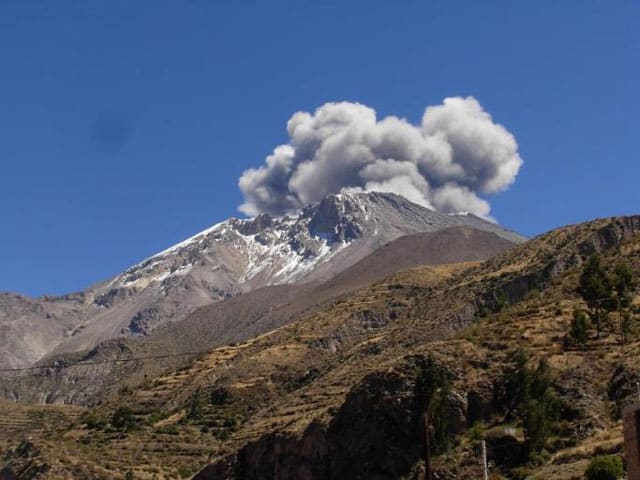
About Ubinas Volcano:
- Location:
- Ubinas is a stratovolcano located in the Central Volcanic Zone of the Andes.
- It is one of the most active volcanoes in Peru, with more than 26 eruptive episodes recorded in the last 500 years.
- The Ubinas volcano is part of a group of seven volcanoes in southern Peru located within a volcanic zone that extends from southern Peru to northern Chile.
- The affected area is situated within the “Ring of Fire,” a region encompassing the edges of the Pacific Ocean that is renowned for its volcanic activity and seismic events, such as earthquakes.
- The upper portion of the volcano is made from lava flows from the Pleistocene.
- The depression (caldera) at the summit contains a cone of volcanic ash sporting a vent shaped like a funnel.
What is a Stratovolcano?
- The stratovolcano is a tall, steep, and cone-shaped type of volcano.
- Unlike flat shield volcanoes like in Hawaii, they have higher peaks. At the peak, stratovolcanoes usually have a small crater.
- Stratovolcanoes build up on height by layering lava, ash and tephra. By definition, they have alternating layers of pyroclastics and lava.
- When ash falls or lava flows, it solidifies and makes a narrower cone.
- Strato Volcanoes comprise the largest percentage (~60%) of the Earth’s individual volcanoes.
- Strato volcanoes are usually about half-half lava and pyroclastic material, and the layering of these products gives them their other common name of composite volcanoes.
Q1) What are Shield Volcanoes?
Shield volcanoes are the largest volcanoes on Earth that actually look like volcanoes. The Hawaiian shield volcanoes are the most famous examples. Shield volcanoes are almost exclusively basalt, a type of lava that is very fluid when erupted. For this reason these volcanoes are not steep. Eruptions at shield volcanoes are only explosive if water somehow gets into the vent, otherwise they are characterized by low-explosivity fountaining that forms cinder cones and spatter cones at the vent, however, 90% of the volcano is lava rather than pyroclastic material
Source: Peru’s Ubinas Volcano Spews Smoke & Ash, Emergency Declared In Moquegua






 Last updated on March, 2026
→ UPSC Final Result 2025 is now out.
→ UPSC has released UPSC Toppers List 2025 with the Civil Services final result on its official website.
→ Anuj Agnihotri secured AIR 1 in the UPSC Civil Services Examination 2025.
→ UPSC Marksheet 2025 is now out.
→ UPSC Notification 2026 & UPSC IFoS Notification 2026 is now out on the official website at upsconline.nic.in.
→ UPSC Calendar 2026 has been released.
→ Check out the latest UPSC Syllabus 2026 here.
→ UPSC Prelims 2026 will be conducted on 24th May, 2026 & UPSC Mains 2026 will be conducted on 21st August 2026.
→ The UPSC Selection Process is of 3 stages-Prelims, Mains and Interview.
→ Prepare effectively with Vajiram & Ravi’s UPSC Prelims Test Series 2026 featuring full-length mock tests, detailed solutions, and performance analysis.
→ Enroll in Vajiram & Ravi’s UPSC Mains Test Series 2026 for structured answer writing practice, expert evaluation, and exam-oriented feedback.
→ Join Vajiram & Ravi’s Best UPSC Mentorship Program for personalized guidance, strategy planning, and one-to-one support from experienced mentors.
→ Shakti Dubey secures AIR 1 in UPSC CSE Exam 2024.
→ Also check Best UPSC Coaching in India