What’s in today’s article?
- UGC Regulations and State University Laws Latest News
- UGC Regulations and State University Laws Overview
- UGC Regulations and State University Laws Dispute
- Constitutional Questions at Play
- Impact of the Debate
- Judicial Precedents on UGC Authority
- What Needs to be Done?
- Conclusion
- UGC Regulations vs State University Laws FAQs
UGC Regulations and State University Laws Latest News
- There is an ongoing conflict between the University Grants Commission (UGC) and State governments regarding the appointment of Vice Chancellors (VCs) in State universities.




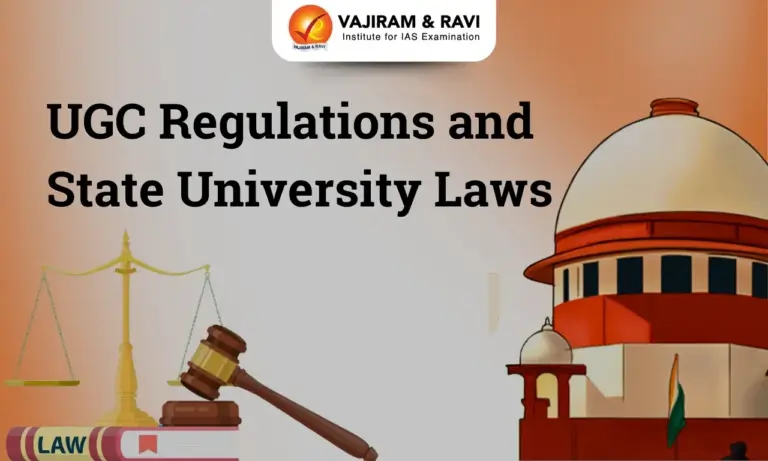
UGC Regulations and State University Laws Overview
- A contentious dispute has emerged between the University Grants Commission and various State governments regarding the appointment of Vice Chancellors (VCs) in State universities.
- The core issue revolves around whether UGC Regulations, 2018, which mandate a UGC nominee in the VC search committee, can supersede State University Acts.
- This has led to leadership vacuums in several universities, notably in Tamil Nadu, Kerala, and Punjab, impacting their governance and academic administration.
UGC Regulations and State University Laws Dispute
- UGC’s Stance:
- Regulation 7.3 of the UGC Regulations, 2018 mandates the inclusion of a UGC nominee in VC search committees.
- The UGC asserts this is essential to maintain uniform academic standards across the nation.
- State Government’s Argument:
- State University Acts, passed by State legislatures, have their own provisions for VC appointments.
- States, like Tamil Nadu, argue that imposing UGC nominees erodes their autonomy in governing universities.
- Legal Complexity:
- Conflicting judgments from the Supreme Court have further complicated the issue.
- While some rulings uphold UGC regulations as mandatory, others deem them advisory for State universities unless explicitly adopted by the State.
Constitutional Questions at Play
- Federal Structure and Delegated Legislation:
- The Constitution’s Article 254(1) states that Central laws prevail over State laws in the Concurrent List, but this applies only to plenary laws, not delegated legislation like UGC regulations.
- Judicial Interpretations:
- Landmark rulings like Ch. Tika Ramji v. State of Uttar Pradesh (1956) and Indian Express Newspapers v. Union of India (1984) clarify that subordinate legislation cannot override plenary laws.
- Recent cases like Annamalai University v. Secretary, Tourism (2009) and Kalyani Mathivanan v. K.V. Jeyaraj (2015) offer conflicting interpretations, leaving ambiguity.
Impact of the Debate
- Administrative Paralysis:
- Leadership vacancies in universities delay critical decisions, including staff appointments and degree conferrals.
- Erosion of State Autonomy:
- Imposing UGC norms without State consent undermines the federal structure and States’ legislative authority.
- Academic Implications:
- Disruptions in governance hinder the universities’ ability to achieve academic and research excellence.
Judicial Precedents on UGC Authority
- Supporting UGC Regulations:
- Cases like Gambhirdan K. Gadhvi v. State of Gujarat (2022) upheld UGC’s authority, emphasizing the uniformity of higher education standards.
- Advisory Nature of UGC:
- The Supreme Court in University of Delhi v. Raj Singh (1994) ruled that UGC guidelines are advisory unless adopted by States.
- Contradictory Judgments:
- Some rulings have erroneously equated subordinate legislation with plenary laws, further complicating the legal landscape.
What Needs to be Done?
- Constitutional Clarity:
- A ruling by a Constitutional Bench of the Supreme Court is essential to resolve ambiguities, particularly on the applicability of Article 254(1) to delegated legislation.
- Revised UGC Approach:
- The UGC should limit its role to advisory and collaborative functions, respecting State autonomy.
- Balanced Governance Framework:
- States and the Centre should work together to develop mechanisms that balance uniform academic standards with local governance needs.
Conclusion
- The dispute between UGC regulations and State University Acts reflects larger issues of Centre-State relations, federalism, and the scope of delegated legislation.
- Resolving this impasse requires not only judicial clarity but also a cooperative approach to harmonize governance in India’s higher education system.
- A balanced resolution will ensure robust university administration while preserving the federal spirit enshrined in the Constitution.
UGC Regulations vs State University Laws FAQs
Q1. What is the primary issue between UGC regulations and State university laws?
Ans. The dispute centers around whether UGC Regulations, 2018, can override State University Acts regarding the appointment of Vice Chancellors.
Q2. Why do State governments oppose UGC Regulations, 2018?
Ans. States argue that imposing UGC nominees in VC search committees undermines their autonomy in university governance.
Q3. What does the Constitution say about Central and State laws in higher education?
Ans. Article 254(1) grants Central laws precedence over State laws in the Concurrent List but applies only to plenary laws, not delegated legislation like UGC regulations.
Q4. Have courts issued conflicting rulings on UGC regulations?
Ans. Yes, some Supreme Court judgments consider UGC regulations mandatory, while others deem them advisory for State universities.
Q5. What steps are needed to resolve this conflict?
Ans. A Constitutional Bench ruling and collaborative efforts between the Centre and States are required to harmonize governance and academic standards.
Source :TH

 Last updated on April, 2026
→ UPSC Final Result 2025 is now out.
→ UPSC has released UPSC Toppers List 2025 with the Civil Services final result on its official website.
→ Anuj Agnihotri secured AIR 1 in the UPSC Civil Services Examination 2025.
→ UPSC Marksheet 2025 is now out.
→ UPSC Notification 2026 & UPSC IFoS Notification 2026 is now out on the official website at upsconline.nic.in.
→ UPSC Calendar 2026 has been released.
→ Check out the latest UPSC Syllabus 2026 here.
→ UPSC Prelims 2026 will be conducted on 24th May, 2026 & UPSC Mains 2026 will be conducted on 21st August 2026.
→ The UPSC Selection Process is of 3 stages-Prelims, Mains and Interview.
→ Prepare effectively with Vajiram & Ravi’s UPSC Prelims Test Series 2026 featuring full-length mock tests, detailed solutions, and performance analysis.
→ Enroll in Vajiram & Ravi’s UPSC Mains Test Series 2026 for structured answer writing practice, expert evaluation, and exam-oriented feedback.
→ Join Vajiram & Ravi’s Best UPSC Mentorship Program for personalized guidance, strategy planning, and one-to-one support from experienced mentors.
→ Shakti Dubey secures AIR 1 in UPSC CSE Exam 2024.
→ Also check Best UPSC Coaching in India