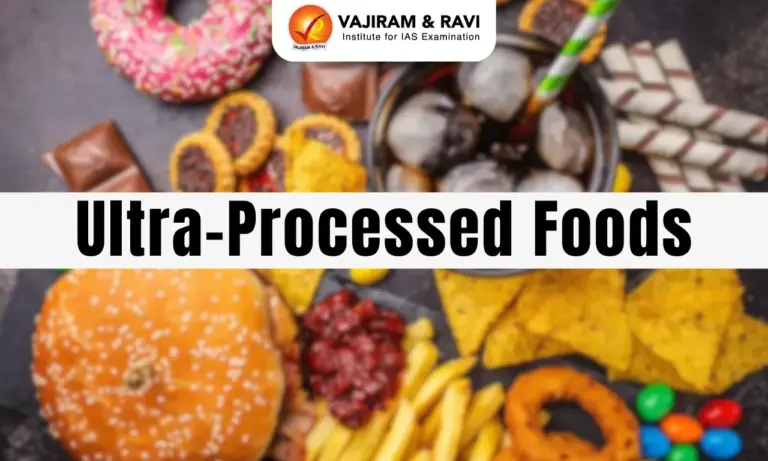
Ultra-Processed Foods Latest News
The Economic Survey 2024-25 has called for stringent front-of-the-pack labelling rules to be enforced, adding that consumption of ultra-processed foods is a big factor in undermining physical and mental health.
About Ultra-Processed Foods
- UPFs refer to food products that have been significantly altered from their original form through various industrial processes.
- These foods typically contain numerous ingredients that are not commonly used in home cooking, such as artificial flavors, colors, preservatives, sweeteners, emulsifiers, and other additives designed to enhance flavor, texture, and shelf life.
- Consuming high amounts of UPF has been linked to chronic health conditions—cardiovascular disease, obesity, colorectal cancer, among others.





Characteristics of Ultra-Processed Foods
- High levels of added sugar, fat, and salt: These ingredients are often added to enhance taste and appeal, but they can contribute to various health issues, including obesity, heart disease, and diabetes.
- Low nutritional value: Despite being calorie-dense, UPFs generally lack essential nutrients, such as vitamins, minerals, and fiber.
- Extensive use of additives: These foods often contain synthetic ingredients that are not typically found in traditional or minimally processed foods.
- Highly palatable and convenient: They are designed to be easy to consume and highly appealing, which can lead to overconsumption.
List of Foods Classified as Ultra-Processed Foods
- According to the Indian Council of Medical Research (ICMR), UPFs include commercially produced bread, breakfast cereals, cakes, chips, biscuits, fries, jams, sauces, mayonnaise, commercially produced ice cream, protein packs powders, peanut butter, soy chunks, tofu, frozen foods with additives, commercially produced cheese, butter, paneer with additives, meats, plant-based meats, refined flours of cereals, millets and legumes, energy drinks, health drinks added to milk, beverages, and fruit juices.
- The group also includes many culinary ingredients such as cooking oils, refined sugars, salt and spices, since cosmetic food additives such as artificial colours and emulsifiers are often used in their processing.
Ultra-Processed Foods FAQs
Q1. How do you know if a food is UPF?
Ans. Ultra-processed foods are often high in salt, sugar and saturated fats.
Q2. What are the named ingredients of ultra-processed foods?
Ans. Ultra processed options tend to contain: Five or more ingredients. Added sugar, salt, oils, fats, stabilizers and preservatives.
Q3. What is the Indian Council of Medical Research (ICMR)?
Ans. ICMR is the apex body in India for the formulation, coordination, and promotion of biomedical research.
Source: THBL

 Last updated on March, 2026
→ UPSC Final Result 2025 is now out.
→ UPSC has released UPSC Toppers List 2025 with the Civil Services final result on its official website.
→ Anuj Agnihotri secured AIR 1 in the UPSC Civil Services Examination 2025.
→ UPSC Marksheet 2025 is now out.
→ UPSC Notification 2026 & UPSC IFoS Notification 2026 is now out on the official website at upsconline.nic.in.
→ UPSC Calendar 2026 has been released.
→ Check out the latest UPSC Syllabus 2026 here.
→ UPSC Prelims 2026 will be conducted on 24th May, 2026 & UPSC Mains 2026 will be conducted on 21st August 2026.
→ The UPSC Selection Process is of 3 stages-Prelims, Mains and Interview.
→ Prepare effectively with Vajiram & Ravi’s UPSC Prelims Test Series 2026 featuring full-length mock tests, detailed solutions, and performance analysis.
→ Enroll in Vajiram & Ravi’s UPSC Mains Test Series 2026 for structured answer writing practice, expert evaluation, and exam-oriented feedback.
→ Join Vajiram & Ravi’s Best UPSC Mentorship Program for personalized guidance, strategy planning, and one-to-one support from experienced mentors.
→ Shakti Dubey secures AIR 1 in UPSC CSE Exam 2024.
→ Also check Best UPSC Coaching in India