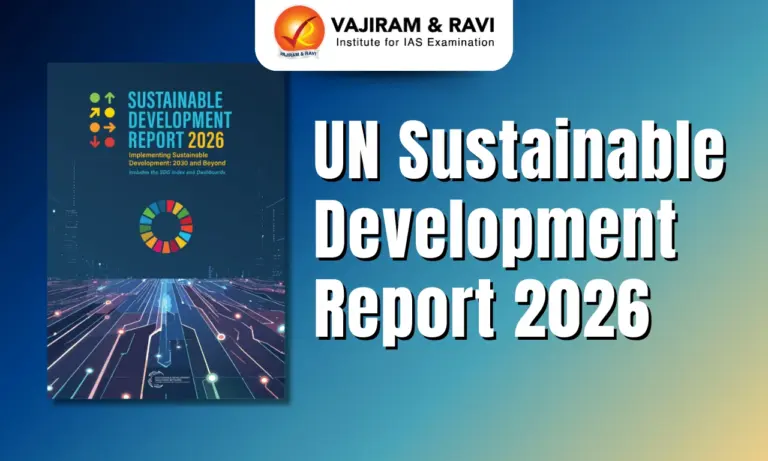
Recently, the Sustainable Development Report (SDR) 2026 was released by the United Nations Sustainable Development Solutions Network (SDSN). The report ranked India 94th out of 167 countries in the 2026 Sustainable Development Goals (SDG) Index, marking India’s highest-ever position since the adoption of the Sustainable Development Goals in 2015.
About the Sustainable Development Report 2026
The Sustainable Development Report (SDR) 2026 is the 11th edition of the annual global assessment that evaluates countries’ progress towards achieving the 2030 Agenda for Sustainable Development and the 17 Sustainable Development Goals (SDGs).
- It is published annually by the United Nations Sustainable Development Solutions Network (SDSN).
- The report assesses the performance of 167 countries using internationally comparable indicators across all 17 Sustainable Development Goals.
- It presents the SDG Index and Dashboards, which rank countries based on their overall progress towards achieving the SDGs.
- The report identifies global, regional and national trends, highlights areas requiring urgent policy attention, and provides recommendations to accelerate SDG implementation.
- The 2026 edition places special emphasis on the global implementation gap as the world enters the final years of the 2030 Agenda, with fewer than four years remaining to achieve the SDGs.
- Besides the SDG Index, the report includes the Index of Countries’ Support to United Nations-based Multilateralism (UN-Mi), which assesses countries’ commitment to the United Nations system and SDG 17 (Partnerships for the Goals).
- The 2026 report also introduces two new global surveys that evaluate government efforts towards SDG implementation and public perceptions regarding SDG challenges and financing priorities across 127 countries.
Key Findings of the Sustainable Development Report 2026
The Sustainable Development Report 2026 presents a mixed picture of global development, highlighting modest progress in some sectors while revealing that the world remains significantly off track to achieve the Sustainable Development Goals (SDGs) by 2030.
Global Performance
- Less than four years before the 2030 deadline, only 16% of the Sustainable Development Goal targets are projected to be achieved globally.
- None of the 17 Sustainable Development Goals is currently on track to be fully achieved by 2030.
- East and South Asia have emerged as the fastest-improving regions in SDG implementation since 2015.
- Finland retained the first position in the global SDG Index, followed by Sweden and Denmark.
- Even the highest-ranked countries continue to face major challenges in Responsible Consumption and Production, Climate Action, Life Below Water, and Life on Land due to unsustainable consumption patterns.
- The greatest global implementation gaps remain in Sustainable Cities and Communities, Life Below Water, Life on Land, and Peace, Justice and Strong Institutions.
- Sustainable agriculture, rising obesity, delays in administrative justice, declining press freedom and corruption remain among the weakest-performing global indicators.
- Significant global progress has been recorded in electricity access, mobile broadband connectivity, internet usage, declining adolescent fertility rates and reduction in HIV infections.
- More than 170 of the 193 United Nations Member States continued to support all United Nations General Assembly resolutions related to sustainable development during 2025, demonstrating continued global commitment to the SDGs.
- Barbados ranked first in commitment to United Nations-based multilateralism, while the United States ranked last after opposing the 2030 Agenda and withdrawing from several international organisations.
- The report identifies eight global priorities, including ending conflicts, increasing development financing, strengthening regional cooperation, reforming global governance and creating international frameworks for emerging technologies such as Artificial Intelligence and biotechnology.
India’s Performance
India emerged as one of the fastest-improving major economies in the Sustainable Development Goals Index, although significant structural challenges continue to limit its progress towards achieving the 2030 Agenda.
- India achieved its highest-ever ranking by securing the 94th position among 167 countries with an overall SDG score of 68.3 out of 100.
- India improved 18 places between 2015 and 2026, making it one of the fastest-improving major economies alongside China.
- Despite this improvement, India continues to rank behind Bhutan, Maldives, Nepal and Sri Lanka in South Asia.
- Only 33.3% of India’s SDG targets are expected to be achieved by 2030, while 42.7% are progressing slowly and 24% have deteriorated.
- India faces major challenges in Zero Hunger, Good Health and Well-being, Gender Equality, Sustainable Cities and Communities, Life Below Water, Life on Land, and Peace, Justice and Strong Institutions.
- Zero Hunger remains India’s biggest development challenge, with high levels of child stunting, increasing child wasting, rising undernourishment and growing adult obesity.
- Health outcomes continue to remain a concern due to increasing deaths from air pollution and non-communicable diseases.
- India’s performance under Climate Action has weakened because of rising carbon dioxide emissions from fossil fuels and cement production.
- Governance indicators continue to require improvement, particularly in areas related to institutional quality, corruption perception and press freedom.
- India has recorded notable progress in expanding electricity access, mobile broadband connectivity and internet penetration, strengthening digital inclusion and infrastructure development.
- The report emphasises that India’s progress is critical to global SDG achievement because improvements in the world’s most populous country will significantly influence the success of the 2030 Agenda.


Why Does India’s Performance Matter?
India accounts for nearly one-sixth of the global population, making its development trajectory central to the achievement of the Sustainable Development Goals worldwide. Faster progress in reducing poverty, improving nutrition, strengthening healthcare, promoting clean energy and ensuring climate resilience in India will have a decisive impact on global SDG outcomes. As one of the world’s fastest-growing major economies, India’s policy choices and development model will significantly shape the success of the global sustainable development agenda.
About Sustainable Development Goals
The Sustainable Development Goals (SDGs) are a universal development framework comprising 17 interconnected goals and 169 targets, adopted by all 193 United Nations Member States in 2015 under the 2030 Agenda for Sustainable Development. The SDGs aim to eradicate poverty, reduce inequalities, promote inclusive economic growth, protect the environment and ensure peace and prosperity for all by 2030.
The concept of sustainable development evolved from the Brundtland Commission Report (1987), followed by the Millennium Development Goals (2000-2015) and the Rio+20 Summit (2012), which ultimately led to the adoption of the SDGs.
| SDG No. | Sustainable Development Goal |
|
SDG 1 |
No Poverty |
|
SDG 2 |
Zero Hunger |
|
SDG 3 |
Good Health and Well-being |
|
SDG 4 |
Quality Education |
|
SDG 5 |
Gender Equality |
|
SDG 6 |
Clean Water and Sanitation |
|
SDG 7 |
Affordable and Clean Energy |
|
SDG 8 |
Decent Work and Economic Growth |
|
SDG 9 |
Industry, Innovation and Infrastructure |
|
SDG 10 |
Reduced Inequalities |
|
SDG 11 |
Sustainable Cities and Communities |
|
SDG 12 |
Responsible Consumption and Production |
|
SDG 13 |
Climate Action |
|
SDG 14 |
Life Below Water |
|
SDG 15 |
Life on Land |
|
SDG 16 |
Peace, Justice and Strong Institutions |
|
SDG 17 |
Partnerships for the Goals |
India’s Institutional Framework for SDG Implementation in India
India has established a robust institutional framework to monitor and implement the Sustainable Development Goals.
- NITI Aayog acts as the nodal agency for SDG implementation through the SDG India Index and Dashboard, promoting cooperative and competitive federalism among States and Union Territories.
- The Ministry of Statistics and Programme Implementation (MoSPI) monitors national progress through the National Indicator Framework (NIF) consisting of 277 indicators, supported by the Data for Development Coordination Forum (DDCF).
- The Ministry of Panchayati Raj promotes localisation of the SDGs through the Local Indicator Framework (LIF) and the Panchayat Advancement Index (PAI), enabling grassroots implementation across more than 2.5 lakh Gram Panchayats.
Government Initiatives Supporting SDG Implementation
India’s progress has been supported by several flagship initiatives, including:
| SDG | Sustainable Development Goal | Major Indian Initiatives |
|
SDG 1 |
No Poverty |
PM Garib Kalyan Anna Yojana (PMGKAY), PM Jan Dhan Yojana, PM Vishwakarma, Aspirational Districts Programme |
|
SDG 2 |
Zero Hunger |
Poshan 2.0, PM POSHAN Scheme, National Food Security Act (NFSA), PM Dhan-Dhaanya Krishi Yojana |
|
SDG 3 |
Good Health and Well-being |
Ayushman Bharat PM-JAY, Ayushman Bharat Digital Mission (ABDM), National Health Mission, PM Jan Aushadhi Pariyojana |
|
SDG 4 |
Quality Education |
National Education Policy (NEP) 2020, PM SHRI Schools, Samagra Shiksha, NIPUN Bharat |
|
SDG 5 |
Gender Equality |
Mission Shakti, Beti Bachao Beti Padhao, Namo Drone Didi, Lakhpati Didi |
|
SDG 6 |
Clean Water and Sanitation |
Jal Jeevan Mission, Swachh Bharat Mission 2.0, Jal Shakti Abhiyan: Catch the Rain, Namami Gange |
|
SDG 7 |
Affordable and Clean Energy |
PM Surya Ghar: Muft Bijli Yojana, National Green Hydrogen Mission, PM-KUSUM, National Bioenergy Programme |
|
SDG 8 |
Decent Work and Economic Growth |
Employment Linked Incentive (ELI) Scheme, PM Internship Scheme, Skill India Mission, Startup India |
|
SDG 9 |
Industry, Innovation and Infrastructure |
PM Gati Shakti, IndiaAI Mission, Make in India, India Semiconductor Mission |
|
SDG 10 |
Reduced Inequalities |
PM JANMAN, PM-DevINE, Direct Benefit Transfer (DBT), Aspirational Blocks Programme |
|
SDG 11 |
Sustainable Cities and Communities |
Smart Cities Mission, AMRUT 2.0, PM-eBus Sewa, PMAY-Urban 2.0 |
|
SDG 12 |
Responsible Consumption and Production |
Mission LiFE, Green Credit Programme, Extended Producer Responsibility (EPR), Plastic Waste Management Rules |
|
SDG 13 |
Climate Action |
National Green Hydrogen Mission, Mission LiFE, National Action Plan on Climate Change(NAPCC), National Adaptation Fund for Climate Change |
|
SDG 14 |
Life Below Water |
Pradhan Mantri Matsya Sampada Yojana (PMMSY), Blue Economy initiatives, Deep Ocean Mission, Coastal Regulation Zone (CRZ) framework |
|
SDG 15 |
Life on Land |
MISHTI, Aravalli Green Wall Project, Green India Mission, Project Tiger etc |
|
SDG 16 |
Peace, Justice and Strong Institutions |
Bharatiya Nyaya Sanhita and allied criminal laws, e-Courts Phase III, Mission Karmayogi, Digital India |
|
SDG 17 |
Partnerships for the Goals |
Coalition for Disaster Resilient Infrastructure (CDRI), Global Biofuels Alliance, India-UN Development Partnership Fund, International Solar Alliance |

 Last updated on Oct, 2026
→ UPSC 2027 Notification will be released on 13 January 2027 at upsconline.nic.in.
→ Check Nobel Prize 2026 Winners List here.
→ Download PIB PRiSM Monthly Magazine 2026 here.
→ Check UPSC Monthly Current Affairs Magazine The Recitals here.
→ Check out the latest UPSC Syllabus here.
→ Download UPSC Model Answers for Mains 2026
→ UPSC Mains Question Paper 2026 is out now for Essay & GS Paper 1, 2, 3 & 4.
→ UPSC Calendar 2027 has been released.
→ Enroll in Vajiram & Ravi’s UPSC Mains Test Series 2027 for structured answer writing practice, expert evaluation, and exam-oriented feedback.
→ Join Vajiram & Ravi’s UPSC Mentorship Program 2027 for personalized guidance, strategy planning, and one-to-one support from experienced mentors.
→ Go through the UPSC Mains Previous Year Papers to enhance your preparation.
→ UPSC has released UPSC Toppers List 2025 with the Civil Services final result on its official website.
→ Also check Best UPSC Coaching in India
UN Sustainable Development Report 2026 FAQs
Q1. What is the UN Sustainable Development Report (SDR) 2026?+
Q2. What are the key highlights of India’s performance in the UN Sustainable Development Report 2026?+
Q3. Which SDGs remain the biggest challenges for India?+
Q4. What are the major global findings of the UN Sustainable Development Report 2026?+
Q5. Why is India’s SDG performance in the UN Sustainable Development Report 2026 important?+
Tags: un sustainable development report 2026