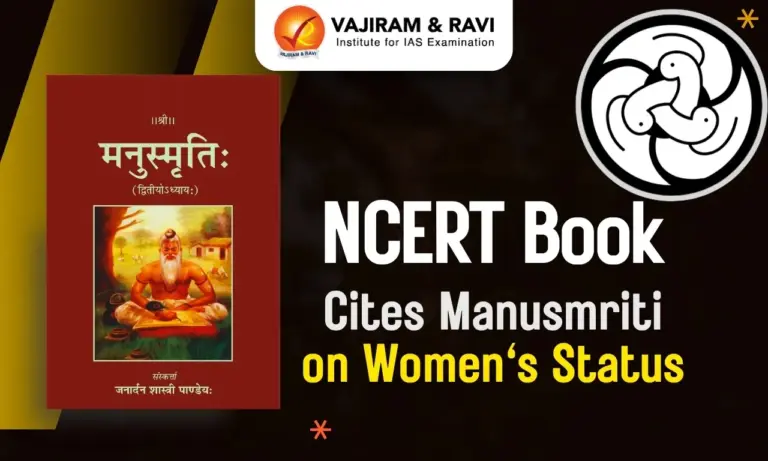
The National Council of Educational Research and Training (NCERT) has introduced new Class 9 Social Science textbooks that discuss the historical position of women in ancient India by referring to Manusmriti. The textbook explains that while women enjoyed respect and rights during the early Vedic period, their social position gradually declined in later centuries. It cites verses from Manusmriti as historical evidence to illustrate these social changes rather than as an endorsement of its ideas.
According to the textbook, the decline in women’s status was reflected in increasing restrictions on education, property rights, and public participation.
What is Manusmriti?
Manusmriti, also known as the Laws of Manu or Manava Dharma Shastra, is one of the oldest and most influential Hindu legal and social texts. It lays down rules related to governance, social duties, family life, morality, inheritance, education, punishment, and religious conduct.
Traditionally attributed to Sage Manu, the text is believed to have been composed between 200 BCE and 300 CE, though scholars differ on its exact date. It reflects the social and legal norms of its time rather than functioning as a universally binding law for all periods of Indian history.
What Does Manusmriti Say About Women?
Manusmriti presents a mixed perspective on women, containing verses that emphasize their respect, dignity, and importance in family life, while other passages prescribe restrictions on their independence and social roles, making it one of the most debated ancient texts in Indian history.
Positive References to Women in Manusmriti
- Women deserve respect: A well-known verse states that where women are honored, the gods rejoice, highlighting the importance of respecting women within the family and society.
- Foundation of family prosperity: The text suggests that the happiness and prosperity of a household depend on the well-being and dignity of its women.
- Central role in family life: Women are described as essential to maintaining the family, raising children, and preserving cultural and religious traditions.
- Importance of motherhood: Mothers are accorded high respect and are regarded as worthy of reverence for their role in nurturing future generations.
- Participation in religious life: Women are considered integral to many household religious ceremonies, especially those performed jointly by husband and wife.
Restrictive Provisions in Manusmriti
- Guardianship throughout life: Manusmriti states that a woman should remain under the protection of her father during childhood, her husband after marriage, and her sons in old age, limiting her independent status.
- Restrictions on autonomy: The text discourages women from living independently or making certain important decisions without the guidance of male guardians.
- Defined gender roles: It assigns women primary responsibilities related to household management, childcare, and supporting family life.
- Marriage as a central duty: Marriage is presented as one of the most important stages in a woman’s life, with significant emphasis on marital responsibilities.
- Inheritance limitations: In several provisions, women’s rights to inherit ancestral property are more limited than those of men, though practices varied across regions and historical periods.
- Educational differences: Unlike the early Vedic tradition, Manusmriti reflects a period in which women’s access to formal Vedic education became more restricted.
- Social discipline: The text prescribes codes of conduct related to modesty, obedience, and family responsibilities, reflecting the patriarchal norms of the period.


Women’s Status During the Early Vedic Period
The Early Vedic Period (c. 1500-1000 BCE) is generally regarded by historians as a time when women enjoyed a relatively respected and active position in society, participating in education, religious ceremonies, family decision-making, and intellectual life.
- Equal access to education: Women were encouraged to pursue education, study the Vedas, and acquire knowledge alongside men in many communities.
- Women scholars and philosophers: Learned women, known as Brahmavadinis, participated in philosophical discussions and composed Vedic hymns. Notable examples include Gargi Vachaknavi, Maitreyi, Lopamudra, Apala, and Ghosha.
- Participation in religious rituals: Women actively took part in yajnas (sacrificial rituals) and other religious ceremonies, often performing them jointly with their husbands.
- Freedom in marriage: Adult marriage was more common, and women in certain communities had the freedom to choose their spouses through practices such as Swayamvara.
- Respected position in the family: Women were regarded as equal partners in household affairs and played an important role in maintaining family harmony and religious traditions.
- Property rights: Women could possess personal property, known as Stridhana, and in some cases enjoyed inheritance and ownership rights, although these varied across regions.
- Participation in public life: Some women attended assemblies such as the Sabha and Samiti, where social and political matters were discussed.
- Economic contribution: Women contributed to agriculture, cattle rearing, weaving, handicrafts, and other household occupations, supporting the family economy.
- Recognition in literature: The Rig Veda contains hymns composed by women sages, demonstrating their intellectual and spiritual contributions.
- Respect for motherhood: Mothers were highly respected and considered the primary educators of children and preservers of family values.
- No widespread practice of child marriage: Historical evidence suggests that girls generally married after attaining maturity rather than during childhood.
- Widow remarriage: Widow remarriage appears to have been accepted in certain Vedic communities, although practices differed across regions.
- Limited social restrictions: Practices such as purdah (veil system) and sati were not prevalent during the Early Vedic Period.
Reasons Behind the Decline in Women’s Status in Later Vedic Period
Historians generally agree that the decline in the status of women in later Vedic and post-Vedic society was a gradual process influenced by social, economic, political, and religious changes rather than by a single event or text.
- Rise of patriarchal social structures: Society gradually became more male-dominated, with authority within the family and community increasingly concentrated in the hands of men.
- Codification of social norms: Dharma Shastra texts, including the Manusmriti, prescribed social rules that emphasized women’s dependence on male guardians and defined gender-specific roles.
- Decline in educational opportunities: Compared to the Early Vedic Period, fewer women received formal education or participated in Vedic learning and philosophical debates.
- Restrictions on religious participation: Women’s direct involvement in certain Vedic rituals and religious ceremonies gradually declined, reducing their public religious role.
- Changes in marriage practices: Child marriage became more common in later periods, limiting women’s access to education and personal development before marriage.
- Reduced freedom in choosing spouses: The practice of women independently selecting their life partners became less common, with arranged marriages gaining greater prominence.
- Inheritance and property limitations: Women’s rights to inherit ancestral property became more restricted, and property ownership increasingly passed through the male lineage.
- Emphasis on lineage and inheritance: Families placed greater importance on preserving paternal lineage, leading to stricter control over women’s marriage and family life.
- Growth of rigid social hierarchy: The caste system became more structured, and social customs governing marriage and family life became increasingly restrictive.
- Political instability and foreign invasions: Repeated invasions and periods of political uncertainty encouraged conservative social practices aimed at protecting family and community structures.
- Expansion of joint family system: Larger patriarchal households often limited women’s decision-making authority and reinforced traditional gender roles.
- Economic transformation: The shift from pastoral to agrarian economies increased the importance of land ownership, strengthening patriarchal inheritance systems.
- Decline in women’s participation in public life: Women gradually became less visible in assemblies, governance, and intellectual discussions.
About NCERT
The National Council of Educational Research and Training (NCERT) is an autonomous organization under the Ministry of Education, Government of India, responsible for developing school curricula, textbooks, educational research, and teacher training to improve the quality of school education nationwide.
- Established: 27 July 1961.
- Headquarters: New Delhi.
- Parent Ministry: Ministry of Education, Government of India.
- Nature: Autonomous educational organization.
- Primary Role: Develops and publishes NCERT textbooks for Classes I to XII.
- Curriculum Development: Prepares the National Curriculum Framework (NCF) for school education.
- Educational Research: Conducts research to improve teaching methods, curriculum, and learning outcomes.
- Teacher Training: Organizes training programmes and workshops for teachers and educational administrators.
- Supports NEP 2020: Assists in implementing the National Education Policy through curriculum reforms and competency-based education.
- Digital Learning: Develops e-learning resources through platforms such as DIKSHA, ePathshala, and PM eVIDYA.
- Academic Support: Provides guidance to State Councils of Educational Research and Training (SCERTs) and education boards.
- Inclusive Education: Promotes equitable and inclusive education for learners from diverse backgrounds.
- Assessment & Evaluation: Conducts national surveys and learning assessments to enhance educational quality.

 Last updated on Oct, 2026
→ UPSC 2027 Notification will be released on 13 January 2027 at upsconline.nic.in.
→ Check Nobel Prize 2026 Winners List here.
→ Download PIB PRiSM Monthly Magazine 2026 here.
→ Check UPSC Monthly Current Affairs Magazine The Recitals here.
→ Check out the latest UPSC Syllabus here.
→ Download UPSC Model Answers for Mains 2026
→ UPSC Mains Question Paper 2026 is out now for Essay & GS Paper 1, 2, 3 & 4.
→ UPSC Calendar 2027 has been released.
→ Enroll in Vajiram & Ravi’s UPSC Mains Test Series 2027 for structured answer writing practice, expert evaluation, and exam-oriented feedback.
→ Join Vajiram & Ravi’s UPSC Mentorship Program 2027 for personalized guidance, strategy planning, and one-to-one support from experienced mentors.
→ Go through the UPSC Mains Previous Year Papers to enhance your preparation.
→ UPSC has released UPSC Toppers List 2025 with the Civil Services final result on its official website.
→ Also check Best UPSC Coaching in India
NCERT Book Cites Manusmriti on Women's Status FAQs
Q1. Why is the NCERT book citing Manusmriti in the news?+
Q2. What is Manusmriti?+
Q3. What does the NCERT textbook say about women?+
Q4. Does the NCERT textbook endorse Manusmriti?+
Q5. What is NCERT?+
Q6. Why is Manusmriti considered controversial?+
Tags: ncert book cites manusmriti on women's status