Particularly Vulnerable Tribal Groups (PVTGs) Latest News
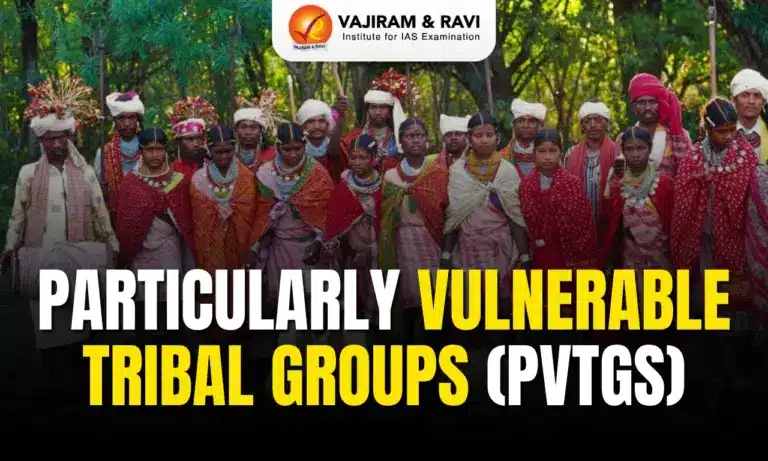
- The Ministry of Tribal Affairs (MoTA) has urged the Registrar General and Census Commissioner of India (RGI) to enumerate particularly vulnerable tribal groups (PVTGs) separately in the upcoming Census.
- The ministry requested that data on households, individuals, and unique demographic, cultural, and socio-economic traits of PVTGs be collected.
- This would enable more accurate planning and effective execution of targeted welfare schemes, including the Pradhan Mantri Janjati Adivasi Nyay Maha Abhiyan (PM JANMAN).
Understanding Particularly Vulnerable Tribal Groups (PVTGs)
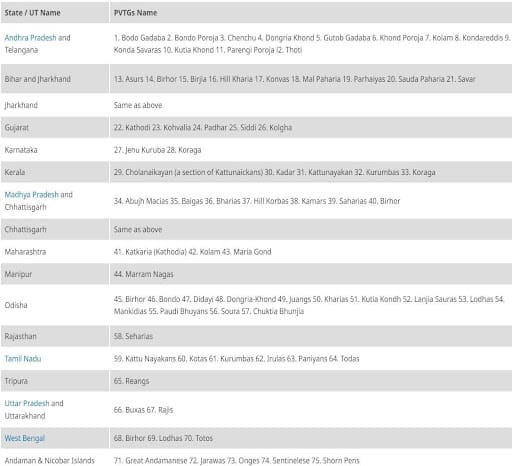
- PVTGs are a sub-category of Scheduled Tribes (STs) characterised by declining or stagnant populations, geographical isolation, pre-agrarian practices, economic backwardness, and low literacy levels.
- The category was created following the Dhebar Commission (1960–61), which highlighted disparities among tribal groups and noted that some were far more vulnerable than others.
- Initially, 52 groups were identified as PVTGs (then called Primitive Tribal Groups) during the Fifth Five-Year Plan (1974–79).
- Later, in 2006, 23 more groups were added, bringing the total to 75 PVTGs across 18 states and the Andaman & Nicobar Islands.
- Experts have raised concerns about the criteria used, particularly the emphasis on geographical isolation.
- They suggested that the government should revisit and update inclusion parameters before conducting a fresh enumeration to reflect improvements or worsening conditions among different groups.




Separate Enumeration of PVTGs
- So far, no separate enumeration of PVTGs has taken place in any Census. Since PVTGs are a sub-category of Scheduled Tribes (STs), they are generally counted within the broader ST category.
- Many PVTGs are not listed individually but grouped under a common nomenclature, leading to limited visibility in Census data.
- According to the Ministry of Tribal Affairs (MoTA), 40 out of 75 PVTGs are listed as ‘single entry’ in the notified ST list under Article 342 of the Constitution.
- For example, in the 2011 Census, Baigas of Madhya Pradesh were counted separately, but groups like Abujh Marias, Bharias, Hill Korbas, and Kamars were not.
- Later, in 2013, Abujh Maria and Hill Korba were formally added to Chhattisgarh’s ST list through legislation.
- By convention, the Registrar General of India (RGI) only publishes data for the main STs, with sub-groups and synonyms automatically included, which has prevented focused data collection on PVTGs until now.
Estimates of PVTG Population
- In November 2023, the government launched the ₹24,104 crore PM JANMAN scheme to uplift PVTGs through improved health, education, livelihoods, and infrastructure in over 200 districts.
- To support its rollout, the Ministry of Tribal Affairs (MoTA) and state governments conducted a habitation-level survey, estimating the total PVTG population at 47.5 lakh.
- Among states, Madhya Pradesh had the largest estimated PVTG population at 13.22 lakh, followed by Maharashtra (6.7 lakh) and Andhra Pradesh (5.18 lakh).
- The 2011 Census data showed that some PVTG groups had populations of fewer than 1,000 people, including:
- the Jarawas, Onges, Sentinelese, and Shompens (Andaman and Nicobar Islands),
- Raji (Uttarakhand),
- Kota (Tamil Nadu),
- Birhor (Odisha),
- Kamar (Madhya Pradesh), and
- small tribal groups in Bihar.
- The Sentinelese were the smallest community with just 15 individuals, while the Baiga of Madhya Pradesh were the largest, numbering 4,14,526.
- Officials emphasise that accurate enumeration will plug gaps in welfare implementation, particularly in health and education, and help reassess whether current PVTG classification criteria remain relevant.

 Last updated on March, 2026
→ UPSC Final Result 2025 is now out.
→ UPSC has released UPSC Toppers List 2025 with the Civil Services final result on its official website.
→ Anuj Agnihotri secured AIR 1 in the UPSC Civil Services Examination 2025.
→ UPSC Marksheet 2025 is now out.
→ UPSC Notification 2026 & UPSC IFoS Notification 2026 is now out on the official website at upsconline.nic.in.
→ UPSC Calendar 2026 has been released.
→ Check out the latest UPSC Syllabus 2026 here.
→ UPSC Prelims 2026 will be conducted on 24th May, 2026 & UPSC Mains 2026 will be conducted on 21st August 2026.
→ The UPSC Selection Process is of 3 stages-Prelims, Mains and Interview.
→ Prepare effectively with Vajiram & Ravi’s UPSC Prelims Test Series 2026 featuring full-length mock tests, detailed solutions, and performance analysis.
→ Enroll in Vajiram & Ravi’s UPSC Mains Test Series 2026 for structured answer writing practice, expert evaluation, and exam-oriented feedback.
→ Join Vajiram & Ravi’s Best UPSC Mentorship Program for personalized guidance, strategy planning, and one-to-one support from experienced mentors.
→ Shakti Dubey secures AIR 1 in UPSC CSE Exam 2024.
→ Also check Best UPSC Coaching in India
Particularly Vulnerable Tribal Groups (PVTGs) FAQs
Q1. What are Particularly Vulnerable Tribal Groups (PVTGs)?+
Q2. Why does the government want separate enumeration of PVTGs?+
Q3. How many PVTGs are there in India?+
Q4. Has India ever enumerated PVTGs separately?+
Q5. What is the estimated population of PVTGs?+
Tags: mains articles Particularly Vulnerable Tribal Groups (PVTGs) upsc current affairs upsc mains current affairs