What’s in today’s article
- Suicide in India
- National Suicide Prevention Strategy – Need, aim, key elements
Why in News:
- The Ministry of Health and Family Welfare has announced a National Suicide Prevention Strategy.
- It is structured on the lines of the World Health Organization’s guidelines for Suicide Prevention in the South East Asian region
Suicide in India
Statistics
- In India, suicide has exceeded deaths due to road traffic accidents and maternal mortality among those aged 15-29 years,
- India’s contribution to global suicides increased from 25.3% in 1990 to 36.6% in 2016 among women, and from 18.7% to 24.3% among men.
- More than one lakh lives are lost every year to suicide in India.
- In the past three years, the suicide rate has increased from 10.2 to 11.3 per 1,00,000 population.
Reasons
- The most common reasons for suicide include family problems and illnesses which account for 34% and 18% of all suicide-related deaths in India respectively.
- Other common reasons include marital conflicts, love affairs, bankruptcy or indebtedness, substance use and dependence.
- It is also to be noted that in approximately 10% of the suicides, the cause is not documented.





National Suicide Prevention Strategy
About
- The strategy includes an action framework for key stakeholders, providing a path forward for preventing suicides.
- This will provide guidance to every stakeholder for setting targets, implementing, monitoring and taking corrective actions, to attain the aim of the strategy.
- The country’s first National Suicide Prevention Strategy has been developed with an aim to synthesise stakeholder efforts with the motto of ‘energise to synergise’.
Aim
- The overall vision of the document is to create a society, where people value their lives and are supported when they are in need.
- It aims at reducing suicide mortality by 10% in the country by 2030.
- The strategy also aims at developing community resilience and societal support for suicide prevention and reducing suicide behavior.
Key elements of the policy
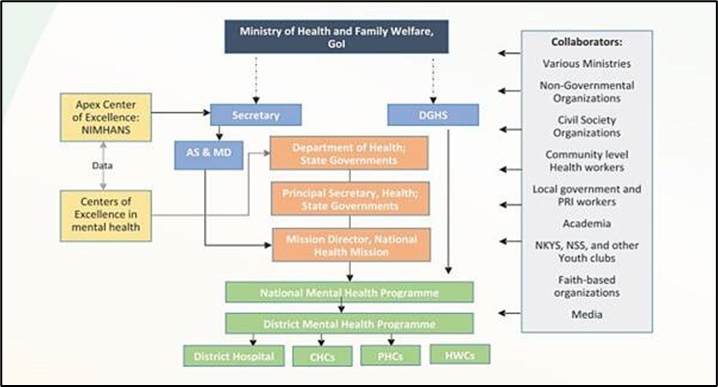
- Ministries/institutions involved
- Ministries involved in implementing the strategy are Agriculture, Home Affairs, Information and Broadcasting, Social Justice and Empowerment, Education, Labour, Women and Child Development, Information Technology, Youth Affairs and Sports.
- The National Institute of Mental Health and Neuro Sciences (NIMHANS) will also play an anchoring role, offering support to the implementation.
- Reducing easy access to means of suicide
- The strategy is focused at reducing easy access to means of suicide, for instance, pesticides.
- Time-bound action plan and data collection
- A time-bound action plan has also been laid out by the government.
- It has offered commitments:
- To establish effective surveillance mechanisms for suicide prevention in the next three years,
- To establish psychiatric OPD that provide suicide prevention services, through the district mental health plan in all the districts within the next five years, and
- To integrate mental well-being curriculum in all educational institutes within the next eight years.
- It focuses on strengthening data collection on suicide and attempts to suicide.
- Stigma reduction
- Reducing stigma is one of the huge components, as it is seen as a hurdle in the process of seeking counseling and treatment options.
- It tends to leverage the media in order to spread awareness and de-stigmatize mental health, and promote responsible media reporting of suicide.

 Last updated on March, 2026
→ UPSC Final Result 2025 is now out.
→ UPSC has released UPSC Toppers List 2025 with the Civil Services final result on its official website.
→ Anuj Agnihotri secured AIR 1 in the UPSC Civil Services Examination 2025.
→ UPSC Marksheet 2025 is now out.
→ UPSC Notification 2026 & UPSC IFoS Notification 2026 is now out on the official website at upsconline.nic.in.
→ UPSC Calendar 2026 has been released.
→ Check out the latest UPSC Syllabus 2026 here.
→ UPSC Prelims 2026 will be conducted on 24th May, 2026 & UPSC Mains 2026 will be conducted on 21st August 2026.
→ The UPSC Selection Process is of 3 stages-Prelims, Mains and Interview.
→ Prepare effectively with Vajiram & Ravi’s UPSC Prelims Test Series 2026 featuring full-length mock tests, detailed solutions, and performance analysis.
→ Enroll in Vajiram & Ravi’s UPSC Mains Test Series 2026 for structured answer writing practice, expert evaluation, and exam-oriented feedback.
→ Join Vajiram & Ravi’s Best UPSC Mentorship Program for personalized guidance, strategy planning, and one-to-one support from experienced mentors.
→ Shakti Dubey secures AIR 1 in UPSC CSE Exam 2024.
→ Also check Best UPSC Coaching in India