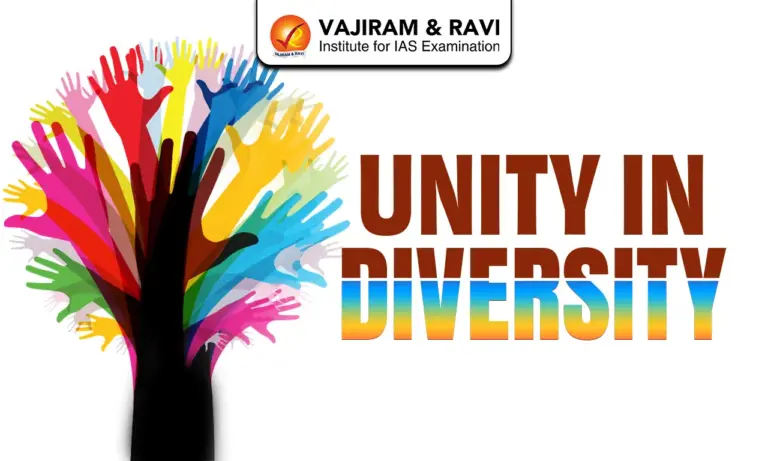
Unity in Diversity in India is one of the most defining characteristics of the nation. India is a land of multiple religions, languages, cultures, traditions, and geographical variations. Yet, despite these differences, the people of India live together with a shared identity and national pride.
This concept explains how India remains united even though it is socially and culturally diverse. It reflects the spirit of harmony, brotherhood, tolerance, and mutual respect that binds 1.4 billion people together.
Unity in Diversity Meaning
Unity in Diversity means maintaining oneness and solidarity despite differences in religion, language, culture, caste, region, and lifestyle. It reflects the idea that diversity does not divide a nation; rather, it enriches it. In India, people may look different, speak different languages, and follow different customs, but they identify themselves as Indians first.
This concept is deeply rooted in India’s civilization and cultural traditions. It shows that differences are natural, but unity is a conscious choice. India proves that diversity can exist without conflict when there is mutual respect and constitutional values.
Features of the Concept
- Acceptance of Differences – People respect each other’s beliefs, customs, and traditions without forcing uniformity.
- Common National Identity – Despite regional identities, the feeling of being Indian remains strong.
- Shared Democratic Values – Equality, liberty, justice, and fraternity bind citizens together.
- Cultural Integration – Different traditions blend and influence each other over time.
- Emotional Integration – A sense of belonging and patriotism connects citizens across regions.
Unity in Diversity Historical Background
India’s unity in diversity has developed over thousands of years through cultural interaction, trade, migration, and shared spiritual ideas. Even when India was divided into different kingdoms, there was cultural and philosophical unity. The idea of India as a civilization existed long before political unity.
Ancient Period
- India was known as Bharat, symbolizing cultural and spiritual unity.
- Epics like the Ramayana and the Mahabharata were read and respected across regions, creating moral and cultural unity.
- Pilgrimage routes connected North, South, East, and West India, promoting interaction among people.
- Ancient universities like Takshashila and Nalanda attracted students from different regions.
Medieval Period
- Cultural exchange between different communities led to the development of composite culture.
- Architecture, music, and art reflected a blend of traditions.
- Bhakti and Sufi movements emphasized love, equality, and devotion beyond religious divisions.
Freedom Struggle
- Leaders like Mahatma Gandhi, Jawaharlal Nehru, and Sardar Vallabhbhai Patel united people from all backgrounds.
- Movements like Non-Cooperation and Quit India involved participation from every region.
- The struggle created a strong feeling of national identity and unity.





Religious Diversity in India
India is home to almost every major religion in the world. It is the birthplace of Hinduism, Buddhism, Jainism, and Sikhism, and also has large populations of Muslims and Christians. This religious diversity is visible in festivals, places of worship, and daily life.
Despite following different faiths, Indians often participate in each other’s celebrations. Religious harmony is a key pillar of unity in diversity.
- Important religious sites such as Golden Temple, Kashi Vishwanath Temple, and Mecca Masjid represent different faiths coexisting peacefully.
- National holidays include festivals from various religions like Diwali, Eid, Christmas, and Guru Nanak Jayanti.
- The Constitution guarantees freedom of religion to all citizens.
- Interfaith harmony is visible in mixed neighborhoods and workplaces.
- Many Indians respect and visit places of worship of different religions.
Linguistic Diversity in India
India is one of the most linguistically diverse countries in the world. The Constitution recognizes 22 scheduled languages, and hundreds of dialects are spoken across the country. Language reflects culture, history, and regional identity.
Despite language differences, communication and cooperation continue smoothly due to multilingualism and national integration.
- Hindi, English, Tamil, Bengali, Marathi, Telugu, Kannada, and many other languages are widely spoken.
- States are organized largely on linguistic basis, yet national unity remains intact.
- People often learn multiple languages for education and employment.
- Literature in regional languages contributes to India’s cultural richness.
- Language differences rarely stop people from working and living together.
Cultural Diversity in India
Cultural Diversity in India includes traditions, customs, art forms, dance, music, dress, and food habits. Every state in India has its own unique cultural identity. However, these cultures influence and enrich each other. Indian culture is not uniform but inclusive. It absorbs new ideas while preserving ancient traditions.
- Classical dances like Bharatanatyam, Kathak, and Odissi belong to different regions.
- Food varies from dosa in the South to litti chokha in Bihar and dhokla in Gujarat.
- Traditional clothing differs such as saree, phiran, mekhela chador, and lungi.
- Festivals are celebrated with regional variations but shared enthusiasm.
- Art and handicrafts reflect regional skills and creativity.
Geographical Diversity in India
India’s geography ranges from the Himalayas to coastal plains and deserts. This physical diversity influences occupation, climate, food habits, and lifestyle. People living in mountains have different lifestyles compared to those in coastal areas.
Despite geographical differences, transportation and communication systems connect the country strongly.
- The Himalayas in the north protect the country and influence climate.
- The Thar Desert shapes the culture and lifestyle of Rajasthan.
- Fertile plains of the Ganga support agriculture and dense population.
- Coastal regions promote fishing and trade activities.
- The Northeast region has unique biodiversity and tribal cultures.
Role of the Constitution in Promoting Unity
The Constitution of India plays a central role in maintaining unity in a diverse country like India. It provides a common legal and moral framework that binds citizens together despite differences in religion, language, caste, and region. By guaranteeing equality, justice, liberty, and fraternity, the Constitution ensures that diversity becomes a strength rather than a source of division.
- Equality Before Law (Article 14): Ensures that all citizens are treated equally without discrimination based on religion, caste, gender, or place of birth. This prevents social divisions and promotes fairness in governance.
- Prohibition of Discrimination (Articles 15–16): The State cannot discriminate against any citizen on grounds of religion, race, caste, sex, or place of birth. Equal opportunity in public employment strengthens national integration.
- Freedom of Religion (Articles 25–28): Guarantees the right to freely profess, practice, and propagate religion. This constitutional secularism ensures peaceful coexistence of different faiths.
- Cultural and Educational Rights (Articles 29–30): Protects the language, script, and culture of minorities. It assures communities that their identity will be preserved within the national framework.
- Single Citizenship: India provides single citizenship for the whole country, unlike some federal systems. This creates a strong sense of national identity above regional identity.
- Federal Structure with Unitary Features: Powers are divided between the Centre and States, but the Union remains strong during emergencies. This balance prevents regional conflicts while maintaining national integrity.
- Fundamental Rights: Protect individual freedoms such as speech, expression, and movement across India. These rights help people live and work anywhere in the country.
- Directive Principles of State Policy: Guide the government to promote social and economic justice, reduce inequality, and ensure welfare of all sections of society.
- Fundamental Duties (Article 51A): Encourage citizens to promote harmony and the spirit of common brotherhood transcending religious, linguistic, and regional differences.
- Independent Judiciary: The Supreme Court and High Courts safeguard constitutional values and resolve disputes between states or communities peacefully.
- Official Language Provisions: Recognize multiple languages and allow states to adopt their own official languages, respecting linguistic diversity.
- Emergency Provisions: Allow the central government to take necessary steps during crises to protect sovereignty, unity, and integrity of the nation.
Unity in Diversity Importance
- Promotes national integration by uniting people beyond differences of religion, caste, language, and region.
- Strengthens the feeling of patriotism and common national identity among citizens.
- Ensures peaceful coexistence and reduces social conflicts in a diverse society.
- Supports the smooth functioning of democracy by encouraging participation from all communities.
- Encourages economic growth and development by maintaining internal stability and cooperation among states.
- Enhances India’s cultural richness and global identity through diverse traditions, art, and heritage.
- Builds mutual respect and tolerance among different religious and social groups.
- Protects fundamental rights and equality as guaranteed by the Constitution of India.
- Strengthens national security by creating unity against external and internal threats.
- Encourages social harmony and brotherhood among citizens.
- Promotes inclusive growth by ensuring representation of diverse communities in governance and society.
- Increases India’s international reputation as a successful multicultural nation.
Unity in Diversity Challenges
- Rise of communalism leading to religious tensions and conflicts between communities.
- Growth of caste-based discrimination and social inequality in different regions.
- Increase in regionalism and separatist movements demanding special status or independence.
- Linguistic conflicts over language imposition and regional language identity issues.
- Spread of misinformation and hate speech through social media and digital platforms.
- Political misuse of identity politics for vote-bank and electoral gains.
- Economic inequality creating a gap between rich and poor states or communities.
- Lack of proper value-based education promoting tolerance and constitutional values.
- Cultural misunderstandings due to lack of awareness about other communities.
- Migration-related tensions causing competition over jobs and resources.
- External forces attempting to disturb India’s unity through propaganda and interference.
Way Forward
- Promote value-based and constitutional education in schools and colleges to develop tolerance, respect, and civic responsibility.
- Ensure effective implementation of the Constitution of India to protect equality, secularism, and fundamental rights.
- Encourage interfaith and intercultural dialogue to reduce misunderstandings among communities.
- Strengthen strict action against hate speech, communal violence, and discrimination.
- Promote balanced regional development to reduce economic inequality among states.
- Encourage youth participation in national integration programs and cultural exchange initiatives.
- Regulate and monitor misinformation on social media platforms to prevent division.
- Promote inclusive governance ensuring representation of diverse communities in decision-making.
- Encourage responsible media reporting that highlights unity rather than division.
- Strengthen national campaigns like “Ek Bharat Shreshtha Bharat” to promote cultural bonding.
- Support policies that reduce caste and gender inequality through social justice measures.

 Last updated on April, 2026
→ UPSC Final Result 2025 is now out.
→ UPSC has released UPSC Toppers List 2025 with the Civil Services final result on its official website.
→ Anuj Agnihotri secured AIR 1 in the UPSC Civil Services Examination 2025.
→ UPSC Marksheet 2025 is now out.
→ UPSC Notification 2026 & UPSC IFoS Notification 2026 is now out on the official website at upsconline.nic.in.
→ UPSC Calendar 2026 has been released.
→ Check out the latest UPSC Syllabus 2026 here.
→ UPSC Prelims 2026 will be conducted on 24th May, 2026 & UPSC Mains 2026 will be conducted on 21st August 2026.
→ The UPSC Selection Process is of 3 stages-Prelims, Mains and Interview.
→ Prepare effectively with Vajiram & Ravi’s UPSC Prelims Test Series 2026 featuring full-length mock tests, detailed solutions, and performance analysis.
→ Enroll in Vajiram & Ravi’s UPSC Mains Test Series 2026 for structured answer writing practice, expert evaluation, and exam-oriented feedback.
→ Join Vajiram & Ravi’s Best UPSC Mentorship Program for personalized guidance, strategy planning, and one-to-one support from experienced mentors.
→ Shakti Dubey secures AIR 1 in UPSC CSE Exam 2024.
→ Also check Best UPSC Coaching in India
Unity in Diversity FAQs
Q1. What is meant by Unity in Diversity?+
Q2. Why is Unity in Diversity important in India?+
Q3. How does the Constitution promote Unity in Diversity?+
Q4. What are examples of Unity in Diversity in India?+
Q5. What are the main challenges to Unity in Diversity?+
Tags: unity in diversity