Biochar Potential in India Latest News
- India’s upcoming carbon market, expected to launch in 2026, positions biochar as a key carbon dioxide removal (CDR) technology.
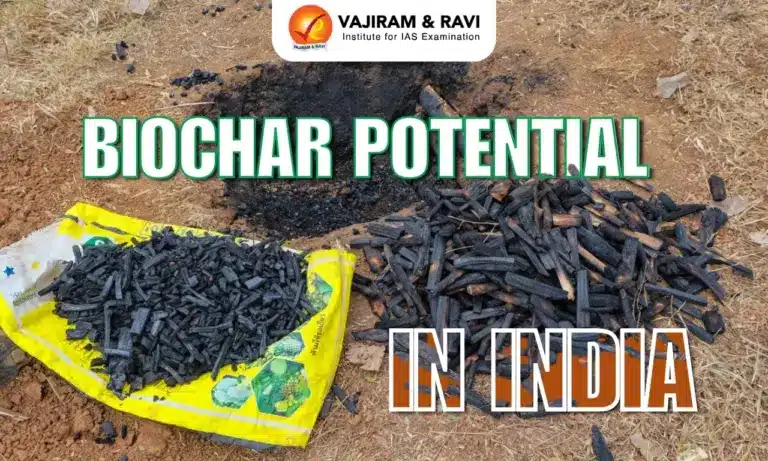
- Produced from agricultural residue and organic municipal waste, biochar is a carbon-rich charcoal that offers a dual advantage: sustainable waste management and long-term carbon sequestration.
- However, to transform biochar into a scalable and impactful solution for negative emissions, active involvement and coordinated support from various stakeholders across sectors is essential.
Unlocking Biochar’s Climate and Energy Potential in India
- India produces over 600 million metric tonnes of agricultural residue and 60 million tonnes of municipal solid waste annually, much of which is either burnt or dumped, contributing to severe air pollution and greenhouse gas emissions.
- Harnessing just 30–50% of this surplus waste could yield 15–26 million tonnes of biochar annually, enabling the removal of approximately 0.1 gigatonnes of CO2-equivalent.
- Additionally, biochar production generates valuable byproducts like syngas and bio-oil.
- These can produce 8–13 TWh of electricity—about 0.5–0.7% of India’s total—and replace up to 0.7 million tonnes of coal each year.
- Bio-oil could also substitute 12–19 million tonnes of diesel or kerosene, lowering crude oil imports and cutting over 2% of fossil fuel-based emissions.





Biochar as a Versatile and Long-Term Carbon Sink
- Biochar’s stable molecular structure enables it to sequester carbon in soil for 100 to 1,000 years, making it a highly effective and long-lasting carbon sink.
- Its applications across agriculture, industry, construction, and wastewater treatment offer scalable opportunities for reducing greenhouse gas emissions.
- In agriculture, biochar enhances water retention and can reduce nitrous oxide emissions—273 times more potent than CO₂—by 30–50%.
- It also improves soil organic carbon and aids in restoring degraded lands.
- In industrial carbon capture, specially modified biochar can absorb CO₂ from exhaust gases, though it currently has lower efficiency than conventional methods.
- In the construction sector, incorporating 2–5% biochar in concrete can strengthen the material, boost heat resistance by 20%, and capture up to 115 kg of CO₂ per cubic metre.
- Additionally, in wastewater treatment, one kilogram of biochar can treat 200–500 litres of water, unlocking a potential demand of 2.5–6.3 million tonnes annually in India, which produces over 70 billion litres of wastewater daily.
Barriers to Biochar Adoption
- Despite its immense potential as a carbon sink and its wide applicability across sectors, biochar’s adoption remains limited due to several systemic challenges.
- Key among them are the lack of standardised feedstock markets and uniform carbon accounting frameworks, which diminish investor confidence and hinder its recognition in carbon credit systems.
- Although research supports its technical feasibility, deployment is constrained by limited financial resources, evolving technologies, market uncertainties, and insufficient policy backing.
- The absence of viable business models and weak awareness among stakeholders further restrict market development.
- Additionally, the lack of robust monitoring, reporting, and verification (MRV) systems, coupled with poor coordination across agriculture, energy, and climate policies, slows progress.
The Road Ahead
- To overcome these hurdles, India must invest in region-specific R&D, integrate biochar into crop residue management and bioenergy programmes, and formally recognise it as a carbon removal pathway in its upcoming carbon market.
- This can not only unlock carbon credit revenue for farmers and investors but also generate over 5.2 lakh rural jobs.
- The added benefits of improved soil health, reduced fertilizer use (by 10–20%), and enhanced crop yields (by 10–25%) underscore the need to mainstream biochar in both policy and market frameworks.
Conclusion
- In sum, although biochar is not a silver bullet, it offers a science-backed multisectoral pathway for India to achieve its climate and development goals.
Source: TH

 Last updated on March, 2026
→ UPSC Final Result 2025 is now out.
→ UPSC has released UPSC Toppers List 2025 with the Civil Services final result on its official website.
→ Anuj Agnihotri secured AIR 1 in the UPSC Civil Services Examination 2025.
→ UPSC Marksheet 2025 is now out.
→ UPSC Notification 2026 & UPSC IFoS Notification 2026 is now out on the official website at upsconline.nic.in.
→ UPSC Calendar 2026 has been released.
→ Check out the latest UPSC Syllabus 2026 here.
→ UPSC Prelims 2026 will be conducted on 24th May, 2026 & UPSC Mains 2026 will be conducted on 21st August 2026.
→ The UPSC Selection Process is of 3 stages-Prelims, Mains and Interview.
→ Prepare effectively with Vajiram & Ravi’s UPSC Prelims Test Series 2026 featuring full-length mock tests, detailed solutions, and performance analysis.
→ Enroll in Vajiram & Ravi’s UPSC Mains Test Series 2026 for structured answer writing practice, expert evaluation, and exam-oriented feedback.
→ Join Vajiram & Ravi’s Best UPSC Mentorship Program for personalized guidance, strategy planning, and one-to-one support from experienced mentors.
→ Shakti Dubey secures AIR 1 in UPSC CSE Exam 2024.
→ Also check Best UPSC Coaching in India
Biochar Potential in India FAQs
Q1. What is biochar and how is it produced?+
Q2. How much CO₂ can biochar offset in India?+
Q3. What are biochar’s sectoral applications?+
Q4. What are the main barriers to biochar adoption?+
Q5. How can India promote biochar adoption?+
Tags: biochar potential in India mains articles upsc current affairs upsc mains current affairs