Plant Variety Act Latest News
- Union Agriculture Minister Shivraj Singh Chouhan announced that the Centre plans to amend the Protection of Plant Variety and Farmers’ Rights Act (PPV&FRA).
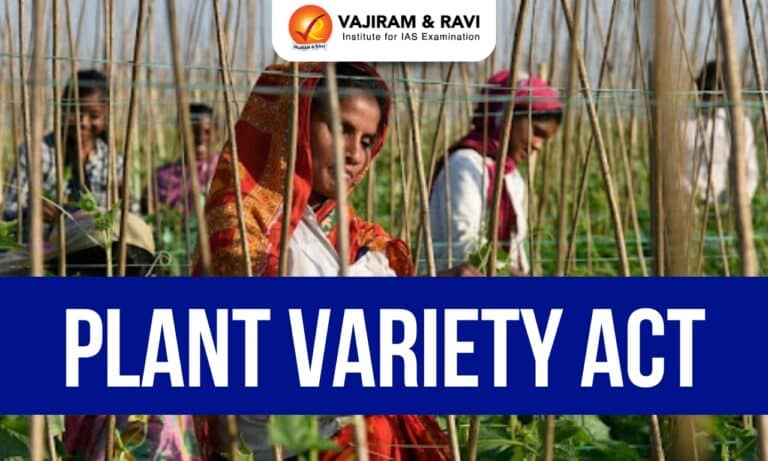
- The PPV&FRA, 2001 is India’s plant variety protection law that creates an IPR framework for new plant varieties while also safeguarding farmers’ traditional rights.
- It grants breeders and researchers exclusive rights over newly developed varieties, but ensures farmers can save, use, exchange, sell, and even register their own seeds.
- The Act was designed to balance breeder innovation with the long-standing contributions of farmers to conserving and developing plant genetic resources.
- He emphasised the need to balance the promotion of high-yielding, improved crop varieties with the preservation of traditional seeds.
Consultations on Amending the Plant Variety Act Begin
- A committee led by agricultural scientist R.S. Paroda, set up by the Protection of Plant Varieties and Farmers’ Rights Authority (PPVFRA), has begun extensive stakeholder consultations on proposed amendments to the PPV&FRA Act.
- The committee will study the rationale for revising the law and engage widely with farmers’ groups, civil society, industry, and researchers.
- The panel, comprising scientists and policymakers, will review the Act in the context of current challenges, technological advances, trade changes, and evolving farmer needs.
- Its mandate includes identifying issues faced by stakeholders and proposing specific amendments to the PPV&FRA Act, 2001, which has now completed two decades.






Key Issues Being Debated in the PPV&FRA Amendment Consultations
- Early discussions indicate several major themes. Stakeholders are considering revising the definition of “variety” to include a combination of genotypes, aligning it with the draft Seeds Bill 2019.
- There is also a proposal to broaden the definition of “seed” to cover seedlings, tubers, bulbs, rhizomes, roots, tissue-culture plantlets, synthetic seeds, and other vegetatively propagated materials.
- Consultations also focus on clarifying the definition of “institution” in the term “breeder” to explicitly include both public and private seed-sector entities.
- The committee is seeking stakeholder feedback on reforms to the DUS (Distinctness, Uniformity, Stability) test, particularly the inclusion of traits in DUS guidelines.
- DUS testing is a technical process used to evaluate new plant varieties and is the basis for obtaining Plant Variety Protection (PVP).
- The test determines if a new variety is Distinct from all known varieties, Uniform in its traits, and Stable over subsequent generations.
- Another key issue is the proposal to define “abusive acts”, making activities such as producing, selling, marketing, exporting, or importing any variety with an identical or misleading denomination punishable under the Act.
Farmer Groups Demand Protection for Community Seeds
- Farmer representatives stressed that all community-developed seeds must be registered collectively rather than under an individual or company’s name.
- They argue that seeds passing the DUS test should not be privately registered, to prevent monopolisation and future exploitation by seed companies.
- Concerns were also raised about alleged misuse of DUS testing, citing the example of njavara paddy, where farmers suspect improper procedures before registration.
Concerns About IPR and Exclusion of Small Farmers
- Policy analysts highlighted that small farmers remain outside the techno-legal system and view seeds as shared biocultural resources, conflicting with exclusive Intellectual Property Rights (IPR) frameworks.
- They noted growing global efforts to keep local varieties in open-source systems to avoid private ownership, warning against pressure on developing nations to align domestic laws with UPOV-style regimes.
Gaps in Accountability and Farmer Compensation
- Experts pointed out that the PPV&FRA Act includes provisions for holding breeders accountable for non-performing seeds.
- However, the Rules still lack clear criteria for farmer compensation. This creates uncertainty and weakens farmer protections.
Global Negotiations and Broader Seed-Sovereignty Issues
- Stakeholders also emphasised the relevance of upcoming plant treaty negotiations in Peru, particularly discussions on expanding the Multilateral System (MLS) for access and benefit-sharing.
- Linked concerns include in situ conservation, equitable benefit sharing with local seed custodians, and safeguarding farmer rights in global seed-governance frameworks.

 Last updated on April, 2026
→ UPSC Final Result 2025 is now out.
→ UPSC has released UPSC Toppers List 2025 with the Civil Services final result on its official website.
→ Anuj Agnihotri secured AIR 1 in the UPSC Civil Services Examination 2025.
→ UPSC Marksheet 2025 is now out.
→ UPSC Notification 2026 & UPSC IFoS Notification 2026 is now out on the official website at upsconline.nic.in.
→ UPSC Calendar 2026 has been released.
→ Check out the latest UPSC Syllabus 2026 here.
→ UPSC Prelims 2026 will be conducted on 24th May, 2026 & UPSC Mains 2026 will be conducted on 21st August 2026.
→ The UPSC Selection Process is of 3 stages-Prelims, Mains and Interview.
→ Prepare effectively with Vajiram & Ravi’s UPSC Prelims Test Series 2026 featuring full-length mock tests, detailed solutions, and performance analysis.
→ Enroll in Vajiram & Ravi’s UPSC Mains Test Series 2026 for structured answer writing practice, expert evaluation, and exam-oriented feedback.
→ Join Vajiram & Ravi’s Best UPSC Mentorship Program for personalized guidance, strategy planning, and one-to-one support from experienced mentors.
→ Shakti Dubey secures AIR 1 in UPSC CSE Exam 2024.
→ Also check Best UPSC Coaching in India
Plant Variety Act FAQs
Q1. Why is the PPV&FRA Act being amended?+
Q2. Who is leading the consultation process?+
Q3. What key issues are under discussion?+
Q4. What concerns have farmers raised?+
Q5. What broader policy issues are linked to the reforms?+
Tags: mains articles plant variety act upsc current affairs upsc mains current affairs