
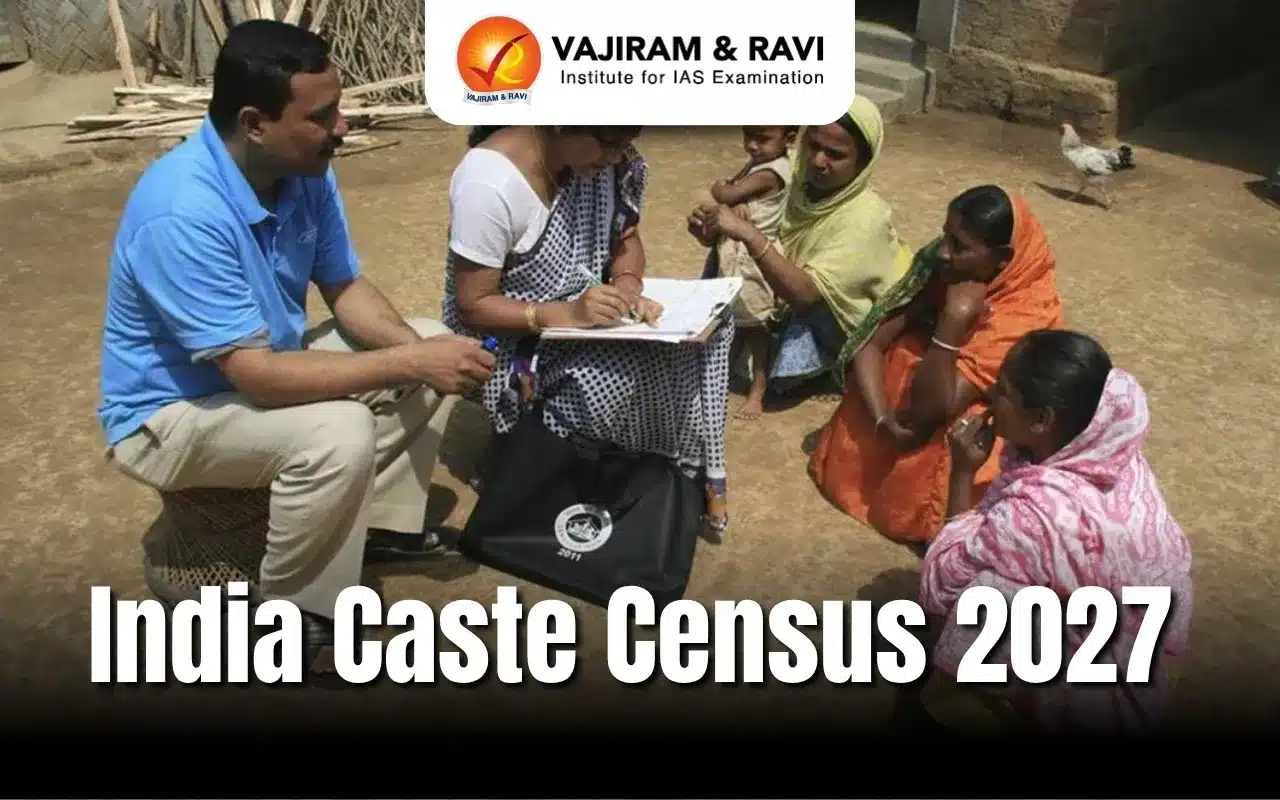
Caste Enumeration in India’s 2027 Census: Rethinking Data Collection for Inclusive Policy

India Caste Census 2027

Caste Census Latest News

The Central Government has announced that the next Census would take place in 2027 and that it would collect information on castes.

Introduction

  • India is preparing to conduct its next decennial Census in 2027, with a significant change: the inclusion of caste enumeration. 
  • This marks the first such effort since 1941 and aims to provide data that could help bring marginalised communities into the policy mainstream. 
  • However, experts and statisticians argue that to fulfil this ambitious goal, a fundamental restructuring of the current Census design and methodology is essential.

Timeline and Process of the Upcoming Census

  • The Census will be conducted in two key phases:
    • House-listing Phase (2026): Scheduled between April and September 2026, this phase will record data about dwelling units and household amenities.
    • Population Enumeration Phase (2027): This phase will collect demographic, social, and economic data, including caste-related information.
  • Caste enumeration will occur during the second phase, which represents a marked departure from earlier Censuses that did not record comprehensive caste data, except for Scheduled Castes (SCs).

Significance of Caste Enumeration

  • India last attempted caste enumeration in the 1941 Census, but the data was never processed due to the outbreak of World War II. 
  • The last usable caste data, therefore, dates back to 1931, making it grossly outdated for modern policy use.
  • The Union government, led by Prime Minister Narendra Modi, has justified this inclusion as a measure to integrate marginalised communities and enhance targeted policymaking. 
  • However, questions remain whether the current Census framework can deliver on this promise without substantive changes.

Limitations of the Existing Census Framework

  • The current format of the Census questionnaire, based on the 2021 draft, only gathers caste data for SCs
  • To make caste enumeration meaningful, experts argue the need to collect data for all castes (excluding Scheduled Tribes), accompanied by adjustments in enumerator training, software tools, and data processing protocols.
  • Moreover, key socio-economic indicators like employment, education, age at marriage, and place of birth are currently not cross-tabulated effectively with caste information. 
  • Existing questions on unemployment, migration, and childbirth suffer from conceptual ambiguity and low data quality, reducing their usefulness for caste-based policy analysis.

Suggested Reforms for Enhanced Data Collection

  • Linking Household Data with Demographic Information
      • One major reform proposed is the integration of housing and asset-related questions from the house-listing phase into the population enumeration phase. This change would:
      • Reduce data linkage errors arising from a 6-9 month time gap between phases.
      • Enable accurate correlation between caste and access to housing, electricity, and sanitation.
      • Improve coverage in urban areas, which often suffer from higher omission rates.
  • Making the Questionnaire Leaner
      • Several questions have become outdated or redundant due to rapid social and technological change. These include:
      • Ownership of mobile phones or computers.
      • Household access to bank accounts.
      • Streamlining the questionnaire would allow enumerators to focus on collecting accurate responses to more impactful variables.
  • Ensuring the Utility of Collected Data
    • Despite the Census providing caste-wise data for socio-economic variables for decades, such data has rarely informed the identification of Most Backward Castes (MBCs) or shaped welfare schemes beyond reservation frameworks. 
    • For caste enumeration to be genuinely transformative, the data must be analysed and integrated into broader public policy processes.

Challenges in Collecting Caste Data

  • While Census data can be a vital tool, it also faces logistical and methodological hurdles, such as:
    • Self-identification inconsistencies across castes and sub-castes.
    • Lack of standardised caste lists.
    • Enumerator biases and recording errors.
  • Nevertheless, in the absence of any other large-scale, uniform data source, the Census remains the most feasible mechanism to gather caste-wise socio-economic data across India.

Way Forward

  • To ensure the 2027 Census lives up to its potential, policymakers must:
    • Redesign the questionnaire to capture more granular and relevant data.
    • Improve enumerator training and digital tools for data collection.
    • Integrate caste data with other critical indicators such as literacy, employment, housing, and migration.
    • Commit to using the data beyond reservation quotas for broader social and economic reforms.
  • If executed thoughtfully, this exercise could provide India with a rich dataset for evidence-based policymaking aimed at inclusive development.

Source : TH

India Caste Census 2027

Q1: When will the next Census in India be conducted?

Ans: The Census is scheduled to take place in 2027, with the house-listing phase beginning in 2026.

Q2: Why is caste being recorded in the 2027 Census?

Ans: The government aims to collect caste data to better integrate marginalised communities into mainstream development.

Q3: What are the main criticisms of the current Census method?

Ans: The existing questionnaire structure lacks the capacity to generate meaningful, caste-disaggregated socio-economic data.

Q4: What reforms are suggested for better caste-based data collection?

Ans: Experts recommend redesigning the questionnaire, integrating household data with demographic information, and dropping outdated questions.

Q5: How can caste data from the Census be used effectively?

Ans: If properly analysed, caste data can inform policies beyond reservations, targeting education, employment, housing, and welfare.


Supreme Court Upholds Attorney-Client Privilege, Bars Summons to Lawyers for Client Advice

Attorney-Client Privilege

Attorney-Client Privilege Latest News

The Supreme Court stated that summoning lawyers for advising clients violates their rights and undermines the autonomy of the legal profession, which is protected by statutory provisions.

Background of the Case

  • The Supreme Court made its remarks while hearing a case involving a Gujarat-based lawyer summoned by police for helping his client secure bail in a loan dispute.
  • The observation followed the Supreme Court Bar Association's criticism of the Enforcement Directorate's summons to senior advocates Arvind Datar and Pratap Venugopal. 
  • They were called in connection with an Employee Stock Option Plans (ESOPs) probe involving Care Health Insurance and former Religare Enterprises chairperson Rashmi Saluja.

Privileges Associated with the Attorney-Client Communication

The Bharatiya Sakshya Adhiniyam, 2023 (replacing the Indian Evidence Act, 1872), grants privileged status to communications between lawyers and their clients, protecting them from third-party disclosure.

Conditions for Disclosure

  • Section 132 of the BSA prohibits advocates from disclosing client communication, even post-employment, except when:
    • The client consents,
    • The communication involves illegal activity,
    • The lawyer observes criminal conduct during employment.

Exemption from Testifying

Lawyers are exempt from testifying or disclosing client communications in any form—oral, written, or electronic.

Exclusive Protection for Legal Professionals

This privilege is exclusive to legal professionals; other experts like chartered accountants, company secretaries, and cost accountants do not enjoy such protection.

Judicial Stand on Summoning Lawyers

Indian courts have consistently held that police or prosecution agencies cannot summon lawyers merely for advising their clients.

A.V. Pavithran v. CBI (2024) – Bombay High Court Ruling

  • The Bombay High Court quashed a CBI summons to Advocate Pavithran, asserting that legal advice is privileged under Section 126 of the Indian Evidence Act (now Section 132 of the BSA). 
  • The court reiterated the principle: “once privileged, always privileged.”

Praram Infra v. State of M.P. (2025) – Madhya Pradesh High Court Decision

  • The Madhya Pradesh High Court also quashed summons issued to Advocate Rahul Maheshwari, emphasizing that an advocate who is neither an accused nor a witness should not be summoned. 
  • The court again cited the protection under Section 126 of the Evidence Act.

The Significance of Attorney-Client Privilege for Legal Sanctity

  • Attorney-client privilege, as upheld by Section 132 of the BSA, 2023 and reinforced by the Advocates Act, 1961, is central to maintaining the integrity of the legal profession and the rule of law. 
  • This privilege ensures lawyers can provide impartial and fearless advice without fear of coercion or reprisal.
  • Summoning legal professionals without any evidence of wrongdoing not only violates this protection but threatens the institutional balance between the Bar, Bench, and Executive. 
  • Such actions create a chilling effect—discouraging legal advocacy, fostering self-censorship, and undermining public interest litigation and constitutional advocacy.

Source: IE | B&B | LT

Attorney-Client Privilege FAQs

Q1: What did the Supreme Court rule regarding lawyer summons?

Ans: The Court ruled that summoning lawyers for client advice violates professional rights and judicial independence.

Q2: What law protects attorney-client communication in India?

Ans: Section 132 of the Bharatiya Sakshya Adhiniyam, 2023, ensures privileged lawyer-client communication remains confidential.

Q3: Are there any exceptions to attorney-client privilege?

Ans: Yes—if the client consents, the advice is illegal, or the lawyer observes criminal conduct during representation.

Q4: Can lawyers be compelled to testify about client conversations?

Ans: No, lawyers are exempt from testifying about client communications in oral, written, or electronic form.

Q5: What risks arise from violating attorney-client privilege?

Ans: It weakens legal independence, causes fear among lawyers, and undermines public interest and constitutional advocacy.

India’s Shubhanshu Shukla Joins Axiom-4 Mission, Marks New Era in Human Spaceflight

Shubhanshu Shukla Axiom-4

Shubhanshu Shukla Axiom-4 Latest News

  • In a historic moment, India's Group Captain Shubhanshu Shukla piloted the Axiom-4 mission aboard SpaceX’s Dragon capsule, which lifted off from Florida’s Kennedy Space Center. 
  • Shukla became the first Indian in 41 years to cross the Karman line after Rakesh Sharma in 1984.
    • The Kármán line is an imaginary boundary at an altitude of 100 kilometers (62 miles) above sea level, which is widely recognized as the boundary between Earth's atmosphere and outer space. 
  • PM Modi congratulated Shukla, calling him the first Indian en route to the International Space Station.

India’s Human Spaceflight Milestone and the Road Ahead

  • Shukla’s mission marks the beginning of human spaceflight becoming routine for India, similar to its satellite launches.

Gaganyaan and Strategic Shifts

  • Though ISRO missed its 2022 deadline for human spaceflight, the Gaganyaan program has injected urgency and focus into the agency, positioning India for strategic advantages in space exploration.

Human Spaceflight as a Strategic Capability

  • Human spaceflight is now a key tool for scientific, commercial, and geopolitical leverage. 
  • As global space travel risks becoming exclusionary, India’s capabilities ensure it stays in the race.

Equal Partnership in Axiom-4

  • ISRO played an active role in Axiom-4, not merely as a passenger partner. 
  • A large ISRO team, including Chairman V. Narayanan, was deeply involved in planning and troubleshooting the mission.

Preparing for Future Missions

  • The knowledge gained from Axiom-4 will strengthen the Gaganyaan program, with India’s first indigenous crewed mission expected by 2027. 
  • ISRO also plans to establish its own space station and send astronauts to the Moon by 2040.

Leveraging Space as a Strategic and Economic Frontier

  • Space is poised to be one of the most impactful technologies of the future, alongside AI, quantum computing, and clean energy, with vast economic and strategic implications.

India Among Global Front-Runners

  • Unlike other tech domains where India lags, space is an area where India holds a leading position. 
  • However, maintaining this edge will require competing with space giants like the U.S. and China.

Private Sector and Economic Potential

  • India’s space capabilities offer significant business opportunities. 
  • While India is a top space power, it contributes only about 2% to the global space economy—leaving immense room for growth.

Inspiring Youth and Driving Innovation

  • Human spaceflight can inspire young Indians, attract talent to the space sector, and boost innovation, employment, and economic development.

Capitalising on Shukla’s Mission

  • Shubhanshu Shukla’s journey must be leveraged not just as a symbolic milestone but as a springboard to accelerate India’s space ambitions and build a thriving space ecosystem.

Shubhanshu Shukla Axiom-4 FAQs

Q1: Who is Shubhanshu Shukla?

Ans: Shubhanshu Shukla is an Indian Air Force Group Captain piloting the Axiom-4 mission to the International Space Station.

Q2: What is the significance of Axiom-4 for India?

Ans: Axiom-4 marks India’s return to space after 41 years and advances its human spaceflight ambitions like Gaganyaan.

Q3: How is ISRO involved in the Axiom-4 mission?

Ans: ISRO played an equal partner role, aiding planning and troubleshooting alongside U.S. counterparts during Axiom-4’s preparation.

Q4: What future plans does ISRO have for space exploration?

Ans: ISRO plans to launch its own space station by 2035 and conduct a crewed Moon landing mission by 2040.

Q5: Why is space tech important for India’s future?

Ans: Space technology drives innovation, strategic advantage, private sector growth, and inspires youth towards science and engineering careers.

Enquire Now