
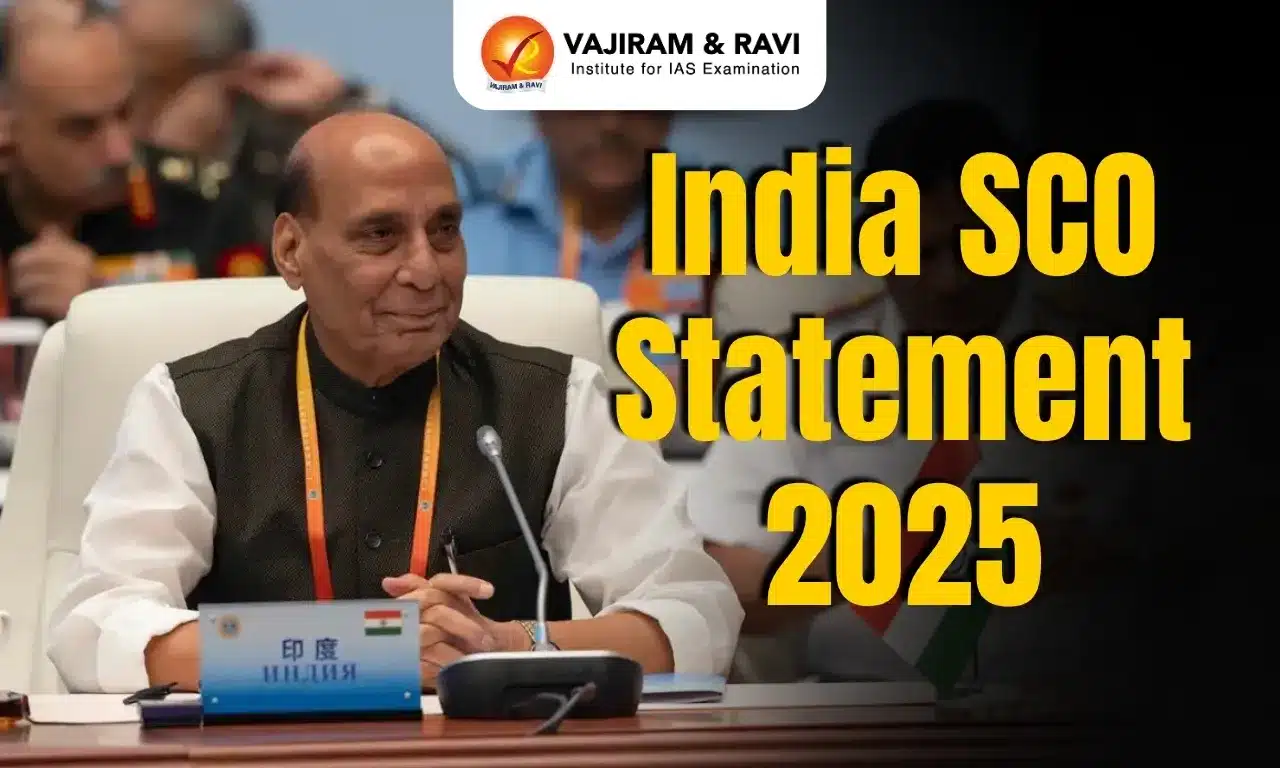
India Refuses to Sign SCO Statement Over Terrorism Omission

India SCO statement 2025

India SCO Statement 2025 Latest News

  • India refused to endorse the joint declaration at the Shanghai Cooperation Organisation (SCO) Defence Ministers’ meeting in China, objecting to the omission of references to terrorism. 
  • As the current SCO chair, Beijing hosted the 2025 defence ministers' meeting in Qingdao.
  • According to the MEA, India had strongly pushed for including terrorism concerns, but one country blocked the consensus, leading to the exclusion and India’s decision to withhold endorsement.

Shanghai Cooperation Organisation (SCO)

  • SCO is a regional bloc of 10 countries: India, China, Russia, Pakistan, Kazakhstan, Kyrgyzstan, Tajikistan, Uzbekistan, Iran, and Belarus. 
  • It is the world’s largest regional organisation by area and population.

Origins and Formation

  • The SCO evolved from the “Shanghai Five” (1996), formed by China, Russia, Kazakhstan, Kyrgyzstan, and Tajikistan to address post-Soviet security concerns, including religious extremism and ethnic tensions.
  • It was formally established on June 15, 2001, in Shanghai.

Focus on Regional Security

Unlike most global organisations, the SCO focuses on security cooperation among Asian nations. It addresses challenges like terrorism, separatism, and extremism.

RATS – The Security Arm

  • The SCO’s Regional Anti-Terrorist Structure (RATS) is its key security mechanism. 
  • It facilitates intelligence sharing and coordination among member states through regular meetings and exchanges.

India Refuses to Sign SCO Draft Statement

  • At the 2025 SCO Defence Ministers’ meeting, Defence Minister Rajnath Singh refused to sign the joint statement.
  • This was after the joint statement excluded any mention of the April 22 Pahalgam terror attack but included a reference to the Jaffar Express hijacking in Balochistan.

India’s Objection: Terrorism Omitted

  • According to MEA, India had pushed to include references to terrorism, particularly Operation Sindoor and the Pahalgam attack, but “one particular country” objected—a veiled reference to Pakistan.
  • As consensus was required, the statement was not adopted.

India Highlights Pahalgam Attack and Operation Sindoor

  • In his speech, Indian Defence Minister strongly condemned the Pahalgam terror attack, where victims were targeted based on religious identity. 
  • He named The Resistance Front, a proxy of Lashkar-e-Taiba (LeT), as responsible.
  • He described India’s retaliatory Operation Sindoor as a demonstration of its zero tolerance for terrorism.

No Tolerance for Double Standards

  • India asserted that peace cannot coexist with terrorism or WMD proliferation. It called for:
    • Decisive global action against terror sponsors
    • Consequences for countries enabling cross-border terrorism
    • An end to SCO’s silence on state-sponsored terror

India’s Refusal to Sign SCO Draft Statement – Analysis

SCO, traditionally dominated by Russia and China, now sees China playing a more dominant role due to Russia’s preoccupation with the Ukraine war

China-Pakistan Nexus at Play

  • China, a staunch ally of Pakistan, has extended military and diplomatic support to Islamabad following India’s Operation Sindoor. 
  • It has consistently shielded Pakistan in global forums from criticism over terrorism.

India’s Refusal – A Strategic Signal

  • Rajnath Singh’s refusal to sign the SCO draft document, which ignored the Pahalgam terror attack but mentioned the Balochistan train hijacking, sent a strong diplomatic message. 
  • As a result, no joint statement was issued at this year’s meeting.

Reaffirming India’s Stance on Terrorism

  • India reiterated its "no compromise on terrorism" doctrine. 
  • Indian Minister’s action reflects New Delhi’s consistent position that terrorism and normal diplomatic engagement cannot coexist.

What Lies Ahead

  • All eyes are now on the upcoming SCO Council of Heads of State meeting in Tianjin this autumn. 
  • India’s stance may influence future regional discourse on terrorism and security cooperation.

Source: IE | LM | TH

India SCO Statement 2025 FAQs

Q1: Why did India refuse to sign the SCO statement?

Ans: Because it excluded terrorism references, including the Pahalgam attack, which India insisted on including.

Q2: What was India’s objection at the SCO Defence Ministers’ meeting?

Ans: India objected to the omission of terrorism and the inclusion of the Balochistan hijacking incident.

Q3: Which country likely blocked terrorism references in the SCO draft?

Ans: Pakistan is believed to have blocked the consensus on including terrorism-related content in the draft.

Q4: What is India's position on terrorism in global forums?

Ans: India maintains a firm "no compromise on terrorism" stance and expects global acknowledgment of terror threats.

Q5: What impact did Rajnath Singh’s action have at the SCO?

Ans: It prevented the issuance of a joint statement, signalling India’s uncompromising position on cross-border terrorism.


India’s Coastline Grows by 3,500 km After Precise Mapping

India Coastline Expansion

India Coastline Expansion Latest News

  • India’s coastline has increased by nearly 50%, not due to territorial expansion but because of more accurate recent measurements. 
  • The number of offshore islands has also risen slightly following a reassessment and recount. While these changes hold administrative and strategic significance, they do not reflect any actual change on the ground.

India’s Coastline Now Measures 11,098 km

  • India’s coastline has increased from 7,516 km to 11,098 km, a rise of 3,582 km (nearly 48%). 
  • This change is due to improved measurement techniques, not territorial expansion.

From Low to High-Resolution Mapping

  • The previous measurement used low-resolution data (scale 1:4,500,000), which missed fine land features.
  • The new measurement used high-resolution data (scale 1:250,000), capturing more bends, curves, and irregularities, thereby increasing the measured length.

How Scale Affects Measurement

  • Using a smaller-scale “ruler” (low resolution) smoothens out intricate details, showing straight lines where bends exist.
  • High-resolution tools now map minute variations more precisely, thanks to modern GIS software, replacing older manual methods.

Inclusion of Offshore Islands

  • Another contributor to the increase is the inclusion of many previously uncounted offshore islands, which were either invisible in older data or missed due to manual limitations.

Significance

  • Though the actual land has not changed, the updated coastline data holds strategic and administrative value, improving mapping accuracy and planning for coastal development and security.

The Coastline Paradox: Why Lengths Keep Changing

  • India’s new coastline measurement is more accurate but still not definitive. 
  • This is due to the coastline paradox, which states that irregular natural features like coastlines have no fixed length, as the measured length increases with finer resolution.

Precision Changes Everything

  • The more detailed the measurement (higher resolution), the longer the coastline appears. 
  • Advancements in mapping technologies, such as GIS, lead to greater precision and thus a longer calculated length.

The Paradox Beyond Coastlines

  • The coastline paradox applies to other natural features too, like river networks and mountain ranges. 
  • For instance, river banks are irregular, but river lengths are typically calculated along the main stream, avoiding the same variability.

Periodic Reassessment Now a Norm

  • Due to evolving technology and natural processes (like erosion and land reclamation), India has decided to recalculate its coastline every 10 years. 
  • This aligns with practices in other countries to maintain updated and precise coastal data.

Implications

  • The changing length has administrative, environmental, and strategic relevance, even if it doesn’t reflect a change in physical territory. 
  • It emphasizes the importance of continuous monitoring and adaptive planning.

Island Counting: A Different Challenge

  • Unlike coastlines, island counts don’t face measurement paradoxes, but they do suffer from classification ambiguities—such as whether a landmass submerged at high tide qualifies as an island.

Previous Discrepancies in Island Numbers

  • In 2016, the Surveyor General of India listed 1,382 offshore islands, while state agencies, Coast Guard, and Navy reported a lower count of 1,334. 
  • The difference arose due to varying definitions and criteria.

Standardisation and Updated Island Count

  • A data reconciliation and standardisation exercise resolved these discrepancies. The final count is:
    • 1,298 offshore islands
    • 91 inshore islands
    • Total: 1,389 islands
  • This count excludes river islands like those in Assam and West Bengal.

Why It Matters

  • Standardising island counts has administrative, security, and environmental implications, especially for maritime boundaries, disaster planning, and coastal development.

Source: IE | WION

India Coastline Expansion FAQs

Q1: Why has India’s coastline length increased?

Ans: Due to better high-resolution mapping tools that capture more detail in coastline curves and offshore islands.

Q2: What is the coastline paradox?

Ans: It refers to the fact that natural coastlines have no fixed length and grow with measurement precision.

Q3: How often will India now reassess its coastline?

Ans: India will now recalculate its coastline every 10 years due to evolving tech and natural changes.

Q4: How many islands does India now officially have?

Ans: After standardisation, India has 1,389 islands, including 1,298 offshore and 91 inshore islands.

Q5: Does the new coastline length reflect land acquisition?

Ans: No, it only reflects improved measurement accuracy, not any territorial expansion.

India Rejects Arbitration Court Ruling Under Indus Waters Treaty

The Indus Water Treaty

Indus Waters Treaty Latest News

  • India has rejected a Court of Arbitration ruling that issued a "supplemental award" on its competence concerning the Kishenganga and Ratle hydroelectric projects in Jammu and Kashmir.

Grievance Redressal Mechanism under the Indus Waters Treaty

  • The Indus Waters Treaty (IWT), signed in 1960 between India and Pakistan with the World Bank as a guarantor, includes structured mechanisms for resolving disputes and differences over the interpretation and application of its provisions. 
  • These mechanisms include:
    • Permanent Indus Commission (PIC):
      • Comprising one commissioner from each country, the PIC serves as the first tier for resolving issues. 
      • It conducts annual meetings and field visits and works to resolve technical and operational matters through mutual consultation.
    • Neutral Expert Mechanism:
      • For technical differences that cannot be resolved at the PIC level, either party can approach the World Bank to appoint a neutral expert. 
      • The expert’s mandate is limited to factual and technical questions, and their decisions are binding on both parties.
    • Court of Arbitration (CoA):
      • For disputes involving legal interpretations or the validity of treaty provisions, a Court of Arbitration can be constituted. 
      • However, both countries must agree on invoking this mechanism. Any deviation from mutual consent challenges the treaty’s fundamental design.
  • India has consistently favoured the Neutral Expert route, while Pakistan has pushed for the arbitration court on issues like the design of hydropower projects. 
  • India maintains that parallel proceedings before both mechanisms violate the treaty's structure and purpose.

India’s Rejection of the Court of Arbitration’s Authority

  • Recently, the Hague-based Court of Arbitration issued a supplemental award asserting its jurisdiction over disputes concerning the Kishenganga and Ratle hydropower projects in Jammu and Kashmir.
  • India has categorically rejected the authority of the Court of Arbitration, labelling it “illegally constituted” and devoid of legal legitimacy. 
  • Ministry of External Affairs (MEA) stated that the very constitution of the court violates the provisions of the IWT, and hence, any decisions or awards issued by it are “per se void.” 
    • India reiterated that it never recognised the court’s authority and views its functioning as lacking legal standing.
  • In response to Pakistan's request, the arbitration court examined India’s move to place the IWT in abeyance after the April 22 Pahalgam terror attack, which killed 26 Indian civilians. 
  • India clarified that its suspension of treaty obligations was a sovereign act justified under international law and that a tribunal formed without mutual consent has no jurisdiction over such decisions.

Pakistan’s Legal Strategy and India’s Firm Opposition

  • India has accused Pakistan of manipulating international legal mechanisms to divert global attention from its support of cross-border terrorism. 
  • The MEA described the court’s proceedings as a “charade at Pakistan’s behest” and reiterated that Pakistan must permanently renounce terrorism before India considers resuming its treaty obligations.
  • The legal confrontation stems from longstanding differences over the design parameters of the Kishenganga (Jhelum tributary) and Ratle (Chenab) hydroelectric projects. 
  • In 2015, Pakistan approached the World Bank for the appointment of a Neutral Expert, but later shifted to seek arbitration in 2016. 
  • India, upholding the original treaty provisions, continued to insist on the Neutral Expert route, rejecting arbitration as a breach of the IWT's sequential dispute resolution framework.

Treaty Review, Neutral Expert Engagement, and Strategic Implications

  • On October 13, 2022, in an unusual move, the World Bank appointed both a Neutral Expert and constituted a Court of Arbitration simultaneously, based on separate requests by India and Pakistan. 
  • India objected to this parallel process, asserting it violated the treaty’s single-track mechanism for handling disputes. 
  • Consequently, while India has actively participated in the Neutral Expert proceedings, it has refused to recognise or engage with the arbitration court.
  • This legal escalation coincides with the 65th anniversary of the Indus Waters Treaty. 
  • Reflecting a broader strategic posture, India issued formal notices to Pakistan in January 2023 and September 2024, calling for a comprehensive review and potential modification of the treaty, in light of evolving geopolitical and hydrological conditions.
  • India’s recent decision to suspend treaty obligations is part of this larger recalibration. 
  • The government maintains that under international law, this action is valid until Pakistan takes verifiable steps to cease support for terrorism. 
  • These developments mark a significant turning point in the water-sharing relationship between the two nations, with far-reaching diplomatic and political implications for the future of the treaty.

Source: IE | TOI | IT

Indus Waters Treaty Dispute FAQs

Q1: What is the Indus Waters Treaty?

Ans: The Indus Waters Treaty is a 1960 agreement between India and Pakistan that governs the sharing of the Indus river system, with the World Bank as a third-party signatory.

Q2: Why has India rejected the Court of Arbitration's authority?

Ans: India considers the arbitration court illegally constituted and argues that it breaches the treaty’s provisions by bypassing mutual consent.

Q3: What triggered the current legal standoff?

Ans: Disputes over the design of Kishenganga and Ratle hydroelectric projects led to Pakistan seeking arbitration, while India insisted on a neutral expert.

Q4: What does placing the treaty in abeyance mean?

Ans: India has suspended its treaty obligations, citing Pakistan’s continued support for cross-border terrorism as justification under international law.

Q5: Is India participating in any dispute resolution mechanism?

Ans: Yes, India is engaging with the Neutral Expert proceedings, which it considers consistent with the treaty.

Enquire Now