Gig Workers in India: Data Gaps and the Need for Inclusive Labour Statistics

Gig Workers in India

Gig Economy Latest News

  • India’s key labour survey, the PLFS, has come under scrutiny for failing to adequately capture the growing gig and platform workforce despite policy-level recognition and welfare initiatives.

Recognising the Growing Gig Workforce

  • India’s workforce has undergone a structural transformation in recent years with the rise of gig and platform-based employment. 
  • From food delivery and ride-hailing to digital freelancing and home services, a new generation of workers is operating outside traditional employment frameworks. 
  • According to a 2022 NITI Aayog report, India’s gig workforce is projected to grow to 23.5 million by 2029-30
  • Recognising this shift, the 2025 Union Budget extended key social protection measures to gig workers. 
  • However, the country’s primary labour statistics source, the Periodic Labour Force Survey (PLFS), still fails to appropriately reflect this emerging segment.

Legal Definitions and Policy Intentions

  • The legal groundwork for recognising gig and platform workers was laid through the Code on Social Security, 2020
  • It defines gig workers as those engaged in income-generating work outside a traditional employer-employee relationship. Platform work, specifically, involves using digital platforms to access clients or services in exchange for payment.
  • Chapter I, Section 2(35) of the Code offers this broad definition but does not sufficiently distinguish gig workers from categories like the self-employed or casual labourers. 
  • Clause 141 of the same Code mandates the creation of a Social Security Fund for gig and unorganised workers. 
  • The National Social Security Board, under Section 6, is entrusted with designing and monitoring welfare schemes. 
  • However, for these welfare mechanisms to function effectively, they rely on robust labour statistics, which are currently lacking in granularity for gig roles.

Limitations of the Periodic Labour Force Survey (PLFS)

  • Inclusion Without Visibility
    • The Ministry of Statistics and Programme Implementation recently clarified in Parliament that while all economic activities, defined as activities performed for pay or profit, are included in PLFS, no specific changes have been made to identify gig workers separately. 
    • This means that gig workers are captured under broad and vague classifications like ‘self-employed’, ‘own-account workers’, or ‘casual labour’.
    • As a result, key aspects of gig work, such as multiple app-based employment, dependence on platform algorithms, income volatility, and absence of employment contracts, remain unreported. 
    • This “statistical invisibility” not only underrepresents the scale of gig work but also hinders equitable access to welfare and social protection.
  • Misclassification and Misrepresentation
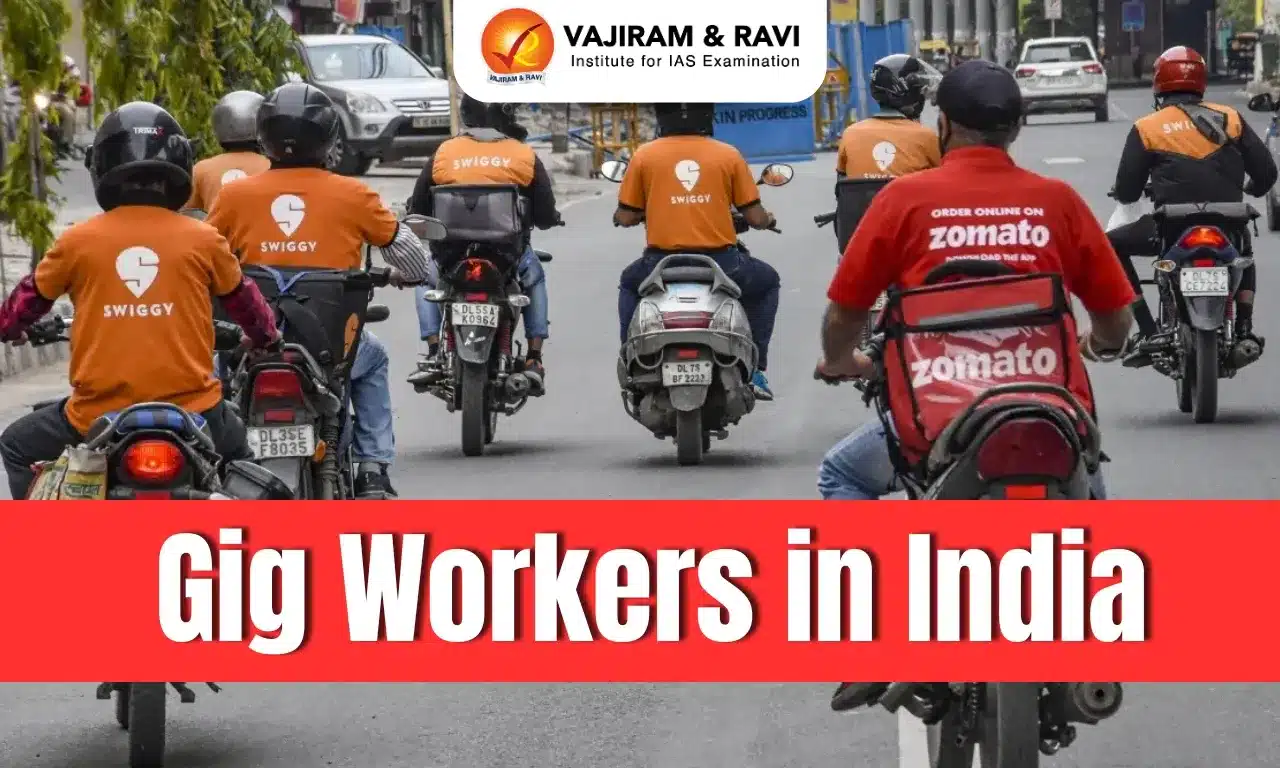
    • The existing PLFS design does not differentiate between a traditional shopkeeper and a food delivery worker operating across multiple platforms like Zomato or Swiggy. 
    • Both may be classified under the “self-employed” category, even though their work conditions, income sources, and risk exposures vary significantly.
  • Gig work often involves:
    • Lack of written job contracts
    • No employer-provided safety nets
    • Dependency on digital platforms and customer ratings
    • Flexible but precarious task-based arrangements
      These nuances go unnoticed in PLFS coding, undermining the precision of labour data used in policymaking.

Current Measures: Recognition Without Representation

  • In recent years, government initiatives such as e-Shram registration, digital ID issuance, and inclusion under Ayushman Bharat PM-JAY have aimed to bring gig workers into the formal safety net. 
  • However, without parallel updates in labour statistics, it becomes difficult to measure the impact, monitor delivery, or identify excluded beneficiaries.
  • The 2025 PLFS revision introduced some improvements, like a larger sample size, monthly estimates, and expanded rural coverage. 
  • But it still fails to address the core issue, the lack of a dedicated category for gig and platform-based work.

Towards Inclusive Labour Statistics

  • India's labour statistics framework must evolve to support the realities of a changing workforce. This means:
    • Updating PLFS classification codes to identify gig and platform workers distinctly.
    • Introducing special survey modules or time-use surveys to capture task-based work.
    • Leveraging digital trace data (e.g., from platforms like Uber, Urban Company) to supplement official statistics.
    • Ensuring that beneficiary data from welfare schemes feeds into national employment databases.
  • Inclusive labour data is not just about representation; it is crucial for delivering effective and equitable welfare.

Source: TH

Gig Workers in India FAQs

Q1: Who is legally defined as a gig worker in India?

Ans: A gig worker is defined under the Code on Social Security, 2020, as someone earning through work arrangements outside traditional employment contracts.

Q2: Does India’s PLFS separately identify gig workers?

Ans: No, gig workers are included under broad categories like self-employed or casual labour, without dedicated classification.

Q3: Why is the current PLFS classification problematic for gig workers?

Ans: It fails to reflect the unique conditions of digital labour such as algorithmic management, task-based work, and absence of job contracts.

Q4: What are the policy steps taken to support gig workers?

Ans: Measures like e-Shram registration, digital ID cards, and Ayushman Bharat health coverage have been extended to gig workers.

Q5: What changes are needed in labour statistics to better represent gig workers?

Ans: PLFS codes need to be updated or supplemented with special survey modules to capture gig and platform-based employment distinctly.


Madras High Court Quashes Unlawful Phone Tapping

Right to Privacy under Article 21

Reasserting Right to Privacy under Article 21 Latest News

  • In a landmark judgment with deep constitutional implications, the Madras High Court quashed a 2011 phone-tapping order issued by the Union Ministry of Home Affairs (MHA). 
  • The Court held that such surveillance, absent the conditions of "public emergency" or "public safety," violated the fundamental right to privacy under Article 21 of the Constitution. 
  • The judgment reinforces jurisprudence established in the PUCL (1997) and Puttaswamy (2017) cases, reasserting right to privacy under Article 21.

Key Highlights of the Judgement

  • Violation of Article 21 – Right to Privacy:
    • The Court ruled that phone tapping constitutes a breach of privacy unless it adheres to the procedure established by law.
    • The Court observed that covert surveillance for crime detection does not qualify under exceptions like public emergency or public safety.
    • The Court cited the K.S. Puttaswamy v. Union of India (2017) decision, which elevated the right to privacy to a fundamental right.
  • Key observation by the Madras HC: “The impugned order does not meet the thresholds of 'public emergency' or 'public safety'... It is a secretive operation which falls outside the legal framework laid down by the Supreme Court.”
  • Case background:
    • Surveillance was authorised in 2011 under [Section 5(2)] of the Indian Telegraph Act, 1885 and (Rule 419-A) of the Indian Telegraph Rules, 1951, on the allegation of a bribe of ₹50 lakh to an Income Tax officer.
    • CBI argued interception was necessary to detect and prevent corruption.
    • A writ petition (under Article 226 of the Constitution) was filed in 2018 against the surveillance order.

Legal Framework and Judicial Interpretation

  • Indian Telegraph Act and Rules:
    • Section 5(2) allows interception only in case of a public emergency or in the interest of public safety.
    • Rule 419-A mandates the interception to be reviewed by a Review Committee, which was not done in this case.
  • Supreme Court precedents:
    • PUCL v. Union of India (1997): Established that phone tapping is permissible only under stringent conditions.
    • K.S. Puttaswamy (2017): Recognised privacy as a fundamental right under Article 21.
    • Maneka Gandhi v. Union of India (1978): Any law or procedure impacting fundamental rights must be just, fair, and reasonable.

CBI’s Contention and Court’s Rebuttal

  • CBI's arguments:
    • Claimed tapping was necessary to uncover a bribe.
    • Emphasized public interest in preventing corruption.
    • Claimed Rs 50 lakh cash was recovered from a car associated with the first accused (tax officer).
  • Court’s response:
    • The petitioner was not present at the scene of seizure.
    • Scope of Section 5(2) cannot be expanded to accommodate secret crime detection.

Broader Constitutional Implications

  • Evolution of the Right to Privacy: The court order detailed the evolution of the right to privacy, 
    • Tracing its journey from early British common law to landmark US Supreme Court cases like Katz v. United States, and 
    • Culminating in the Indian apex court’s interpretation in Puttaswamy.
  • Emphasis: Executive overreach without legal sanction threatens democratic values.
  • Reaffirmation: Procedure affecting fundamental rights must follow due process, aligning with natural justice and civilised norms.

Conclusion

  • This verdict is a milestone in upholding individual liberties against unlawful state surveillance. 
  • It clarifies the constitutional limitations on executive powers, particularly in the context of modern surveillance technologies, reinforcing the judiciary's role in safeguarding democratic freedoms in India, and reasserting right to privacy under Article 21.

Source: THIE

Reasserting Right to Privacy under Article 21 FAQs

Q1: Which Supreme Court judgment was cited by the Madras High Court to reaffirm that phone tapping without legal backing violates the right to privacy under Article 21?

Ans: The Madras High Court cited K.S. Puttaswamy v. Union of India (2017) to reaffirm that privacy is a fundamental right under Article 21.

Q2: Under what conditions does Section 5(2) of the Indian Telegraph Act, 1885, legally permit phone interception?

Ans: Section 5(2) permits interception only during a public emergency or in the interest of public safety, as interpreted in PUCL v. Union of India (1997).

Q3: Why was the phone tapping order in the case of P. Kishore declared unconstitutional by the Madras High Court?

Ans: Because the interception was not justified under public emergency or public safety and violated procedural safeguards under Rule 419-A.

Q4: What procedural lapse did the Madras High Court identify in the 2011 surveillance order issued by the Union Ministry of Home Affairs?

Ans: The tapped conversations were not reviewed by the Review Committee, violating Rule 419-A of the Indian Telegraph Rules.

Q5: How was the judgment in Maneka Gandhi v. Union of India (1978) influence the reasoning in the Madras High Court's verdict?

Ans: It reinforced that any law affecting fundamental rights must be just, fair, and reasonable, supporting the court's view that covert surveillance lacked due process.

AI and Copyright Law: US Courts Back Fair Use in AI Training

AI and Copyright Law

AI and Copyright Law Latest News

  • Recently, in two significant rulings, US courts sided with tech companies developing generative AI, addressing for the first time whether training AI models on copyrighted content constitutes “theft.”
  • Generative AI tools like ChatGPT and Gemini rely on massive datasets—including books, articles, and internet content—for training. 
  • While various lawsuits have been filed accusing tech firms of copyright infringement, the companies argue their use of content is “transformative” and qualifies as “fair use.”
  • Though the two court decisions arrived via different legal paths, both support the tech companies’ stance, potentially setting an important precedent for future cases. 
  • These rulings highlight the growing legal acceptance of using copyrighted material in AI training under fair use—provided the output serves a transformative, public-interest purpose.

Case 1: Writers vs Anthropic – Court Rules in Favour of AI Developer

  • In August 2024, writers Andrea Bartz, Charles Graeber, and Kirk Wallace Johnson filed a class action lawsuit against Anthropic, creator of the Claude LLMs. 
  • They alleged that Anthropic used pirated versions of their books without compensation, harming their livelihoods by enabling free or cheap content generation.

Court's Decision: Fair Use Applies

  • Judge of the Northern District of California ruled in favour of Anthropic, stating that the AI's training use was “fair use.” 
    • The doctrine of fair use in copyright law allows limited use of copyrighted material without permission from the copyright holder.
    • It allows use for purposes such as criticism, comment, news reporting, teaching, scholarship, or research.
  • He emphasized the transformative nature of the process, noting that the AI did not replicate or replace the original works but created something fundamentally new.
  • Key Quote - The judge wrote: “Like any reader aspiring to be a writer, Anthropic’s LLMs trained upon works… to create something different.”

Case 2: Writers vs Meta – Court Sides with Meta, But Flags Compensation Concerns

  • Thirteen authors filed a class action lawsuit against Meta, seeking damages and restitution for allegedly using their copyrighted works to train its LLaMA language models.
  • The plaintiffs argued Meta copied large portions of their texts, with the AI generating content derived directly from their work.

Court’s Decision: No Proven Market Harm

  • The Judge ruled in Meta’s favour, stating the plaintiffs failed to show that LLaMA’s use of their works harmed the market for original biographies or similar content.
  • While affirming the transformative potential of AI, the Judge noted that companies profiting from the AI boom should find ways to compensate original content creators, even if current use qualifies as fair use.

Ongoing and Escalating Legal Battles

  • Anthropic faces a separate lawsuit from music publishers over copyrighted song lyrics. 
  • Meta and other tech companies remain entangled in numerous other copyright disputes.
  • Twelve copyright lawsuits—including one from The New York Times—have been consolidated into a single case against OpenAI and Microsoft. 
    • Publishing giant Ziff Davis is also suing OpenAI separately.
  • Visual creators have sued platforms like Stability AI, Runway AI, Deviant Art, and Midjourney for unauthorized use of their work. Getty Images is suing Stability AI for copying over 12 million images.

Indian Media’s Legal Challenge

  • In 2024, ANI filed a case against OpenAI for misusing Indian copyrighted content. 
  • Major Indian media houses like The Indian Express, Hindustan Times, and NDTV have joined through the Digital News Publishers Association (DNPA), hinting at rising domestic litigation.

Significance of the Rulings: A Win, But Not the Final Word

  • The court rulings favour Anthropic and Meta by upholding their use of copyrighted material under the “fair use” doctrine. 
  • However, both companies still face unresolved legal challenges—particularly for sourcing training data from pirated databases like Books3.
  • While courts may allow AI’s current training practices, unresolved concerns remain: How will creators be protected? What happens to livelihoods and creativity as AI output grows?

Conclusion

  • These rulings mark a significant moment in the evolving legal landscape of AI, but they don’t resolve the fundamental copyright and ethical dilemmas surrounding AI-generated content.

Source: IEipleaders

AI and Copyright Law FAQs

Q1: What did US courts rule on AI and copyright law?

Ans: They ruled AI training on copyrighted content is fair use if the output is transformative and doesn't replicate original works.

Q2: Why were Anthropic and Meta sued by writers?

Ans: Writers claimed their copyrighted content was used without permission to train AI models, harming their earnings and creative work.

Q3: What was the court’s reasoning in Anthropic’s case?

Ans: The court said Anthropic’s use was transformative and comparable to a reader learning to write, qualifying as fair use.

Q4: What did the Meta judgment emphasize?

Ans: It emphasized no proven market harm, but noted tech firms should consider compensating original creators in future.

Q5: Are more lawsuits expected in AI copyright space?

Ans: Yes, multiple ongoing cases in the US and India indicate this legal debate is far from over.

PM Modi’s Five-Nation Visit: Strengthening India’s Global South Outreach

India’s Global South Outreach

India’s Global South Outreach Latest News

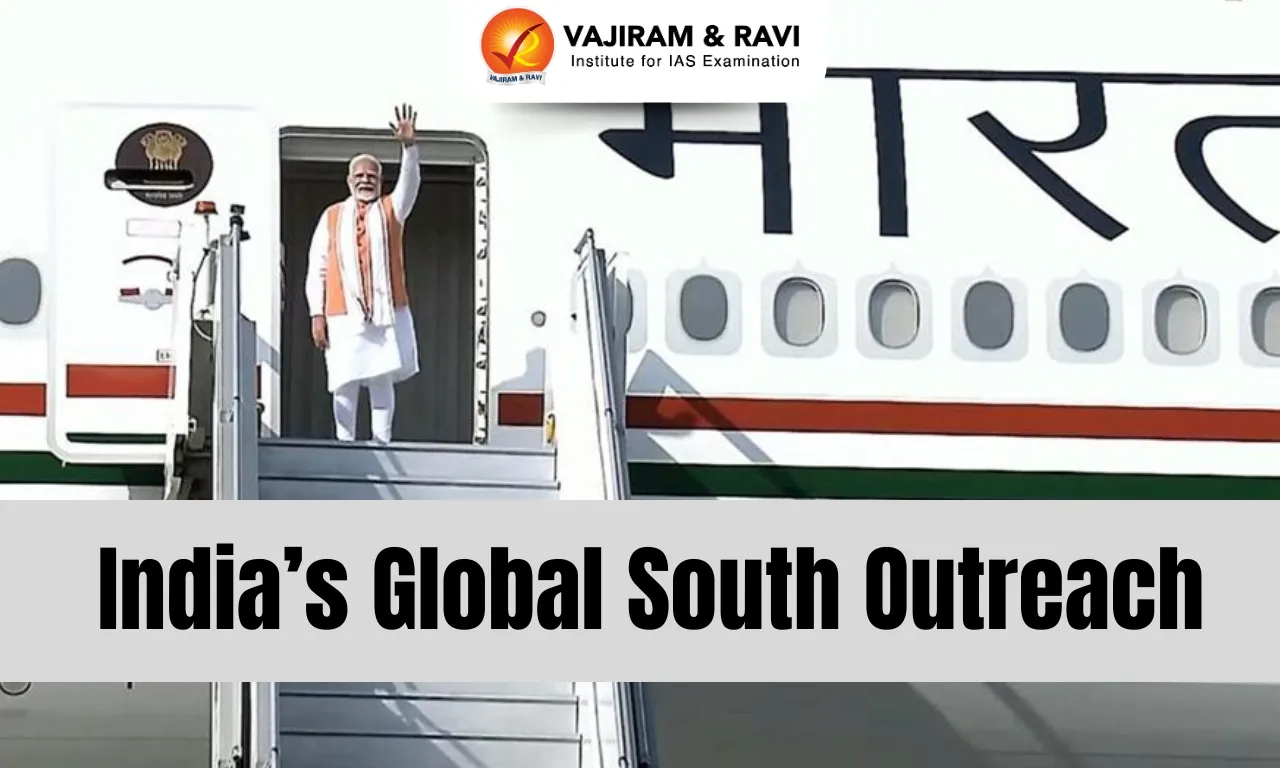
  • PM Modi began a five-nation tour from July 2 to 9, 2025, covering Ghana, Trinidad & Tobago, Argentina, Brazil, and Namibia.

Ghana Visit

  • Prime Minister Narendra Modi's visit marks the first bilateral trip by an Indian PM to Ghana in three decades. It is also his first visit to the country.
  • India is the largest destination for Ghanaian exports, with gold making up over 70% of India’s imports from Ghana. 
  • A proposal for a vaccine manufacturing hub and digital initiatives highlights India’s COVID-era goodwill, but the presence of China and the EU makes execution competitive and difficult.

Trinidad & Tobago (T&T) Visit

  • PM Modi’s visit marks his first to Trinidad & Tobago and the first bilateral visit by an Indian PM in over two decades.
  • Around 40–45% of the Indian diaspora in the Caribbean resides in T&T. 
    • Both PM Kamla Persad-Bissessar and President Christine Carla Kangaloo are of Indian origin. 
  • The visit also commemorates 180 years since the arrival of Indian immigrants in T&T.
  • India-T&T bilateral trade reached $341.61 million in FY 2024–25, indicating steady economic growth and deepening commercial relations.
  • This is PM Modi’s second visit to the Caribbean in eight months, following his trip to Guyana in November 2024, reflecting India’s strategic focus on the region.
  • Despite this, critics argue that diaspora engagement has yet to translate into meaningful economic or tech collaboration.

Argentina Visit

  • PM Modi’s visit is the first bilateral trip by an Indian PM to Argentina in 57 years. 
  • He will hold talks with President Javier Milei, following their earlier meeting at the G20 Summit in 2024.
  • India-Argentina ties have grown notably in the mineral resources sector, especially lithium—crucial for India’s green energy goals. Argentina also supplies soybean and sunflower oil to India.
  • India ranked as Argentina’s fifth-largest trading partner and export destination in 2024, underscoring the growing economic significance of the partnership.
  • However, political instability under President Javier Milei raises concerns about long-term consistency.

Brazil Visit

  • PM Modi will attend the BRICS Leaders’ Summit, where he will meet President Luiz Inacio Lula da Silva.
  • Following the summit, PM Modi will undertake a State Visit to Brasilia. He will hold detailed talks with President Lula to deepen the India-Brazil Strategic Partnership.
  • Brazil remains India’s largest trading partner in South America, underscoring the importance of the relationship.
  • Still, internal power imbalances—especially China’s assertiveness—pose limitations.

Namibia Visit

  • PM Modi’s trip marks his first visit to Namibia and only the third by an Indian Prime Minister.
  • Bilateral trade has surged from under $3 million in 2000 to nearly $600 million in 2025. Indian investments span mining, manufacturing, diamond processing, and services.
  • The visit recalls the historic 2022 translocation of eight Namibian cheetahs to India’s Kuno National Park—marking the world’s first intercontinental relocation of a major carnivore species.
  • The visit combines digital diplomacy (launching UPI) and environmental soft power (conservation discussions post-cheetah translocation). 
  • However, India enters a digital investment space already crowded by other global powers.

India’s Global South Outreach: Challenges

  • PM Modi has embarked on an eight-day, five-nation tour covering three continents.
  • This visit aims to strengthen India’s diplomatic and economic engagement with the Global South, reflecting India’s aspiration to lead among postcolonial, developing nations.

Championing the Global South: Aspirations vs. Execution

  • India has long positioned itself as a voice for the Global South, notably through the 2023 Voice of the Global South Summit. 
  • However, turning aspirational leadership into actionable, sustainable outcomes remains a significant challenge.

Modest Scale and Follow-Through Deficit

  • India’s developmental outreach, while ambitious, often lacks the institutional scale and execution strength seen in China’s Belt and Road Initiative (BRI). 
  • Initiatives announced frequently suffer from poor follow-through in infrastructure and trade facilitation.

Overreliance on Soft Power

  • Cultural and diaspora diplomacy are important tools but risk becoming hollow without accompanying economic programs. 

Conclusion

  • This tour lays the foundation for new partnerships in critical minerals, digital public goods, climate action, and vaccine production. 
  • It may also signal the emergence of “Modi Doctrine 3.0” – a foreign policy approach centered on Global South solidarity, technology-led diplomacy, and institutional reform.

Source: IE | TD | FP

India’s Global South Outreach FAQ

Q1: What is the objective of PM Modi’s Global South outreach?

Ans: To enhance India’s diplomatic, economic, and technological ties with underrepresented countries across Africa, Latin America, and the Caribbean.

Q2: Which countries are part of PM Modi’s 2025 five-nation tour?

Ans: Ghana, Trinidad & Tobago, Argentina, Brazil, and Namibia are part of the eight-day Global South engagement tour.

Q3: How is India engaging with Ghana during the visit?

Ans: India is proposing a vaccine manufacturing hub and digital cooperation, leveraging its COVID-era credibility and goodwill.

Q4: Why is Argentina strategically important for India?

Ans: Argentina has vast lithium reserves, key for India’s electric vehicle and green energy goals, making it a critical partner.

Q5: What is Modi Doctrine 3.0 in foreign policy?

Ans: It signifies India’s pivot to Global South solidarity, technology-led diplomacy, and calls for reforming global governance systems.

Enquire Now