

Supreme Court Reviewing State Laws: Understanding the Chhattisgarh Auxiliary Police Case

Supreme Court Reviewing State Laws

Supreme Court Latest News

  • The Supreme Court recently held that the passing of an Act by the State of Chhattisgarh, subsequent to its order, cannot be said to be an act of contempt of the order passed by the Court.

Introduction

  • The Supreme Court of India recently concluded a writ and contempt petition in the landmark case of Nandini Sundar and Others vs State of Chhattisgarh. 
  • The Court clarified that the passing of a new State law, even when related to a matter previously ruled upon, cannot be equated with contempt unless it contradicts constitutional norms. 
  • This judgment highlights the boundaries of judicial review in legislative affairs and reaffirms the doctrine of separation of powers in Indian democracy.

Background to the Case

  • In July 2011, the Supreme Court issued a significant order prohibiting the use of Special Police Officers (SPOs) by the Chhattisgarh government for anti-Maoist operations. 
  • The Court had ruled that recruiting inadequately trained and poorly paid SPOs for counter-insurgency was violative of Articles 14 and 21 of the Constitution, which safeguard the right to equality and right to life, respectively. 
  • It also directed the withdrawal of all arms issued to SPOs and ordered the Union Government to cease funding their recruitment.

Legislative Response by Chhattisgarh 

  • Subsequent to the Court’s 2011 order, the Chhattisgarh government enacted the Chhattisgarh Auxiliary Armed Police Forces Act, 2011. 
  • This law authorised the creation of an auxiliary force to support regular security forces in controlling insurgencies, with specific provisions to address the Court’s earlier concerns:
    • Section 4(1) authorised auxiliary forces for non-frontline assistance.
    • Section 5(2) ensured such personnel would not be deployed in direct combat.
    • Mandatory training of six months and strict eligibility screening were introduced.
  • This legislative move was challenged as being in violation of the 2011 judgment, leading to the contempt petition.

Supreme Court’s Ruling on Contempt

  • The Supreme Court dismissed the contempt allegations on the following grounds:
  • Compliance with Prior Orders:
    • The Court noted that all directions issued in 2011 were duly complied with by the Chhattisgarh government, including reports submitted to that effect.
  • Legislative Competence and Validity:
    • The Court held that legislatures, whether State or Parliament, possess plenary powers to enact laws as long as those laws are within their legislative competence and conform to constitutional mandates. 
    • A newly enacted law, by itself, cannot be deemed as contempt of Court unless it is shown to contradict the Constitution.
  • Separation of Powers Doctrine:
    • Citing precedents such as Indian Aluminium Co. vs State of Kerala (1996), the Court emphasised that judicial, legislative, and executive branches must maintain their functional boundaries.
    • The Court reaffirmed that judicial review can only test a law's constitutionality, not the mere fact of its enactment.

Implications for Judicial Oversight and State Legislation

  • This ruling reinforces the principle that courts cannot obstruct legislatures from enacting laws unless such laws are proven unconstitutional. 
  • It acknowledges a legislature's right to respond to judicial pronouncements by drafting fresh laws that address previously flagged concerns.
  • Furthermore, it also underscores how constitutional courts cannot act as supervisory bodies over the legislative process unless the outcome is ultra vires to the Constitution or lacks legislative competence.

Broader Significance

  • Preserving Democratic Balance
    • The judgment affirms that the Indian judiciary, while empowered to interpret laws and protect fundamental rights, must not undermine the legislative domain unless constitutional limits are breached.
  • Legal Clarity for Contempt Cases
    • It sets a precedent that enacting new legislation post-judicial pronouncement does not automatically amount to contempt, thereby offering clarity to both lawmakers and petitioners.
  • Guidance for Future Law-making
    • State governments can now confidently legislate on sensitive issues provided they incorporate judicial concerns and adhere to constitutional boundaries.

Source : TH

Supreme Court Legislative Powers FAQs

Q1: What prompted the recent Supreme Court ruling on a State law?

Ans: The ruling was in response to a contempt petition challenging Chhattisgarh’s 2011 police auxiliary law following a previous Supreme Court directive.

Q2: Did the Supreme Court find the new Chhattisgarh law unconstitutional?

Ans: No, the Court did not find the law unconstitutional and held it was not in contempt of its 2011 order.

Q3: What powers do State legislatures have in making laws post-SC rulings?

Ans: State legislatures have plenary powers to make laws unless the laws are unconstitutional or lack legislative competence.

Q4: What did the Supreme Court say about contempt in this context?

Ans: The Court ruled that enacting a law is not contempt unless it disobeys a binding judicial order or violates the Constitution.

Q5: Why is the ruling significant for Indian federalism?

Ans: It reaffirms the doctrine of separation of powers and upholds the constitutional role of State legislatures within a federal structure.
Quad Launches Critical Minerals Initiative to Reduce Dependence on China

Critical Minerals

Critical Minerals Latest News

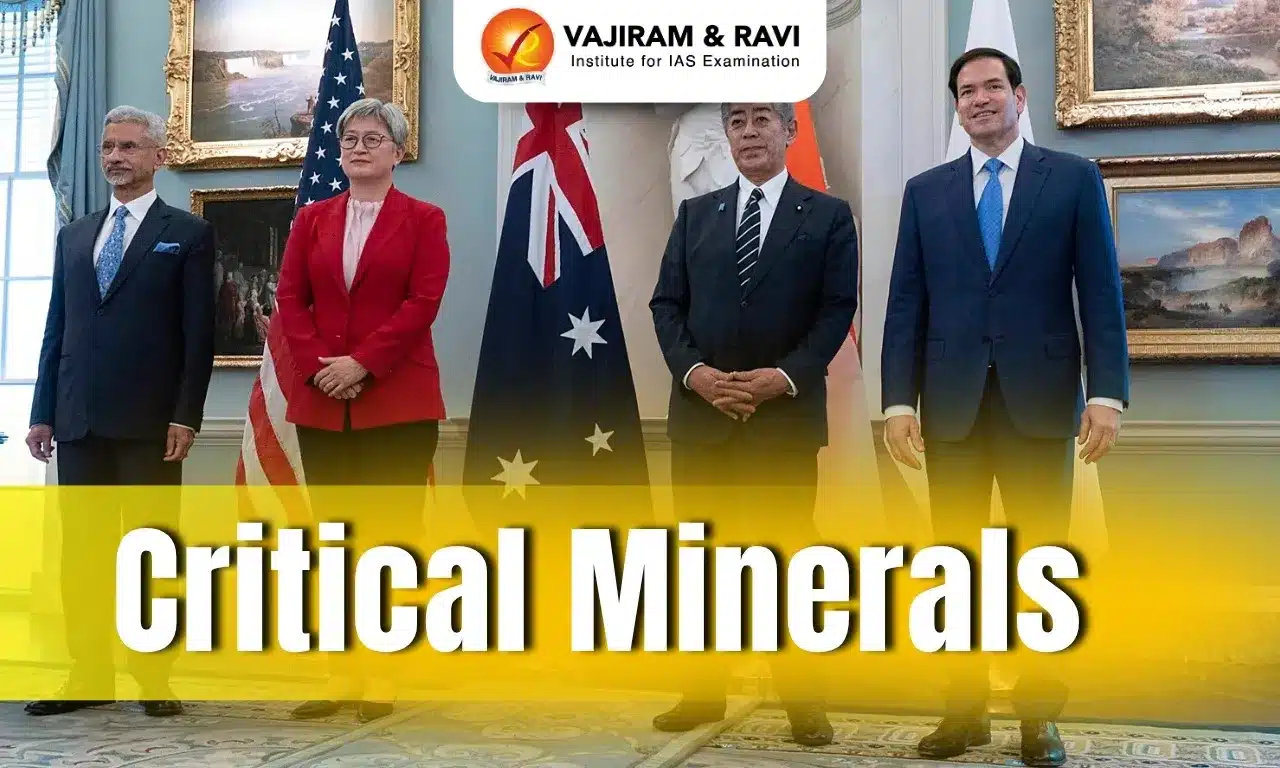
  • The Quad nations—India, Australia, Japan, and the US—have launched a joint initiative to secure critical mineral supply chains amid growing concerns over China’s dominance and potential disruptions.

Quad Foreign Ministers Meet in Washington, DC

  • The second Quad foreign ministers’ meeting took place in Washington, DC. 
  • During the meeting, members reaffirmed its commitment to four key areas: maritime and transnational security, economic prosperity and security, critical and emerging technologies, and humanitarian assistance.
  • The ministers strongly condemned the Pahalgam terror attack, urging that the perpetrators, organisers, and financiers be brought to justice promptly.

Launch of Quad Critical Minerals Initiative

  • The ministers launched the Quad Critical Minerals Initiative to secure supply chains and reduce dependency on China for essential resources.

Focus on Maritime and Logistics Cooperation

  • The participating ministers also announced:
    • The first Quad Indo-Pacific Logistics Network field training exercise to be held this year.
    • The launch of the Quad Ports of the Future Partnership in Mumbai later this year.

Quad Critical Minerals Initiative

  • India, Australia, Japan, and the United States have jointly launched the Quad Critical Minerals Initiative to build resilient and diversified supply chains for critical minerals vital to modern technologies.
  • The initiative will enhance cooperation on securing and diversifying supply chains, recovering critical minerals from e-waste, and boosting private sector investment to strengthen supply chain resilience.
  • Quad members expressed serious concerns about the growing dependency on China for processing and refining critical minerals, warning of risks like economic coercion, price manipulation, and supply disruptions.

China’s Dominance in Critical Minerals

  • Critical minerals, including rare earth elements (REEs), are essential for advanced technologies like semiconductors, EVs, and jet fighters.
  • China dominates the production of neodymium-iron-boron (NdFeB) magnets, which are vital for EV motors, power steering, braking, and more.
  • Though rare earth metals are globally available, China leads in efficient processing—a position once held by the US and Japan.
  • Japan has revived part of its mineral processing industry through policy measures, while the US and India remain largely dependent on Chinese exports.

Supply Chain Barriers Amid Geopolitical Tensions

  • In response to US tariffs under President Trump, China imposed bureaucratic barriers and later restricted exports of key critical minerals.
  • China has also restricted the export of several heavy rare earth elements and high-tech materials with potential military uses, intensifying supply chain concerns globally.

India’s EV Industry Hit by Chinese Export Curbs

  • India’s emerging electric vehicle sector is facing production setbacks due to China’s restrictions on exporting rare earth magnets crucial for EV motors.
  • Despite multiple requests, China has not approved any applications from Indian carmakers to source critical minerals, raising serious supply concerns.
  • China mandates end-user licences and local government endorsements ensuring minerals won’t be used for military purposes—a major hurdle for Indian firms.
  • Beijing is now urging foreign carmakers to purchase entire electric motor assemblies from Chinese suppliers, rather than just magnets.
  • China has granted export permits to magnet producers serving companies like Volkswagen, reportedly after intense lobbying—something Indian firms have struggled to match.

G7 Action Plan Laid the Groundwork for Quad Critical Minerals Push

  • The Quad Critical Minerals Initiative builds on the G7 Critical Minerals Action Plan announced in Canada, which India also endorsed.
  • The G7 plan commits to partnering with emerging markets and developing countries to diversify supply chains and promote local value addition.
  • G7 finance ministers pledged support for the World Bank-led Resilient and Inclusive Supply Chain Enhancement (RISE) initiative.

India’s National Critical Mineral Mission 

  • India’s Mines Ministry proposed external funding via RISE for its ₹16,300 crore National Critical Mineral Mission, which aims to strengthen exploration, overseas acquisition, R&D, and recycling.
  • India joined the US-led Minerals Security Partnership (MSP) in June 2023.
    • The MSP was formed in June 2022 with all G7 countries and a few others like Australia, South Korea, Finland, and Sweden. 
  • During PM Modi’s visit to Washington in February 2025, India and the U.S. signed the Transforming Relationship Utilizing Strategic Technology (TRUST) initiative to collaborate on mineral extraction and processing technologies.
    • The TRUST agreement targets key minerals like lithium and rare earth elements, aiming to co-develop extraction and processing capabilities.

Source: IE | IE | LM

Critical Minerals FAQs

Q1: What is the Quad Critical Minerals Initiative?

Ans: It’s a collaborative effort to secure and diversify supply chains for minerals essential to modern technologies.

Q2: Why is China’s dominance a concern?

Ans: China controls processing and exports of key critical minerals, risking economic coercion and global supply chain disruptions.

Q3: How does the initiative help India’s EV sector?

Ans: It aims to counter Chinese export curbs that are delaying India’s access to rare earth magnets for EVs.

Q4: What role does the G7 plan play?

Ans: The Quad initiative builds on the G7 Action Plan and RISE funding to ensure supply chain resilience.

Q5: Which technologies depend on critical minerals?

Ans: Semiconductors, EVs, jet fighters, solar panels, and advanced batteries all rely heavily on critical mineral supply chains.

NITI Aayog’s Strategy to Double Chemical Exports by 2030

Chemical Exports

Chemical Exports Latest News

  • NITI Aayog has proposed measures to nearly double India’s $44 billion chemical exports by 2030. 
  • Key recommendations include developing production clusters for scale, upgrading port infrastructure for improved logistics and storage, and introducing a sales-linked incentive scheme to localise production and enhance exports of critical chemicals. 
  • The initiative addresses limited domestic demand as a major growth constraint.

India’s Chemical Industry

  • India is the 6th largest chemical producer globally and 3rd in Asia, contributing 7% to the national GDP.  It ranks 14th in global chemical exports (excluding pharma).
  • In FY23, exports of major chemicals and petrochemical products stood at US$ 23.8 billion.
  • It had a $31 billion trade deficit in chemicals in 2023 and held a 3.5% share in global value chains, compared to China’s 23%.
  • India’s chemical market was valued at $220 billion in 2023, with ambitions to reach $1 trillion by 2040.
    • Experts emphasized the need to prioritize exports, noting that domestic demand alone cannot drive the sector to a $1 trillion valuation by 2040.

Regional Manufacturing Hubs

  • Chemical manufacturing is concentrated in Maharashtra and Gujarat, with West Bengal and Tamil Nadu also being major contributors.
  • India’s chemical industry produces over 80,000 commercial products and is classified into bulk chemicals, agrochemicals, specialty chemicals, polymers, petrochemicals, and fertilizers.

Global Leadership in Niche Segments

  • 4th largest agrochemical producer
  • 3rd largest polymer consumer
  • Major exporter of dyes and colourants, contributing 16–18% to global dyestuff production and holding a ~15% market share in colourants

Government Support to Chemical Industry

  • India has de-licensed the sector (except hazardous chemicals) and is promoting PCPIRs and plastic parks to provide modern infrastructure, increase output, and generate employment.

PCPIR Policy 2020–2035: Driving Massive Investment and Job Creation

  • The revised Petroleum, Chemicals and Petrochemicals Investment Region (PCPIR) Policy targets:
    • US$ 142 billion investment by 2025
    • US$ 213 billion by 2030
    • US$ 284 billion by 2035

Chemical Promotion and Development Scheme (CPDS)

  • CPDS supports the growth of the chemical and petrochemical industry through:
    • Creation of knowledge products
    • Knowledge dissemination via surveys and studies
    • Excellence awards for research and innovation in the sector

NITI Aayog Charts Roadmap to Boost Chemical Exports

  • NITI Aayog aims to nearly double India’s annual chemical exports from $44 billion by 2030, citing limited domestic demand as a major constraint.
  • Proposed measures include:
    • Developing new and existing production clusters
    • Upgrading port infrastructure for improved logistics and storage
    • Launching a sales-linked incentive scheme to promote local production and exports of critical chemicals

Shift to Specialty Chemicals to Raise Global Value Chain (GVC) Share

  • The report suggests India can double its share in global value chains to 5–6% by 2030 by moving from bulk to high-demand specialty chemicals and increasing exports by $35–40 billion with the right policy support.

Proposed Sales-Linked Incentive as Opex Subsidy

  • A sales-linked incentive scheme, structured as an operational expenditure (opex) subsidy, is proposed to:
    • Reduce dependence on specific countries for imports
    • Expand capacity in targeted sectors like agrochemical and pharma intermediates, battery chemicals, dyes, pigments, and petrochemicals

Identifying Supply Chain Choke Points

  • The report stressed the importance of identifying potential choke points in India’s chemical supply chain—mirroring China’s approach in 2018—to guide the strategic allocation of subsidies.

Revamping PCPIRs and Revitalizing Hubs

  • The report called for revitalizing existing Petroleum, Chemicals, and Petrochemicals Investment Regions (PCPIRs) in Dahej, Paradeep, and Vizag, which face infrastructure, financing, and regulatory challenges.

Port-Centric Cluster Development and Infrastructure Gaps

  • It recommended forming a Chemical Committee to address port infrastructure bottlenecks and proposed the development of eight high-potential chemical clusters linked to 14 major and 12 minor ports across the country.

Source: IE | IBEF

Chemical Exports FAQs

Q1: What is India’s current chemical export target by 2030?

Ans: NITI Aayog aims to nearly double India's chemical exports to $88 billion by 2030.

Q2: What incentives has NITI Aayog proposed?

Ans: A sales-linked operational expenditure (opex) subsidy is proposed to boost local production and reduce import dependency.

Q3: Which regions are key chemical hubs in India?

Ans: Maharashtra, Gujarat, West Bengal, and Tamil Nadu are key manufacturing regions for India’s chemical industry.

Q4: How is the government supporting infrastructure?

Ans: Revamping PCPIRs and creating chemical clusters at major ports are central to the proposed infrastructure plan.

Q5: Why is export focus necessary for the chemical industry?

Ans: Limited domestic demand cannot drive growth alone; exports are crucial to reach the $1 trillion industry target by 2040.

Enquire Now