US Remittance Tax Impact on India: Limited Losses but Higher Costs

US Remittance Tax Impact on India

US Remittance Tax Impact on India Latest News

The United States has enacted a 1% tax on certain outbound remittances under the One Big Beautiful Bill Act, raising concerns about its impact on India’s remittance inflows.

Introduction to the New US Remittance Tax

  • A newly passed US legislation, the One Big Beautiful Bill Act (OBBBA), has introduced a 1% tax on certain outbound remittances, sparking concern among countries that rely heavily on money sent back by expatriates. 
  • The tax, effective from January 1, 2026, is expected to marginally affect India, the world’s largest recipient of remittances, primarily through higher costs rather than a significant decline in remittance volumes.

Key Features and Exemptions

  • Originally proposed as a 5% tax, the remittance levy was later reduced to 1% after bipartisan negotiations. However, key exemptions in the Senate-passed version limit its reach:
    • Applies only to physical modes of transfer like cash, money orders, and cashier’s checks.
    • Bank account transfers or payments through US-issued debit/credit cards are exempt.
    • Transfers under $15 are not taxed.
  • US citizens sending remittances are not subject to the tax.
  • These exclusions will mitigate the adverse impact for a large portion of Indian-origin remitters using digital channels.

Implications for India’s Remittance Economy

  • According to the Centre for Global Development, India may lose just under $500 million in formal remittance inflows, second only to Mexico, which could lose over $1.5 billion.
  • Although this is a small portion of the $124.31 billion India received in net remittances during 2024-25, the tax is a symbolic reminder of increasing policy barriers to international money flows.
  • Moreover, remittances from the US account for nearly 27.7% of India’s total, approximately $32 billion in 2023-24. 
  • While the proportion of cash-based transfers is low, even a slight disruption can impact rural households relying on such inflows.
  • Distributional and Timing Effects
    • According to economists, the impact will be frontloaded into the first three quarters of FY2025-26, as senders might advance transfers to avoid the tax. 
    • However, the lower-than-expected rate (1%) means that the overall long-term impact will remain limited and primarily felt in transaction costs rather than volume reductions.

Broader Trends in Remittance Flows

  • India’s remittance receipts have been growing steadily:
    • Net remittances in FY2024-25: $124.31 billion (up 16%)
    • Gross inflows: $132.07 billion (up 14%)
    • US share of remittances: Grew from 22.9% in 2016-17 to 27.7% in 2023-24
  • Notably, in FY2024-25, net remittances not only covered India’s entire trade deficit of $98.39 billion but also left a $26 billion surplus, underlining their macroeconomic significance.

Growing Costs of Cross-Border Transfers

  • Even before this new tax, sending money to India has involved significant transaction costs. As per World Bank data, the average cost of sending $200 to India in Q4 2024 was 5.3%, compared to the global average of 6.6%
  • The tax could push these costs further up, particularly in channels involving multiple intermediaries or non-bank methods.
  • Moreover, delays and fees from correspondent banking chains are an ongoing concern, making remittance infrastructure innovation all the more essential.

India’s Payment Infrastructure as a Cushion

  • India has proactively worked on reducing frictions in cross-border payments:
    • UPI-PayNow Link: Seamless money transfer between India and Singapore
    • RBI participation in Project Nexus (by BIS): Aims to enable “cheaper, faster, more transparent” global transfers
  • Such efforts will be critical in mitigating the impact of policy changes abroad and improving the ease of formal remittance channels for the Indian diaspora.

Source: IE | TH

US Remittance Tax FAQs

Q1: What is the US remittance tax that will impact India?

Ans: The US has introduced a 1% tax on outbound remittances made using physical instruments under the One Big Beautiful Bill Act.

Q2: When will the US remittance tax come into effect?

Ans: The tax will be implemented from January 1, 2026.

Q3: How much could India lose due to this remittance tax?

Ans: India may see a decline of under $500 million in formal remittances, according to the Center for Global Development.

Q4: Are all types of remittances from the US to India affected by this tax?

Ans: No, the tax excludes bank transfers and payments made through US-issued debit or credit cards.

Q5: Why are remittances from the US important to India?

Ans: The US accounts for nearly 28% of India’s total remittance inflows, amounting to around $32 billion annually.
Government’s Strategic Push for Pulses Cultivation in India

Pulses Cultivation in India

Pulses Cultivation in India Latest News

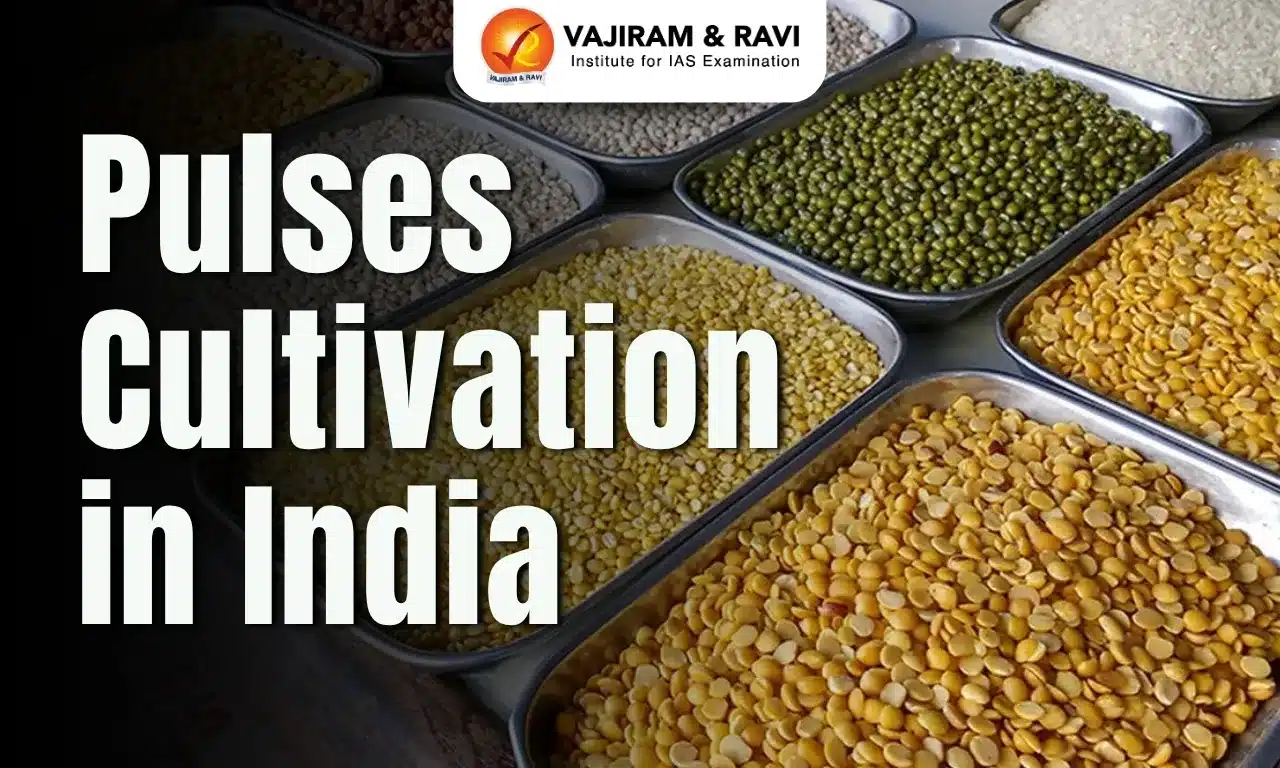
  • In response to surging pulse imports and rising domestic demand, the Department of Consumer Affairs, under the Ministry of Consumer Affairs, Food and Public Distribution, has initiated a targeted programme.
  • This programme aims to promote pulses (like arhar (tur) and urad) cultivation in India during the Kharif season 2025. 
  • This is part of a broader food security and import reduction strategy.

Key Highlights and Government Initiatives

  • Launch of pulse cultivation campaign:
    • Aim: The Department of Consumer Affairs will promote arhar and urad cultivation through seed distribution campaigns.
    • Implementation: By the National Cooperative Consumer’s Federation of India Ltd. (NCCF).
    • Extent: The campaign is extended from a successful pilot in two Jharkhand districts to 12 districts across seven states - 
      • Jharkhand: Palamu, Latehar, Garhwa
      • Uttar Pradesh: Mirzapur, Lalitpur
      • Bihar: Gaya, Jehanabad
      • Karnataka: Vijaypura
      • Others: Manipur and Tripura (districts not specified)
  • Criteria for district selection: Rainfed areas, presence of Aspirational Blocks as identified by NITI Aayog.
  • Financial and procurement support:
    • ₹1 crore allocated for seed distribution.
    • 100% procurement guarantee at Minimum Support Price (MSP) if market price falls.
    • MSP for Kharif Marketing Season 2025-26 - 
      • Arhar: ₹8,000/quintal
      • Urad: ₹7,800/quintal

Pulse Production and Trade Trends

  • Overview:
    • Pulses are rich in protein (20–25% by weight); crucial for a carbohydrate-rich Indian diet.
    • India is the largest producer of pulses globally.
    • Major pulses produced in India are Arhar (Tur), Urad, Moong, Masur, Gram, etc.
  • Domestic production trends:
    • Increased from 163.23 lakh tonnes in 2015–16 to 244.93 lakh tonnes in 2023–24.
    • Key producing states: MP, Maharashtra, Rajasthan, UP, Karnataka, Tamil Nadu, Kerala, West Bengal, etc.
  • Import-export data (in lakh tonnes):
    • In 2021-22, imports are 26.99 and exports are 3.87.
    • In 2022-23, imports are 24.96 and exports are 7.62.
    • In 2023-24, imports are 47.38 (~$5 billion) and exports are 5.94 ($ 686.9 million) Imports doubled in 2023–24 compared to previous year, highlighting dependency risks.
    • Major export destinations: Bangladesh, China, UAE, USA, Sri Lanka.
    • India's major destinations for pulse imports: Canada, Australia, Myanmar, Mozambique, and Tanzania.

Policy Support for Pulse Cultivation

  • Pradhan Mantri Annadata Aay Sanrakshan Abhiyan (PM-AASHA): Under the Price Support Scheme (PSS), the government procures pulses at MSP. Procurement limit of 25% lifted for Tur, Masoor, and Urad during 2023–24 and 2024–25.
  • National Food Security Mission (NFSM): Implemented in 28 States and 2 UTs (J&K and Ladakh), it aims to enhance foodgrain production including pulses.
  • Crop Diversification Programme (CDP): Implemented in Green Revolution States - Haryana, Punjab, Western UP, it encourages shift from water-intensive paddy to pulses and oilseeds.
  • Rashtriya Krishi Vikas Yojana (RKVY): It offers states flexibility to address regional agricultural needs, including pulse promotion.

Source: IEPIB | APEDA

Pulses Cultivation in India FAQs

Q1: Discuss the significance of the Government’s recent initiative to promote arhar and urad cultivation in the context of India’s pulse import dependency.

Ans: The initiative addresses growing pulse import dependence—highlighted by a record 47.38 lakh tonnes in 2023–24—by incentivizing domestic production through seed distribution and MSP-based procurement.

Q2: Examine the role of central government schemes such as PM-AASHA, NFSM, and CDP in promoting sustainable pulse cultivation in India.

Ans: PM-AASHA ensures price assurance, NFSM enhances productivity across states, and CDP facilitates diversification from paddy to pulses in water-stressed Green Revolution regions.

Q3: How does the use of institutions like the National Cooperative Consumer’s Federation (NCCF) reflect a cooperative approach in implementing agricultural policy?

Ans: Involving NCCF in seed distribution underlines a cooperative governance model where central institutions support localized, farmer-centric interventions in agriculture.

Q4: Critically analyze how targeting 'Aspirational Blocks' and rainfed areas under the pulse cultivation campaign supports inclusive agricultural development.

Ans: By focusing on underdeveloped rainfed districts and Aspirational Blocks, the policy promotes equitable growth, improves livelihood security, and bridges regional disparities in agricultural productivity.

Q5: Evaluate the role of pulse promotion in enhancing nutritional security in India.

Ans: Promoting protein-rich pulses like tur and urad, especially among low-income groups, helps combat malnutrition and ensures dietary balance in carbohydrate-heavy Indian meals.

India Urged to Relax Emission Norms for Small Cars in Line with Global Practices

Emission Norms for Small Cars

Emission Norms for Small Cars Latest News

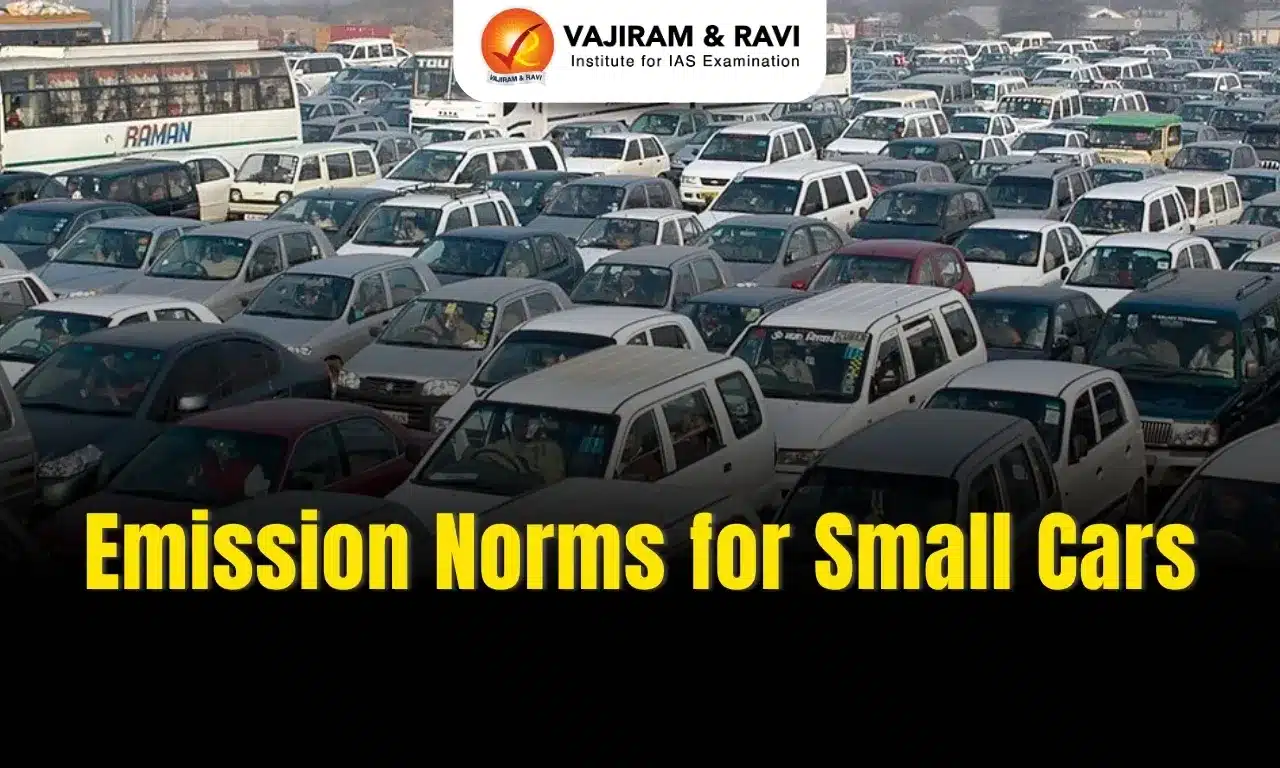
new study by researchers at Nomura suggests that India should reform its Corporate Average Fuel Efficiency (CAFE) norms to align with global best practices by including protection measures for small cars.

India’s CAFE Norms

  • Corporate Average Fuel Efficiency (CAFE) norms are government-mandated standards that require auto manufacturers to meet a fleet-wide average fuel economy target.
  • India’s CAFE norms, introduced by the Bureau of Energy Efficiency (BEE) in 2017, aim to regulate fuel consumption and CO₂ emissions from passenger vehicles under 3,500 kg. 
    •  In India, CAFE norms were introduced in two phases, with the first stage effective from 2017-18 and the second from 2022-23. 
  • These norms apply to vehicles powered by petrol, diesel, LPG, CNG, hybrids, and electric power.

Objective: Lower Emissions and Oil Dependence

  • CAFE norms were designed to:
    • Reduce oil imports
    • Cut air pollution
    • Promote cleaner vehicles like EVs, CNG cars, and hybrids
  • Tighter norms were enforced in 2022–23, with penalties for non-compliance. Manufacturers were required to achieve:
    • Fuel consumption ≤ 4.78 litres/100 km
    • CO₂ emissions ≤ 113 g/km

Heavier Cars Get Relaxed Targets

  • Under India’s CAFE system, heavier vehicles are allowed higher absolute CO₂ emissions, making it easier for large SUVs and premium cars to comply. 
  • Meanwhile, smaller, lighter cars face stricter targets, even if their emissions are already low.

Call to Reform India’s Emission Norms for Small Cars

  • A recent study by Nomura researchers has urged India to reform its CAFE framework to align with global best practices. 
  • The study recommends incorporating protection mechanisms for small, lightweight cars, similar to what is done in major automobile markets like the US, EU, China, Japan, and Korea.

Current Linear Weight-Based Approach Flawed

  • India’s current CAFE norms follow a linear weight-based system, where lighter vehicles are subject to more stringent CO₂ targets. 
  • The study highlights a contradiction: a heavy SUV emitting 130g/km CO₂ (Model A) is compliant, while a small car emitting just 100g/km (Model B) is non-compliant. T
  • This creates a structural bias—penalising small cars with lower emissions, while allowing heavier, more polluting vehicles to meet norms more easily.

Impact on Small Car Market and Decarbonisation

  • Manufacturers try to reduce emissions by lightweighting, but the CAFE framework assigns even stricter targets to lighter vehicles. 
  • Thus, entry-level small cars—already efficient—struggle to meet their moving goalposts, discouraging further innovation in this segment.
  • The lack of regulatory protection has discouraged lightweighting, a critical strategy for decarbonisation. 
  • Manufacturers like Maruti Suzuki have been lobbying for a relaxation in norms for this category.

Global Practices: Relaxed Emission Norms for Small Cars

Researchers highlight how major auto markets adopt flexible emissions frameworks to protect small, fuel-efficient vehicles, unlike India’s linear approach.

United States: Fixed Targets for Smaller Cars

  • The US uses a piecewise linear approach based on vehicle footprint.
  • For cars below a specific size, fuel economy targets remain fixed.
  • This prevents disproportionately stricter norms as cars get smaller.

China: Constant Targets Below Weight Threshold

  • China follows a similar strategy:
  • For cars below a certain curb weight, fuel consumption targets become constant.
  • This avoids punishing lighter cars with tighter norms.

South Korea: Constant Targets and Bonus Credits

  • For small cars under a defined curb weight, targets stay constant.
  • Manufacturers also receive a 5–7g/km bonus on CAFE scores based on small car sales share.

Japan: Non-Linear Norms to Protect Small Cars

  • Japan adopts a non-linear emissions approach by ensuring light cars aren’t disproportionately penalised, encouraging efficient, small vehicle production.

European Union: Inverted Slope Benefits Small Cars

  • Europe has a negative slope (-0.0144) in its CAFE framework.
  • Larger cars face tighter CO₂ limits, while smaller cars enjoy relaxed targets, promoting their use.

Source: IE | FE

Emission Norms for Small Cars FAQs

Q1: What are India’s CAFE norms?

Ans: CAFE norms regulate average fuel efficiency and CO₂ emissions for all passenger vehicles under 3,500 kg across manufacturers’ fleets.

Q2: Why are small cars disadvantaged under current norms?

Ans: India’s linear weight-based targets penalize small, efficient cars while allowing heavier, more polluting vehicles to meet relaxed targets.

Q3: How do other countries handle emissions for small cars?

Ans: Countries like the US, China, and EU offer relaxed or fixed emission targets to support small, lightweight vehicles.

Q4: What impact does this have on the market?

Ans: It discourages small car innovation and lightweighting, negatively affecting sales and decarbonisation efforts in India.

Q5: What reforms are being suggested?

Ans: Experts recommend aligning India’s CAFE norms with global practices by introducing protection mechanisms for small, efficient vehicles.

Delhi’s Fuel Ban for Old Vehicles: Legal Rules, Challenges, and Pollution Impact

Delhi Fuel Ban

Delhi Fuel Ban Latest News

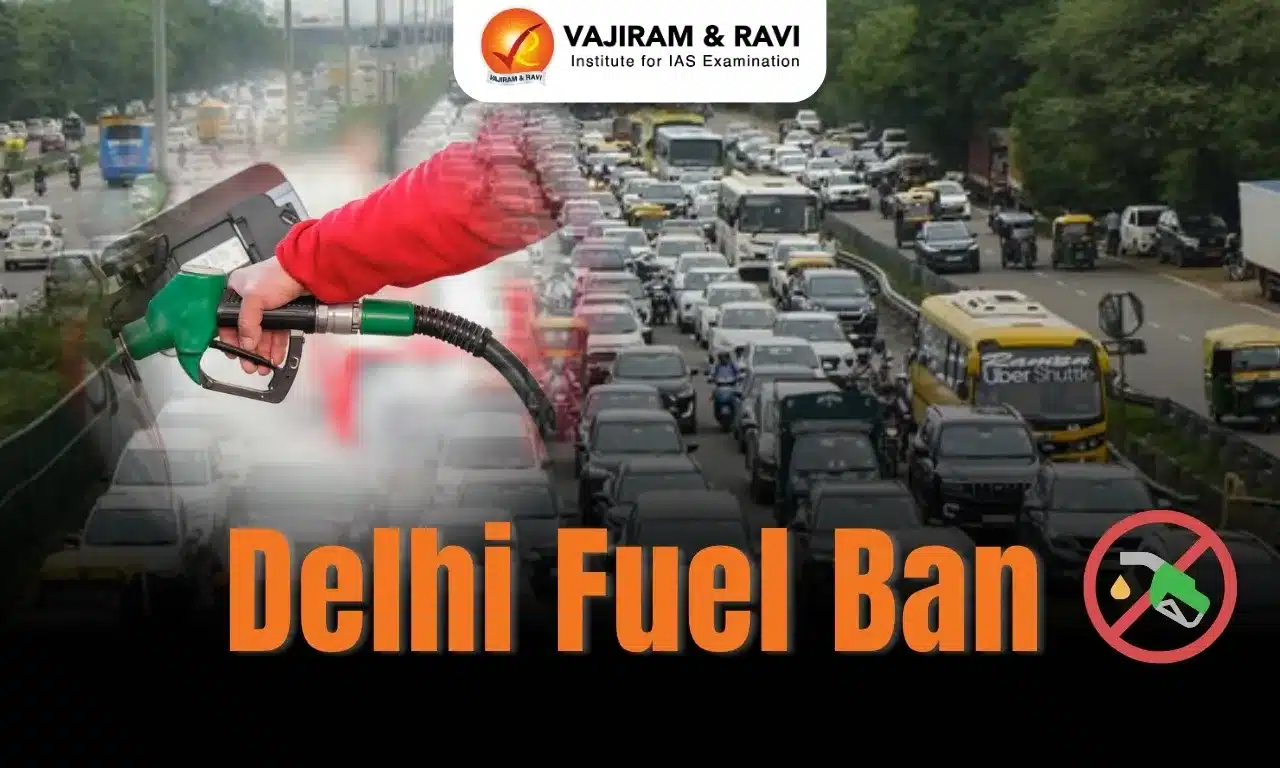
  • Facing backlash over the fuel ban for old vehicles, the Delhi Government announced that end-of-life vehicles will not be impounded. 
  • Environment Minister of Delhi said a new system for handling old vehicles is being planned. 
  • The Commission for Air Quality Management (CAQM) directive to remove end-of-life vehicles from roads is based on long-standing court orders and serious environmental concerns.

Delhi’s Fuel Ban for Old Vehicles

  • Starting July 1, diesel vehicles over 10 years old and petrol vehicles over 15 years old are denied fuel at Delhi’s fuel stations under the CAQM directive.
    • In April 2025, the CAQM directed a phased denial of fuel to ELVs at fuel stations in the NCR:
      • in Delhi from July 1, 
      • in high-density NCR districts from November 1, and 
      • in the rest of the NCR from April 1, 2026.

Real-Time Enforcement with ANPR Technology

  • 498 fuel stations and 3 ISBTs now have Automatic Number Plate Recognition (ANPR) cameras.
  • These scan vehicle plates and cross-check with the VAHAN database.
  • If identified as an End-of-Life Vehicle (ELV), an audio alert is triggered, and fuel is denied.

Enforcement and Penalties

  • ELVs may be impounded and scrapped unless valid exemptions or documents are shown.
  • Enforcement teams include the Transport Department, Traffic Police, and civic bodies.

Delhi Government Flags Premature Implementation

  • Delhi Environment Minister, in a letter to CAQM, called the immediate enforcement of the fuel ban “premature and potentially counterproductive”.
  • The Automatic Number Plate Recognition (ANPR) system is facing multiple issues:
    • Camera misplacement
    • Non-functional sensors and speakers
    • Inability to detect ELVs due to HSRP-related issues
  • The system lacks integration with vehicle databases of adjoining NCR districts, making it easy for vehicle owners to bypass the ban by refueling in nearby areas.
  • Due to these technological and operational issues, the public is facing inconvenience, leading to widespread discontent and backlash.

Why Older Vehicles Are a Concern

  • Authorities say pre-BS-VI vehicles significantly contribute to air pollution, even if maintained well.
    • BS-IV vehicles emit 4.5 to 5.5 times more particulate matter than BS-VI vehicles.
    • BS-VI norms became mandatory from April 1, 2020, setting stricter emission standards.
  • Transport sector accounts for: 28% of PM2.5; 41% of SO₂; 78% of NOx emissions. CAQM highlights transport as a key driver of Delhi’s air pollution.
  • While legal mandates for banning overage vehicles existed since 2015, lack of technology delayed enforcement.

NGT’s 2015 Ban on Old Vehicles

  • In 2015, the National Green Tribunal (NGT) banned - Diesel vehicles older than 10 years; Petrol vehicles older than 15 years - from operating or being registered in Delhi-NCR.
  • In 2018, the Supreme Court upheld the NGT’s directive and ordered that violating vehicles must be impounded.

New Scrapping Rules Reinforce Mandate

  • In 2023, Delhi framed guidelines under the Motor Vehicles Act and Registered Vehicle Scrapping Facility (RVSF) Rules.
  • The Environment Protection (End-of-Life Vehicles) Rules, 2025, effective April 1, mandate scrapping within 180 days of a vehicle’s registration expiry.

Legal Basis Under Motor Vehicles Act

  • Motor Vehicles Act, 1988: Registration for non-transport vehicles valid for 15 years, renewable thereafter.
  • Central Motor Vehicles Rules, 1999: After expiry, a vehicle is no longer considered validly registered.

Effectiveness of Such Measures in Dealing with Delhi’s Bad Air Problem

  • Experts agree that no single measure, including the fuel ban for old vehicles, can fully resolve Delhi’s severe air quality crisis.
  • The Centre for Science and Environment (CSE) cautions that age caps aren’t scalable nationwide and older vehicles aren’t the only polluters. 
  • Poor maintenance can make even newer vehicles highly polluting.

Multi-Pronged Approach Needed

  • CSE advocates a comprehensive strategy, including:
    • Upgrading fuel and emission standards
    • Strict Pollution-Under-Control (PUC) enforcement
    • Major expansion of public transport

Source: IE | TH | IT

Delhi Fuel Ban FAQs

Q1: What is Delhi’s fuel ban for old vehicles?

Ans: As of July 1, old petrol/diesel vehicles are denied fuel under CAQM orders to reduce vehicular pollution.

Q2: Why are older vehicles targeted in Delhi?

Ans: Older vehicles, especially pre-BS-VI ones, emit significantly more pollutants, worsening Delhi’s already severe air quality.

Q3: What legal backing supports Delhi’s fuel ban?

Ans: The National Green Tribunal’s 2015 order, upheld by the Supreme Court in 2018, mandates removal of old vehicles.

Q4: What issues hamper enforcement of the ban?

Ans: Faulty ANPR tech, poor integration with NCR databases, and public backlash challenge implementation of the fuel ban.

Q5: Can this ban alone solve Delhi’s pollution?

Ans: Experts say no single measure works; coordinated action including stricter norms and public transport is essential.

Enquire Now