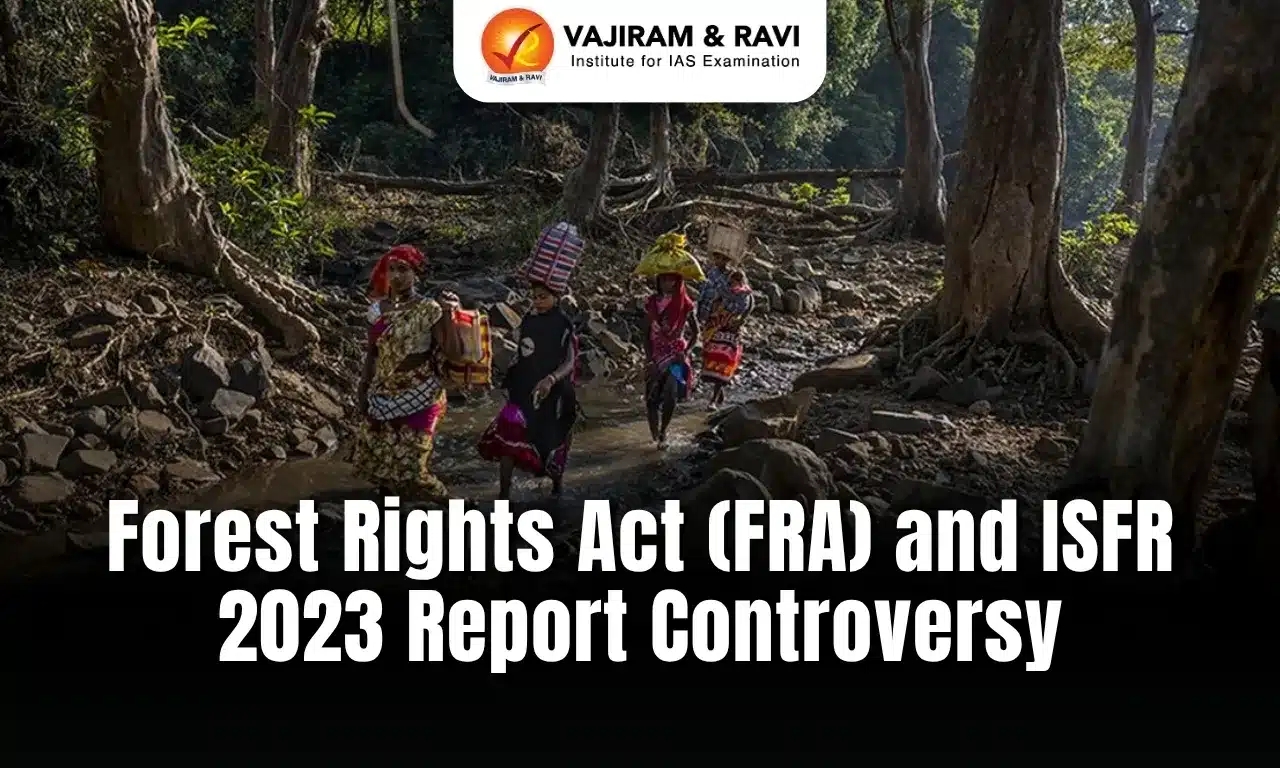
Controversy Over ISFR 2023 – Forest Rights Act (FRA) Blamed for Forest Cover Loss

Forest Rights Act

Forest Rights Act (FRA) and ISFR 2023 Report Controversy Latest News

  • The India State of Forest Report (ISFR) 2023 attributed the “negativechange in forest and tree cover partly to the implementation of the Forest Rights Act (FRA), 2006. 
  • This has sparked a strong rebuttal from the Ministry of Tribal Affairs, which has questioned the scientific validity of this claim and expressed concerns about its implications for the implementation of FRA.

Findings of the ISFR 2023

  • The 18th biennial assessment of India’s forests, ISFR 2023, by the Forest Survey of India, reveals a major drop in the country’s dense natural forests
  • Within the Recorded Forest Area (RFA), the country lost over 1,200 sq km of Mid-Dense Forest (MDF) and an equal area of Open Forest (OF). However, it has added over 2,400 sq km of Very Dense Forest. 
  • Outside the recorded forest area, India lost around 64 sq km of Dense Forest and over 416 sq km of Mid-Dense Forest. 
  • The report attributes the negative changes in forest coverage in RFA and non-RFA areas to -
    • Human encroachments, 
    • Natural calamities like storms, floods and landslides, 
    • Harvesting of short rotation plantations or other forms of logging, and 
    • Finally, titles given to beneficiaries under the Forest Rights Act 2006

The Forest Rights Act (FRA), 2006

  • Official title: The Scheduled Tribes and Other Traditional Forest Dwellers (Recognition Of Forest Rights) Act, 2006.
  • Objective: 
    • The act acknowledges and grants forest Dwelling Scheduled Tribes (FDST) and Other Traditional Forest Dwellers (OTFD), who have lived in these forests for generations, the right to occupy and use the forest.
    • This is to undo historical injustice that occurred to forest dwelling communities, ensuring their livelihood. 
  • Eligibility: Rights can be claimed by any member or community that has for at least three generations (75 years) before the 13th day of December 2005 lived in the forest.
  • Critical wildlife habitats: It provides that critical wildlife habitats of national parks and sanctuaries must remain inviolate for wildlife conservation.
  • Authorities for vesting forest rights:
    • Gram sabha: Initiate process for determining nature and extent of individual or community forest rights.
    • Sub-divisional level committee: Constituted by state government for examining resolutions passed by gram sabha.  
    • District level committee: Final approval of forest rights.

Major Points of Contention

  • FRA blamed for forest cover loss: This is the first time FRA has been explicitly cited in this context in any ISFR.
  • Tribal Affairs Ministry’s rebuttal: The charge was contested by the Ministry, which said that - 
    • The ISFR 2023 lacks scientific evidence and “ground truthing.”
    • Such claims may reinforce administrative bias against FRA implementation.
    • FRA acknowledges pre-existing rights of forest dwellers; it does not legalise encroachments.
    • It does not introduce new rights that may damage ecological balance.

Reaction from Civil Society and Official Clarifications

  • Activist and civil society mobilisation:
    • Over 150 organisations wrote to the Union government condemning the claim.
    • They criticised the Ministry of Environment, Forest and Climate Change (MoEFCC) for delegitimising FRA through unverified conclusions.
  • Environment Ministry’s clarification: ISFR 2023 showed substantial increase in forest cover, indicating community-led conservation. It called civil society’s inferences “devoid of merit.”

Conclusion

  • The controversy reflects the delicate balance between environmental conservation and tribal rights. 
  • The demand for scientific backing before policy implications is crucial to protect the credibility of forest governance mechanisms and the integrity of tribal rights under FRA. 
  • This debate underlines the importance of evidence-based policymaking and inter-ministerial coordination in managing India’s forests sustainably.

Source: TH

Forest Rights Act (FRA) and ISFR 2023 Report Controversy FAQs

Q1: Critically examine the implications of attributing forest cover loss to the implementation of the Forest Rights Act (FRA), 2006.

Ans: Attributing forest degradation to FRA without scientific evidence risks delegitimising constitutionally guaranteed tribal rights and may reinforce administrative bias against community-led forest governance.

Q2: Discuss the role of inter-ministerial coordination in ensuring the balanced implementation of developmental and environmental policies in India.

Ans: The conflict between the Environment and Tribal Affairs Ministries over ISFR 2023 highlights the need for scientific consensus and collaborative governance in reconciling conservation goals with socio-economic justice.

Q3: Analyze how narratives around forest degradation can impact the implementation of the Forest Rights Act and the rights of forest-dwelling communities.

Ans: Unsubstantiated narratives linking FRA to forest loss may erode administrative trust in community forest management and hinder the effective realisation of forest-dweller rights.

Q4: Evaluate the role of civil society in safeguarding environmental justice and tribal rights in India.

Ans: The intervention by civil society groups illustrates how public discourse and political advocacy can serve as checks on policy misinterpretation and defend marginalised communities.

Q5: Explain the significance of scientific evidence and ground truthing in environmental policymaking, especially in the context of the India State of Forest Report.

Ans: The Tribal Affairs Ministry's demand for scientific validation underscores the necessity of evidence-based analysis to ensure objective and credible environmental policy formulation.

Promise and Pitfalls of India’s ₹99,446 Crore Employment-Linked Incentive Scheme

Employment-Linked Incentive Scheme

Employment-Linked Incentive Scheme Latest News

  • The Union Cabinet has approved an Employment-Linked Incentive (ELI) scheme with a budget of ₹99,446 crore, as announced in the 2024–25 Union Budget. 
  • Aimed at boosting job creation, especially in the manufacturing sector, the ELI scheme is part of the Prime Minister’s broader five-scheme employment package, which also includes internships with major companies and youth skill development initiatives.

Key Provisions of the Employment-Linked Incentive (ELI) Scheme

  • Implementation duration: August 1, 2025 – July 31, 2027
  • Implementing Agency: Employees Provident Fund Organisation (EPFO)
  • Goal: Create over 3.5 crore jobs in two years
  • Expected Beneficiaries: 1.92 crore newly employed individuals

Employee Benefits

  • Eligibility: Salaries up to ₹1 lakh/month
  • Incentive: One-month EPF wage (up to ₹15,000)
  • Disbursal:
    • 1st instalment after 6 months of service
    • 2nd instalment after 12 months
  • Mode: Direct bank transfer
  • Savings Component: Part of the benefit will go into a fixed deposit account, withdrawable later

Employer Incentives

  • Eligibility: Establishments registered with EPFO
  • Support: Up to ₹3,000/month for each new employee retained for at least 6 months, for two years
  • For manufacturing firms, the incentives extend to the 3rd and 4th years as well

Employers’ Response to the Employment-Linked Incentive (ELI) Scheme

  • Employers have called the ELI scheme a “laudable initiative” that encourages first-time employment and sustained job creation, especially in manufacturing.
  • They highlighted the scheme’s potential to boost labour-intensive sectors and transform India’s employment ecosystem.
  • Industry experts stressed the need to include micro and small manufacturing units, especially those with fewer than 20 employees, under the scheme’s benefits.
    • They proposed shifting the scheme to the Ministry of MSME and using a structured reimbursement model based on payroll growth.
  • Experts suggested a direct monthly subsidy to both employer and employee, tied to continued employment, for simpler and wider adoption.

Trade Union Response and Concerns on the ELI Scheme

  • The Bharatiya Mazdoor Sangh (BMS) has welcomed the scheme but called for expanding social security and improving job quality.
  • The other 10 central trade unions have criticised the scheme, citing risks and past experiences.

Fear of Misuse of Funds

  • Unions fear that the ELI scheme could divert workers' savings to subsidise employers.
  • They referenced the 2020 Production-Linked Incentive (PLI) scheme, where benefits reportedly went to large firms without meaningful job creation.

Concerns Over EPFO’s Role

  • EPFO is a custodian of employee savings, not a job-creating body.
  • Unions question how it can implement an incentive scheme without dedicated government funding.

Call for a Separate Implementation Body

There is growing demand for the creation of a specialised agency to administer the scheme, instead of placing the responsibility on EPFO, which lacks the mandate and mechanism for employment generation.

Other Concerns

  • Quality vs Quantity Trade-off - Firms may focus on hiring more rather than hiring skilled or productive workers.
  • Short-Term Gains - Risk of firms inflating hiring temporarily to gain benefits, without long-term employment commitment.
  • Implementation Challenges - Requires robust verification mechanisms to prevent misuse and false reporting of employment data.
  • Skewed Sectoral Impact - May benefit larger firms with better compliance systems, leaving out MSMEs that employ a majority.

Source: TH | ET

Employment-Linked Incentive Scheme FAQs

Q1: What is the ELI scheme?

Ans: A government initiative to boost jobs by offering EPF-linked incentives to employers hiring new workers till 2027.

Q2: How do employees benefit from the ELI scheme?

Ans: Eligible new hires get up to ₹15,000 in EPF benefits, split across 6- and 12-month milestones.

Q3: What are employers saying about the scheme?

Ans: Industry leaders welcome the initiative but seek more inclusion for MSMEs and simplified, direct subsidy models.

Q4: Why are trade unions critical of the scheme?

Ans: They fear workers’ savings may subsidise firms and question EPFO’s role as a job-creation authority.

Q5: What are the risks in implementing the ELI scheme?

Ans: Concerns include possible misuse, temporary hiring spikes, and limited MSME coverage without stronger verification systems.

Lessons from the Telangana Blast: Safety, Regulation, and Environmental Impact

Telangana Blast

Telangana Blast Latest News

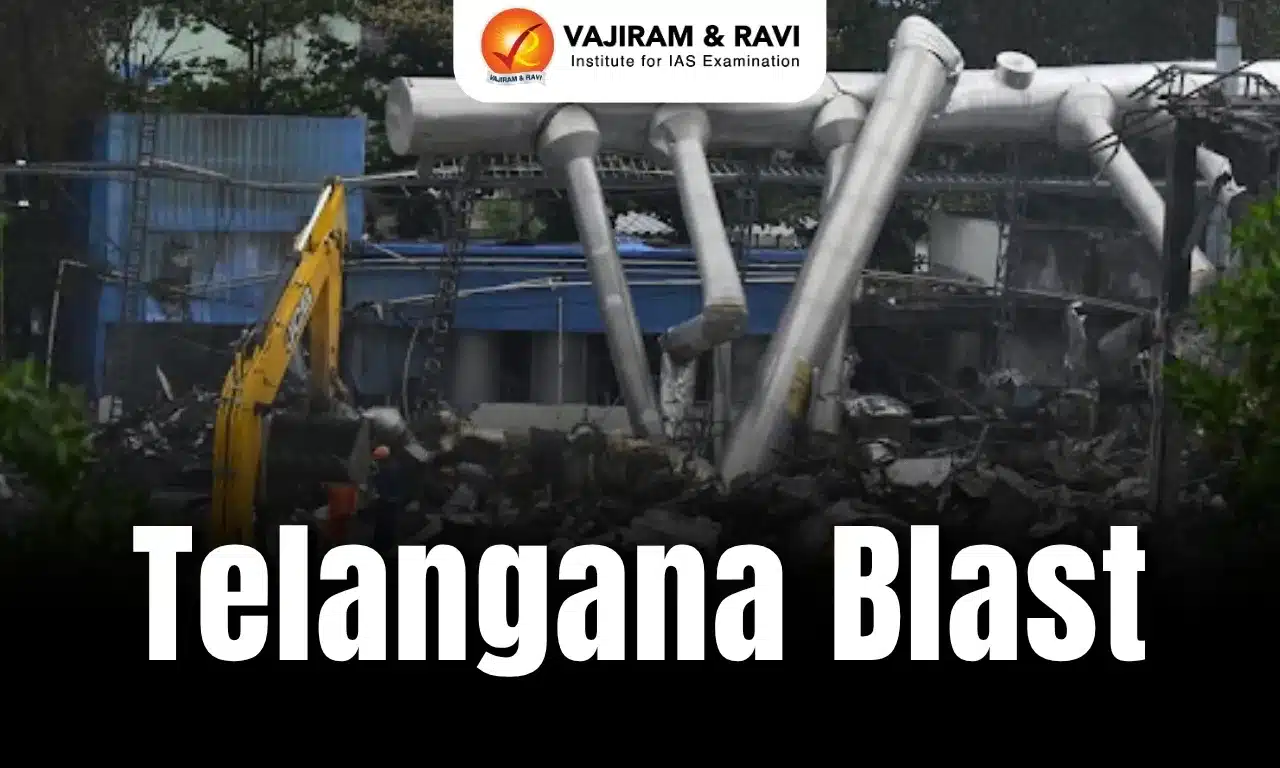
  • Recently, a powerful explosion at Sigachi Industries, a pharmaceutical factory in Pashamylaram near Hyderabad, flattened a three-storey building. Of the 143 workers present, 39 lost their lives.
  • Sigachi Industries denied initial claims of a reactor explosion, asserting the blast did not originate from reactor failure.
  • A four-member expert committee, led by CSIR-IICT emeritus scientist B. Venkateshwar Rao, is probing the cause of the explosion.

Part of a Larger Pattern

  • The incident follows a series of deadly accidents in pharmaceutical units:
    • SB Organics, Sangareddy (2024): 6 dead
    • Anakapalli, Andhra Pradesh (Aug 2024): 17 dead
    • Parawada, Andhra Pradesh (June 2025): 2 dead

Telangana Sigachi Industries Blast: Likely Cause

  • The blast was initially thought to be a Boiling Liquid Expanding Vapour Explosion (BLEVE), but this theory was dismissed by the company and forensic experts.
  • Experts now suspect a dust explosion, likely triggered by airborne microcrystalline cellulose—a fine wood pulp powder used in pharmaceutical manufacturing.
  • Dust explosions have a well-documented history in industries like flour milling, mining, and grain storage, dating back to 1785 in Turin, Italy.
  • The factory processed wood slurry into microcrystalline cellulose using spray dryers. The powder is highly combustible when suspended in air, making it prone to ignition.

Regulatory Lapses in the Telangana Factory Blast

  • Emergency responders arrived at the site without knowing the materials involved, as mandatory environmental display boards were incomplete or missing.
  • Both the State and Central Pollution Control Boards require factories to display environmental and operational details to guide fire and disaster teams. Sigachi Industries failed to comply.
  • The lack of environmental data delayed and complicated rescue and firefighting efforts, putting lives at greater risk.
  • A robust regulatory framework with periodic audits could have ensured compliance and faster emergency response.

Implications of Telangana Blast for the Pharmaceutical Sector

Safety is integral to brand trust in the pharma sector. Any compromise in manufacturing practices can cause ripple effects across the industry’s global reputation.

Telangana’s Strategic Role in Pharma

  • Telangana accounts for:
    • One-third of India’s pharmaceutical production
    • One-fifth of pharmaceutical exports
    • One-third of global vaccine output
  • It has attracted over $1.49 billion in life sciences investments in four years and hosts India’s largest concentration of biotech incubators in Hyderabad.
  • Despite global success, smaller pharma firms in India face ongoing safety and quality issues. Lapses like the Sigachi blast undermine industry credibility.

U.S. Market and Regulatory Scrutiny

  • India’s pharma exports heavily rely on the U.S. FDA-regulated market. 
  • To maintain access, firms must adhere to stringent quality and safety standards under the United States Pharmacopeia-National Formulary.
  • It is a well documented fact that regulatory gaps and cost-cutting measures have led to unsafe drug production practices in Indian firms.

Pollution Control Failures in Telangana’s Pharma Hub

  • The growth of the pharmaceutical sector in Telangana, especially around Hyderabad, has been driven by permissive zoning and weak regulatory enforcement. 
  • Industrial zones like IDA Pashamylaram, once isolated, are now encroached by residential settlements, increasing health risks for nearby communities.

Alarming Environmental Impact

  • Environmental studies show that toxic chemicals and untreated effluents from pharma units have been leaching into soil and local water bodies, degrading both ecosystem and public health.
  • The Musi River ranks 22nd globally in terms of active pharmaceutical ingredient concentration.
  • This highlights severe water contamination linked to ineffective wastewater management and poorly regulated discharge from pharma factories.
  • Pollutants in the river and groundwater have been associated with a rise in antimicrobial resistance, posing a global health threat and demanding urgent regulatory intervention.

The Way Forward for India’s Pharmaceutical Sector

  • Recent explosions and accidents are critical warning signs. A strong, transparent, and enforceable regulatory framework is essential to ensure safety and sustainability.
  • To remain a trusted global pharma supplier, India must align growth with stringent safety, environmental, and quality standards.
  • Reforming regulations is not just an industrial need—it’s a national imperative to protect lives, preserve global reputation, and build long-term economic resilience.

Source: TH | ToI

Telangana Blast FAQs

Q1: What caused the Telangana blast?

Ans: Experts suspect a dust explosion from microcrystalline cellulose powder, not a reactor blast as initially believed.

Q2: Were there regulatory failures in the Telangana blast?

Ans: Yes, missing environmental display boards hampered emergency response and revealed major compliance gaps in factory safety norms.

Q3: What are the environmental concerns from pharma industries?

Ans: Toxic waste and poor wastewater management have severely polluted local ecosystems, including the Musi River.

Q4: How does this affect India’s pharmaceutical reputation?

Ans: Safety lapses hurt India's global credibility, especially with export markets like the U.S. demanding strict quality standards.

Q5: What reforms are needed in the pharma sector?

Ans: India needs stronger enforcement of safety, zoning, and pollution norms to balance growth with public and environmental health.

India Ranks 4th in Global Income Equality – World Bank Report

Global Income Equality

Global Income Equality Latest News

According to a World Bank report, inequality in India has come down significantly between 2011-12 and 2022-23, making it the fourth-most equal country globally.

India Emerges as the Fourth Most Equal Country in the World

  • According to the World Bank’s latest estimates, India has achieved a remarkable position as the fourth most income-equal country globally, with a Gini Index score of 25.5. Only the Slovak Republic, Slovenia, and Belarus have recorded better equality indicators.
  • This development comes alongside a significant reduction in extreme poverty, falling from 16.2% in 2011-12 to just 2.3% in 2022-23
  • Over 171 million Indians have been lifted out of extreme poverty in the last decade, signalling the success of India’s welfare-oriented policy architecture.

Understanding the Gini Index and India's Score

  • The Gini Index is a statistical measure used to gauge inequality in income, wealth, or consumption. A score of 0 represents perfect equality, while 100 denotes maximum inequality.
  • India’s Gini Index (2022-23) is 25.5. In comparison, China: 35.7, United States: 41.8, G7/G20 Averages: Significantly higher than India
  • India’s placement within the “moderately low inequality” category (Gini score of 25-30) positions it far ahead of many advanced economies and closer to the “low inequality” threshold.

Decline in Extreme Poverty as a Key Driver

  • A major contributor to India’s improved income equality is the substantial decline in poverty rates. Based on the global poverty line of USD 2.15/day, India’s extreme poverty rate dropped from 16.2% in 2011 to just 2.3% in 2022-23.
  • This progress has resulted in 171 million Indians exiting the poverty trap in a decade, making it one of the most significant anti-poverty achievements globally in recent years.

Government Schemes and Inclusive Policy Interventions

  • The World Bank attributes this achievement not only to economic growth but to India’s focused, inclusive welfare policies. Key initiatives include:
  • Financial Inclusion and Direct Transfers
    • PM Jan Dhan Yojana: Over 55 crore bank accounts have expanded financial access, especially for rural and underbanked citizens.
    • Aadhaar-linked Direct Benefit Transfers (DBT): Enabled efficient and leak-proof delivery of government benefits, saving over ₹3.48 lakh crore by March 2023.
  • Health and Social Security
    • Ayushman Bharat: Offers ₹5 lakh in health insurance, with over 41 crore cards issued to date.
    • PMGKAY: Provided free food grains to over 80 crore beneficiaries, contributing to food security and nutrition.
  • Livelihood and Entrepreneurship
    • Stand-Up India: Supports SC/ST and women entrepreneurs with loans and financial assistance.
    • PM Vishwakarma Yojana: Aims to uplift traditional artisans with training, credit, and market support.

Balancing Growth with Equity

  • India’s journey reflects a rare convergence of economic reform with social protection
  • According to the Social Welfare Department’s statement, “India’s path to income equality has been steady and focused… The Gini Index of 25.5 reflects real change in people’s lives, better access to food, jobs, healthcare, and banking.”
  • The country’s progress in this domain is being seen as a model for developing economies that aim to pursue growth with fairness.

Global Context and India’s Distinct Approach

  • India’s achievement stands out among 167 countries surveyed. Other nations in the “moderately low inequality” category include Scandinavian welfare states like Norway, Finland, and Belgium, as well as rapidly growing economies like Poland and the UAE.
  • While many of these nations have relied on long-standing welfare systems, India’s success has come through digital inclusion, targeted cash transfers, and integrated rural support, making it a unique example of equity in a large, diverse democracy.

Source: TH | TOI

Global Income Equality FAQs

Q1: What is India’s current Gini Index score according to the World Bank?

Ans: India’s Gini Index score is 25.5, ranking it fourth globally in income equality.

Q2: How many Indians have been lifted out of extreme poverty in the past decade?

Ans: 171 million Indians have exited extreme poverty between 2011 and 2023.

Q3: What is the significance of the Gini Index in assessing equality?

Ans: The Gini Index measures income inequality, where 0 denotes perfect equality and 100 indicates maximum inequality.

Q4: Which government schemes contributed to India’s rise in income equality?

Ans: Schemes like Jan Dhan Yojana, DBT, Ayushman Bharat, Stand-Up India, and PM Vishwakarma Yojana played key roles.

Q5: How does India compare with the US and China in terms of income inequality?

Ans: India fares better, with a Gini score of 25.5 compared to China’s 35.7 and the US’s 41.8.

Enquire Now