Catastrophe Bonds – Innovative Financial Tools for Disaster Resilience in India

Catastrophe Bonds

Catastrophe Bonds Latest News

India is exploring the use of catastrophe bonds as an innovative financial instrument to strengthen disaster risk financing and enhance climate resilience amid the rising frequency of natural disasters.

Introduction

  • As climate change intensifies the frequency and severity of natural disasters, countries like India are increasingly vulnerable to financial shocks arising from catastrophic events such as cyclones, floods, and earthquakes. 
  • While traditional insurance coverage remains sparse, especially for individuals and small businesses, innovative financial tools such as catastrophe bonds or cat bonds offer a promising solution for governments to transfer disaster risk to global capital markets and ensure quicker post-disaster recovery.

Understanding Catastrophe Bonds

  • Catastrophe bonds are hybrid financial instruments that combine features of insurance and debt. They allow at-risk entities, usually sovereign states, to transfer defined disaster risks to investors. 
  • In the event of a predefined natural disaster, investors lose a part or all of their principal, which is then used for post-disaster relief and reconstruction. 
  • If no disaster occurs during the bond's tenure, investors receive their principal back along with a relatively high coupon (interest) rate.
  • These bonds effectively turn a country’s hazard exposure into a tradable security, opening access to a wider pool of capital beyond traditional insurers and reinsurers. 
  • This reduces counterparty risk and enables faster payouts, essential in times of crisis.

Key Stakeholders and Mechanism

  • Cat bonds are typically:
    • Sponsored by sovereign governments, who pay premiums.
    • Issued through intermediaries, such as the World Bank or Asian Development Bank, to reduce issuance risks.
    • Purchased by global investors, including pension funds, hedge funds, and family offices, who are attracted by high returns and the diversification benefits of non-market correlated risks.
  • The risk level and frequency of disaster occurrence directly influence coupon rates. For instance, earthquake-related bonds often offer lower premiums (1-2%) compared to those covering cyclones or hurricanes.

Global Adoption and Profitability

  • Since their inception in the late 1990s following major hurricanes in the U.S., catastrophe bonds have seen over $180 billion in issuances globally, with approximately $50 billion currently outstanding. 
  • Their appeal lies in diversification: natural hazard risks are statistically independent of traditional financial risks, making cat bonds valuable for risk-averse portfolios.
  • Moreover, Nobel laureate Harry Markowitz’s emphasis on diversification aligns with the strategic rationale for including cat bonds in investment portfolios. 
  • Their unique risk-return profile complements conventional assets, especially during market downturns.

India’s Need for Cat Bonds

  • India faces an increasingly precarious climate future with rising occurrences of floods, cyclones, forest fires, and earthquakes. 
  • Yet, disaster insurance coverage remains low. This exposes vast segments of the population to irreversible economic loss, while placing a significant burden on public finances for reconstruction.
  • Sponsoring cat bonds could help India:
    • Ring-fence public expenditure for disaster recovery.
    • Leverage its strong sovereign credit profile to negotiate favourable terms.
    • Transfer risk away from the government to global investors, ensuring immediate access to relief funds when needed.
  • India’s proactive disaster management steps, including an annual allocation of Rs. 15,000 crore ($1.8 billion) for mitigation and capacity building, could further lower bond premiums.

Regional Collaboration through South Asian Cat Bonds

  • India is well-positioned to lead the creation of a regional catastrophe bond framework for South Asia. This could:
    • Spread risk across multiple countries
    • Reduce overall premium costs
    • Foster financial preparedness across the region
  • Such a bond could cover high-impact hazards like:
    • Earthquakes across India, Nepal, and Bhutan
    • Cyclones and tsunamis are affecting India, Bangladesh, Maldives, Myanmar, and Sri Lanka
  • By pooling diverse risks across geographies, a South Asian cat bond would be more attractive to investors and more robust in coverage.

Challenges and Considerations

  • Despite their promise, cat bonds are not without drawbacks:
    • Poorly designed bonds may miss payouts due to rigid trigger conditions. For example, a bond triggered only by earthquakes above 6.6 magnitude may not activate for a 6.5 event, even if damage is severe.
    • Governments may question the cost-benefit ratio if no disasters occur during the bond period, leading to a perception of wasted premium payments.
  • Therefore, India must evaluate:
    • Transparent cost comparisons with historical disaster recovery expenditures.
    • Carefully calibrated payout thresholds and coverage areas.
    • Engagement with credible intermediaries and risk modellers.

Source: TH

Catastrophe Bonds FAQs

Q1: What is a catastrophe bond?

Ans: A catastrophe bond is a financial instrument that transfers disaster risk from a sponsor, like a government, to investors.

Q2: Who typically invests in cat bonds?

Ans: Investors include pension funds, hedge funds, and family offices seeking high returns and portfolio diversification.

Q3: Why should India consider sponsoring a cat bond?

Ans: Cat bonds can help India secure rapid post-disaster funds, reduce insurance burden, and protect public finances.

Q4: How do cat bonds compare to traditional insurance?

Ans: Cat bonds offer faster payouts, lower counterparty risks, and access to global capital markets, unlike conventional insurance.

Q5: Can cat bonds be used at a regional level in South Asia?

Ans: Yes, India could lead a South Asian cat bond covering regional hazards, improving risk-sharing and financial resilience.
India’s Global South Strategy: Balancing Leadership, Leverage & Diplomacy

India Global South Strategy

India Global South Strategy Latest News

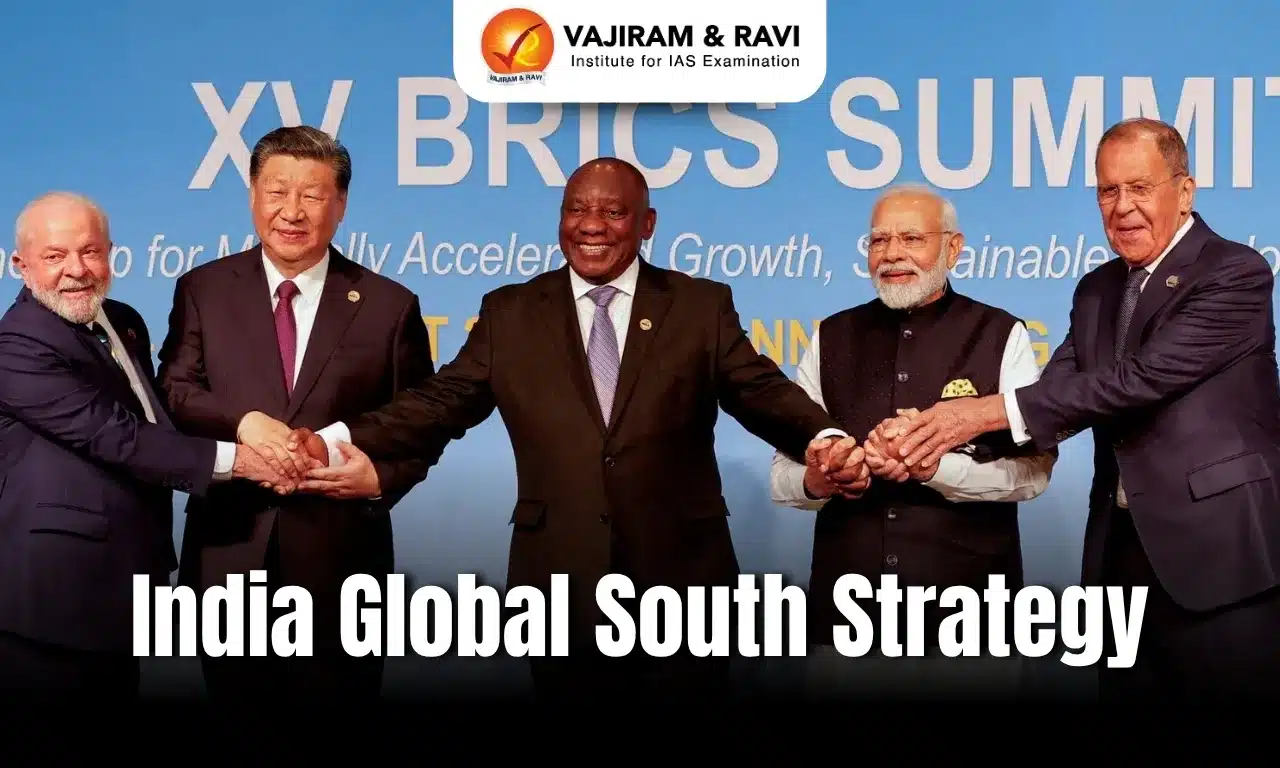
Prime Minister Narendra Modi's July 2–9 visit to Brazil for the BRICS summit was his longest in 11 years, including four additional stops—Ghana, Trinidad & Tobago, Argentina, and Namibia—underscoring India’s strategic outreach to the Global South.

Global South

  • The Global South refers to countries primarily in Asia, Africa, Latin America, and Oceania that are often characterized by lower levels of economic development, colonial histories, and a shared interest in reforming global governance to be more equitable. 
  • While not a strictly geographical term, it contrasts with the "Global North," which includes wealthier, industrialized nations like those in North America and Western Europe.
    • Australia and New Zealand, both in the southern hemisphere, are not in the Global South.
  • The term has gained currency in international relations and diplomacy to signify a collective identity among developing countries, especially in forums like the BRICS, G77, and the Non-Aligned Movement
  • These countries often advocate for fairer trade terms, technology transfer, climate justice, and a multipolar world order.
  • India has positioned itself as a key voice of the Global South, especially through initiatives like the Voice of Global South Summit, aiming to amplify the concerns of developing nations on global platforms such as the G20.

India as the Leader of the Global South

  • India has been actively working to project itself as a bridge between the developed and developing worlds, and to emerge as the voice and leader of the Global South.
  • Hosting the Voice of Global South Summits
    • In 2023 and 2024, India hosted the Voice of Global South Summits, bringing together over 120 developing countries to discuss common concerns such as climate change, debt crisis, food and energy insecurity, and digital divide.
  • Leveraging G20 Presidency (2023)
    • India used its G20 presidency to champion the cause of the Global South, advocating for inclusive growth, equitable development, and debt relief for poor nations.
    • It succeeded in pushing for the African Union's permanent membership in G20 — a significant diplomatic move that cemented India's leadership credentials.
  • Development Partnerships
    • India continues to expand its development assistance and capacity-building programs in Africa, Latin America, and Southeast Asia.
  • Countering China's Influence
    • India seeks to offer an alternative model of development to China's Belt and Road Initiative — one that is less debt-driven and more transparent.
  • Moral and Historical Positioning
    • Drawing from its non-aligned legacy and role in founding the NAM (Non-Aligned Movement), India invokes its history of anti-colonial solidarity to align with the aspirations of the Global South.

India’s Gaza Stance Strains Ties with Global South

  • India’s pro-Israel position during the Gaza war post-October 7, 2023, has led to concerns among Global South nations. 
  • This shift was reflected in India’s defeat to Pakistan in the UNESCO Executive Board vice-chair election, and reduced high-level participation in India’s Second Voice of the Global South summit. 
  • Many developing countries now perceive India as aligning with major powers and not speaking out against Israel’s actions in Gaza.

India Shifts Tone on Israel to Safeguard Global South Ties

  • At the BRICS foreign ministers’ meet in June 2024 and again at the July 2025 BRICS summit, India joined in sharply criticising Israel's actions in Gaza, marking its strongest multilateral rebuke yet. 
  • These statements also condemned strikes on Iran, signalling India’s strategic balancing between its ties with Israel and its aspirations for leadership within the Global South. 
  • While Israel remains a key defence partner, many Global South nations view its actions in Gaza critically — pushing India to recalibrate its stance to maintain influence in the bloc.

India Secures BRICS Support on Terror, Balances Gains Amid Gaza-Iran Trade-off

  • During the BRICS summit in Rio, India achieved a diplomatic win by getting the grouping — including China — to strongly condemn the Pahalgam terror attack and affirm support against cross-border terrorism and terror financing. 
  • This came despite prior skepticism from several Global South nations over India’s Operation Sindoor strikes in Pakistan. 
  • To counter that narrative, India sent multi-party delegations to explain its stance. 
  • While New Delhi gained crucial language on terrorism in the BRICS declaration, it had to accommodate concessions on Gaza and Iran-related paragraphs.

Source: IE | ToI

India Global South Strategy FAQs

Q1: What is India’s Global South strategy?

Ans: India seeks to lead the Global South by bridging North-South gaps, promoting equity, and building diplomatic partnerships.

Q2: What role did India’s G20 presidency play?

Ans: India used its G20 presidency to advocate for debt relief, equitable growth, and secured AU’s permanent G20 membership.

Q3: Why did India recalibrate its Gaza stance?

Ans: To regain support from Global South nations, India criticized Israel's Gaza actions in BRICS multilateral forums.

Q4: How does India counter China’s influence?

Ans: India offers transparent development models and assistance, challenging China’s debt-heavy Belt and Road Initiative.

Q5: How did India secure BRICS support on terrorism?

Ans: Despite prior skepticism, India got BRICS to condemn cross-border terror and support anti-terror financing measures.

Reforming the UNFCCC Process – Challenges, Criticisms, and Proposals

UNFCCC

UNFCCC Latest News

  • The article discusses the ongoing credibility crisis in international climate negotiations under the UN Framework Convention on Climate Change (UNFCCC). 
  • Despite repeated conferences and global commitments, progress on climate action has been limited, especially regarding climate justice for developing nations. 
  • The article evaluates the structural inefficiencies of the UNFCCC, highlights reform demands, and outlines Brazil’s efforts to revive confidence in the process ahead of COP30.

About the UNFCCC

  • The UNFCCC is the UN process for negotiating an agreement to limit dangerous climate change
  • It is an international treaty among countries to combat dangerous human interference with the climate system. The main way to do this is limiting the increase in greenhouse gases in the atmosphere.
  • It was signed in 1992 by 154 states at the United Nations Conference on Environment and Development (UNCED), informally known as the Earth Summit, held in Rio de Janeiro. The treaty entered into force on 21 March 1994.
  • "UNFCCC" is also the name of the Secretariat charged with supporting the operation of the convention, with offices on the UN Campus in Bonn, Germany.
  • By 2022, the UNFCCC had 198 parties, and its supreme decision-making body, the Conference of the Parties (COP), meets every year. 

Background - The UNFCCC Credibility Crisis

  • Failure to deliver climate justice:
    • Developed countries have failed to meet emission targets and financial commitments.
    • Developing nations, especially small islands and vulnerable states, feel ignored in negotiations. Complaints include being left out of decision-making and lack of accountability for developed nations.
  • US withdrawal impact:
    • The withdrawal of the United States under Trump’s administration eroded trust in climate negotiations.
    • Led to a perception that the process of climate negotiations is ineffective and increasingly irrelevant.

Bonn Climate Meeting and the Road to COP30

  • Bonn (Germany) climate meet (June 2025):
    • It is held annually to prepare for COP summits.
    • This year’s focus is on rebuilding confidence in the process before COP30 in Brazil.
  • Brazil’s leadership role: As COP30 host, Brazil is proactively seeking reforms by floating a 30-point ideas list, aiming to make negotiations more inclusive and efficient.

Key Reform Proposals

  • Structural streamlining: To - 
    • Eliminate overlapping agenda items.
    • Shorten negotiation time.
    • Limit delegation sizes to avoid crowding and dominance by wealthier nations.
  • Limit on host countries:
    • Proposals to bar countries with poor climate action records (like fossil fuel dependency) from hosting COPs.
    • Backlash against hosting COPs in oil-dependent states like the UAE (Dubai, COP28) and Azerbaijan (Baku, COP29).
  • Mainstreaming UNFCCC:
    • Brazil’s idea to hold discussions in other multilateral forums (e.g., UN agencies, financial institutions).
    • Proposal for alternate mechanisms that complement UNFCCC and speed up implementation.

Developing Nations’ Demand - More Climate Finance

  • Finance deficit:
    • The biggest hurdle for developing countries is the lack of adequate climate finance.
    • To fulfill the 2015 Paris Agreement, developed countries are required to collectively mobilize at least $100 billion annually to assist developing nations in climate action. 
    • However, their recent pledge at the Baku meeting fell short, offering only $300 billion per year starting from 2035, while the actual needs of developing countries are estimated at $1.3 trillion annually. 
  • Bonn meeting outcome:
    • Developing nations (like BRICS) have demanded more urgent and increased financial support, calling on developed countries to honor their UNFCCC and Paris Agreement financial commitments.
    • They demanded a decision on a new climate finance goal, emphasizing the urgent need for accessible, predictable, and sustained finance flows.

Civil Society and Observers’ Role

  • Civil society groups must push for more transparent, inclusive negotiations.
  • Demand for a restructured format of the COP meetings that limits the influence of fossil-fuel-dependent entities/ companies.

Conclusion

  • Despite strong proposals and Brazil’s leadership, major structural reforms to the UNFCCC process are unlikely to be adopted soon due to lack of consensus and entrenched interests.
  • However, these efforts represent an important push to make global climate governance more accountable, inclusive, and action-oriented.

Source: IE

UNFCCC FAQs

Q1: Examine the major structural limitations of the UNFCCC process that have hindered effective global climate action.

Ans: The UNFCCC process suffers from overlapping agenda items, lack of accountability for developed countries, limited participation of smaller delegations, and an absence of enforcement mechanisms to ensure compliance with climate commitments.

Q2: Discuss the significance of Brazil’s role as the host of COP30 in pushing for UNFCCC reforms.

Ans: As the COP30 host, Brazil has taken a proactive role by floating a 30-point reform proposal aimed at streamlining negotiations, mainstreaming climate action, and enhancing participation from developing nations.

Q3: How has the issue of climate finance emerged as a critical point of contention between developed and developing countries in global climate negotiations?

Ans: Developing countries have consistently highlighted the lack of adequate and predictable climate finance as a key barrier to implementing mitigation and adaptation actions, while developed countries have failed to fulfill their financial commitments under the Paris Agreement.

Q4: Critically analyze the proposal to bar fossil fuel–dependent countries from hosting COP meetings.

Ans: The proposal aims to prevent countries with poor climate action records from hosting COPs to avoid legitimacy issues, but it also raises concerns over inclusivity and geopolitical fairness in climate governance.

Q5: Evaluate the role of civil society and observer groups in advocating for reforms within the UNFCCC framework.

Ans: Civil society and observer groups have demanded greater transparency, inclusivity, and restrictions on the fossil fuel lobby’s influence, contributing significantly to the push for more equitable and accountable climate negotiations.

India’s Gini Index Debate: Measuring Inequality the Right Way

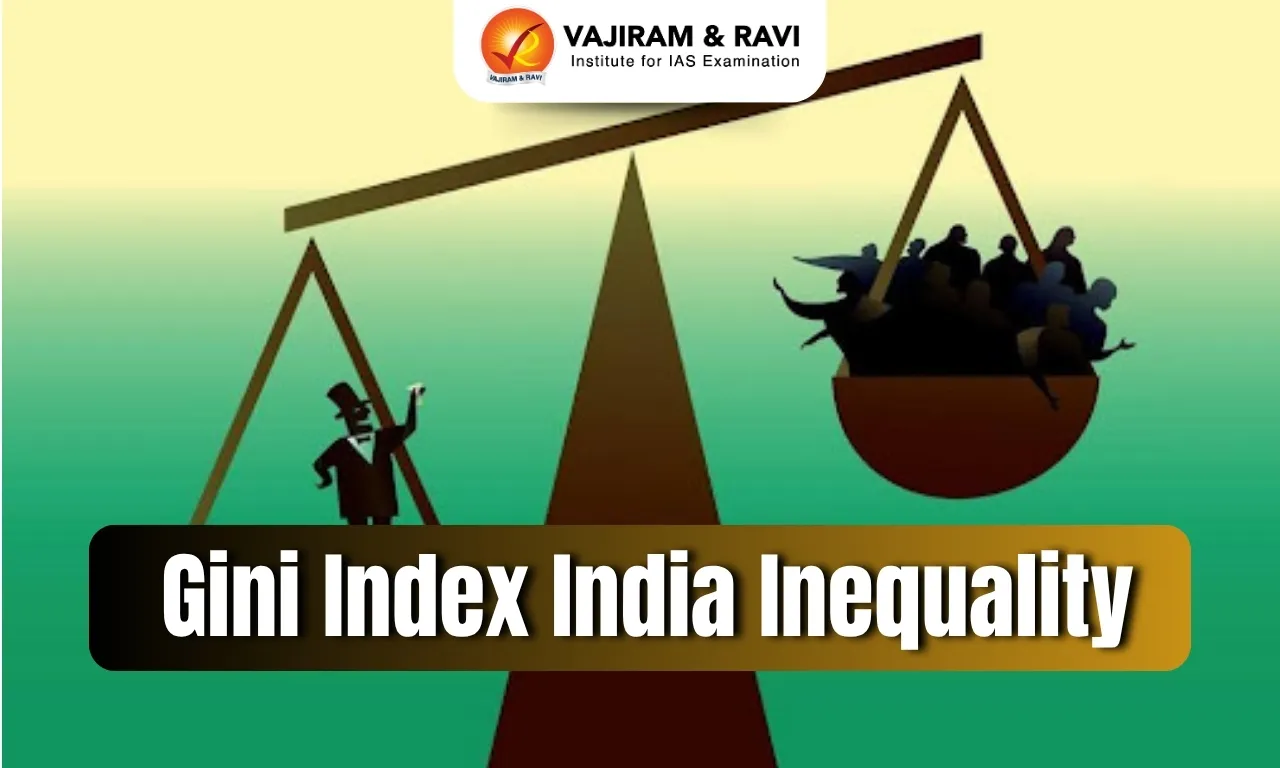
Gini Index India Inequality

Gini Index India Inequality Latest News

  • A government release claimed that India is now the world's fourth most equal country, citing a Gini Index of 25.5 from the World Bank’s Poverty and Equity Brief
  • This, it said, reflects that the benefits of economic growth are being shared more evenly. 
  • However, this claim—ranking India just behind Slovak Republic, Slovenia, and Belarus—has been contested by academics and observers, many of whom regard India as a country with high inequality
  • The Gini Index measures income inequality on a scale from 0 (perfect equality) to 1 (perfect inequality).

Data Discrepancy and Omitted Caveats

  • The government's claim citing the World Bank’s Gini Index of 25.5 omits critical qualifiers from the World Bank’s Poverty and Equity Brief
  • The brief notes that inequality may be underestimated due to data limitations
  • In contrast, the World Inequality Database indicates that income inequality in India has risen, with the Gini Index increasing from 52 in 2004 to 62 in 2023
  • It also highlights high wage disparity, with the top 10% earning 13 times more than the bottom 10% in 2023–24. 
  • Thus, the official narrative fails to capture the full and accurate picture of inequality.

Why Consumption-Based Gini Understates Inequality

  • The consumption-based Gini Index shows lower inequality because it measures variations in spending, not earnings or wealth
  • Income inequality reflects broader disparities, as higher earners often save more, reducing their consumption gap with others. 
  • Consequently, using consumption data underestimates real inequality.
  • Experts caution against comparing India’s consumption-based Gini with other countries that use income-based measures, calling such comparisons misleading and inaccurate.

Why Survey Data Fails to Reflect True Inequality in India

  • Despite a general improvement in overall economic indicators, the gap between India’s richest 1% and the bottom 10% is widening. 
  • However, most surveys fail to reflect this rising inequality due to two key limitations:
    • Differential Non-Response: The richest sections of society are far less likely to respond to surveys, leading to underrepresentation.
    • Sampling Bias: Standard survey methodologies rarely capture members of the top 1%, whose wealth significantly skews inequality data.
  • Because of these issues, survey-based Gini Index values systematically underestimate inequality. 
  • To address this, researchers often integrate survey data with tax records, especially income tax data, to more accurately estimate the wealth of the top 1%. 
  • This approach is used in the World Inequality Database, which shows that inequality in India has increased sharply over the years, contradicting the government’s claims of being one of the most equal societies.

Problems with Gini Index

  • The Gini Index, while widely used, has notable limitations in capturing the full scope of inequality. 
  • It is less sensitive to changes at the extreme ends — the very rich and very poor — and is more responsive to variations in the middle-income groups
  • This makes it an incomplete measure, especially in societies with stark disparities.
  • Experts have, for decades, advocated for the use of additional indicators alongside the Gini to get a fuller picture of inequality. 
  • Nobel laureate Abhijit Banerjee has noted that while the Gini is hard to interpret, its global trend signals a rise in income inequality across all countries.

The Need for Broader Measures to Gauge Inequality

  • To truly understand and address rising inequality, governments must move beyond consumption-based Gini indices. 
  • Relying solely on these can create a misleading picture of declining inequality, even when income and wealth disparities are actually growing. 
  • A comprehensive approach using income tax and wealth data is essential for accurately capturing inequality and crafting effective policy responses.

Source: IE

Gini Index India Inequality FAQs

Q1: What is India’s Gini Index as per the government?

Ans: The government claims a Gini Index of 25.5, making India one of the most equal societies globally.

Q2: Why is consumption-based Gini misleading?

Ans: It underestimates inequality by ignoring income and wealth gaps, especially among top earners.

Q3: How does survey data fail to capture inequality?

Ans: Surveys miss the top 1% due to non-response and sampling bias, underrepresenting true wealth distribution.

Q4: What do experts say about the Gini Index?

Ans: Experts like Abhijit Banerjee find the Gini Index hard to interpret and insensitive to extreme inequality.

Q5: What’s a better way to measure inequality?

Ans: Combining survey data with income tax records gives a clearer picture of top earners’ income and wealth.

Enquire Now