
SC on Bihar Electoral Roll Revision

Electoral Roll Revision in India

Electoral Roll Revision Latest News

  • The Supreme Court of India declined to stay the Election Commission of India’s (ECI) Special Intensive Revision (SIR) of electoral rolls in Bihar, which is scheduled ahead of the upcoming Assembly elections. 
  • Amid concerns raised by petitioners over the timing and process of the electoral roll revision, the Court urged the ECI to consider Aadhaar, voter ID, and ration cards for verification purposes and scheduled a detailed hearing for July 28.

Background - Electoral Roll Revision in Bihar

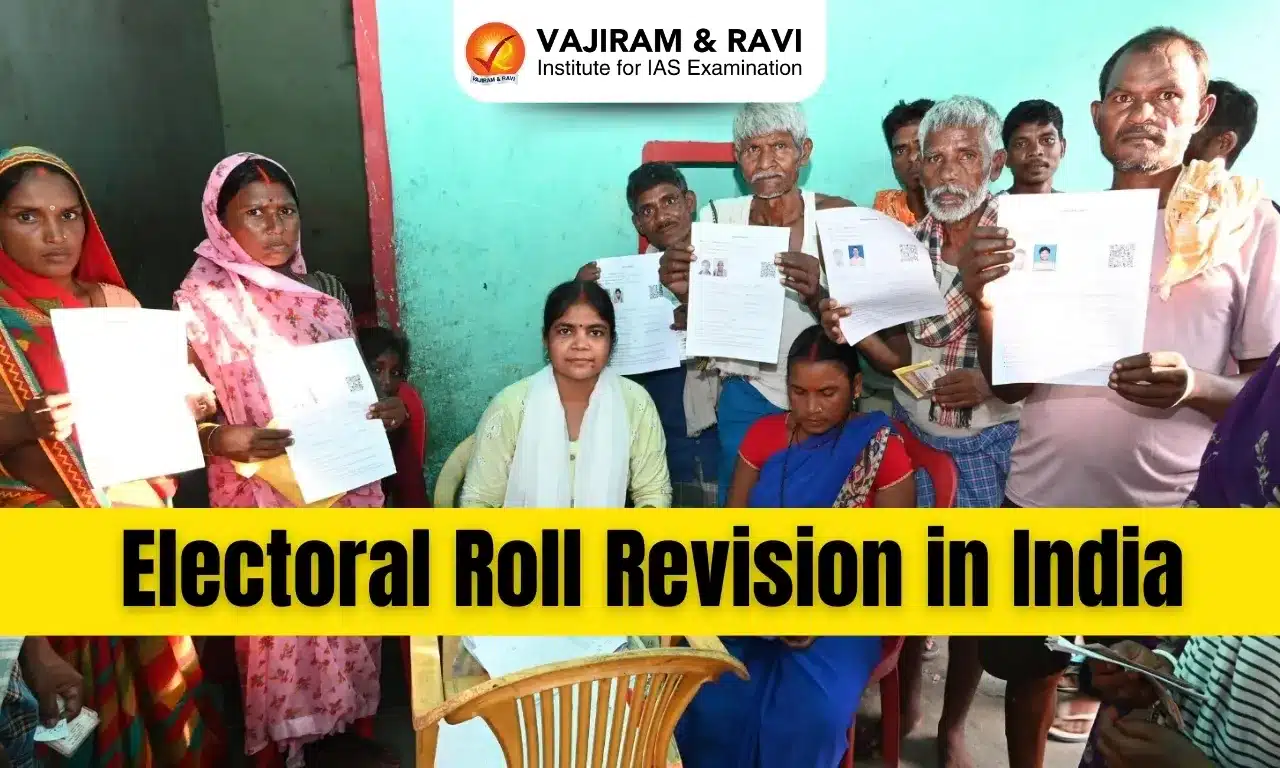
  • Special Intensive Revision (SIR): SIR involves a de novo/ afresh preparation of electoral rolls through house-to-house verification by electoral registration officers.
  • Applicability in Bihar:
    • Those listed on the 2003 electoral rolls need only submit an extract from that roll.
    • Those enrolled after 2003 must submit one or more of 11 prescribed documents and a pre-filled enumeration form to establish birthplace and date, indirectly serving as a citizenship determination process.

Supreme Court Proceedings and Key Observations

  • Major concerns raised:
    • Timing of revision:
      • Petitioners argued that the electoral roll revision is timed too close to the November 2025 Bihar Assembly elections.
      • Demanded delinking of the revision exercise from the election process.
    • Document exclusion:
      • Objection to exclusion of Aadhaar from the accepted list of identity/citizenship documents.
      • Concerns of citizenship screening under the guise of voter verification.
    • Risk of voter disenfranchisement:
      • Petitioners warned that lack of accepted documentation could exclude genuine voters (particularly marginalized groups like EBCs, Dalits, minorities, and women).
      • A Bihar government survey reportedly revealed most voters did not possess the required certificates sought by ECI.
  • Supreme Court’s stand and directions:
    • No interim stay: Court allowed ECI to proceed with SIR but reserved right to intervene if violations are proven.
    • Document suggestion: SC urged ECI to consider Aadhaar, voter ID, and ration cards—though left the final decision to the Commission.
    • Rationale for transparency: ECI was directed to provide reasons if it chooses to exclude these documents.
  • Three key legal questions identified by SC:
    • Powers of the Election Commission under the Constitution.
    • Procedure and methodology of SIR being adopted.
    • Timing of the revision vis-à-vis the upcoming election.

Accessibility of Suggested Documents in Bihar

  • Aadhaar card:
    • Aadhaar is available to over 88% of Bihar’s population (approx. 11.48 crore people).
    • Saturation level (eligible people with Aadhaar) stands at 94% across the state.
    • Some districts like Kishanganj and Katihar show saturation above 120%, indicating coverage exceeding projections.
    • Adult coverage (18+ years): 70.29% of total Aadhaar holders.
  • Voter ID (EPIC card):
    • Issued compulsorily to all enrolled electors.
    • Bihar has 7.89 crore registered voters, almost all of whom hold a Voter ID.
    • Used presently only for identification, not for eligibility verification.
  • Ration cards:
    • Cover about two-thirds of Bihar’s population.
    • 1.79 crore ration cards cover around 8.71 crore beneficiaries (as of July 10, 2025).
    • Easily accessible to low-income and marginalized groups, including EBCs and minorities.

Election Commission’s Position and Defence

  • Key submissions by ECI:
    • The list of 11 documents is not exhaustive, and room for additions exists.
    • Aadhaar is not conclusive for citizenship, hence not mandatory.
    • Extensive public outreach ongoing via:
    • Mobile notifications to over 7.89 crore electors.
    • House-to-house verification and real-time monitoring via ECINET.
  • Rebuttal to citizenship allegations:
    • ECI claimed that it has no intent to remove voters arbitrarily.
    • Exclusion will happen only if required by law and supported by evidence.

Conclusion

  • The Supreme Court has upheld the ECI’s constitutional autonomy in revising electoral rolls but emphasized accountability and transparency
  • The July 28 hearing is expected to address the legal validity, procedural fairness, and timing concerns of the SIR process ahead of Bihar’s crucial elections.
  • It will also try to balance documentary rigor with universal suffrage, underlining the importance of institutional accountability and voter inclusion in India’s electoral democracy.

Source: IE | IE

Electoral Roll Revision

Q1: Examine the constitutional mandate and autonomy of the Election Commission of India (ECI) in the context of the Special Intensive Revision (SIR) of electoral rolls in Bihar.

Ans: The ECI, as a constitutional body under Article 324, enjoys autonomy in conducting elections and revising electoral rolls, but its actions remain subject to judicial scrutiny to ensure fairness, legality, and protection of voter rights.

Q2: Discuss the implications of excluding widely held documents like Aadhaar, Voter ID, and ration cards from the eligibility criteria for electoral roll inclusion.

Ans: Excluding commonly held documents risks disenfranchising millions, particularly marginalized communities, and raises concerns over accessibility, inclusiveness, and the democratic integrity of the electoral process.

Q3: Analyze how the timing and procedure of the SIR exercise in Bihar may affect the credibility and inclusiveness of the upcoming Assembly elections.

Ans: The SIR’s proximity to the Bihar Assembly elections, coupled with limited timelines and burdensome documentation, may compromise procedural fairness and voter inclusivity, thereby affecting electoral credibility.

Q4: Do you agree with the view that the current SIR process resembles a citizenship verification exercise?

Ans: The requirement for post-2003 voters to submit specific documents proving birth and residence, while excluding Aadhaar or Voter ID, has led to perceptions that the process mirrors a de facto citizenship screening.

Q5: Critically evaluate the Supreme Court's approach in balancing the ECI’s constitutional independence with the need to ensure voter inclusion and transparency.

Ans: The SC allowed the ECI to continue the SIR while suggesting inclusion of accessible documents and demanding reasoned justification for their exclusion, thereby preserving institutional autonomy and democratic accountability.
Protecting and Preserving Voting Rights in India: Legal Status, Electoral Rolls & Universal Suffrage

Voting Rights in India

Voting Rights in India Latest News

  • Recently, the Supreme Court asked the Election Commission to accept Aadhaar, voter ID, and ration cards for updating Bihar’s voter list. The court said the right to vote is core to India’s democracy.
  • Unlike some Western countries, India gave voting rights to all adults from the start. 
    • In the UK, voting was once limited to rich men. Women there got voting rights only in 1928. 
    • In the U.S., Black citizens and women legally gained voting rights early, but many still faced unfair barriers for years.
  • The article highlights the Supreme Court's emphasis on protecting the right to vote, linking it to India's commitment to universal adult suffrage.

How India Made Universal Adult Suffrage a Reality

  • India chose immediate universal adult suffrage from the beginning, ensuring voting rights for all citizens, unlike many countries that granted it slowly.
  • Constitutional Guarantee
    • Article 326 granted voting rights to all adults, regardless of gender, caste, religion, education, or property. 
    • The voting age was later reduced from 21 to 18 through the 61st Amendment in 1989.
  • Legal Framework
    • Two laws support this right:
      • The Representation of the People Act, 1950 — for preparing electoral rolls.
      • The Representation of the People Act, 1951 — for regulating elections and addressing offences.
  • Administrative Innovations
    • To include 173 million largely illiterate voters, election symbols were introduced by Chief Election Commissioner Sukumar Sen, making voting easier for all.
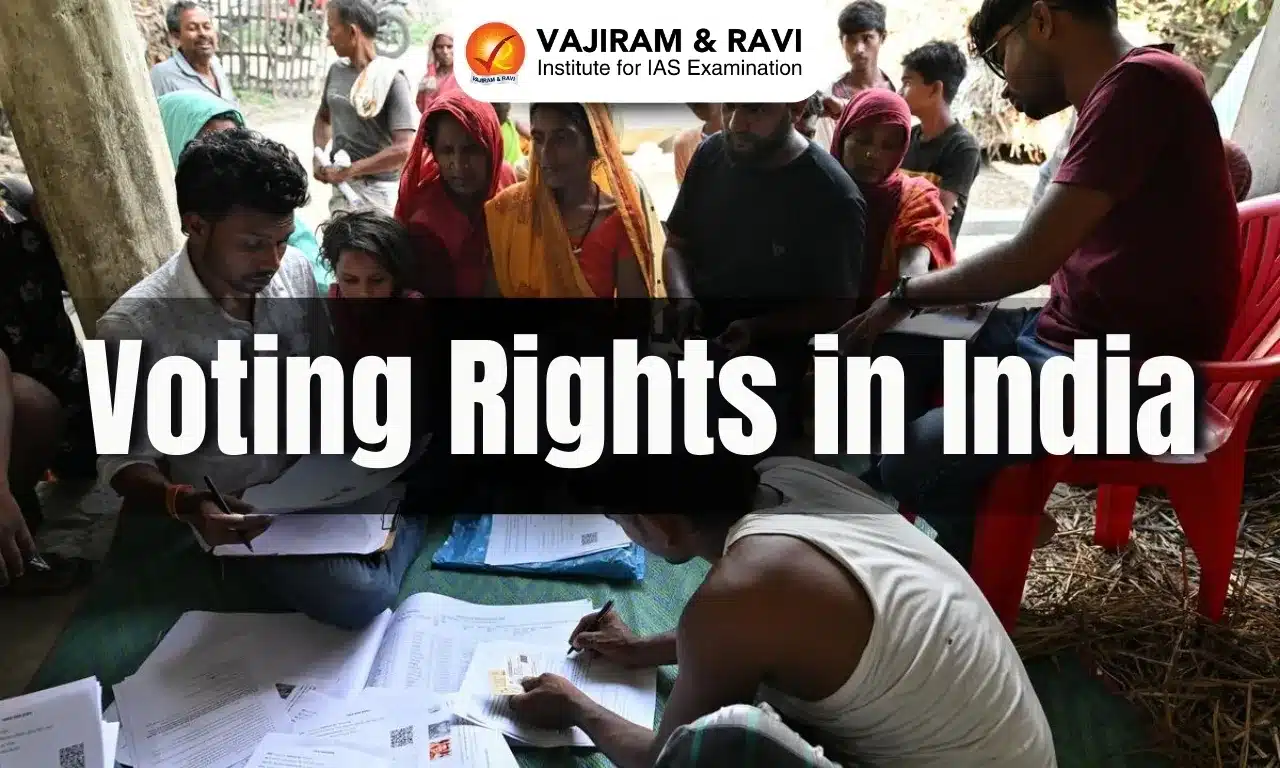
    • The Election Commission ensures that every citizen, no matter how remote, can exercise their right to vote — a core pillar of India’s democracy.

Legal Status of Voting Rights in India

  • In India, the ‘right to vote’ is not a fundamental or constitutional right but a statutory right under Section 62 of the Representation of the People Act, 1951.
  • In Kuldip Nayar v. Union of India (2006), the Supreme Court ruled that voting is a statutory right, not a fundamental or constitutional one.
  • A 2016 judgment in Rajbala v. State of Haryana termed it a constitutional right, but the larger bench ruling in Kuldip Nayar prevails.
  • In Anoop Baranwal v. Union of India (2023), the Court maintained the established view. 
  • Justice Ajay Rastogi’s dissent linked voting to fundamental rights under Articles 19(1)(a) and 21, but his opinion was a minority view.
  • Even as a statutory right, courts and thinkers consider voting essential for democracy’s health and survival, reflecting its status as a “democratic imperative.”

Importance of Electoral Roll Accuracy in Safeguarding Democracy

  • Accurate electoral rolls are essential for free and fair elections in India, ensuring the principle of “one person, one vote.” 
  • Under the Representation of the People Act, 1950, the Election Commission is empowered to regularly update and correct these rolls.
  • Errors such as mass omissions, duplicate entries, or ineligible inclusions can lead to impersonation, voter disenfranchisement, and distortion of election outcomes.
  • Allowing multiple ID documents like Aadhaar, voter ID, and ration cards strengthens every citizen’s right to be included and represented.
  • According to Lakshmi Charan Sen v. A.K.M. Hassan Uzzaman (1985), political parties have a responsibility to ensure voter rolls are accurate, especially in a country with widespread illiteracy.
    • Given India’s party-based Parliamentary system, such vigilance will help to preserve ‘electoral integrity’.

Ordinary Resident in India’s Voter List

  • The Election Commission (EC) prepares electoral rolls under Article 324 of the Constitution and Section 19 of the Representation of the People Act (RPA), 1950.
  • Definition of Ordinary Resident
    • Any Indian citizen aged 18 or above who usually lives in a constituency can register as a voter.
    • Ordinary residence means regular and genuine presence — not a short or temporary stay.
    • For example, a student in a hostel may not qualify if their permanent home is elsewhere.
  • Why It Matters
    • This rule prevents fake registrations and keeps voters connected to their constituencies.
    • In Manmohan Singh’s case (1991), the court clarified that ordinary residence means habitual presence, not just a formal address.
  • Special Voter Categories
    • Postal ballots are allowed for service voters like soldiers, government staff abroad, and election officials.
    • Overseas Indians can register under Section 20A of the RPA but must vote in person.

Citizenship Verification Debate in Bihar

  • A key issue in Bihar's SIR process is citizenship verification. 
  • In Lal Babu Hussein v. ERO (1995), the Supreme Court struck down Election Commission orders that allowed officials to remove alleged foreigners from voter rolls without proper procedure.
  • The Court held:
    • Proof of citizenship cannot be unfairly demanded from voters.
    • Past voter lists must be respected.
    • EROs must conduct full inquiries, follow fair procedures, and act under the Citizenship Act and Constitution.
  • As reaffirmed in Md. Rahim Ali Case (2024), no one can be excluded from voter rolls based on mere suspicion or unverified allegations.

Source: TH | AJ

Voting Rights in India FAQs

Q1: What is the legal status of voting rights in India?

Ans: Voting is a statutory right under the Representation of the People Act, not a fundamental right as per the Supreme Court.

Q2: How does India ensure universal adult suffrage?

Ans: Through Article 326, RPA laws, and innovations like election symbols ensuring inclusivity even for illiterate voters.

Q3: Why is electoral roll accuracy important?

Ans: It safeguards free elections by preventing impersonation, disenfranchisement, and duplication while upholding democratic integrity.

Q4: Who qualifies as an ordinary resident for voting?

Ans: A person habitually living in a constituency, not just temporarily staying, as clarified in multiple court judgments.

Q5: What did the Supreme Court rule on citizenship verification?

Ans: Citizenship verification must follow due process, respecting past voter rolls, without vague suspicions or arbitrary deletions.

Electoral Roll Revision in India: Special Intensive Revision, History, and Legal Safeguards Explained

Electoral Roll Revision in India

Electoral Roll Revision in India Latest News

  • The Supreme Court allowed Bihar’s Special Intensive Revision (SIR) of electoral rolls to continue but advised accepting Aadhaar, voter ID, and ration cards as valid documents.
  • Political opposition has grown over the ECI’s rule requiring even existing voters (enrolled after 2003) to provide birth-related documents to prove citizenship, raising fears of large-scale voter disenfranchisement.
  • In earlier electoral roll revisions across India, similar concerns had arisen. Over time, legal safeguards evolved:
    • Courts ruled that voters cannot be excluded without full inquiry and due process.
    • Past voter lists must be respected as valid proof.
  • Citizenship verification cannot rely on vague suspicions or unverified claims.

Types of Electoral Roll Revisions in India

  • An intensive revision involves preparing fresh electoral rolls through house-to-house visits, recording eligible voters as of a set date. 
  • This is done when existing rolls are outdated or inaccurate, usually before major elections or after constituency changes. 
  • In contrast, a summary revision is a regular annual update where draft rolls are published, and citizens can request additions, deletions, or corrections without home visits. 
  • A special revision occurs in exceptional situations like missed areas, major errors, or legal or political needs. 
  • It may follow either summary or intensive methods, depending on what is required to maintain accurate and inclusive voter lists.

Bihar’s Exercise: A Special Intensive Revision

  • The ongoing Special Intensive Revision (SIR) in Bihar combines elements of both intensive and summary revisions under the ECI’s powers in Section 21(3) of the 1950 law. 
  • It involves door-to-door verification along with using existing voter lists.
  • What makes it different is a new requirement: electors must provide documentary proof of birth or place of birth during enumeration — a step not seen in earlier revisions. 
  • The term “special” highlights this flexible, hybrid method tailored to specific needs.

Why the Special Intensive Revision Began Now, Starting with Bihar

  • The Special Intensive Revision (SIR) is a nationwide exercise announced by the Election Commission of India (ECI)— the first such drive in over 20 years. 
  • It began with Bihar, where Assembly elections are due before November.
  • The ECI cited major changes in voter lists caused by urbanisation, migration, and voters shifting addresses without deleting previous entries, leading to duplication. 
  • Repeated political complaints, including allegations of electoral roll manipulation, have also prompted this verification drive to clean up and standardise rolls across the country.

History and Purpose of Intensive Electoral Roll Revisions in India

    • Since Independence, the Election Commission of India (ECI) has conducted intensive revisions of electoral rolls multiple times — in 1952–56, 1957, 1961, 1965, 1966, 1983–84, 1987–89, 1992, 1993, 1995, 2002, 2003, and 2004.
    • Early Focus - The first revisions aimed to correct serious flaws in the rolls used for the 1951–52 Lok Sabha election, caused by public inexperience, administrative gaps, and the absence of a formal electoral law. 
      • A notable issue was the mass exclusion of women, many of whom did not share their names with officials.
  • Phased Approach - To improve accuracy, the ECI adopted a phased revision strategy — covering sections of each state yearly before major elections.
  • Changing Priorities Over Time - By the 1980s, focus shifted toward preventing ineligible entries, especially foreign nationals. 
    • Border states often reported such concerns, prompting the ECI to issue guidelines stressing that no name could be removed without due process, placing the burden of proof on the objector.
  • Role of EPIC - In 1993 and 1995, intensive revisions helped introduce Elector’s Photo Identity Cards (EPIC), although that wasn’t their main purpose.
  • Shift to Summary Revisions - As voter lists improved and costs grew, the ECI made summary revisions the norm. 
  • But when serious concerns arose due to demographic changes, political complaints, or administrative needs, the ECI returned to intensive methods tailored to that moment’s challenges.

Source: IE

Electoral Roll Revision in India FAQs

Q1: What is an intensive revision of electoral rolls?

Ans: A fresh house-to-house survey to record eligible voters, usually done before major elections or after constituency changes.

Q2: Why is Bihar undergoing a special intensive revision?

Ans: Due to upcoming Assembly elections and to address duplication, migration, and political complaints about voter list manipulation.

Q3: How is special intensive revision different?

Ans: It combines house visits with existing roll checks and introduces new document requirements during voter data collection.

Q4: How has India historically revised electoral rolls?

Ans: Through phased intensive revisions since the 1950s, focusing on correcting flaws, migration issues, and ineligible voter entries.

Q5: What safeguards exist against wrongful voter exclusion?

Ans: Courts mandate due process, respect for past rolls, and require credible evidence before removing any name from lists.

Enquire Now