
Enforcement Crackdown in ‘U.S. Donkey Route’ Case

Donkey Route

Donkey Route Latest News

  • The Enforcement Directorate (ED) and the National Investigation Agency (NIA) of India have intensified their investigations into human trafficking networks exploiting the "Donkey Route".
  • The donkey route is an illegal immigration pathway used predominantly by Indian migrants to reach the United States. 
  • The ongoing probe reveals an intricate web of traffickers, agents, fake visa consultancies, and international conduits, with grave implications for national security, human rights, and foreign relations.

Recent ED and NIA Crackdown

  • ED raids in Punjab and Haryana: Probing money laundering linked to illegal immigration rackets.
  • NIA arrests key operatives:
    • Arrest of traffickers linked to Gagandeep Singh, a kingpin arrested earlier.
    • Gagandeep allegedly trafficked over 100 Indians to the U.S. via Latin America, charging ₹45 lakh per person.

The Donkey/Dunki Route Explained

  • Meaning: It refers to long, illegal, and often dangerous migration routes involving multiple country border crossings. It was popularised by the 2023 Shahrukh Khan film Dunki.
  • Journey path and hazards:
    • Typical route: Starts from India → UAE → Latin American countries (Ecuador, Guyana, Bolivia, where Indian citizens can get visa on arrival or tourist visas easily) → Colombia → Panama (via Darién Gap) → Costa Rica → Nicaragua → Mexico → US.
    • Hazards: Dense forests (Darién Gap), risk of assault, extortion, and animal attacks. Dark, dangerous pathways/ tunnels under the US-Mexico border (e.g., Ciudad Juarez to El Paso).
    • Cartels: The criminal gangs operating in the vicinity of the Mexico-US border have in recent times shifted their primary business from drug trafficking to human trafficking, charging up to $6,000 per person.

Economic Dimensions of Human Trafficking

  • Cost to migrants: Agents charge ₹30-60 lakh, depending on the route. In a 2023 case, passengers paid ₹40 lakh–₹1.25 crore for Nicaragua-bound flights via Europe.
  • Agent networks: Local-level agents in India connected to international kingpins, facilitating fraudulent practices like fake visas, forged documents, and forced illegal crossings.

India’s Position in Global Illegal Migration

  • Trends:
    • In 2023, 96,917 Indians were caught/expelled at the US border (up from 30,662 in 2021).
    • According to Pew Research (2022), over 700,000 undocumented Indians in the US — third highest after Mexicans and Hondurans.
  • Deportation data (2009–2025):
    • Total deported since 2009: 15,756
    • Highest: 2,042 in 2019.
    • Latest (2025): 104 deported so far this year (as per EAM S. Jaishankar).

Variations of Illegal Migration Routes

  • Student visa route via Canada:
    • Agents arrange admissions in dummy Canadian colleges. Students then cross into the US illegally.
    • Cost: ₹50–60 lakh per person.
    • ED probe: An international syndicate of human traffickers that includes at least 260 colleges in Canada issued student visas to "illegal migrants" to take the Canadian route to the US.
  • Case study: Three members of a Gujarati family froze to death at the US-Canada border. This prompted an ED probe into fraudulent agents and money laundering.

Implications for India

  • National security: Involvement of transnational criminal networks poses risks of terror infiltration and financial crimes.
  • Diplomatic concerns: India’s image as a top source of undocumented migrants can strain bilateral relations, especially with the US and Canada.
  • Human rights violations: Migrants face extreme conditions — death, sexual assault, extortion — violating basic human dignity.
  • Policy responses needed:
    • Strengthening emigration laws.
    • Regulating private travel and visa consultancies.
    • Enhancing bilateral cooperation on anti-trafficking.

Conclusion

  • The “Donkey Route” is not just a route — it is a symptom of deep socio-economic desperation and systemic regulatory failures
  • While enforcement agencies like the ED and NIA have intensified crackdowns, a comprehensive policy approach addressing demand, enforcement, international cooperation, and public awareness is essential to tackle this complex issue.

Source: TH | ET

Donkey Route FAQs

Q1: What is the “Donkey Route” used by Indian migrants?

Ans: It involves illegal migration through a chain of countries including the UAE, Latin America, Mexico and finally into the U.S.

Q2: What is the role of ED and NIA in tackling the human trafficking network?

Ans: They have launched coordinated operations, and probing financial crimes like money laundering linked to illegal migration rackets using the Donkey Route.

Q3: What are the implications of rising illegal migration from India to the US?

Ans: India's emergence as a top source of illegal migrants to the U.S. strains diplomatic relations, undermines international trust, and challenges its image as a responsible global actor.

Q4: What factors push Indian citizens to undertake dangerous illegal migration routes?

Ans: Unemployment, rural distress, aspiration for a better life abroad, and lack of awareness about legal channels are the key drivers pushing towards dangerous illegal migration routes.

Q5: What are the challenges in regulating visa consultancy networks of illegal immigration from India?

Ans: Weak oversight, unlicensed agents, transnational linkages, and limited legal deterrence make it difficult to regulate fraudulent consultancies.
Maharashtra’s Urban Maoism Bill 2024: Provisions, Concerns, and Impact Explained

Urban Maoism Bill Maharashtra

Urban Maoism Bill Maharashtra Latest News

  • The Maharashtra Assembly has passed the Special Public Security Bill, 2024, targeting “urban Maoism” and left-wing extremism. 
  • It criminalises activities like disturbing public order and encouraging law disobedience. The Bill allows property forfeiture even before conviction, raising concerns over vague definitions and potential police misuse. 
  • It now awaits clearance from the Legislative Council and the Governor’s assent.

Urban Maoism

  • Urban Maoism refers to the CPI (Maoist) strategy of expanding its influence in cities by mobilising students, intellectuals, professionals, and religious minorities
  • Their methods include creating NGOs, using protests, media campaigns, and infiltrating political and civil society organisations to weaken the state from within.
  • These supporters may not be armed insurgents but are accused of aiding the movement through intellectual, financial, or logistical help, including media campaigns, legal defence, or resource mobilisation.

The Strategy Document: STIR

  • The 2004 document titled Strategies and Tactics of Indian Revolution (STIR) guides CPI (Maoist) activities. It specifically directs cadres to:
    • Build urban bases to support armed struggle in rural areas.
    • Mobilise intellectuals, students, professionals, and minorities by spreading a sense of victimhood.
    • Form secret alliances with political parties, civil society groups, and other anti-state organisations.
    • Infiltrate mass organisations while maintaining secrecy.

Real-World Examples and Allegations

  • Official communications reveal alleged links between Maoists and groups like Popular Front of India (PFI).
  • Elgar Parishad Case (2018): Several activists and intellectuals were arrested in connection with alleged Maoist links following violence during the Bhima Koregaon event in Maharashtra.

Threats and Challenges

  • Expansion Beyond Forest Areas: While traditional Maoist activity is concentrated in rural belts like Chhattisgarh and Jharkhand, urban support networks help sustain it.
  • Disruption of Law and Order: Authorities claim Urban Maoists use protests, NGOs, and legal platforms to undermine state policy or law enforcement.
  • Difficult to Identify: Unlike armed insurgents, urban supporters operate under legal covers like academia, activism, or journalism, making legal action complex.

A New Kind of Warfare

  • Urban Naxalism is described as Naxalism minus AK-47
  • Instead of guns, it uses propaganda, protests, and alliances to destabilise the Indian state. 
  • It represents a form of Fifth Generation Warfare (5GW), where the battlefield includes media, politics, and public perception.

Maharashtra’s Special Public Security Bill: Background

  • First introduced in July 2024, Maharashtra’s Special Public Security Bill lapsed due to elections and was reintroduced in December after joint committee clearance. 
  • Aimed at countering “naxalism,” it empowers the government to declare organisations “unlawful” and penalise individuals linked to them. 
  • Modelled after the UAPA, it covers a broader range of “unlawful activities,” targeting urban Maoist networks and alleged support structures within cities.

Maharashtra’s Special Public Security Bill: Key Provisions and Penalties

  • The Bill defines unlawful activity as acts disrupting public order, violence, disobedience to law, or aiding extremist organisations. 
  • It prescribes 2–7 years' jail and fines for membership, fundraising, or managing such organisations. Offences are cognizable and non-bailable
    • Cognizable offences are serious crimes where police can arrest without a warrant.
    • Non-bailable offences require a court's discretion for bail, and are usually reserved for more serious crimes. 
  • The government can forfeit properties linked to unlawful organisations even before trial, with a 15-day notice. 
  • Affected parties can challenge forfeiture in the High Court within 30 days. 
  • An Advisory Board of three High Court-qualified persons must confirm the unlawful status of organisations.

Maharashtra’s Special Public Security Bill: Key Concerns

  • Unlike UAPA and PMLA, Maharashtra’s Bill uses vague terms like “practising disobedience” or “disrupting communication,” sparking fears it could criminalise legitimate protests. 
  • While UAPA and PMLA limit property attachment to terror or crime proceeds, Maharashtra’s Bill allows pre-trial property forfeiture without such safeguards. 
  • Critics argue it dilutes constitutional protections like presumption of innocence, risking misuse against dissenters.

Source IE; DDN

Urban Maoism Bill Maharashtra FAQs

Q1: What is Maharashtra’s Urban Maoism Bill 2024?

Ans: A law aimed at countering left-wing extremism and urban Maoist networks through criminal penalties and property forfeiture provisions.

Q2: What activities are criminalised under the Bill?

Ans: Disturbing public order, violence, disobedience, aiding extremist groups, and fundraising for unlawful organisations are penalised.

Q3: Why are there concerns about the Bill?

Ans: Vague definitions and pre-trial property forfeiture provisions may threaten civil liberties and criminalise legitimate protests.

Q4: How is this Bill different from UAPA?

Ans: It allows broader powers, including pre-conviction property seizure, with looser definitions compared to UAPA’s more specific guidelines.

Q5: What is Urban Maoism?

Ans: A strategy by CPI (Maoist) to expand influence in urban areas via intellectual, financial, and organisational support networks.

Kailash-Mansarovar Yatra Resumes 2025: Routes, History & Key Details

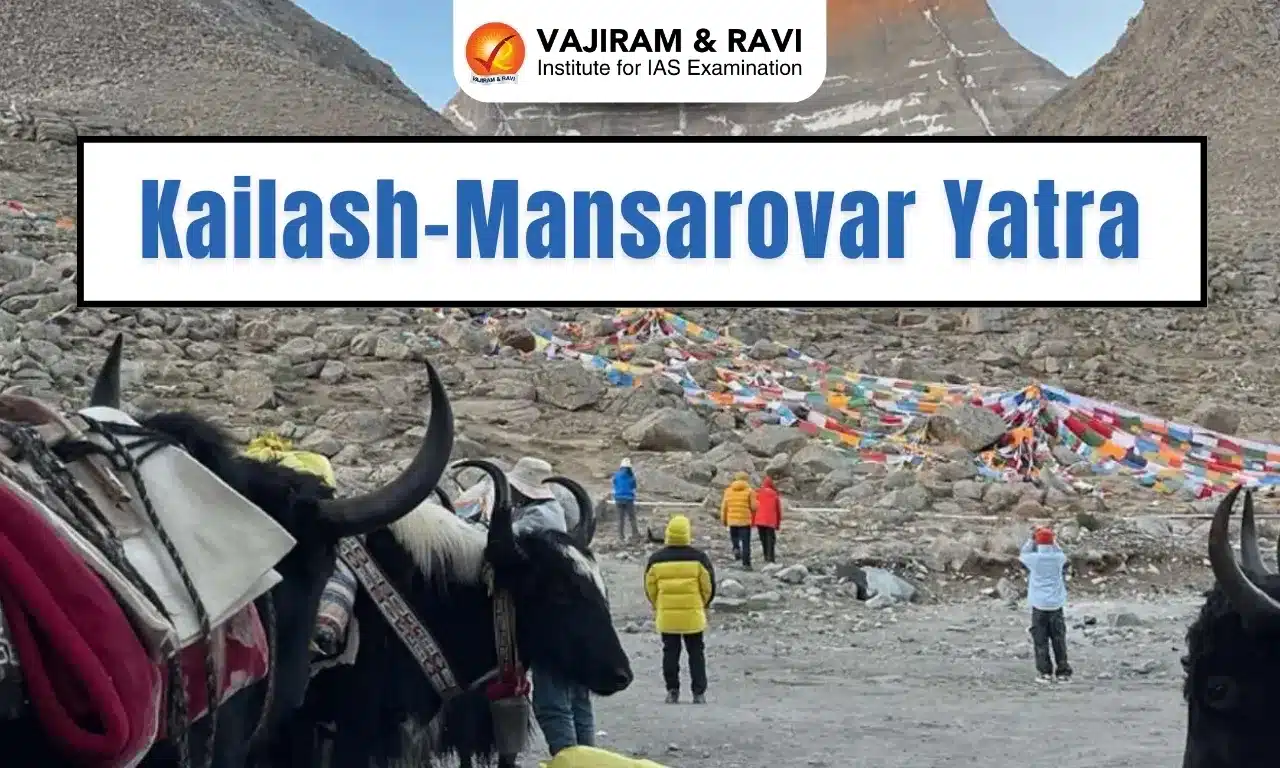
Kailash-Mansarovar Yatra

Kailash-Mansarovar Yatra Latest News

  • After a five-year pause due to Covid-19 and India-China tensions, the Kailash-Mansarovar yatra resumed in 2025. 
  • This year, 750 pilgrims were selected by the Ministry of External Affairs. 
    • Five batches of 50 pilgrims each are travelling via Uttarakhand’s Lipulekh Pass, while 10 batches of 50 each are using Sikkim’s Nathu La Pass.

Mount Kailash and the Sacred Lakes: Spiritual and Geographical Significance

  • Rising 6,638 metres in Tibet’s Ngari Prefecture near India and Nepal, Mount Kailash holds deep religious importance for Hindus, Buddhists, Jains, and Tibetan Bon followers. 
  • Hindus believe it is Lord Shiva’s abode; Jains see it as the site of their first leader’s enlightenment; Buddhists call it the universe’s centre, and Bon traditions consider it the home of the sky goddess Sipaimen. 
  • South of the mountain lie two lakes — freshwater Manasarovar and saltwater Rakshastal — both central to these spiritual traditions. 
  • Mount Kailash also serves as the source of four major rivers: the Brahmaputra, Indus, Sutlej, and Karnali, making it both a spiritual and geographical landmark.

How Kailash-Mansarovar Became a Popular Pilgrimage

  • Though revered for centuries, Kailash-Mansarovar wasn’t a mainstream pilgrimage site for ordinary Indians until the early 20th century. 
  • Tibetologists note that early Hindu and Buddhist texts described Kailash as a divine place accessible only to advanced spiritual practitioners. 
  • This changed after 1904, when Tibet opened up to British subjects. 
  • Charles Sherring, then Almora’s district collector, visited Kailash in 1905, recommended improving the pilgrimage route, and promoted it. 
  • His efforts helped popularise the Lipulekh pass route and brought attention to the site among the broader Hindu community, encouraging pilgrim traffic for both spiritual and economic reasons. 
  • By 1930, around 730 Indian pilgrims made the journey annually, until China’s annexation of Tibet in 1950 led to its closure. 
  • The pilgrimage resumed in 1981, making way for the first batch of Indian pilgrims to Kailash via Lipulekh since its closure.

Kailash-Mansarovar Yatra: Then and Now

  • The Kailash-Mansarovar pilgrimage involves two main treks: 
    • a 90 km circumambulation of Lake Mansarovar, taking 3–5 days, and 
    • a tougher 52 km circumambulation of Mount Kailash, completed in around three days. 
  • In the late 1990s, pilgrims would begin at Tseti camp, walk around Mansarovar via places like Huore and Seralung Monastery, then trek around Kailash starting from Tarchen, passing landmarks such as Dirapuk and Dolma La.
  • With new motorable roads, trekking on the Indian side has reduced from 27 km in 2019 to just 1 km in 2025.
  • The Nathu La route, opened in 2015, offers an even easier journey — pilgrims cover the entire 1,500 km stretch from Nathu La to Mansarovar by car or bus.
  • This reflects how the pilgrimage has become more accessible over time.

Source IE

Kailash-Mansarovar Yatra FAQs

Q1: What is the Kailash-Mansarovar Yatra?

Ans: A pilgrimage to Mount Kailash and Mansarovar Lake, holding spiritual significance for Hindus, Buddhists, Jains, and Bon followers.

Q2: Why was Kailash-Mansarovar Yatra paused?

Ans: It was paused due to Covid-19 restrictions and India-China border tensions, resuming officially in 2025.

Q3: What are the main routes for the Yatra?

Ans: Through Uttarakhand’s Lipulekh Pass and Sikkim’s Nathu La Pass, as designated by the Ministry of External Affairs.

Q4: How has the Yatra changed in 2025?

Ans: New motorable roads have reduced trekking distances, making the journey easier for pilgrims, especially along the Lipulekh route.

Q5: Why is Mount Kailash spiritually significant?

Ans: It is regarded as Lord Shiva’s abode and the origin point of four major rivers including the Brahmaputra and Indus.

Enquire Now