

Aircraft Accident Investigation Bureau (AAIB): India’s Air Crash Probe Authority Explained

Aircraft Accident Investigation Bureau

Aircraft Accident Investigation Bureau Latest News

  • A month after the Air India AI 171 crash in Ahmedabad, where 241 of 242 onboard died, the Aircraft Accident Investigation Bureau (AAIB) released its preliminary report. 
  • The report revealed both engine fuel control switches moved from 'RUN' to 'CUTOFF' within seconds of takeoff, raising serious concerns. 
  • One pilot reportedly questioned the other about cutting off fuel, but the latter denied doing so. 
  • Since these switches don’t usually move accidentally, the incident has prompted deeper scrutiny, especially of the cockpit voice recorder (CVR) and flight data recorder (FDR), as part of the AAIB’s ongoing investigation process.

Investigating Aircraft Crashes

  • Under the 1944 Chicago Convention, overseen by the International Civil Aviation Organization (ICAO), aircraft crash investigations are primarily conducted by the ‘State of Occurrence’—the country where the accident takes place.
    • ICAO is a specialized agency of the United Nations that promotes the safe and orderly development of international civil aviation. 
    • Established in 1944, it sets standards and recommends practices for aviation safety, security, efficiency, and environmental protection.
  • Additionally, the State of Registry, State of the Operator, State of Design, and State of Manufacture have formal rights to participate in the investigation process. 
    • State of Registry - where the aircraft is registered,
    • State of the Operator - which operated the flight, 
    • State of Design - The country that regulates and oversees the organization responsible for designing and ensuring the airworthiness of an aircraft.
    • State of Manufacture - the country or jurisdiction that has authority over the organization responsible for the final assembly of an aircraft. 
  • These protocols are detailed in Annex 13 of the Convention.

AAIB: India’s Independent Air Crash Investigation Body

  • The Aircraft Accident Investigation Bureau (AAIB), under India’s Ministry of Civil Aviation, investigates civil aviation accidents and serious incidents. 
  • It was established in 2012 to ensure investigation independence from regulatory bodies like the Directorate General of Civil Aviation (DGCA), following global standards set by the International Civil Aviation Organization (ICAO). 

Legal Framework of the AAIB

  • Under Section 7 of the Aircraft Act, 1934, the Government of India is empowered to make rules for investigating aircraft accidents in India or involving Indian-registered aircraft.
  • Initially, the Air Safety Directorate of DGCA handled these investigations under the Aircraft Rules, 1937, aligned with Article 26 of the Chicago Convention.

Governing Rules

  • The Aircraft (Investigation of Accidents and Incidents) Rules, 2012 were formulated to formalize AAIB’s role.
  • These rules were later amended in 2017 and 2021.
  • AAIB is now designated as an “Attached Office” of the Ministry of Civil Aviation.

Functions and Role of the AAIB

  • AAIB classifies safety occurrences as Accidents, Serious Incidents, and Incidents.
  • It is empowered with immediate and unrestricted access to all relevant evidence from any agency or organisation, without requiring prior approval from judicial or government authorities.
  • It investigates all Accidents and Serious Incidents involving aircraft over 2,250 kg All Up Weight (the total weight of an aircraft with passengers and cargo) and Turbojet aircraft.
  • Investigations focus solely on preventing future accidents, not on assigning blame or liability (as per Rule 3 of Aircraft (Investigation of Accidents and Incidents) Rules, 2017).
  • Investigation Process
    • Immediate site investigation: AAIB sends investigators to collect and preserve perishable evidence, black boxes, wreckage samples, etc.
    • Evidence collection: Includes data from operators, regulators, involved personnel, and unrestricted access to all relevant materials.
    • Expert analysis: AAIB may engage domain experts and collaborate with agencies like Hindustan Aeronautics Limited and DGCA laboratories.
    • Report preparation: After internal review, a final report is published and shared with the ICAO and involved states.
  • Additional Functions
    • Conducting safety studies.
    • Issuing safety recommendations to DGCA India or other international aviation regulatory bodies for implementation and monitoring.

Source: IE | MoCA

Aircraft Accident Investigation Bureau FAQs

Q1: What is AAIB India?

Ans: AAIB is India’s official body investigating civil aviation accidents, ensuring independent, evidence-based probes under global ICAO standards.

Q2: When was AAIB established?

Ans: The AAIB was set up in 2012 under the Ministry of Civil Aviation to separate investigation from regulatory functions.

Q3: What powers does AAIB have?

Ans: AAIB has unrestricted access to crash sites, black boxes, and evidence, focusing solely on accident prevention, not liability.

Q4: Which laws govern AAIB?

Ans: AAIB operates under Aircraft (Investigation of Accidents and Incidents) Rules, 2012, amended in 2017 and 2021, under Aircraft Act 1934.

Q5: How does AAIB investigate crashes?

Ans: AAIB conducts on-site evidence collection, expert analysis, prepares public reports, and issues safety recommendations to DGCA and international bodies.
Why India Must Support CIMMYT and IRRI: Repaying the Green Revolution Debt

Green Revolution Debt

Green Revolution Debt Latest News

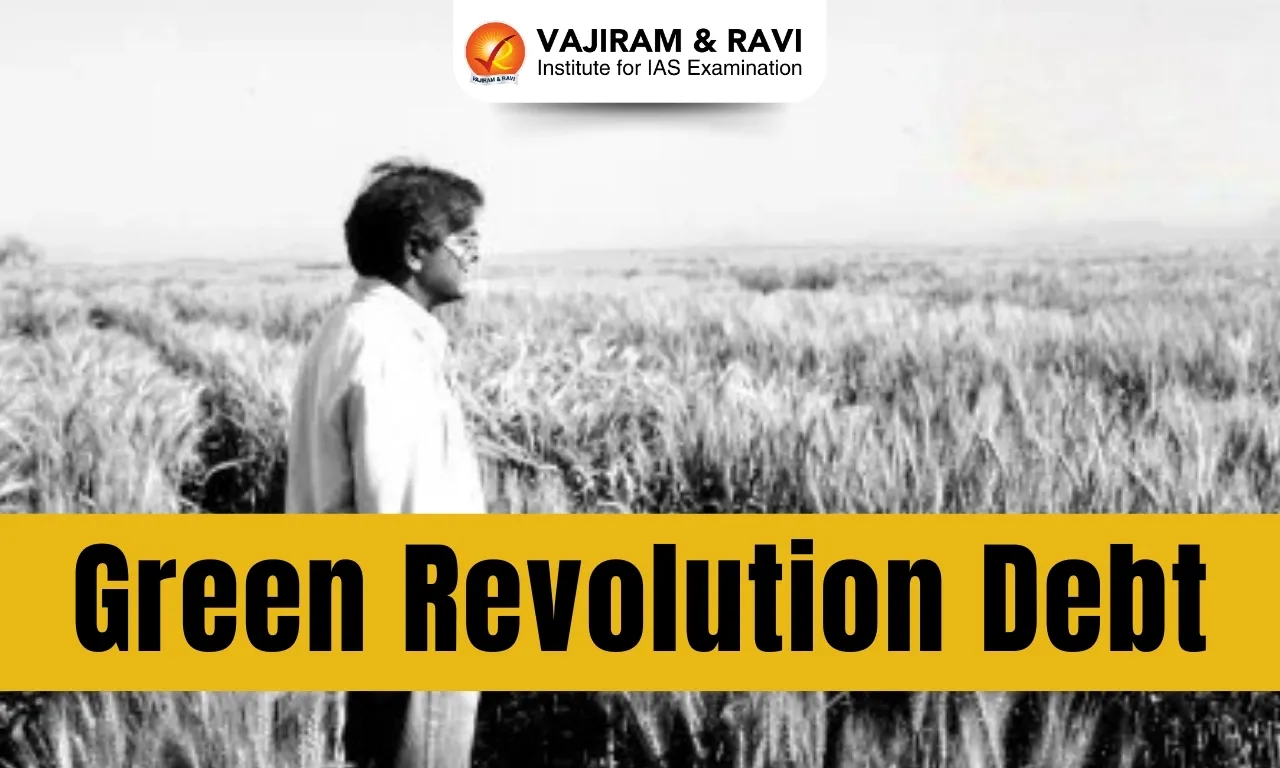
  • William S. Gaud of USAID coined the term “Green Revolution” in 1968, highlighting efforts like India’s adoption of high-yield wheat varieties to tackle global food challenges. 
  • USAID, which played a key role in supporting such agricultural advances, was shut down by the Trump administration from July 1. 
  • Its closure has affected institutions like CIMMYT, a major centre for maize and wheat research.
  • CIMMYT, linked to Norman Borlaug, developed key semi-dwarf wheat varieties that sparked India’s Green Revolution. 
  • Initially funded by Mexico and the Rockefeller Foundation, CIMMYT later relied heavily on USAID, which contributed $83 million of its $211 million funding in 2024. 
  • With USAID now shut, CIMMYT is turning to India—one of its biggest beneficiaries—for future support.

CIMMYT

  • Mexico-headquartered International Maize and Wheat Improvement Center or CIMMYT is a major centre for maize and wheat research.
  • CIMMYT is to wheat what the Philippines-based International Rice Research Institute (IRRI) — established by the Ford and Rockefeller foundations in 1960 — has been to the other big cereal grain crop.
  • It developed semi-dwarf wheat varieties like Lerma Rojo 64A and Sonora 63, first sown in India in 1964–65, sparking the Green Revolution.
    • Renowned agricultural scientist Norman Borlaug was closely associated with CIMMYT.
  • It originated from a Mexican government and Rockefeller Foundation initiative in the 1940s–50s.
  • USAID later became CIMMYT’s main funder, contributing $83 million of its $211 million grant revenues in 2024.
  • With USAID dismantled, CIMMYT is now seeking India as a major funding partner.

How Wheat and Rice Research Became Cold War Tools

  • CIMMYT and IRRI, key institutions backed by US foundations, helped expand wheat and rice production globally, especially in developing countries like India. 
  • This was part of US Cold War strategy to prevent food-related political instability and communist influence. 
  • Borlaug’s wheat varieties and IRRI’s semi-dwarf rice strains significantly increased crop yields and reduced growing times. 
    • Borlaug’s wheat varieties boosted Indian wheat yields from 1–1.5 tonnes to 4–4.5 tonnes per hectare, overcoming issues like lodging in traditional tall cultivars.
  • Borlaug received the 1970 Nobel Peace Prize for his contributions to global food security.

How India Benefited from the Green Revolution

  • The Green Revolution in India was driven by wheat and rice varieties from CIMMYT and IRRI. 
  • Indian scientists adapted these into wheat varieties like Kalyan Sona and Sonalika in 1967–68 using CIMMYT breeding material.
  • At IARI New Delhi, scientists led by VS Mathur developed high-yielding wheat varieties such as HD 2285 (1982), HD 2329 (1985), and later HD 2967 (2011), pushing wheat yields to 7+ tonnes per hectare.
  • In rice, V Ramachandra Rao and MV Reddy at Andhra Pradesh Agricultural University created mega varieties like Swarna (1982) and Samba Mahsuri (1986). 
  • IARI scientists developed top-selling basmati varieties like Pusa Basmati 1 (1989), 1121 (2003), and 1509 (2013).
  • India exported 6.1 million tonnes of basmati worth $5.94 billion in 2024–25, with over 90% from IARI varieties.
  • Norman Borlaug credited India’s success to strong institutions like IARI and leadership from MS Swaminathan. 

Why India Still Needs CIMMYT and IRRI

  • In 2024–25, six out of the top 10 wheat varieties in India—covering over 20 million hectares out of 32 million hectares—were developed using CIMMYT germplasm.
  • The only major recent Indian-bred wheat variety, HD 2967, peaked at 12–14 million hectares in 2017–19. Most new varieties since rely on CIMMYT material.
  • CIMMYT and IRRI remain crucial for India’s food security and agricultural growth. 

Conclusion

  • In 2024, India contributed just $0.8 million to CIMMYT and $18.3 million to IRRI, despite being a major beneficiary.
  • India should increase funding for these global institutions, focusing on strategic research in heat and drought tolerance, nitrogen use efficiency, gene editing, and AI tools. 
  • However, this support must complement—not replace—investment in India’s own agricultural research system.

Source: IE | IE

Green Revolution Debt FAQs

Q1: What is CIMMYT’s role in India’s agriculture?

Ans: CIMMYT developed semi-dwarf wheat varieties that kickstarted India’s Green Revolution and still contribute to major wheat production.

Q2: Why did CIMMYT look to India for support?

Ans: After USAID’s closure, CIMMYT seeks Indian funding, as India remains one of its biggest beneficiaries and stakeholders.

Q3: How did India benefit from IRRI and CIMMYT?

Ans: India’s high-yield wheat and rice varieties, including top basmati exports, were developed using CIMMYT and IRRI breeding material.

Q4: Why is continued support for CIMMYT important?

Ans: CIMMYT provides India with vital germplasm and research in heat tolerance, drought resistance, nitrogen efficiency, and crop improvement technologies.

Q5: How much does India contribute to CIMMYT and IRRI?

Ans: In 2024, India contributed $0.8 million to CIMMYT and $18.3 million to IRRI, despite being a key beneficiary.

Recognising India’s Open Ecosystems – A Call for Conservation and Policy Reform

Open Ecosystems

Open Ecosystems Latest News

Experts and environmentalists have raised concerns over India’s continued misclassification of deserts, grasslands, and savannas as “wastelands,” urging policymakers to recognise the ecological and socio-cultural value of these open ecosystems to ensure their protection and sustainable management.

Introduction

  • India’s deserts, grasslands, and savannas, collectively known as open ecosystems, are rich in biodiversity and cultural heritage. 
  • Yet, these landscapes continue to be misunderstood and misclassified as “wastelands,” often targeted for tree plantations or industrial use. 
  • Recent expert commentary emphasises the ecological importance of these open ecosystems and the urgent need to re-evaluate national land-use policies that ignore or erase them.

Understanding Open Ecosystems and Their Importance

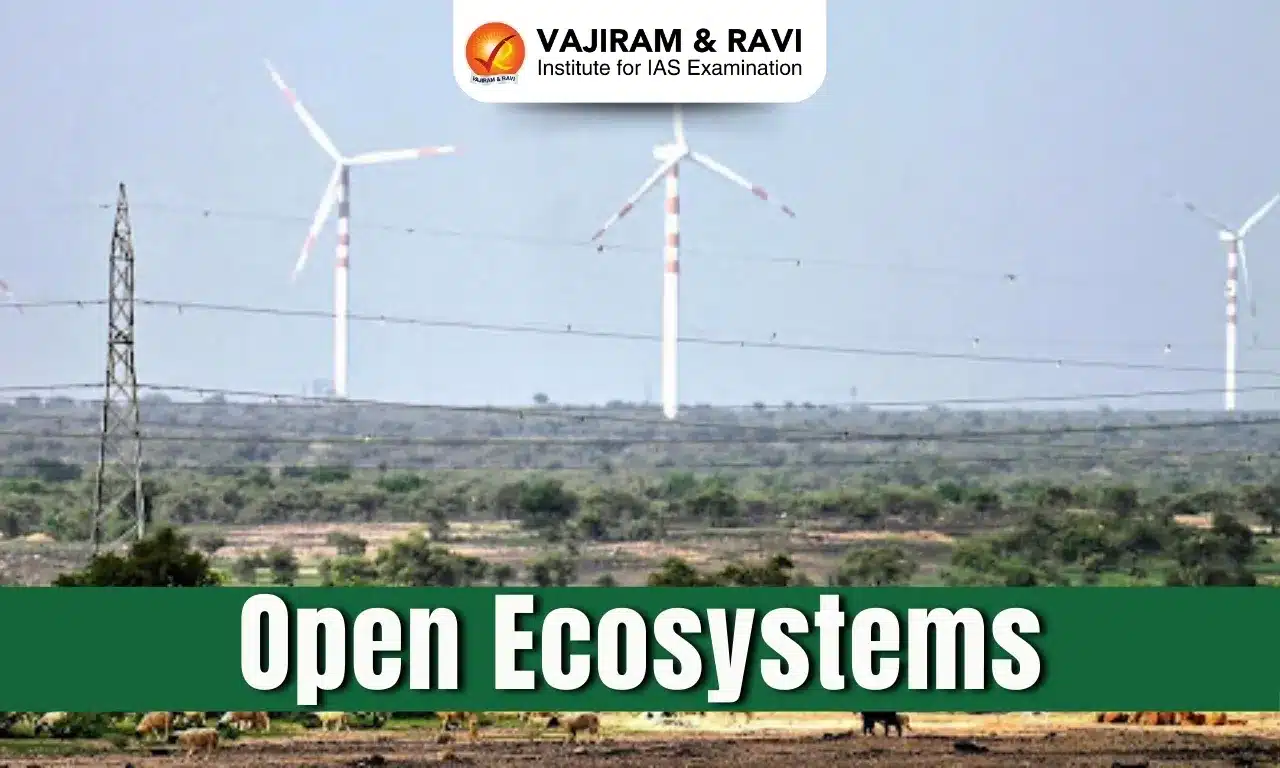
  • Open ecosystems such as arid deserts, grasslands, scrublands, and savannas are characterised by sparse tree cover and vast stretches of herbaceous or shrubby vegetation. 
  • Contrary to the common perception of being barren, these landscapes are finely tuned to their environmental extremes and support rich biodiversity.
  • Notably, deserts occupy nearly one-third of Earth’s terrestrial surface and host uniquely adapted flora and fauna
  • Historical evidence also reveals that several ancient civilisations, including those in Mesopotamia, Egypt, and the Indus Valley, emerged in desert climates, underscoring the capacity of these ecosystems to support complex societies.

Misclassification and the Legacy of 'Wastelands'

  • India’s policy and administrative frameworks have long inherited colonial land-use classifications, wherein vast tracts of open natural ecosystems are marked as "wastelands." 
  • This term erroneously implies that such lands are unproductive and in need of transformation, typically through afforestation, agricultural conversion, or urban development.
  • Official government records have classified millions of hectares of grasslands, savannas, and scrublands as wastelands. 
  • This mischaracterisation has led to extensive ecological damage and a weakening of ecosystem services such as carbon sequestration, soil fertility, and water retention.

Ecological and Social Value of Open Landscapes

  • India's open ecosystems are home to several endangered and endemic species such as the Great Indian Bustard, caracal, Indian wolf, and the chinkara. 
  • These species rely on the unique structure and rhythm of open habitats to thrive. 
  • Additionally, while tree-based carbon storage receives most attention, grasslands and savannas store substantial carbon deep in the soil, making them important in combating climate change.
  • Beyond biodiversity, these ecosystems are also vital to human livelihoods. 
  • Millions of pastoralist communities, including the Dhangars of Maharashtra, Rabaris of Gujarat, and Kurubas of Karnataka, depend on these landscapes for grazing. These groups have historically functioned as custodians of ecosystem health through practices like rotational grazing and water conservation.
  • However, policies that promote fencing, tree planting, or repurposing of grasslands often result in displacement, loss of income, and erosion of traditional ecological knowledge among these communities.

Rethinking Land Restoration and Greening Goals

  • The tendency to “green” deserts or grasslands through tree plantations often stems from the flawed belief that tree cover alone equates to ecological health. 
  • Such approaches may lead to monoculture plantations that degrade local biodiversity and disrupt seasonal ecological cycles.
  • Experts advocate for a restoration model that is low-tech, community-driven, and grounded in ecological principles. Strategies include:
    • Protecting native vegetation and enabling natural regeneration.
    • Promoting soil and moisture conservation through water harvesting.
    • Drawing from indigenous land management knowledge.
    • Recognising carbon stored in soil as a climate mitigation metric.
    • Importantly, policies must move away from one-size-fits-all afforestation efforts and instead embrace the diversity of India’s ecosystems.

Policy Recommendations and the Road Ahead

  • To ensure a sustainable future, India needs a paradigm shift in how it understands and manages open ecosystems. Policy recommendations include:
    • Revising land classification systems to eliminate the “wasteland” tag.
    • Formulating ecosystem-specific conservation plans.
    • Recognising the rights and stewardship roles of pastoralist communities.
    • Integrating open ecosystems into national climate and biodiversity strategies.
    • Incentivising the conservation of soil carbon alongside forest carbon.
  • Experts also call for symbolic shifts, such as renaming the World Day to Combat Desertification and Drought to “World Day to Combat Land Degradation”, to acknowledge the ecological legitimacy of deserts and grasslands.

Source: TH

Open Ecosystems FAQs

Q1: Why are open ecosystems like deserts and grasslands important?

Ans: They support unique biodiversity, store deep-soil carbon, and sustain millions of pastoralist livelihoods.

Q2: What is the problem with classifying such areas as ‘wastelands’?

Ans: It leads to ecological degradation by promoting inappropriate land-use changes like afforestation or industrial conversion.

Q3: How do pastoral communities contribute to ecosystem health?

Ans: Through rotational grazing, indigenous knowledge, and biodiversity stewardship practices honed over generations.

Q4: Why is afforestation in grasslands and deserts controversial?

Ans: Planting trees in open ecosystems can disrupt native species, soil systems, and reduce biodiversity.

Q5: What policy reforms are recommended for open ecosystem conservation?

Ans: Reclassifying wastelands, recognizing soil carbon storage, and empowering community-based restoration efforts.

Enquire Now