
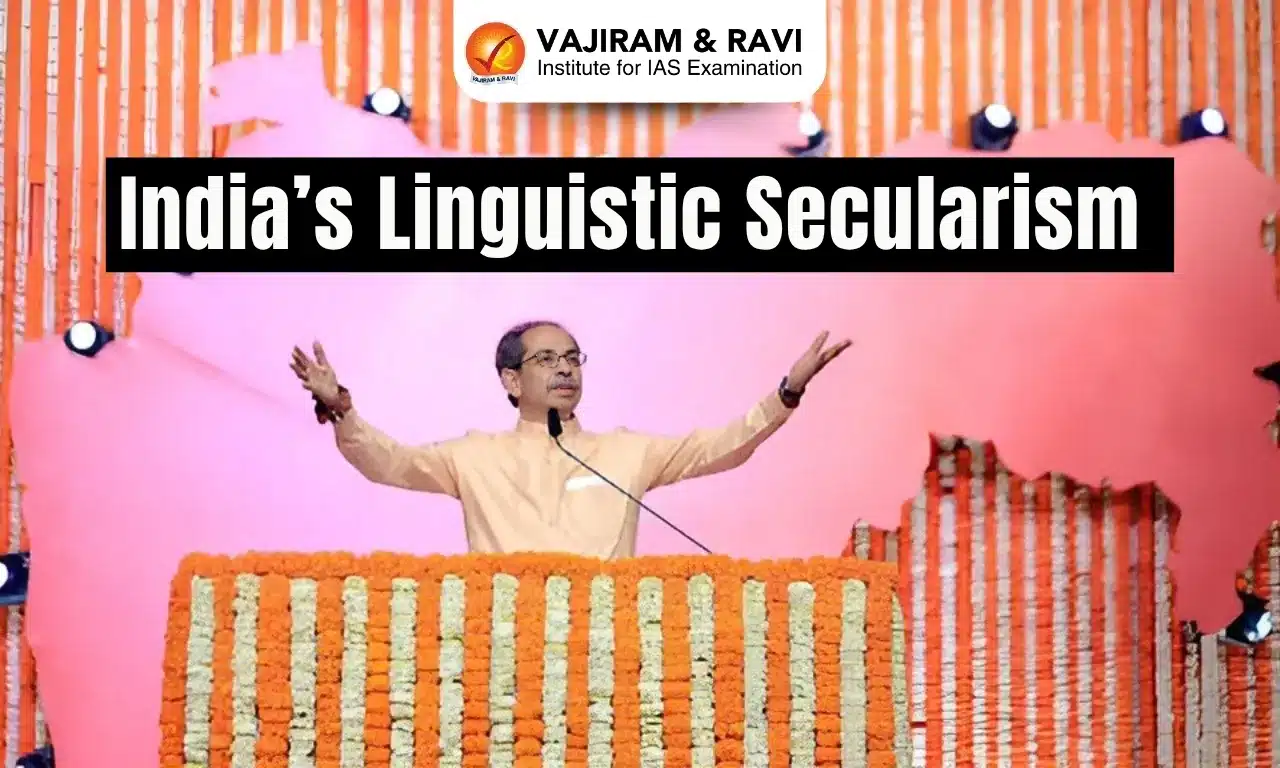
India’s Linguistic Secularism – Constitutional Values and Cultural Unity

India’s Linguistic Secularism

India’s Linguistic Secularism Latest News

Amid rising instances of language-based tensions and cultural exclusion, the article highlights the need to reaffirm India’s constitutional commitment to linguistic secularism to protect national unity and cultural diversity.

Introduction

  • India's strength lies in its diversity, and language forms a critical component of this pluralistic fabric. With 121 languages and 270 mother tongues as per the 2011 Census, India's linguistic richness is protected under the constitutional umbrella of secularism. 
  • However, recent regional tensions and identity politics threaten this equilibrium. 

Understanding Linguistic Secularism in the Indian Context

  • Secularism in India extends beyond religion; it encompasses language as a vital dimension of cultural identity and democratic coexistence. 
  • Unlike Western secularism, which emphasises the separation of church and state, Indian secularism is embedded in the idea of inclusive pluralism. The state neither promotes nor suppresses any religion or language but ensures equal treatment for all.
  • This inclusive model allows the state to actively counter both religious and linguistic communalism. 
  • It also empowers citizens with the right to preserve their linguistic and cultural identity without fear of discrimination.

Constitutional Provisions Supporting Linguistic Plurality

  • The Indian Constitution provides multiple safeguards to preserve the linguistic diversity of the nation:
    • Article 343: Declares Hindi in Devanagari script as the official language of the Union, while allowing states to adopt their own official languages.
    • Eighth Schedule: Lists 22 scheduled languages that are accorded recognition and development support from the government.
    • Article 29: Grants every section of citizens the right to conserve their distinct language, script, or culture, ensuring that language is not a basis for exclusion or discrimination.
  • These provisions form the legal foundation of India’s linguistic secularism, preventing the dominance of any single language and promoting the coexistence of multiple languages within a single national identity.

Official Language vs. National Language

  • Contrary to popular perception, India does not have a national language. The Constitution deliberately avoids designating any language as national, recognising the sensitivities associated with India's multilingual reality.
  • While Hindi is the official language at the central level, states are free to conduct their affairs in their own official languages. 
  • This decentralised approach has helped maintain harmony but also led to periodic friction, especially where fears of cultural imposition arise.

Language Politics and Rising Tensions

  • The recent incidents of violence in Maharashtra against non-Marathi-speaking citizens, along with historic resistance to Hindi imposition in Tamil Nadu and parts of the Northeast, reflect deeper anxieties about identity and cultural domination.
  • Such incidents indicate that language-based identity politics, when unchecked, can fragment society. 
  • The misuse of linguistic pride for political gains undermines the inclusive ethos of the Indian Constitution. Instead of cultural preservation, these movements often descend into exclusionary practices that contradict India’s secular and federal ideals.

The Role of Political and Civil Institutions

  • The preservation of linguistic secularism is not only a constitutional mandate but also a political responsibility. 
  • Political parties must act as guardians of India's linguistic harmony, resisting the temptation to exploit language for electoral benefits.
  • Civil society, media, and educational institutions must also play a proactive role in promoting tolerance, mutual respect, and inter-lingual understanding. Recognition of each language’s value in the national narrative can strengthen India’s unity in diversity.

A Call for Respect and Inclusivity

  • The essence of India’s linguistic secularism lies in its ability to respect all languages equally. 
  • This respect must extend beyond scheduled languages to the many dialects and mother tongues that constitute the soul of India’s cultural heritage.
  • Respecting linguistic rights is not only a constitutional imperative but also a moral one. It ensures social harmony, fosters inclusive development, and strengthens democratic citizenship.

Source: TH

India’s Linguistic Secularism FAQs

Q1: What is linguistic secularism in the Indian context?

Ans: Linguistic secularism in India refers to the constitutional principle of treating all languages equally without promoting or suppressing any.

Q2: Does India have a national language?

Ans: No, India does not have a national language; Hindi is the official language of the Union, and states are free to adopt their own official languages.

Q3: How many languages are listed in the Eighth Schedule of the Constitution?

Ans: The Eighth Schedule includes 22 languages officially recognized by the Indian Constitution.

Q4: What constitutional article protects the rights of linguistic minorities?

Ans: Article 29 guarantees linguistic and cultural rights to all citizens, including minority groups.

Q5: Why is linguistic secularism important for India’s unity?

Ans: It ensures equal respect for all languages, prevents linguistic domination, and strengthens India’s unity in diversity.

Decarbonising Global Shipping: India’s Role, Green Fuels, and Shipbuilding Strategy

Global Shipping Decarbonisation

Global Shipping Decarbonisation Latest News

  • Global shipping aims for decarbonisation by 2040–50, shifting from Very Low Sulphur Fuel Oil (VLSFO), diesel, and LNG to green fuels like green ammonia, e-methanol, and biofuels. 
  • This transition offers significant opportunities for India.

Production of Green Fuels

  • Green hydrogen is produced via water electrolysis using renewable energy. 
  • For shipping, more stable alternatives like green ammonia (from green hydrogen and nitrogen) and green methanol (from green hydrogen and industrial carbon dioxide) are preferred. 
  • India promotes green ammonia to reduce LNG imports in fertilizer production.

Green Methanol as Shipping’s Preferred Transition Fuel

  • Shipping is gradually adopting green methanol as its primary decarbonisation fuel due to its ease of use and lower carbon emissions—about 10% compared to conventional fuels. 
  • Green methanol can largely replace VLSFO without major engine modifications, unlike green ammonia, which, despite emitting no greenhouse gases, requires complex onboard handling.
  • Over 360 methanol-capable ships are already operational or on order, supported by major companies like Maersk, CMA CGM, and Evergreen. 
  • However, green e-methanol is significantly more expensive—costing $1,950 per tonne in Singapore as of February, compared to $560 per tonne for VLSFO. 
    • This price gap is driven by high renewable electricity requirements (10–11 MWh per tonne of methanol) and the substantial upfront cost of electrolyser facilities. 
  • Demand for green methanol is projected to exceed 14 million tonnes by 2028, while supply is expected to lag at around 11 million tonnes, adding further price pressure.

India’s Shipping Decarbonisation Strategy and Global Green Fuel Ambitions

  • India plans to decarbonise its domestic shipping by promoting green fuels for container ships and establishing green fuel bunkering hubs at ports like Tuticorin (V.O. Chidambaranar) and Kandla. 
  • The government also aims to produce and export green fuels to Singapore, a major global ship fuelling hub handling nearly 25% of the world's ship fuel needs. 
  • With its large solar power capacity and expertise, India is positioning itself as a key global supplier of green fuels to support international shipping’s shift towards sustainability.

Building India’s Green Marine Fuel Hub: Challenges and Solutions

  • India aims to become a major producer of marine green fuels like green methanol but faces challenges such as dependence on imported solar panels and electrolysers. 
  • However, India’s solar power growth—from 2.82 GW in 2014 to 105 GW in 2025—shows how sovereign guarantees and strategic policies can overcome such hurdles. 
    • Sovereign guarantees help lower project costs by enabling cheaper international financing.
  • For large-scale green methanol production, India needs innovative financial tools, including Production-Linked Incentive (PLI) schemes for electrolysers and incentives for carbon capture, utilisation, and storage (CCUS). 
    • These measures would support local value chains, reduce raw material transport costs, and make green methanol production from captured CO₂ feasible. 
  • The government's push to establish 1.5 GW local electrolyser manufacturing capacity and expanded industrial CO₂ sourcing positions India well for developing integrated green fuel hubs. 
  • Multilateral development banks offering low-interest financing (around 4% compared to 11–12% from Indian lenders) can also be leveraged to scale up efforts.

Reviving Indian Shipbuilding Through Green Fuel Initiatives

  • To boost shipbuilding and shipowning, India is offering demand-side support and incentives for foreign partnerships, especially with South Korean and Japanese shipbuilders. 
  • The focus is on building new ships and retrofitting existing ones for green fuel compatibility. 
  • India has committed $10 billion to purchase over 110 ships, with plans to ensure 10–20% of these are green fuel-capable, built in Indian shipyards, and fly the Indian flag. 
  • This strategy aims to scale up local shipbuilding while aligning with global decarbonisation goals.

Source: PR | UNCTAD

Global Shipping Decarbonisation FAQs

Q1: What is global shipping’s decarbonisation target?

Ans: Global shipping aims for net-zero emissions by 2040–50, transitioning from fossil fuels to green ammonia, methanol, and biofuels.

Q2: Why is green methanol preferred over green ammonia?

Ans: Green methanol is easier to handle onboard ships, requires minimal engine changes, and emits lower carbon compared to VLSFO.

Q3: What is India’s plan for green fuel bunkering?

Ans: India plans bunkering hubs at Tuticorin and Kandla to supply green fuels domestically and export to Singapore’s shipping hub.

Q4: How will India finance green methanol production?

Ans: Through sovereign guarantees, PLI schemes, CCUS incentives, and low-interest financing from multilateral development banks to reduce project costs.

Q5: How is India reviving shipbuilding through green fuels?

Ans: India will invest $10 billion to build and retrofit over 110 ships, with incentives for green fuel-capable vessels.

PM Professorship Scheme: Strengthening State University Research with ANRF Mentorship

PM Professorship Scheme

PM Professorship Scheme Latest News

  • Under this, the expertise of retired and eminent scientists, industry professionals, and Professors of Practice will be used for mentoring State universities with emerging research ecosystems.

Partnerships for Accelerated Innovation and Research Programme

  • ANRF has launched the Partnerships for Accelerated Innovation and Research (PAIR) Programme to strengthen India’s R&D ecosystem.
  • PAIR aims to cultivate research excellence across Indian universities, especially those with limited research capabilities. 
  • It uses a mentorship-driven hub and spoke model, pairing top-tier institutions (hubs) with emerging universities (spokes) to bridge capability gaps and foster collaborative research growth.

Hub and Spoke Model Structure

  • Hubs
    • Institutions within the top 25 of the NIRF overall ranking.
    • Institutions of National Importance within the top 50 NIRF ranking.
  • Spokes
    • Central and State Public Universities.
    • Select NITs and IIITs.
  • Network Composition
    • One hub can mentor up to seven spoke institutions.
    • Multi-departmental faculty teams from spoke institutions must be involved.
    • Regional diversity among participants is mandatory.

Key Benefits and Goals

  • Strengthening research and innovation ecosystems in emerging institutions.
  • Facilitating access to advanced infrastructure and best practices.
  • Driving impactful, internationally competitive research outputs.
  • Establishing collaborative research networks across institutions.

Prime Minister Professorship Scheme

  • Launched by ANRF, the Prime Minister Professorship aims to strengthen research and innovation culture in emerging state universities in India. 
  • It provides a platform for eminent, active, and superannuated scientists, faculty, and industry professionals to mentor universities where research ecosystems are still developing.

Need for the Scheme

  • India seeks to boost R&D in less endowed state universities.
  • There is a need for structured mentoring from experienced professionals to foster world-class research and innovation.
  • The scheme addresses gaps in research capability, international collaboration, and technological development in state universities.

Eligibility Criteria

  • Superannuated (retired) faculty/scientists from reputed Indian or foreign institutions/research labs/industries.
  • Active professionals from industry or experienced Professors of Practice with a proven track record in research and innovation.
  • Non-Resident Indians (NRIs), Persons of Indian Origin (PIOs), and Overseas Citizens of India (OCIs) are also eligible.
  • Willingness to relocate full-time to the host university in India is mandatory.
  • Host universities must be Category A spoke institutions under ANRF’s PAIR program.

Scope of Work and Responsibilities

  • Mentor faculty and students for world-class research.
  • Help enhance R&D capabilities in state universities.
  • Facilitate collaborations with established institutions, research labs, and industry.
  • Promote interdisciplinary research and knowledge exchange.
  • Guide in establishing research labs or common research facilities.
  • Provide 6-month internships to scholars in established institutions.

Funding and Support

  • Each selected Professor will receive:
    • Fellowship: ₹30 lakh per annum.
    • Research Grant: ₹24 lakh per annum (for consumables, travel, contingencies, equipment, etc.).
    • Overhead for host institution: ₹1 lakh per year.

Duration and Terms

  • Tenure: Up to 5 years (based on performance review).
  • No upper age limit but applicant must be superannuated.
  • Full-time presence at the host university is required.
  • No simultaneous honorarium/fellowship/salary from other institutions.
  • Intellectual property rights governed by the host institution’s norms.

Focus on State Universities through the PAIR Framework

  • Under the scheme, recipients must be placed at State universities designated as spoke institutions within Category A of ANRF’s Promoting Advanced and Inclusive Research (PAIR) programme.
  • PAIR connects universities with limited research capacity to top-tier “hub” institutions. 
  • These hub institutions are ranked 25 or below in the National Institutional Ranking Framework. 
  • The goal is to promote structured mentorship and collaborative research development.

Source: TH | SERB | DST

PM Professorship Scheme FAQs

Q1: What is the PM Professorship Scheme?

Ans: A programme where retired scientists mentor state universities to strengthen research ecosystems and foster world-class research capabilities.

Q2: Who is eligible for PM Professorship?

Ans: Retired scientists, industry professionals, and Professors of Practice with strong research credentials willing to work full-time in India.

Q3: What is the PAIR programme’s role?

Ans: PAIR links top-ranked universities (hubs) with emerging state universities (spokes) for mentorship-driven collaborative research growth.

Q4: What are the benefits for selected professors?

Ans: Each professor receives ₹30 lakh fellowship and ₹24 lakh research grant annually, along with institutional overhead support.

Q5: What is the scheme’s duration and terms?

Ans: Up to 5 years tenure, full-time presence required, no dual fellowships allowed, with intellectual property governed by host university.

Enquire Now