India Hits 50% Non-Fossil Fuel Power Capacity 5 Years Early

India Clean Energy Target

India Clean Energy Target Latest News

  • India has reached 50% of its installed electricity capacity from non-fossil fuel sources, five years before its Paris Agreement target. This milestone highlights India’s strong commitment to climate action and sustainable development.

India Reaches 50% Non-Fossil Fuel Power Capacity

  • As of June 30, 2025, India has achieved a major climate milestone: 50.1% of its installed electricity capacity now comes from non-fossil fuel sources
    • Back in 2015, non-fossil sources made up only 30% of India’s capacity, which grew to 38% by 2020. 
  • This achievement comes five years ahead of its 2030 target under the Paris Agreement.
  • The sharp increase over the last five years is largely due to solar and wind energy growth.
  • India’s total installed power capacity now stands at 485 gigawatts (GW). Out of this:
    • 185 GW comes from renewables like solar, wind, small hydro, and biogas.
    • 49 GW comes from large hydro projects.
    • 9 GW comes from nuclear energy.
  • Thermal power, mostly from coal and gas, now accounts for 242 GW or 49.9%. This is a significant drop from 70% in 2015. 
  • India’s clean energy transition is progressing faster than expected.

Renewable Energy Grows, But Thermal Power Still Dominates in India

  • India has made strong progress in expanding renewable energy, mainly through solar and wind power. 
  • By 2024, India became the fourth-largest country in renewable installed capacity, after China, the US, and Brazil.
  • However, even though thermal power capacity now accounts for less than 50% of total installed capacity, it still produces over 70% of India’s actual electricity
  • This is because renewable sources like solar and wind are not available all the time, while thermal plants provide steady, round-the-clock power.
  • To reduce thermal power’s share and meet the goal of 500 GW non-fossil fuel capacity by 2030, India will need major efforts to stabilise and strengthen its electricity grid.

India’s Power Grid Faces Challenges Due to Low Storage Capacity

  • From April 2020 to June 2025, India added 95 GW of solar and wind power, making up 35% of the country’s total installed capacity. 
  • However, this fast growth in renewable energy has created grid stability issues because India lacks enough power storage systems like batteries and pumped hydro.
  • When renewable generation is high and demand is low, the extra power cannot be stored. 
  • For example, on May 30, 2024, India faced its peak electricity demand of 250 GW, but grid managers struggled as renewable supply was low and thermal plants couldn’t fully cover the gap. 
    • Similarly, in May 2025, erratic rains caused weak demand, making solar power prices drop to zero on some afternoons.
  • These situations show how important storage is for absorbing extra renewable power and releasing it during peak demand. Without enough storage, grid instability increases and investors hesitate to fund new renewable projects.
    • By the end of 2024, India had less than 5 GW of storage capacity: 4.75 GW from pumped storage and just 110 MW from battery storage. 
  • Strengthening storage systems is crucial for managing India’s growing renewable energy share.

India Focuses on Energy Storage, But Progress Remains Slow

  • In February 2025, the Central Electricity Authority (CEA) advised co-locating energy storage systems with new solar projects. 
  • The Ministry of Power also expanded its viability gap funding (VGF) scheme, now supporting 43 GWh of battery storage with ₹5,400 crore in funding.
  • On the pumped hydro front, India plans to add 51 GW of capacity by 2032. To encourage investment, the government has extended the waiver on inter-state transmission system (ISTS) charges for storage projects until June 2028.
  • Despite these policy moves, actual progress has been slow. Very few battery storage projects have been commissioned so far, even though bid prices have fallen. 
  • Challenges include high upfront costs, import duties, and strict domestic content rules. Approvals for pumped hydro projects are also delayed.
  • China’s dominance in the global battery supply chain adds another layer of risk for India, especially with China’s restrictions on exporting key materials like rare earths.

Challenges Slowing India’s Renewable Energy Growth

  • India’s renewable energy sector is shifting towards hybrid tenders combining solar, wind, and storage for better grid stability. 
  • However, around 30 GW of older projects still lack power purchase agreements (PPAs), creating cash flow issues for developers.
  • Another major constraint is the limited supply of high-voltage direct current (HVDC) transformers, essential for long-distance power transmission. 
  • With rising global demand and few manufacturers, delays in transformer supply are affecting grid access and could slow down new capacity addition. 
  • Underinvestment in transmission infrastructure further adds to these challenges.

Source: IETH

India Clean Energy Target FAQs

Q1: When did India achieve its clean energy milestone?

Ans: By June 30, 2025, with 50.1% installed capacity from non-fossil fuel sources, surpassing Paris Agreement targets.

Q2: What contributes most to India’s clean energy capacity?

Ans: Solar and wind energy, supported by large hydro and nuclear, now form over half of India’s installed capacity.

Q3: Does thermal power still dominate in India?

Ans: Yes, despite capacity share falling below 50%, thermal power produces over 70% of India’s actual electricity output.

Q4: Why is grid stability a challenge for India?

Ans: Due to low power storage capacity, grid faces instability during peak demand or low renewable generation periods.

Q5: What is slowing India’s storage capacity growth?

Ans: High costs, delayed approvals, reliance on imports, and transformer shortages hinder faster development of energy storage infrastructure.


Spousal Privilege – Supreme Court Allows Secretly Recorded Spousal Conversations as Evidence

Spousal Privilege

Spousal Privilege Latest News

  • The Supreme Court of India has recently ruled that secretly recorded conversations between spouses are admissible as evidence in matrimonial disputes, including divorce proceedings.

Understanding Spousal Privilege under Indian Law

  • Spousal privilege, codified under Section 122 of the Indian Evidence Act, protects private communications between spouses during their marriage. 
  • This provision states that one spouse cannot be compelled, or permitted, to disclose any communication made by the other during the marriage, unless the communicating party consents or the case is between the married individuals themselves.
  • Historically, this privilege has been upheld to preserve the sanctity of marriage and shield spouses from being forced to testify against each other, particularly in criminal cases.

Scope and Limitations in Divorce Cases

  • Unlike criminal proceedings, divorce cases present unique legal challenges. When one spouse levels allegations such as cruelty, adultery, or mental harassment, they are permitted to present corroborative evidence, including letters, testimonies, and photographs.
  • In recent years, evidence in matrimonial cases has expanded to include electronic forms, like text messages, emails, and recorded conversations
  • However, many High Courts have hesitated to admit secret recordings due to concerns over privacy and coercion, as well as the legality of how such material is obtained.

The Supreme Court’s Landmark Ruling

  • Setting aside a 2021 Punjab and Haryana High Court verdict, the apex court ruled that secret recordings between spouses are legally admissible in matrimonial disputes. 
  • The Court justified this by relying on an earlier 1973 case involving police-recorded evidence in a bribery case. 
  • It noted that as long as evidence is relevant, verifiable, and falls under statutory exceptions, it can be admitted even if it was secretly obtained.
  • The Court interpreted that a recording device merely functions as a “digital eavesdropper”, akin to a third-party witness who overhears and testifies to a private conversation.

Balancing Privacy with Fair Trial Rights

  • This ruling raises fundamental questions about the right to privacy, which the Supreme Court recognised as a fundamental right in 2017. 
  • While critics argue that secret recordings infringe on individual privacy, the Court held that this right must be balanced against the right to a fair trial, particularly in cases of matrimonial disputes where truth and justice are paramount.
  • The judges observed that if a marriage has reached a stage where spouses are snooping on each other, it indicates an already eroded trust and a fractured relationship.

Gendered Concerns and Digital Access

  • A significant concern arising from this ruling is the digital gender divide. According to the 2025 Mobile Gender Gap Report, women in India are 39% less likely than men to own smartphones
  • In a scenario where evidence is increasingly collected through digital means, such disparity could disadvantage women litigants who may lack the tools or technical means to present their case effectively.
  • This uneven access to surveillance technologies may tilt the balance of fairness in matrimonial litigation, unintentionally reinforcing societal and technological inequalities.

Legal and Social Implications

  • The ruling redefines how courts can interpret Section 122 of the Indian Evidence Act, clarifying that the provision is rooted in protecting marital sanctity, not privacy within marriage. 
  • With evolving societal norms and the emergence of digital evidence, the judgment reflects the judiciary’s effort to adapt outdated laws to modern realities.
  • While this decision promotes judicial truth-seeking, it also calls for future legislative clarity to define permissible boundaries of surveillance within domestic relationships, ensuring that justice does not come at the cost of consent and dignity.

Conclusion

  • The Supreme Court's ruling on the admissibility of secretly recorded spousal conversations marks a turning point in Indian matrimonial jurisprudence
  • It reorients the principle of spousal privilege in light of technological realities and competing constitutional rights. 
  • While it strengthens the evidentiary tools available in divorce cases, it also underscores the need to address privacy concerns, gender disparities, and digital ethics in the courtroom.

Source: IE

Spousal Privilege FAQs

Q1: What is spousal privilege under Indian law?

Ans: Spousal privilege prohibits compelled disclosure of private communications between spouses, as per Section 122 of the Indian Evidence Act.

Q2: Is secretly recorded audio between spouses admissible in court?

Ans: Yes, the Supreme Court has ruled that such recordings can be used as evidence in matrimonial disputes if they are relevant and verifiable.

Q3: Does this ruling violate the right to privacy?

Ans: The Court held that the right to privacy must be balanced with the right to a fair trial, especially in divorce cases.

Q4: Why were High Courts earlier hesitant to allow such evidence?

Ans: High Courts often cited concerns over coercion, legality of the recording method, and the sanctity of marital privacy.

Q5: What concerns have been raised regarding this ruling?

Ans: Critics point to a gender gap in digital access, which could disadvantage women in presenting or countering such evidence.

PM Dhan-Dhaanya Krishi Yojana: Developing 100 Agricultural Districts in India

PM Dhan-Dhaanya Krishi Yojana

Dhan-Dhaanya Krishi Yojana Latest News

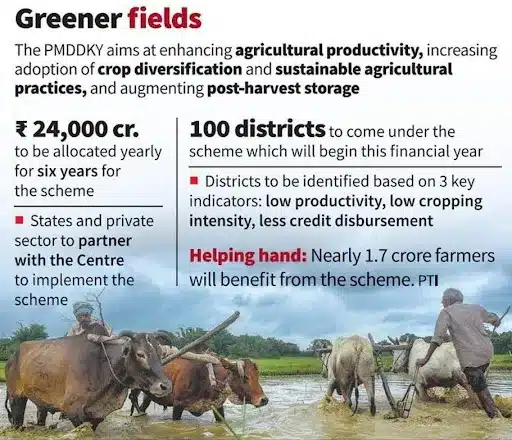
  • The Union Cabinet has approved the Prime Minister Dhan-Dhaanya Krishi Yojana (PMDDKY) to develop 100 agricultural districts by integrating 36 schemes across 11 ministries. 
  • The scheme has a yearly budget of ₹24,000 crore and will run for six years starting from 2025–26. It draws inspiration from NITI Aayog’s Aspirational District Programme and is first of its kind focusing exclusively on agriculture and allied sectors.

Main Goals of PM Dhan-Dhaanya Krishi Yojana

  • PMDDKY was announced in the Union Budget 2025. It focuses on improving farming in 100 districts that currently have low agricultural productivity, moderate crop intensity, and below-average credit access.
  • The scheme has five main goals:
    • Increase agricultural productivity.
    • Promote crop diversification and sustainable farming practices.
    • Expand post-harvest storage facilities at panchayat and block levels.
    • Improve irrigation systems.
    • Ensure easy access to both long-term and short-term credit for farmers.
  • By focusing on these areas, the government aims to boost productivity, support local livelihoods, and make the country more self-reliant in agriculture. 
  • As these 100 districts show improvement, India’s overall farming performance is expected to rise as well.

How PM Dhan-Dhaanya Krishi Yojana Districts Will Be Selected

  • Under PMDDKY, 100 districts will be chosen based on three main factors:
    • Low agricultural productivity
    • Moderate crop intensity
    • Below-average credit availability for farmers
  • Cropping intensity measures how many crops are grown on the same land in a year. At the national level, it was 155% in 2021–22, but this varies from state to state.
  • The number of districts selected from each state or Union Territory will depend on its share of net cropped area and the number of farming households. 
  • However, every state will have at least one district included in the scheme.

Implementation of the PM Dhan-Dhaanya Krishi Yojana 

  • For the PMDDKY scheme, each of the 100 selected districts will get a master plan covering agriculture and related activities. 
  • This District Agriculture and Allied Activities Plan will be prepared by a District Dhan Dhaanya Samiti, led by the Collector and including progressive farmers as members.
  • The district plans will focus on key national goals like crop diversification, saving water, protecting soil health, becoming self-sufficient in farming, and promoting natural and organic agriculture. 
  • Plans will be based on local farming patterns and climate conditions, created after wide consultations.
  • Committees will work at district, state, and national levels to ensure smooth implementation. 
  • Central Nodal Officers (CNOs) will be appointed to visit the districts, monitor progress, and conduct reviews. 
  • Agriculture universities from both central and state levels will help each district as knowledge partners, providing expert guidance.

Performance Ranking System for PM Dhan-Dhaanya Krishi Yojana Districts

  • PMDDKY will follow a model similar to the Aspirational Districts Programme (ADP) launched in 2018. 
  • It focuses on convergence of government schemes, collaboration between officers and districts, and healthy competition through performance rankings.
  • Under PMDDKY, all selected districts will be ranked monthly based on progress across 117 Key Performance Indicators (KPIs)
  • These indicators will cover areas such as agriculture, water resources, financial inclusion, infrastructure, and skill development.
  • NITI Aayog will guide and support the programme by offering expertise and helping build capacity at different levels. 
  • A dedicated portal or dashboard will be created to track and display the progress of each district regularly.

Source: IETHPIB

Dhan-Dhaanya Krishi Yojana FAQs

Q1: What is PMDDKY’s main aim?

Ans: To improve farming productivity, credit access, and infrastructure across 100 selected agricultural districts through integrated planning.

Q2: How are PMDDKY districts chosen?

Ans: Based on low productivity, moderate crop intensity, and below-average credit access, with at least one district per state.

Q3: How is PMDDKY implemented?

Ans: Through District Agriculture Plans prepared by district-level committees including officials and farmers, aligned with national agricultural goals.

Q4: How will PMDDKY’s progress be tracked?

Ans: Districts will be ranked monthly on 117 key indicators using a dedicated portal, following Aspirational Districts model.

Q5: What is the budget and duration of PMDDKY?

Ans: ₹24,000 crore annually for six years, starting 2025–26, to boost self-reliance in agriculture and allied sectors.

Enquire Now