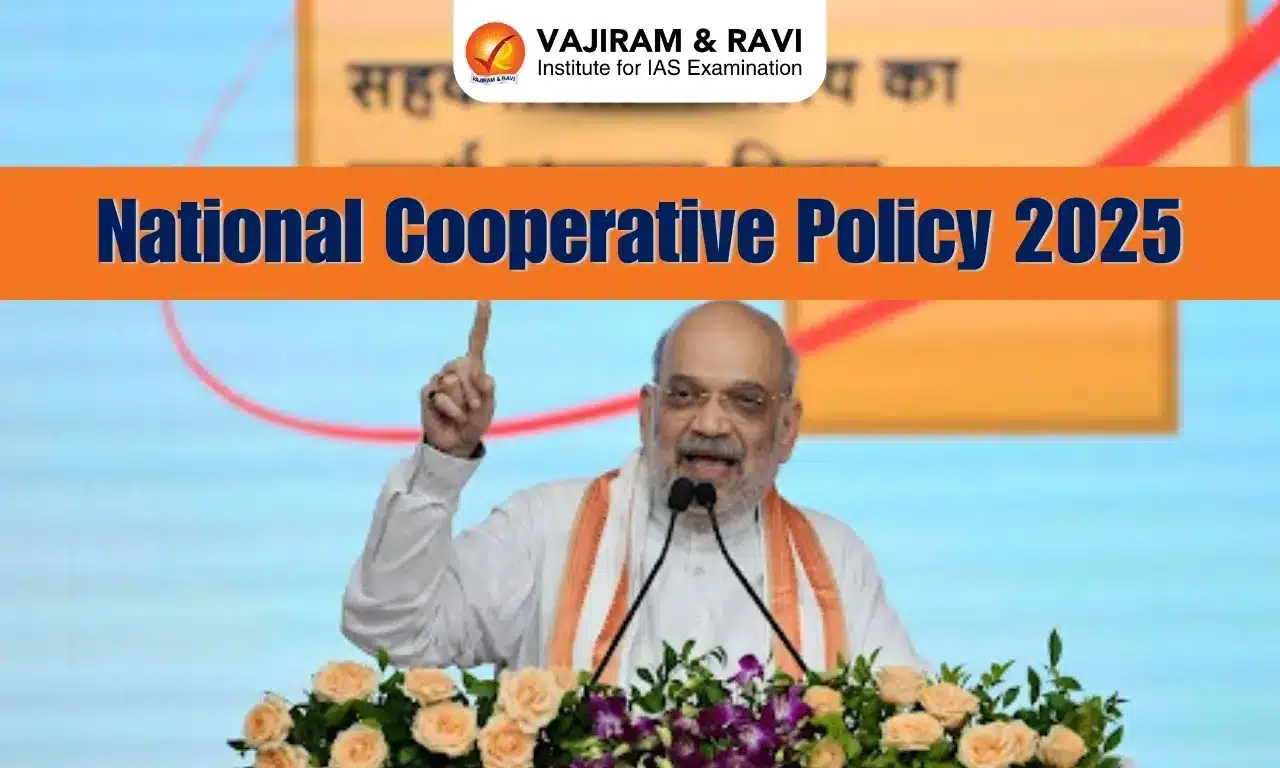
National Cooperative Policy 2025 – Revitalising India’s Cooperative Movement

National Cooperative Policy 2025

National Cooperative Policy 2025 Latest News

  • Union Home Minister Amit Shah has unveiled a new national cooperative policy, replacing one in place for the past 23 years.

National Cooperative Policy 2025

  • Union Home and Cooperation Minister Amit Shah launched the National Cooperative Policy 2025 in New Delhi, replacing the earlier framework introduced in 2002. 
  • The policy aims to strengthen the cooperative sector's institutional capacity, expand its reach into new areas, and align its role with India's broader development goals.
  • Anchored in the vision of Sahkar se Samriddhi (Prosperity through Cooperation), the policy outlines a roadmap for the sector’s growth over the next 20 years, focusing on inclusivity, transparency, technological adoption, and village-level economic empowerment.

Political and Historical Context

  • The National Cooperative Policy 2025 comes after a 23-year gap since the last policy was announced in 2002. 
  • The Union government’s decision to create a separate Ministry of Cooperation in 2021 signalled a renewed commitment to revitalising this sector.
  • With over 8.4 lakh cooperative societies (and a target to increase this by 30%), the sector reaches over 31 crore people, especially in states like Maharashtra and Gujarat. 
  • The policy also seeks to expand this network into other states like Uttar Pradesh and Bihar, thereby decentralising political and economic benefits.

Key Features of the Policy

  • The new policy is structured around six pillars:
    • Strengthening foundational systems
    • Promoting vibrancy in existing cooperatives
    • Preparing for future challenges through digitalisation and innovation
    • Enhancing inclusivity and outreach
    • Expanding into emerging sectors
    • Engaging youth and building capacity for future generations
  • It aims to increase the sector’s contribution to GDP threefold by 2034, establish at least one cooperative society in every village, and bring 50 crore citizens into active cooperative participation.

Expanding into New Sectors

  • Under the new policy, cooperatives will now be supported in non-traditional sectors, including:
    • Green energy
    • Tourism
    • Taxi services (Sahkar Taxi)
    • Insurance
  • PACS (Primary Agricultural Credit Societies) are being enabled to undertake diversified activities like managing fuel outlets, LPG distribution, Jan Aushadhi Kendras, CSCs, and even implementing schemes such as Har Ghar Jal and PM Surya Ghar Yojana.
  • A dedicated roadmap has been prepared for sector-specific cooperative development, particularly in rural India.

Model Cooperative Villages and Rural Integration

  • A major highlight is the Model Cooperative Village initiative. Every tehsil will host five such villages, implemented in coordination with state cooperative banks and NABARD. 
  • These villages will be centres of excellence in cooperative-led development, integrating:
    • Dairy
    • Fishery
    • Floriculture
    • Agri-services
    • Women and tribal participation (via White Revolution 2.0)
  • The goal is to localise economic activity while fostering inclusive growth and community ownership.

Institutional Strengthening and Reforms

  • To ensure efficiency and transparency, the policy mandates:
    • Full computerisation of PACS operations
    • Technology-driven governance for all types of cooperatives
    • Cluster monitoring systems for institutional tracking
    • Legal reviews every 10 years to keep policy aligned with evolving needs
  • As of 2025, over 83 intervention points have been identified for reform, 58 implemented, three completed, and others underway.
  • Additionally, a nationwide cooperative university (Tribhuvan Sahkari University) has been established for professional training and capacity building.

Economic Impact and Inclusive Vision

  • The cooperative sector currently contributes significantly to India’s rural economy:
    • 20% of the total agricultural credit
    • 35% of fertiliser distribution
    • Over 30% of sugar and 10% of milk production
    • Over 21% of the fishing sector
    • 13% of wheat and 20% of paddy procurement
  • With these foundations, the policy envisions a member-centric model where even the smallest cooperative units become self-reliant and future-ready, contributing to employment generation, income stability, and social dignity.

Source: PIB | IE

National Cooperative Policy 2025 FAQs

Q1: What is the National Cooperative Policy 2025?

Ans: It is a strategic policy framework to revitalise India’s cooperative sector for inclusive and sustainable development from 2025 to 2045.

Q2: What are the key goals of the policy?

Ans: The policy aims to triple the cooperative sector’s GDP contribution, establish one cooperative in every village, and include 50 crore active members.

Q3: What new sectors will cooperatives now operate in?

Ans: Cooperatives will expand into taxi services, tourism, insurance, and green energy, among others.

Q4: What is the Model Cooperative Village initiative?

Ans: Five model cooperative villages will be set up in every tehsil to showcase best practices in rural cooperative development.

Q5: How will transparency be ensured in cooperatives?

Ans: Full computerisation, technology-driven management systems, and a 10-year legal review cycle will enhance transparency and accountability.


Draft National Telecom Policy 2025 – Towards a Secure, Inclusive, and Sustainable Telecom Ecosystem

Draft National Telecom Policy 2025

Draft National Telecom Policy 2025 Latest News

  • The Government of India, through the Department of Telecommunications (DoT), has released the Draft National Telecom Policy 2025 for public comment, seven years after the 2018 National Digital Communications Policy (NDCP). 
  • The draft outlines a strategic vision to transform India into a telecom product nation, focusing on connectivity, cybersecurity, indigenous manufacturing, sustainability, and employment generation.

Vision Statement of the 2025 Policy

To create a "telecom product nation" driven by innovation and ensure universal, meaningful, secure, and sustainable connectivity for all citizens.

Key Focus Areas and Policy Highlights of the 2025 Policy

  • Universal and meaningful connectivity:
    • 5G coverage: Target to cover 90% of population with 5G by 2030.
    • 4G coverage: Achieve 100% 4G coverage nationwide.
    • Fiber-connected towers: Increase from 46% to 80% to improve reliability and speed.
    • Wi-Fi hotspots: 1 million new hotspots to be established (revised target from 10 million in 2018).
    • Satellite internet: Promoting satellite-based connectivity in remote areas.
  • Telecom sector employment and skilling:
    • Job creation: Create 10 lakh new jobs in the telecom sector.
    • Upskilling: Reskill another 10 lakh existing workers.
  • Strengthening domestic telecom ecosystem:
    • Domestic manufacturing: Aim for 150% increase in domestic telecom manufacturing by 2030.
    • Telecom manufacturing zone (TMZ): Establish dedicated zones with integrated infrastructure.
    • R&D promotion: Support local R&D and incentivize global standardization participation, including in 6G technologies.
    • CSR recognition: Telecom R&D and standardization efforts may be included under Corporate Social Responsibility (CSR).
  • Cybersecurity and Artificial Intelligence (AI):
    • AI for cybersecurity:
      • Defensive use: AI-enabled systems to detect and prevent cyberattacks.
      • Offensive threats: Address risks from generative AI-based attacks.
      • AI in governance: Use AI chatbots for consumer complaint resolution via a unified grievance portal.
      • Cross-border security: Enhance monitoring of border telecom signals and foreign satellites to reduce interference.
  • Green telecom and circular economy:
    • Carbon footprint: Reduce telecom sector’s emissions by 30%.
    • Material recycling: Promote circular economy by recycling telecom hardware and equipment.
    • Technological advancements:
    • Quantum-secure communications: Focus on quantum encryption technologies for secure communication.
    • Lawful interception: Removed from current policy draft, indicating a shift towards privacy-centric security mechanisms.
    • Mobile number validation: Support for services enabling mobile identity verification; draft regulations already released.

Comparison Between 2018 NDCP and Draft 2025 Telecom Policy

  • Terminology:
    • 2018 NDCP: Named as National Digital Communications Policy (NDCP).
    • 2025 Draft Policy: Termed as National Telecom Policy with a more sector-specific focus.
  • Employment target:
    • 2018 NDCP: Aimed to create 40 lakh jobs in the broader digital communications sector.
    • 2025 Draft Policy: Targets 10 lakh new jobs specifically in the telecom sector.
  • Wi-Fi Hotspot target:
    • 2018 NDCP: Targeted 10 million Wi-Fi hotspots across the country.
    • 2025 Draft Policy: Scaled down to 1 million hotspots, with a more realistic and focused approach.
  • Focus on domestic manufacturing:
    • 2018 NDCP: Had a moderate emphasis on promoting domestic manufacturing.
    • 2025 Draft Policy: Aims for a 150% increase in domestic manufacturing by 2030, including establishment of Telecom Manufacturing Zones (TMZs).
  • Use of AI and cybersecurity:
    • 2018 NDCP: Limited mention of AI in telecom operations.
    • 2025 Draft Policy: Provides a comprehensive strategy for using AI in cybersecurity, complaint redressal, and network security.
  • Environmental sustainability:
    • 2018 NDCP: Sustainability measures were not clearly quantified.
    • 2025 Draft Policy: Aims for a 30% reduction in the sector's carbon footprint and promotes circular economy practices.

Conclusion

  • With its forward-looking emphasis on indigenous innovation, secure communication, and sustainable growth, the Draft National Telecom Policy 2025 positions India to become a global leader in next-generation telecom technologies like 6G and quantum communications. 
  • If implemented effectively, it could serve as the backbone of India’s digital sovereignty and inclusive economic transformation in the decades to come.

Source: TH

Draft National Telecom Policy 2025

Q1: How will the draft National Telecom Policy 2025 make India a telecom product nation?

Ans: By promoting indigenous R&D, 150% rise in manufacturing, and creating Telecom Manufacturing Zones.

Q2: What is the role of AI in telecom cybersecurity?

Ans: AI will detect threats, prevent attacks, and also counter AI-based cyber offenses.

Q3: How does 2025 policy differ from 2018 in jobs and connectivity?

Ans: It narrows focus to telecom, aims 90% 5G by 2030, and creates 10 lakh jobs vs. 40 lakh earlier.

Q4: What are the sustainability goals in the draft policy?

Ans: 30% emission reduction and adoption of circular economy through equipment recycling.

Q5: How will the policy enhance telecom security?

Ans: Through quantum-secure communications, satellite monitoring, and border network control.

ICJ Climate Change Ruling: Legal Accountability, Compensation, and Global Climate Action

ICJ Climate Change Ruling

ICJ Climate Change Ruling Latest News

  • The International Court of Justice (ICJ) has issued a landmark advisory opinion declaring that countries have a legal obligation under international law to reduce greenhouse gas emissions. 
  • While not legally enforceable, the ruling can strengthen climate litigation globally and hold nations accountable for failing to act, including possible compensation. 
  • Prompted by a 2023 UN General Assembly resolution, the opinion underscores that climate action is not just policy but a binding duty—bolstering the demands of developing countries and climate advocates seeking stronger commitments from industrialised nations.

Case Background: Vanuatu's Climate Justice Initiative at the ICJ

Origin of the Initiative

  • In September 2021, the Pacific Island nation of Vanuatu launched a campaign to seek an advisory opinion from the ICJ on climate change. 
  • The move highlighted the urgency for stronger legal action, especially for vulnerable small island nations threatened by rising sea levels.
  • UN General Assembly Resolution
    • Following extensive lobbying by Vanuatu, the UN General Assembly adopted a resolution in March 2023, requesting the ICJ to provide legal clarity on two questions:
      • What are the obligations of States under international law to protect the environment?
      • What legal consequences do States face when they fail to meet these obligations and cause environmental harm?
  • Legal Framework and Importance
    • Under the UN Charter, both the General Assembly and the Security Council have the authority to request advisory opinions from the ICJ. 
    • Although these opinions are not legally binding, they carry significant legal and moral weight, serving to clarify and advance the development of international law.

ICJ Declares Climate Action a Legal Obligation

  • In a landmark advisory opinion, the International Court of Justice (ICJ) ruled that climate action is not optional but a binding legal duty under international law. 
  • Drawing on key climate treaties such as the UNFCCC, Kyoto Protocol, and Paris Agreement, along with environmental agreements like UNCLOS and the Montreal Protocol, the court stated that all countries are legally obligated to reduce greenhouse gas emissions
  • It emphasised that industrialised nations (Annex I countries) must lead in emission cuts and support developing countries through technology and financial aid
  • The court also warned that failing to meet these obligations constitutes an "internationally wrongful act," making countries liable for compensation to those affected by climate-related disasters. 
  • Furthermore, nations may be held accountable for harmful actions by private businesses if they fail to regulate or prevent such behaviour through appropriate laws and oversight.

Significance of ICJ’s Advisory Opinion on Climate Change

  • A Moral and Legal Turning Point
    • Although not legally binding, the ICJ’s advisory opinion is the most authoritative interpretation of international law on climate obligations. 
    • It is expected to influence courts globally and could shape future litigation against countries and corporations for inadequate climate action.
  • Reinforcing Global Climate Responsibility
    • The ruling comes at a time when progress on climate change is faltering. 
    • Many countries, particularly in the developed world, are falling short of their 2030 emission targets. 
    • The ICJ’s opinion reaffirms that countries have legal obligations—not just voluntary commitments—to take meaningful climate action. 
    • This strengthens the voice of vulnerable nations demanding accountability.
  • Loss and Damage: A New Legal Avenue
    • In a significant shift, the court recognised the right of climate-impacted nations—termed “injured states”—to not just compensation but full reparations. 
    • This legal validation of the “loss and damage” principle could pave the way for lawsuits against rich countries and corporate polluters, especially those historically responsible for emissions.
  • Challenges and Future Implications
    • While groundbreaking, the opinion also raises questions. 
    • For instance, the ICJ stated that merely initiating climate action isn’t enough—its adequacy can be challenged. 
    • However, under the Paris Agreement, countries define their own targets, with no provision to judge whether their actions are sufficient. 
    • These contradictions could lead to legal disputes and pushback, even from developing countries.

Conclusion

  • The ICJ’s ruling does not impose penalties or obligations immediately, but it sets a powerful precedent. 
  • Its real impact will emerge as national courts begin referencing it in climate-related disputes and as countries respond politically and legally to its interpretation of their duties under international law.

Source: IE | UN

ICJ Climate Change Ruling FAQs

Q1: What is the ICJ’s climate change ruling about?

Ans: The ICJ declared that countries are legally obligated to reduce emissions under international law and face consequences for failure.

Q2: Who initiated the ICJ advisory opinion on climate?

Ans: The Pacific island nation of Vanuatu, inspired by youth activism, led the movement for the UN to seek ICJ's opinion.

Q3: Are countries legally bound by the ICJ ruling?

Ans: No, it’s advisory. But it holds moral and legal weight, influencing future litigation and international environmental law interpretations.

Q4: What is the impact on developed countries?

Ans: They may face lawsuits, compensation claims, and global scrutiny for not fulfilling their legal climate obligations.

Q5: How does the ruling address corporate pollution?

Ans: Countries can be held liable for harmful actions by private corporations if they fail to regulate or prevent them properly.

India-UK Free Trade Agreement 2025: Key Highlights, Benefits, and Strategic Impact

India-UK Free Trade Agreement

India-UK Free Trade Agreement Latest News

  • India and the United Kingdom signed a landmark Comprehensive Economic Trade Agreement (CETA) during Prime Minister Narendra Modi’s visit to the U.K.
  • Alongside the agreement, both countries unveiled a new strategic cooperation plan — the India-U.K. Vision 2035, replacing the earlier Roadmap 2030
    • The Vision document outlines a comprehensive roadmap to deepen strategic ties across trade, technology, defence, education, climate, and innovation. 
    • It aims to boost jobs, investments, clean energy, and people-to-people links, anchored in shared democratic values and high-level political engagement to ensure mutual growth and global leadership.

Key Highlights of the India-UK Free Trade Agreement

  • The India-UK Free Trade Agreement (FTA), signed on July 24, 2025, offers comprehensive economic gains for India across goods, services, and labour mobility. 
  • Here’s a sector-wise summary:

Market Access: 99% Duty-Free Trade

  • India’s Gains: 99% of Indian exports to the UK will now be duty-free, benefitting nearly all trade value.
  • UK’s Gains: 90% of tariff lines will be reduced, with 85% becoming zero-duty within 10 years.
  • Sectors Impacted: Labour-intensive industries like marine, textiles, chemicals, base metals, and processed foods.
    • Tariffs on processed foods drop from 70% to zero; tea, coffee, spices, rubber, and plastics gain free access.

Agriculture: Boost to Rural Economy

  • Duty-Free Access: 95%+ tariff lines now zero-duty.
  • Products Covered: Fruits, vegetables, pulses, spices, pickles, jackfruit, millets, organic herbs.
  • Export Potential: Agri-exports could rise 20% in 3 years, aiding India’s $100B agri-export target by 2030.
  • Sensitive Items Protected: Dairy, oats, apples, edible oils.

Marine Products: A $5.4 Billion Opportunity

  • Tariff Elimination: Zero tariffs on shrimp, tuna, fishmeal, etc.
  • Current Share: India has only 2.25% share in UK marine imports.
  • Growth Potential: Major boost expected for India’s coastal economy.

Textiles & Apparel: Enhanced Competitiveness

  • Coverage: 1,143 product categories, all duty-free.
  • Market Impact: India may gain 5% more UK market share.
  • Key Products: Ready-made garments, carpets, handicrafts, home textiles.
  • Advantage: Levels playing field with Bangladesh and Cambodia.

Engineering Goods: Export Surge Expected

  • Current Status: $4.28B exports to UK; UK imports $193.5B globally.
  • Tariff Cuts: Up to 18% duties scrapped.
  • Projection: Engineering exports may double to $7.5B by 2030.

Pharmaceuticals & Medical Devices

  • Tariff Elimination: On generic medicines and medical devices.
  • Market Potential: UK imports $30B pharma; India exports just $1B.
  • Products Covered: ECG machines, X-ray systems, surgical equipment.

Chemicals & Plastics

  • Chemical Sector: Exports to rise 30–40% to $650–750M in FY26.
  • Plastic Sector: Focus on films, sheets, kitchenware; 15% export growth targeted.
  • Advantage: More competitive pricing versus global suppliers.

Toys, Sports Goods, Gems & Jewellery

  • Toys & Sports Goods: Export edge over China and Vietnam.
  • Jewellery: Exports may double in 2–3 years to capture UK’s $3B market.

Leather & Footwear

  • Tariff Removal: 16% duties scrapped.
  • Export Target: To exceed $900M.
  • Beneficiaries: MSME hubs in Agra, Kanpur, Kolhapur, Chennai.

Services & Professionals: A Global Edge

  • Worker Benefits: 75,000 Indians exempt from UK social security for 3 years.
  • Sectors Opened: 36 services sectors without Economic Needs Test.
  • Professional Access: Indian professionals can work in 35 UK sectors for 2 years.
  • Cultural Exchange: 1,800 chefs, yoga trainers, and artists to be welcomed annually.

Impact of India-UK Trade Deal

  • Gains for Indian Sectors - India’s key export sectors — including agriculture, processed food, textiles, footwear, seafood, gems and jewellery, and engineering goods — will enjoy expanded market access in the U.K. thanks to reduced tariffs.
  • Benefits for British Exports - British exporters will also benefit significantly. The deal is set to ease the sale of whisky, cars, and other British goods in India, helping diversify and broaden the trade portfolio.
  • Boost to Bilateral Trade - UK exports to India are projected to grow by nearly 60%, contributing an additional £15.7 billion by 2040. Overall bilateral trade is expected to surge by 39%, adding £25.5 billion annually compared to trade levels in the absence of the agreement.
  • Services and Mobility Provisions - The FTA includes chapters on services, innovation, and intellectual property, offering enhanced mobility for Indian professionals.
    • Additionally, a Double Contribution Convention Agreement will prevent Indian workers in the UK from paying into both Indian and British social security systems.
  • Strategic Shift after RCEP Exit - India's decision to exit the RCEP in 2019 due to fears of Chinese import surges shifted focus to Western economies. The India-UK deal is part of India’s strategy to forge stronger ties with high-income nations like the UK and EU.

Conclusion

  • The India–UK FTA marks a pivotal shift in India’s global trade posture. 
  • It not only strengthens bilateral relations but also signals India's readiness to engage in complex, high-standard economic agreements aligned with its broader goals of export growth, services integration, and global competitiveness.

Source: IE | ToI | MEA

India-UK Free Trade Agreement FAQs

Q1: What is the India-UK Free Trade Agreement 2025?

Ans: A landmark trade deal removing tariffs and boosting cooperation across goods, services, jobs, and strategic sectors like defence and innovation.

Q2: Which Indian sectors benefit most from the India-UK FTA?

Ans: Sectors like textiles, agriculture, marine, engineering goods, pharmaceuticals, and leather see massive gains from zero-duty access.

Q3: How does the FTA benefit Indian professionals?

Ans: It opens 36 service sectors and grants easier mobility, social security exemption, and new work visa opportunities in the UK.

Q4: What are the projected trade gains from the FTA?

Ans: India-UK bilateral trade is expected to rise 39%, with UK exports to India growing 60% by 2040.

Q5: Why is this agreement strategically important for India?

Ans: After exiting RCEP, India shifted focus to Western partnerships. This FTA signals readiness for high-standard, complex global trade deals.

Enquire Now