
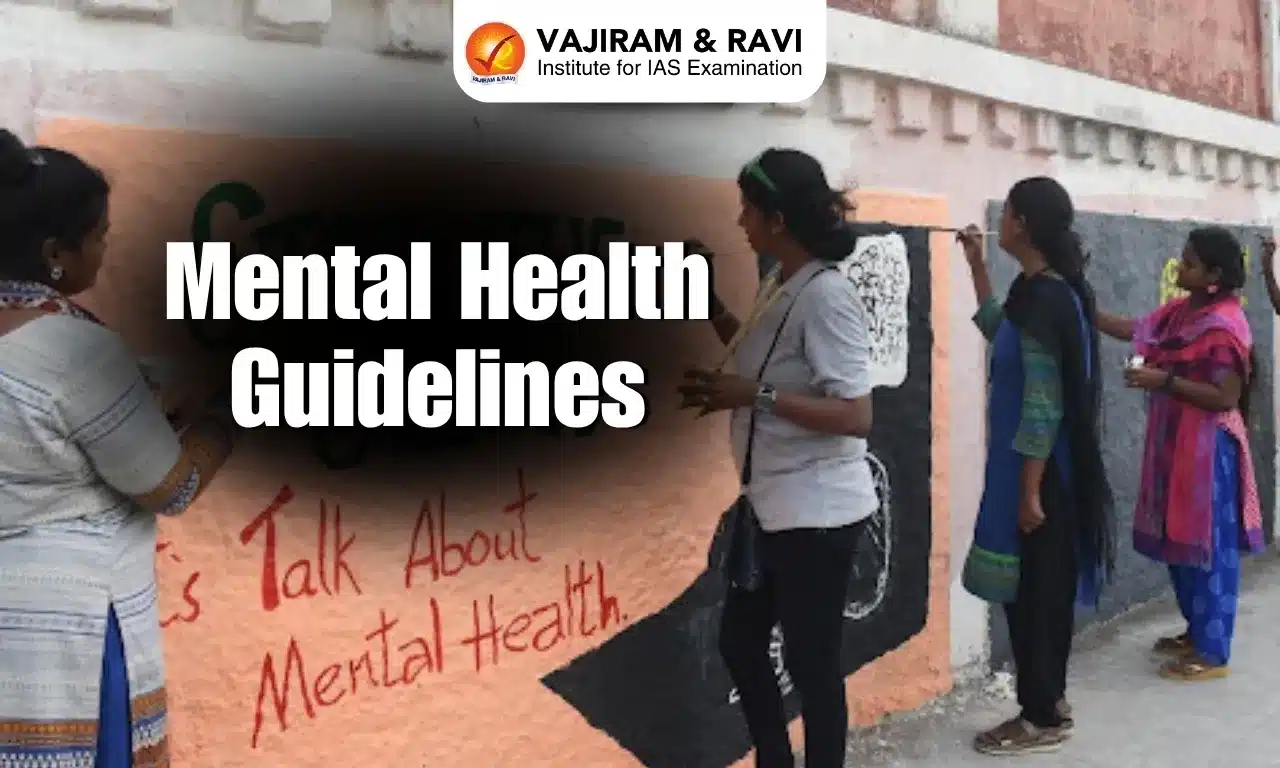
Mental Health Guidelines – Supreme Court’s Response to Rising Student Suicides

Mental Health Guidelines

Mental Health Guidelines Latest News

  • The Supreme Court has issued guidelines to educational institutions across the country.

Introduction

  • Rising cases of student suicides in India have prompted urgent judicial intervention. 
  • On July 26, 2025, the Supreme Court issued sweeping guidelines to educational institutions across the country, terming the growing mental health crisis a “systemic failure”
  • The judgment, issued by a two-judge bench, comes amidst increasing reports of suicides among students, particularly in high-pressure environments such as coaching centres and premier academic institutions.
  • The Court directed a uniform, enforceable mental health policy applicable to all schools, colleges, universities, hostels, and coaching centres, irrespective of their affiliation or ownership.

Increasing Suicides on Campuses

  • According to the National Crime Records Bureau (NCRB), 13,044 student suicides were recorded in 2022, comprising 7.6% of all suicides in the country. 
  • The number has increased sharply from 5,425 in 2001, underscoring a disturbing trend. At least 2,248 deaths in 2022 were directly attributed to exam failure.
  • The Supreme Court observed that students are being driven into a “rat race” where the joy of learning has been eclipsed by anxiety, performance metrics, and parental pressure. 
    • This competitive grind often isolates students, especially those in residential coaching environments far from their homes.
  • The Court stated, “Education is meant to liberate, not burden the learner… its true success lies not in grades or rankings, but in the holistic growth of a human being capable of living with dignity, confidence, and purpose.”
  • The bench also described the institutional silence around mental health as a key factor exacerbating student vulnerability, warning that suicide cases cannot be viewed as isolated tragedies but rather as a collective social failure.

Key Supreme Court Directives

  • In an unprecedented step, the Court issued 15 binding guidelines to be followed until a central regulatory framework is enacted. 
  • These apply to all educational institutions, public and private schools, colleges, universities, residential academies, hostels, and coaching centres.
  • Mandatory Counsellors and Support Systems
    • All institutions with 100 or more students must appoint at least one qualified counsellor, psychologist, or social worker trained in child and adolescent mental health.
    • Smaller institutions must establish referral linkages with external mental health professionals.
    • Staff must be trained twice a year by certified mental health experts.
  • Infrastructure and Physical Safety Measures
    • Residential institutions must install tamper-proof ceiling fans and restrict access to rooftops and high-risk areas to deter impulsive acts of self-harm.
  • Ending Discriminatory Academic Practices
    • Institutions were asked to end batch segregation based on academic performance, avoid public shaming, and refrain from setting unrealistic academic targets.
    • Such practices were deemed detrimental to the mental health of vulnerable students.
  • Institutional Accountability and Protection
    • Institutions must create robust, confidential redressal mechanisms for complaints involving harassment, bullying, caste- or gender-based discrimination, and sexual assault.
    • Retaliation against whistle-blowers or complainants will attract institutional liability.
    • Failure to act promptly will be treated as administrative culpability with legal consequences.
  • Policy Framework and National Coordination
    • All institutions must adopt and publish an annual mental health policy, taking reference from government initiatives such as:
      • Ummeed guidelines (Understand, Motivate, Manage, Empathise, Empower, Develop)
      • Manodarpan, launched by the Ministry of Education during the COVID-19 pandemic
      • National Suicide Prevention Strategy (India’s first nationwide strategy, released in 2022)
  • The Court also called for the formation of a National Task Force to institutionalise student mental health initiatives and suicide prevention mechanisms across the higher education landscape.
    •  

Background of the Verdict

  • The judgment was delivered in a case involving the suicide of a 17-year-old NEET aspirant in Visakhapatnam, whose parents sought a CBI investigation after alleged lapses in the state police inquiry. 
  • While addressing the individual case, the Court widened its scope to frame a national response to student suicides, recognising the broader institutional apathy and lack of psychological safeguards across educational spaces.

Significance and Future Implications

  • This landmark ruling by the Supreme Court marks a shift in recognising mental health as integral to the right to life and education
  • By mandating psychological support systems, regulatory oversight, and institutional accountability, the Court has provided a blueprint for a safer, more empathetic education system.
  • However, the success of these measures will depend on:
    • Timely notification and enforcement by states and Union Territories
    • Adequate budgetary allocations for hiring professionals
    • Sensitisation of staff and students toward emotional well-being
  • It also underscores the need for collective societal change, moving from a culture of academic pressure to one that prioritises the well-being, dignity, and individuality of each student.

Source : IE | TOI

Student Suicides in India FAQs

Q1: How many student suicides were reported in India in 2022?

Ans: A total of 13,044 student suicides were recorded in 2022, according to NCRB data.

Q2: What guidelines has the Supreme Court issued for educational institutions?

Ans: The Court issued 15 binding directives, including mandatory mental health counsellors, safety infrastructure, and redressal systems.

Q3: Which government initiatives were cited for mental health policy formulation?

Ans: The Court referenced the Ummeed guidelines, Manodarpan initiative, and the National Suicide Prevention Strategy.

Q4: Are coaching centres included in the Supreme Court’s guidelines?

Ans: Yes, all coaching institutes, hostels, and educational centres are covered under the new guidelines.

Q5: What role will the National Task Force play?

Ans: It will coordinate nationwide efforts on student mental health and institutional suicide prevention across higher education.
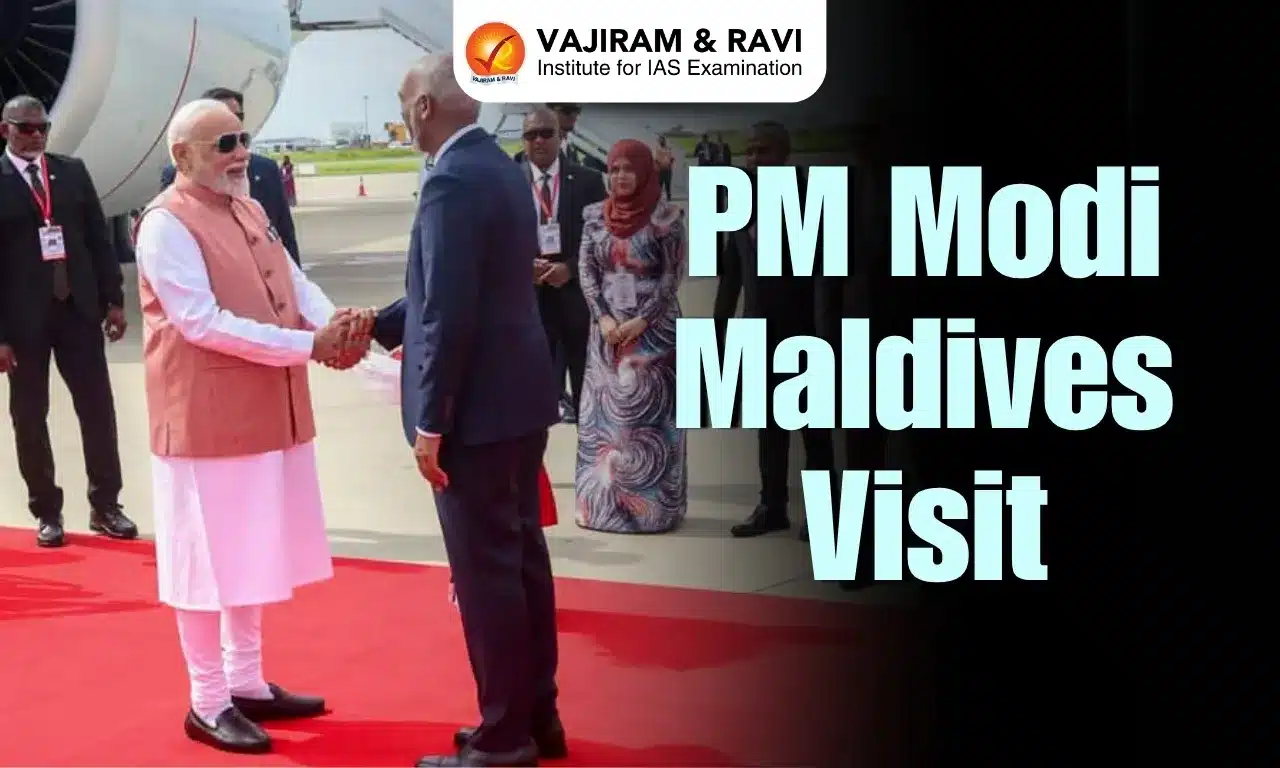
PM Modi’s Maldives Visit Marks Diplomatic Reset and Strategic Gains

PM Modi Maldives Visit

PM Modi Maldives Visit Latest News

  • Prime Minister Narendra Modi is on an official visit the Maldives, at the invitation of President Dr. Mohamed Muizzu. 
  • This marks his third visit to the Maldives and the first by any Head of State or Government during President Muizzu’s tenure.

Key Highlights of PM Modi’s Visit to Maldives

  • 60th Independence Day of Maldives
    • PM Modi congratulated Maldives on its 60th Independence Day
    • He is participating in the 60th Independence Day celebrations of the Maldives, as the Guest of Honour.
  • Stamp to mark 60 years of India-Maldives friendship released
    • PM Modi and President Mohamed Muizzu issued a stamp to mark 60 years of India-Maldives relations.
      • India was one of the first countries to establish diplomatic relations with Maldives following its independence in 1965.
    • The stamps feature India’s Uru boat and Maldives’ Vadhu Dhoni, symbolizing shared maritime heritage and centuries-old Indian Ocean trade.
      • Uru boat - A large wooden dhow handcrafted in the historic boatyards of Beypore, Kerala.
      • The traditional Maldivian fishing boat - Vadhu Dhoni - is used for reef and coastal fishing.
  • India gifts BHISHM health cube sets to Maldives
    • As part of India’s Neighbourhood First policy and Vision MAHASAGAR, India gifted handed over two units of Aarogya Maitri Health Cube [BHISHM] sets to the Government of Maldives. 
    • BHISM is a state-of-the-art portable Cube containing medical essentials, designed for rapid deployment in emergencies and disaster zones.
      • With state-of-the-art medical equipment as part of the cube, it can provide medical aid to 200 casualties with in-built support to sustain a crew of six medical personnel for up to 72 hours.
  • Inauguration of the Building of Ministry of Defence in Male
    • PM Modi and Maldivian President Mohamed Muizzu inaugurate the building of the Ministry of Defence in Malé.
    • This building has been constructed with India’s financial assistance.
  • Other Inaugurations / Handing-over
    • Handing-over of 3,300 social housing units in Hulhumale under India's Buyers' Credit facilities
    • Inauguration of Roads and Drainage system project in Addu city
    • Inauguration of 6 High Impact Community Development Projects in Maldives
    • Handing-over of 72 vehicles and other equipment
  • Agreement/MoU Signed
    • Extension of Line of Credit (LoC) of INR 4,850 crores to Maldives
      • LoC has been extended to support the island as it faces an enduring twin deficit problem.
      • This is the first time that such credit is being extended to the Maldives in Indian Rupee.
    • Reduction of annual debt repayment obligations of Maldives on GoI-funded LoCs
      • This agreement gives major relief to Maldives by reducing its yearly debt payments to India
      • Earlier, Maldives had to pay $51 million every year for an $800 million loan. Now, after a 40% cut, it will only have to pay $29 million annually.
    • Launch of India-Maldives Free Trade Agreement (IMFTA) negotiations
  • Climate Cooperation and Green Commitments
    • Joint tree-planting under India’s "Ek Pedh Maa Ke Naam” and Maldives’s “Pledge of 5 Million Tree Plantation” campaigns.

Analysis - From ‘India Out’ to Independence Day Invitation

  • Maldives' shift from the anti-India ‘India Out’ campaign to extending a ceremonial invitation to Prime Minister Narendra Modi for its Independence Day celebrations in 2025 marks a significant diplomatic turnaround. 
  • Initially, President Mohamed Muizzu’s tenure, beginning in September 2023, reflected a pro-China tilt. 
  • His party's campaign had strongly criticised India's military presence in the Maldives, and his early diplomatic visits to Turkey and China, bypassing India, sent a clear message of divergence.

Pragmatic Diplomacy Paid off

  • Despite derogatory remarks from some Maldivian ministers and demands for troop withdrawal, India maintained composure, choosing engagement over escalation
  • Modi met Muizzu at COP28 in UAE, and India replaced its 76 military personnel with HAL technicians in May 2024, addressing Male's concerns without severing strategic ties.
  • This pragmatic diplomacy coincided with Maldives facing internal economic stress, limited Chinese support, and the ruling PNC gaining a supermajority in Parliament. 
  • Seeking stability and economic aid, Foreign Minister Moosa Zameer visited India in May 2024, followed by President Muizzu’s five-day visit in October. 
    • The visit concluded with the adoption of a joint vision on economic and maritime security partnership.
  • India’s assistance played a crucial role in this reset—raising aid by ₹120 crore, rolling over Treasury Bills worth $150 million, extending currency swaps of $750 million, and offering the highest-ever quotas for essential goods exports. 
  • Trade surged to $548 million in 2023, backed by visa-free access for Indian business travellers and LoC projects.

Conclusion

  • President Muizzu’s public statement affirming that “Maldives will not do anything that would harm India’s security interests” marked a clear departure from the earlier rhetoric. 
  • The Maldives’ gesture to invite PM Modi as Guest of Honour on its 60th Independence Day underlines the maturing of bilateral ties, driven by realism, mutual interest, and regional necessity.
  • In sum, India’s patient diplomacy and sustained economic engagement turned a strained relationship into one of renewed trust and cooperation, exemplifying a successful recalibration in the Indian Ocean neighbourhood.

Source: IT | IE | MEA | LM

PM Modi Maldives Visit FAQs

Q1: What was the occasion of Modi’s visit to Maldives?

Ans: PM Modi was the Guest of Honour for Maldives’ 60th Independence Day, marking his third visit to the country.

Q2: What key projects were inaugurated during the visit?

Ans: Housing units, Defence Ministry building, road systems, and 6 community projects were inaugurated under Indian assistance.

Q3: What strategic agreements were signed?

Ans: India extended ₹4,850 crore LoC, reduced Maldives’ debt repayments, and launched Free Trade Agreement (FTA) negotiations.

Q4: How did Maldives reset its ties with India?

Ans: Despite early pro-China tilt, Maldives sought India’s support amid economic distress and political maturity post-2024 elections.

Q5: How did India respond to ‘India Out’ rhetoric?

Ans: India acted pragmatically—replacing troops with civilians, maintaining engagement, and increasing aid to restore trust and partnership.

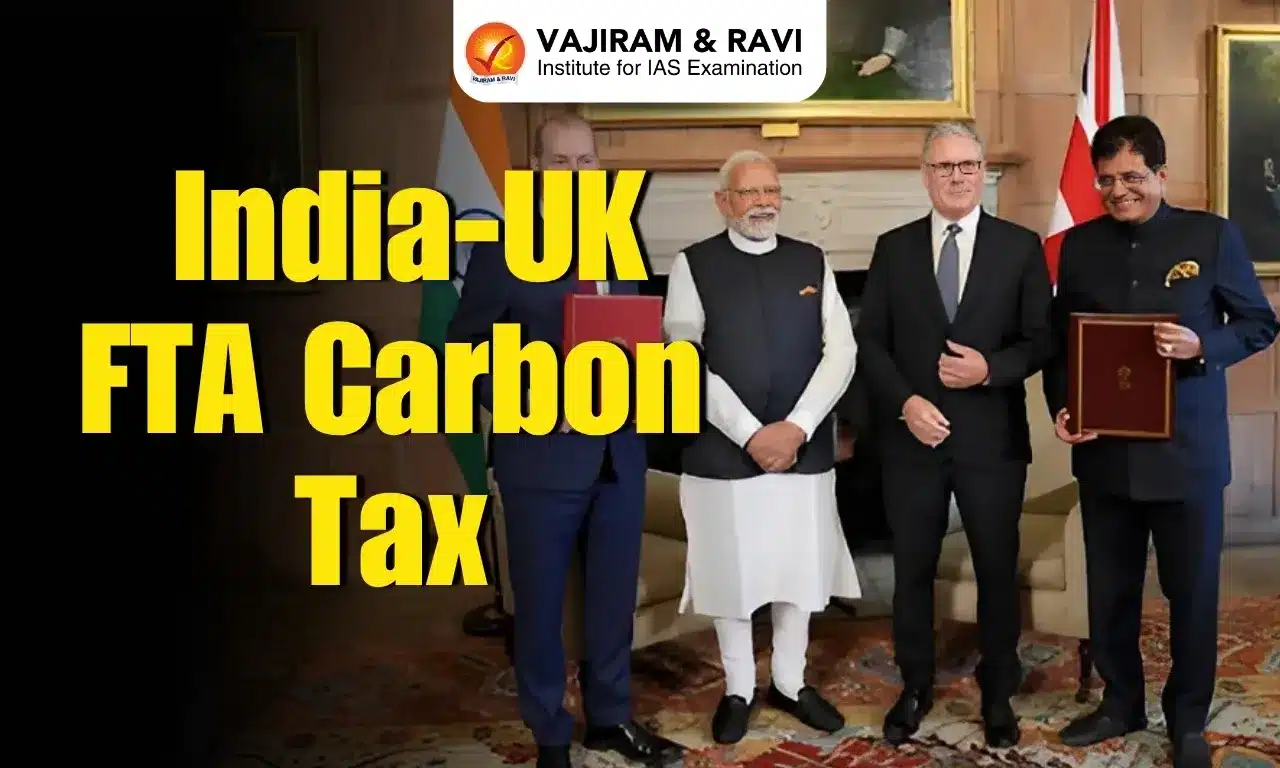
India-UK FTA Ignores Carbon Tax Relief, Raising Export Concerns

India-UK FTA Carbon Tax

India-UK FTA Carbon Tax Latest News

  • India’s push to secure relief for its small and medium enterprises from the UK’s Carbon Border Adjustment Mechanism (CBAM) has failed to find space in the final text of the India-UK Free Trade Agreement (FTA) released recently. 
  • Despite India’s efforts, no resolution or concession on the contentious carbon tax issue was included in the deal — raising concerns about potential cost burdens and trade disadvantages for Indian exporters in the future.

UK’s Expanding Carbon Tax Regime

  • The UK’s Carbon Border Adjustment Mechanism (CBAM), set to begin in January 2027, will initially apply to high-emission sectors such as aluminium, cement, fertiliser, hydrogen, and iron & steel
    • CBAM will levy carbon taxes on imported carbon-intensive goods.
  • However, the UK government has stated that the scope of CBAM could expand beyond 2027 based on evolving data, carbon leakage risks, and technological developments.
  • This poses a growing challenge for India, as future exports across a wider range of sectors may face carbon-based tariffs. 
  • Despite a 12.6% rise in India’s exports to the UK in 2024–25—reaching $14.5 billion—and total bilateral goods trade rising to $21.34 billion, the expanding CBAM regime could threaten India’s competitiveness in the UK market.

India-UK FTA Ignores Carbon Tax Relief: Concerns for Indian Exporters

  • India’s attempt to secure exemptions for its small and medium enterprises under the UK’s upcoming Carbon Border Adjustment Mechanism (CBAM) has failed, as the final text of the India-UK Free Trade Agreement (FTA) does not address the issue. 
  • This omission is significant, as it undermines the broader benefits of the FTA, which promises zero-duty access for 99% of Indian exports. 
  • Indian exporters of carbon-intensive goods, valued at around $775 million annually, now face the risk of additional duties based on the UK’s carbon emission calculations.
  • The situation is further complicated by similar measures planned by the EU, which also refuses to treat CBAM as a trade issue. 
  • The absence of legal safeguards in the FTA could weaken India’s negotiating position in future trade deals and affect its industrial competitiveness in Western markets.

India May Challenge UK’s Carbon Tax at WTO

  • With no concession secured on the UK’s CBAM in the recent FTA, India may consider challenging the measure at the WTO, citing violations of Special and Differential Treatment (SDT) norms meant to protect developing nations.
    • SDT norms in trade agreements allow developed countries to give preferential treatment to developing nations. 
    • These provisions recognize the developmental challenges faced by poorer countries and aim to help them better integrate into and benefit from the global trading system.
  • However, trade law experts caution that delays due to the WTO’s dysfunctional Dispute Settlement Body (DSB) could render such a challenge ineffective by the time CBAM is fully enforced. 
  • Moreover, given the EU and UK’s strong influence at the WTO, experts say a ruling against CBAM is unlikely. 
  • At best, India may push for regulatory adjustments rather than full withdrawal of the carbon tax.

Source: IE | ET

India-UK FTA Carbon Tax FAQs

Q1: What is CBAM and when will it start?

Ans: UK’s Carbon Border Adjustment Mechanism begins in 2027, imposing carbon tariffs on imports like aluminium, steel, and cement.

Q2: Did India secure any relief in FTA on CBAM?

Ans: No, India’s efforts to include CBAM exemptions in the FTA failed, worrying exporters of carbon-intensive goods.

Q3: How could CBAM affect Indian exports?

Ans: UK can impose duties on Indian goods worth $775 million, even on intermediate or precursor products based on emissions.

Q4: Can India challenge CBAM at WTO?

Ans: Yes, India may challenge it under Special and Differential Treatment provisions for developing nations, but results are uncertain.

Q5: Why is a WTO challenge risky?

Ans: WTO delays and EU–UK influence make a ruling unlikely before CBAM is implemented; only regulatory tweaks may happen.

Enquire Now