India’s Insurance Sector – Projected Boom and Structural Shifts by 2030

India's Insurance Sector

India’s Insurance Sector News

  • India’s insurance industry is poised for substantial expansion, with Gross Written Premiums (GWP) expected to grow by 123% by 2030. 
  • This development reflects changing consumer behavior, increasing insurance awareness, and structural transformations in both retail and institutional segments. 
  • The insights are based on a joint report by the Insurance Brokers Association of India (IBAI) and McKinsey & Company, supported by the IBAI Insurance Insights Survey of 2,500 retail customers.

Growth Trajectory of India’s Insurance Sector

  • Rapid increase in GWP:
    • GWP refers to the total amount of premium revenue an insurer collects from policies issued during a specific period, before any deductions for reinsurance or other adjustments.
    • GWP to grow from ₹11.2 lakh crore in 2024 to ₹25 lakh crore by 2030.
    • This reflects a 123% increase in total insurance premium volume.
  • Rising insurance penetration: Insurance penetration (ratio of total insurance premiums collected by insurance companies to a country's GDP) to improve from 3.7% (2024) to 5% by 2030, closing the gap with the global average of 6.8% (2023).
  • Past performance: Between FY 2020 and FY 2024, total premiums rose from ₹7.8 lakh crore to ₹11.2 lakh crore, showing strong double-digit growth.

Retail Segment - Divergent Needs and Behaviors

  • Dominance of life insurance: Retail GWP is expected to reach ₹21 lakh crore by 2030, with over 90% from life insurance.
  • Customer pyramid insights: 65% of opportunity lies at the two ends -
    • UHNI and HNI (Ultra/High Net-Worth Individuals ) with assets over ₹8.5 crore.
    • Mass-market customers (individuals or businesses with relatively similar needs and purchasing power) with basic or first-time insurance needs.
  • Insurance awareness vs. actual coverage:
    • 60% of HNI/UHNI customers believe ideal cover is 10 times of their salary, but only 30% actually hold such coverage.
    • Intent-coverage gap (a period during which an individual lacks insurance coverage) is a major structural issue.
  • Influence on purchase decisions:
    • 70% HNI/UHNI: Rely on trusted advisors.
    • 45% mass-market: Influenced by family and friends.
  • Claims experience:
    • 50% of HNI+ customers considered switching insurers due to poor claims service.
    • 55% SMEs faced claim rejections.
    • 75% need help with claims paperwork.

Institutional Segment - Emerging Growth Frontiers

  • Non-life insurance dominance: Institutional GWP to grow 3 times to ₹2.8 lakh crore by 2030.
  • SME segment potential:
    • Currently contributes approximately 10%, but expected to grow fastest.
    • Half of SME opportunities concentrated in 17 cities and 10 capital-intensive industries: textiles, automotives, pharmaceuticals, industrial goods, etc.
  • Structural barriers: Low intent to purchase due to -
    • Perceived non-necessity.
    • Lack of risk-management knowledge.
    • Margin pressures.
  • Role of regulatory push:
    • 70% SMEs purchase insurance due to compliance, not voluntary need.
    • Seek advisory support, sector-specific products, and handholding in claims.

Policy and Regulatory Implications

  • Bridging the insurance gap can support financial resilience and economic stability.
  • The sector offers scope for regulatory reforms, digital outreach, and inclusive insurance models.
  • Focus needed on -
    • Customer-centric innovations.
    • Simplified claims management.
    • Insurance literacy, especially among SMEs and low-income segments.

India’s Insurance Sector

  • Insurance in India (covers both public and private sector organisations) is listed in the Seventh Schedule of India's Constitution as a Union List subject, meaning it can only be legislated by the Central government.
  • The primary regulator for insurance in India is the Insurance Regulatory and Development Authority of India (IRDAI) which is a statutory body established in 1999.
  • India is the fifth largest life insurance market in the world's emerging insurance markets, growing at a rate of 32-34% each year. 
  • Over the past nine years, the insurance sector has attracted substantial foreign direct investment amounting to nearly Rs. 54,000 crore (US$ 6.5 billion), driven by the government's progressive relaxation of overseas capital flow regulations.
    • The FDI sectoral cap in the insurance sector has been revised from 49% to 74% under the automatic route.
    • The Union Budget 2025 also announced the further increase of FDI sectoral cap for the insurance sector from 74% to 100%. This enhanced limit will be available for those companies, which invest the entire premium in India.
  • The insurance industry of India has 57 insurance companies - 24 are in the life insurance business, while 34 are non-life insurers. 
  • Among the life insurers, Life Insurance Corporation (LIC) is the sole public sector company. There are six public sector insurers in the non-life insurance segment. 
  • In addition to these, there is a sole national re-insurer, namely General Insurance Corporation of India (GIC Re).

Source: IE

India's Insurance Sector FAQs

Q1: What is driving the rise in India’s insurance penetration by 2030?

Ans: Growth is driven by digital expansion, regulatory push, and rising demand across income segments.

Q2: How do UHNI/HNI and mass-market insurance behaviours differ?

Ans: UHNI/HNIs trust advisors and aim for high cover, while mass-market relies on informal advice and remains underinsured.

Q3: Why do MSMEs hesitate to adopt insurance in India?

Ans: MSMEs lack awareness, face cost pressures, and mostly buy insurance due to compliance needs.

Q4: Why is claims experience crucial in the insurance sector?

Ans: Poor claims handling prompts dissatisfaction and insurer-switching, especially among affluent customers.

Q5: How can sector-specific products improve SME insurance coverage?

Ans: Tailored products with advisory support address unique industry risks and enhance insurance adoption.

Understanding India’s Internal Complaints Committees: Laws, Powers, and Implementation Challenges

Internal Complaints Committee

Internal Complaints Committee Latest News

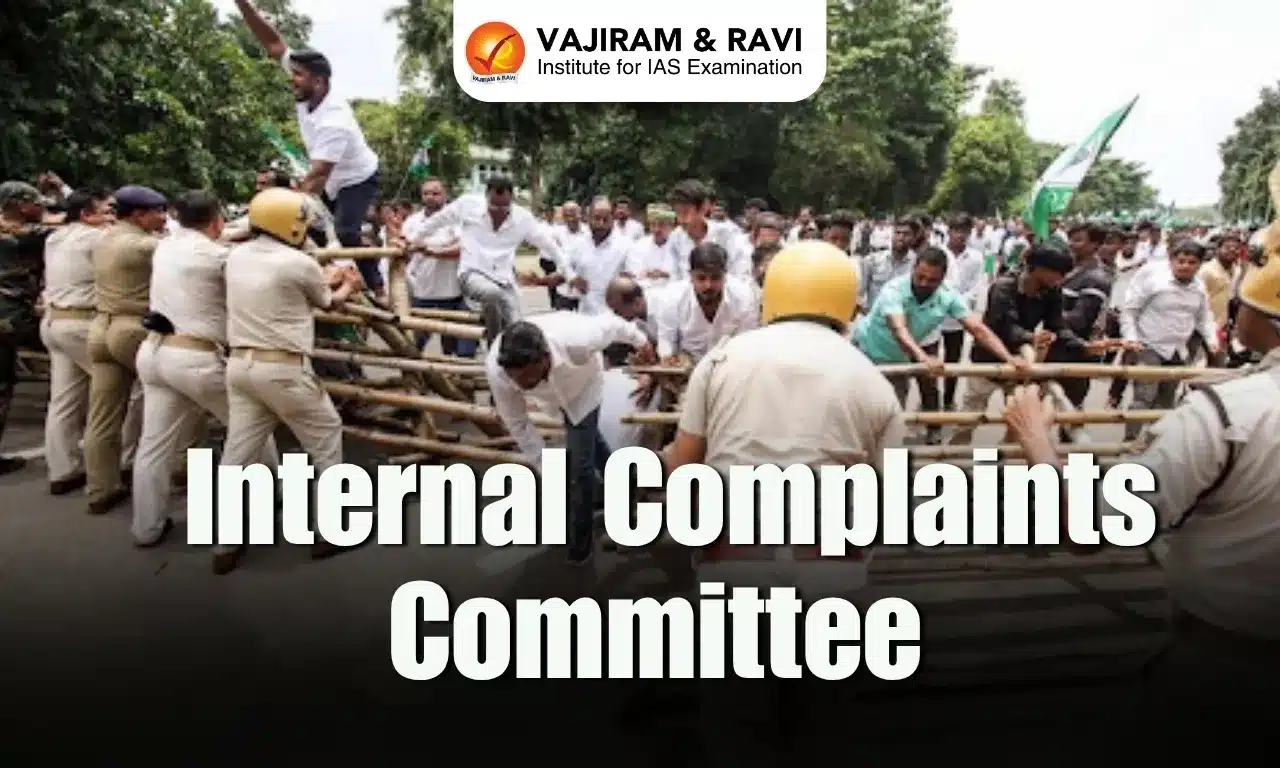
  • A student in Balasore, Odisha, died by self-immolation after her sexual harassment complaints against the head of her department were dismissed by the college’s Internal Complaints Committee (ICC). 
  • Her family alleges that the ICC lacked proper training and operated in a biased environment that favoured the accused, raising serious concerns about the effectiveness and neutrality of institutional grievance redressal systems.

Legal Framework Behind ICCs: From Vishaka Guidelines to the POSH Act

  • The foundation for Internal Complaints Committees (ICCs) was laid by the Supreme Court in 1997 through the Vishaka Guidelines, following the gang-rape of Bhanwari Devi, a social worker in Rajasthan. 
  • These guidelines defined sexual harassment at the workplace and mandated the creation of complaint committees to address such cases. 
  • Each committee was to be headed by a woman, include at least 50% women members, and involve an external third party to ensure fairness. 
  • However, these guidelines remained advisory until the 2012 Nirbhaya case prompted legislative action. 
  • This led to the enactment of the Sexual Harassment of Women at Workplace (Prevention, Prohibition and Redressal) Act, 2013, commonly known as the POSH Act. 
  • The Act made it mandatory for all workplaces with more than 10 employees to establish ICCs
  • It also ensured that women in smaller or informal workplaces could seek redress through Local Committees formed by district authorities.

Powers and Responsibilities of the Internal Complaints Committee (ICC)

  • The ICC, mandated under the POSH Act, is empowered to address complaints of sexual harassment at the workplace. 
  • It must be headed by a senior woman employee as the Presiding Officer, and should include at least two internal members with experience in social work, legal knowledge, or commitment to women's causes. 
  • Additionally, one member must be an external expert, typically from an NGO or with knowledge of sexual harassment issues. Half of the ICC members must be women.
  • Process of Filing Complaints
    • Any aggrieved woman can submit a written complaint within three months of the incident. 
    • Upon receiving the complaint, the ICC can either initiate an inquiry or help settle the matter, if the complainant requests. 
    • The committee enjoys civil court powers under the Code of Civil Procedure, allowing it to summon witnesses, examine evidence, and conduct proceedings accordingly. 
    • It must complete the inquiry within 90 days and recommend appropriate action if the complaint is upheld. 
    • The employer is also obligated to assist the complainant in filing a criminal case if she chooses to do so.
    • Strict confidentiality is mandated by law—covering the identity of the complainant, accused, witnesses, and details of the proceedings or recommendations—to protect the privacy of all parties involved.

Poor Implementation of the POSH Act

  • Even after ten years since the enactment of the POSH Act, the implementation of Internal Complaints Committees (ICCs) remains patchy and inadequate across institutions. 
  • In December 2024, the Supreme Court expressed concern over the "serious lapses" in enforcement, calling the state of affairs “disquieting” and ordering immediate compliance across both public and private sectors. 
  • Activists pointed out that although ICCs exist in some places, they often lack training, maintain no confidentiality, and fail to address workplace power imbalances—rendering them ineffective. 
  • They criticised the lack of coordination between ministries—where the Women and Child Development Ministry oversees the Act, but actual employers fall under the Labour and Industries Ministries
  • This disconnect has resulted in little to no monitoring or analysis of the law's functioning, leaving a “black hole” in accountability and data. 
  • The recent Balasore case underscores how ICCs, without proper structure and enforcement, are reduced to being symbolic rather than functional bodies.

Source: TH | CAG

Internal Complaints Committee FAQs

Q1: What is an Internal Complaints Committee?

Ans: A workplace body under the POSH Act to handle sexual harassment complaints with inquiry powers and confidentiality.

Q2: When was the ICC legally mandated?

Ans: In 2013, through the Sexual Harassment at Workplace (POSH) Act, replacing the earlier Vishaka Guidelines.

Q3: Who must be on an ICC panel?

Ans: It must include a senior woman, two experienced members, and one external NGO/legal expert; 50% women required.

Q4: How effective is the ICC system today?

Ans: Poor implementation and lack of training have weakened ICC effectiveness across institutions, as noted by the Supreme Court.

Q5: What powers does the ICC hold?

Ans: ICC has civil court powers for inquiry, recommends action, and ensures confidentiality throughout proceedings.

India-UK Trade Deal 2025: Key Gains, Missed Chances, and What’s Next

India-UK Trade Deal

India-UK Trade Deal Latest News

  • Recently, India and the U.K. formally signed a Comprehensive Economic and Trade Agreement (CETA), concluding negotiations that began in January 2022. 
  • The pact, finalized after more than three years of intense discussions, aims to significantly boost bilateral trade and deepen economic ties between the two countries.

Key Takeaways from the India-U.K. Trade Deal

  • The India-U.K. trade agreement offers substantial tariff reductions on both sides. 
  • The U.K. has agreed to remove tariffs on 99% of its product lines, benefiting around 45% of India’s current exports such as textiles, footwear, automobiles, seafood, and fresh fruits like mangoes and grapes — all of which will now enter the U.K. duty-free. 
  • Meanwhile, India will cut or reduce duties on 90% of its tariff lines, covering 92% of U.K. exports to India. 
  • This means British whisky, cars, and engineering goods will become more affordable for Indian consumers. 
  • Notably, India’s high-value exports like petroleum products, pharmaceuticals, and diamonds already enjoy duty-free access in the U.K. 
  • Although the U.K. is not among India’s top trading partnersaccounting for just 3.3% of exports and 1.2% of imports in 2024–25 — the deal marks a significant step in enhancing bilateral trade and economic cooperation.

India-U.K. Trade Deal Goes Beyond Goods — Services and Workers Benefit Too

  • The India-U.K. Comprehensive Economic and Trade Agreement (CETA) is not limited to trade in goods; it also includes a strong focus on services — a key area for India’s economy. 
  • Under the agreement, India will open sectors like accounting, auditing, financial services, telecom, and environmental services to U.K. companies, allowing them to offer services in India without setting up a local office, while enjoying the same treatment as Indian firms. 
  • India has also agreed to recognise U.K. professional qualifications in fields such as law and accounting (excluding legal practice). 
  • On the flip side, Indian companies will now be allowed to establish offices in the U.K. in sectors like IT, consulting, and environmental services. 
  • A major win for Indian workers comes through the Double Contribution Convention (DCC), a separate agreement signed alongside CETA. 
  • It ensures that 75,000 Indian workers on short-term assignments in the U.K. can continue contributing only to India’s social security system, avoiding double payments in both countries.
    • This is a significant relief for those who typically don’t stay long enough in the U.K. to benefit from its system.

India-U.K. FTA Features Unusual Provisions on Cars and Government Procurement

  • While most aspects of the India-U.K. trade deal follow a typical pattern of tariff and service liberalisation, it includes a few notable exceptions. 
  • For the first time, India has agreed to reduce import duties on cars through a trade pact. 
  • Import duties on large-engine luxury petrol cars from the U.K. will drop from 110% to 10% over 15 years, though within a quota system starting at 10,000 cars and rising to 19,000 in year five. 
  • Mid-sized and small cars will also see gradual tariff cuts to 10% by the fifth year, again within quotas. These phased cuts are designed to give Indian carmakers time to adjust. 
  • However, electric, hybrid, and hydrogen vehicles are excluded from duty cuts for the first five years to protect India’s emerging green vehicle sector
  • Another unusual feature is that the U.K. will now be allowed access to Indian government procurement.
    • India will open up around 40,000 high-value central government contracts in areas like transport, renewable energy, and infrastructure, allowing U.K. companies to bid for them.

Conclusion

  • The India-U.K. trade deal is not yet in force. It must first be ratified by the Cabinets of both countries, a process expected to take six months to a year. 
  • For India, the agreement is not just significant in its own right — it could also act as a template for future trade negotiations with major economies like the U.S. and the European Union.

Source: TH

India-UK Trade Deal FAQs

Q1: What is the India-UK Trade Deal about?

Ans: It aims to reduce tariffs, boost bilateral trade, and open services and government procurement between India and the UK.

Q2: Which Indian exports benefit from the deal?

Ans: Textiles, footwear, cars, seafood, and fruits like mangoes now enter the UK duty-free under the FTA.

Q3: How does the deal help Indian workers in the UK?

Ans: It prevents double social security contributions for 75,000 Indian workers on short-term UK assignments.

Q4: What’s unique in the FTA regarding car imports?

Ans: It includes India’s first car tariff cuts, phased with quotas, excluding electric vehicles for initial five years.

Q5: Is the trade deal active now?

Ans: Not yet. It awaits ratification by both countries’ Cabinets, which may take up to one year.

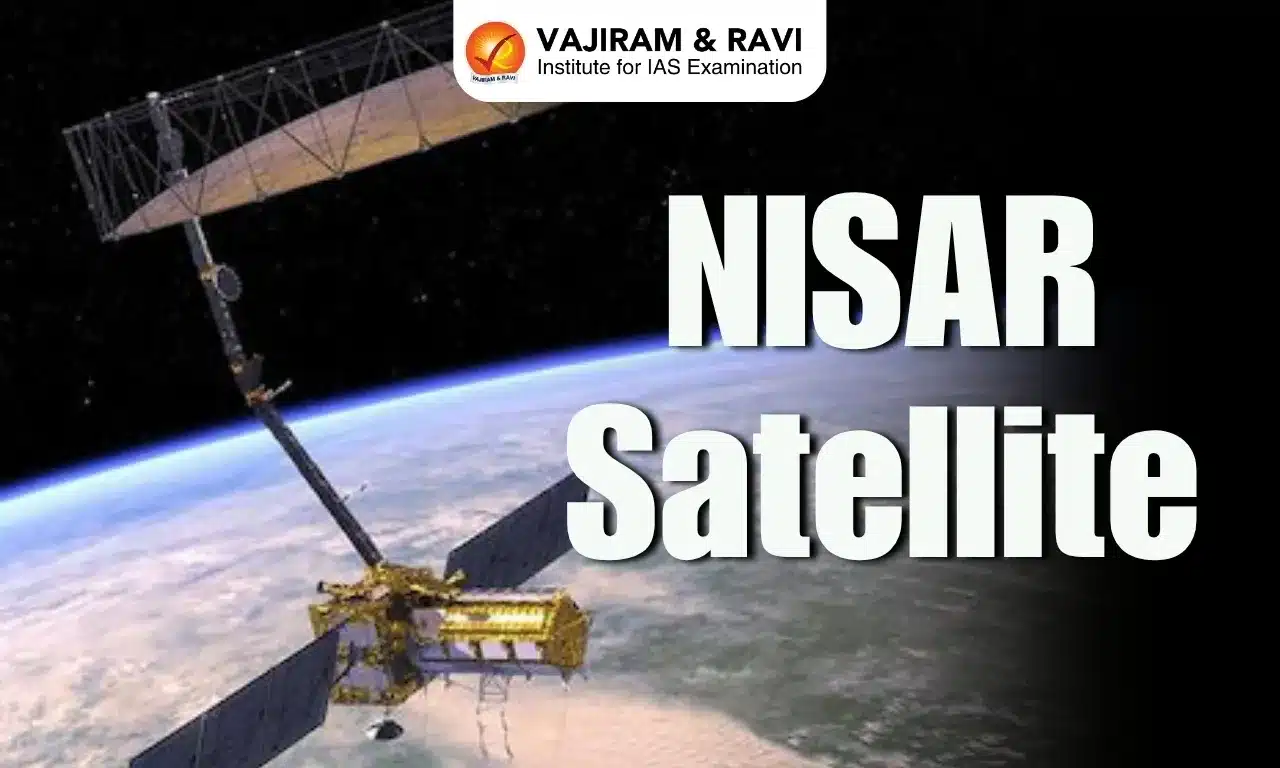
NISAR Satellite – A Landmark NASA-ISRO Collaboration for Earth Observation

NISAR Satellite

NISAR Satellite Latest News

  • The Indian Space Research Organisation (ISRO) is planning to launch the NISAR satellite from Sriharikota onboard a GSLV Mk-II rocket.

Introduction

  • India and the United States are set to launch their most ambitious joint space mission to date, the NASA-ISRO Synthetic Aperture Radar (NISAR) satellite. 
  • Scheduled for lift-off on July 30 from Sriharikota onboard a GSLV Mk-II, the Rs. 12,000-crore mission has been over a decade in the making and is being considered as one of the world’s most advanced Earth observation missions.
  • NISAR will provide real-time, high-resolution radar data on land deformation, biomass, disaster impact, crop patterns, and climate-related changes, not just for India but globally. 
  • It combines NASA’s strength in long-range radar systems with ISRO’s spaceflight engineering and S-band radar technology.

About NISAR Satellite

  • First Dual-Band Radar Satellite for Earth Observation
    • NISAR is the world’s first Earth-observing satellite with dual-frequency synthetic aperture radar (SAR).
    • L-band radar (1.257 GHz) from NASA can penetrate dense forests and soil layers to detect ground deformation and subsurface movement.
    • S-band radar (3.2 GHz) from ISRO is optimised for surface-level changes like crop growth, biomass estimates, and water levels.
    • This dual-frequency advantage allows for all-weather, day-and-night imaging, even through clouds, smoke, or vegetation cover.
  • Wide Swath and High Resolution
    • NISAR’s radar swath width is 240 km, allowing it to scan large areas in one go.
    • It offers a spatial resolution of 3-10 metres and vertical displacement mapping accuracy down to centimetres, enabling early detection of phenomena like land subsidence in cities.
    • Every spot on Earth will be revisited once every 12 days, providing consistent monitoring.

Scientific and Societal Applications

  • NISAR is designed to support research and operations across six broad themes:
    • Solid Earth Processes - Tracking earthquakes, landslides, and land deformation.
    • Ecosystems - Monitoring forests, woody biomass, and biodiversity.
    • Ice and Snow Dynamics - Measuring glacial movements and polar ice thickness.
    • Coastal and Ocean Monitoring - Tracking shoreline erosion, oil spills, and storm surges.
    • Disaster Response - Providing near-real-time damage maps after floods, quakes, or cyclones.
    • Agriculture and Infrastructure - Supporting food security and monitoring subsidence near dams, roads, and reservoirs.
  • During natural disasters, NISAR can provide damage proxy maps within five hours, crucial for emergency relief planning and response.

India-Specific Enhancements

  • While NISAR will operate globally at the L-band, ISRO will routinely operate the S-band radar over Indian territory, enabling:
    • Enhanced biomass and soil moisture mapping
    • Improved agricultural forecasting
    • Ionospheric noise correction for high-precision imagery
  • All of this aligns with India’s national needs in agriculture, disaster management, forestry, and rural development.

Technical Design and Deployment

  • Once launched, NISAR will be placed in a sun-synchronous polar orbit at an altitude of 747 km. 
  • It features a massive 12-metre mesh radar antenna and a 9-metre boom to support deployment and scanning.
  • To overcome size constraints in space, the SAR system mimics a large antenna by collecting radar pulses over time and combining them through complex processing, hence the term “synthetic aperture.”
  • Its advanced SweepSAR mode allows electronic steering of radar beams, providing consistent swath coverage without compromising resolution.

Data Access and Ground Infrastructure

  • NISAR’s open-data policy ensures that data is freely available to all users, typically within a few hours of acquisition.
  • NASA’s Near Earth Network (in Alaska, Norway, and Chile) will handle most global data downlinks (up to 3 TB/day).
  • ISRO’s Ground Stations in Shadnagar and Antarctica will manage India’s data needs.
  • India’s National Remote Sensing Centre (NRSC) will process and distribute NISAR products for domestic use.

India-U.S. Contributions

  • The mission exemplifies balanced international collaboration:
    • ISRO contributed the spacecraft bus, the entire S-band radar system, Ka-band telemetry systems, and launch support via GSLV Mk-II.
    • NASA provided the L-band radar, radar structure, antenna, onboard avionics, and high-capacity data systems.
  • The satellite was integrated and tested in Bengaluru, symbolising “Made-in-India” ownership of a global science instrument.

Source : TH

NISAR Satellite FAQs

Q1: What is the NISAR satellite?

Ans: NISAR is a joint NASA-ISRO satellite equipped with dual-band synthetic aperture radar for advanced Earth observation.

Q2: What makes NISAR unique?

Ans: It is the first satellite to combine L-band and S-band radar systems, enabling high-resolution imaging through clouds and vegetation.

Q3: What are the main applications of NISAR data?

Ans: NISAR will support disaster response, agricultural forecasting, biomass mapping, and climate research globally.

Q4: How will NISAR benefit India specifically?

Ans: India will gain access to S-band radar data focused on its territory for improved crop, forest, and disaster monitoring.

Q5: When and where will NISAR be launched?

Ans: NISAR is scheduled for launch on July 30, 2025, from Sriharikota using ISRO’s GSLV Mk-II rocket.

Enquire Now