

Flash Floods in India: Causes, Climate Impact & Adaptation Strategies

Flash Floods in India

Flash Floods in India Latest News

  • Flash floods have emerged as a deadly and recurring hazard across India, claiming thousands of lives and damaging infrastructure annually. 
  • Tragedies in Himachal Pradesh (July 2025), Kerala’s Wayanad (July 2024), Ladakh (June 2024), and Sikkim (October 2023) underline the severity of the crisis. 
  • These sudden and intense floods, primarily triggered by extreme rainfall, have become more frequent with rising global temperatures — increasing from 132 events in 2020 to 184 in 2022, as per the Union Jal Shakti Ministry.
  • Despite the mounting threat, there remains a lack of detailed research to pinpoint the most vulnerable regions, hampering the effectiveness of mitigation strategies like early warning systems. 

Study Related to Flash Floods in India

  • A recent IIT Gandhinagar study, published in Nature Hazards, addresses the lack of granular data on flash flood vulnerability in India.
  • The study, ‘Drivers of flash floods in the Indian sub-continental river basins’, identifies the Himalayas, western coast, and Central India as key hotspots, using hydrological and geomorphological data to map sub-basin susceptibility. 
  • In the Himalayas, steep terrain and elevation drive flood risk, while in the West Coast and Central India, rapid runoff—termed "flashiness"—plays a key role. 
  • The study finds that nearly 75% of flash floods result from a combination of extreme rainfall and already saturated soil, with only 25% due to precipitation alone. 
  • Alarmingly, even previously low-risk basins are witnessing rising extreme rainfall, suggesting that climate change may create new flash flood zones in the future.

Key Drivers Behind Flash Floods in India

  • The study reveals that only 25% of flash floods in India are caused solely by extreme rainfall
  • Most incidents result from a combination of heavy precipitation and pre-existing soil saturation. 
    • When the ground is already wet, it cannot absorb additional rainfall, leading to rapid runoff and increased flood risk.
  • Notably, only 23% of extreme rainfall events trigger flash floods within six hours. Instead, prolonged periods of both low- and high-intensity rain are more likely to cause such disasters.
  • The study also highlights regional variations. 
    • In the western coast and Central India, sub-basins react quickly to rainfall due to their high "flashiness" — the tendency of water levels to rise rapidly. 
    • In the Himalayan region, steep terrain and high relief further elevate the risk. 
    • Within major river basins like the Ganga, flash flood susceptibility differs — sub-basins in the southern Himalayan stretch are more prone, while central areas show lower risk. 
  • This points to how terrain and local climatic conditions strongly influence flash flood vulnerability.

Climate Change Intensifies Flash Flood Risk in India

  • Rising global temperatures are significantly contributing to the increase in frequency and severity of flash floods. 
  • As the atmosphere warms, it retains more moisture — about 7% more for every 1°C rise — leading to heavier rainfall events. 
    • In India, from 1981 to 2020, the incidence of extreme rainfall during the pre-monsoon season doubled. 
    • During the monsoon, post-monsoon, and winter seasons, extreme precipitation increased by 56%, 40%, and 12.5% respectively. 
    • Notably, over 75% of flash floods between 1980 and 2018 occurred during the monsoon season.
  • The study also shows that flash floods have risen sharply since 1995, especially in the Brahmaputra, Ganga, and Krishna river basins. 
  • Interestingly, many regions that were not previously flood-prone are now experiencing more "wet hours" and higher streamflow due to warming temperatures.
    • 51% of non-prone sub-basins showing increased rainfall and 66.5% showing higher streamflow. 
  • Conversely, some existing flood-prone areas are seeing a decline in wet hours, indicating shifting climate patterns and flood vulnerabilities.

Region-Specific Adaptation Key to Mitigating Flash Flood Risks

  • The study highlights the need for region-specific adaptation strategies tailored to topography, soil conditions, and not just rainfall intensity. 
  • Such localized approaches can strengthen early warning systems, improve disaster preparedness, and support long-term resilience planning. 
  • Researchers emphasize the urgency of identifying emerging flash flood hotspots and investing in climate-resilient infrastructure to reduce the impact of extreme events. 
  • Additionally, with shifting rainfall patterns and rising temperatures, improved land-use planning and integrated flood management are essential for effective mitigation.

Source: IE | Nature

Flash Floods in India FAQs

Q1: What causes most flash floods in India?

Ans: A combination of extreme rainfall and pre-saturated soil triggers most flash floods across Indian river basins.

Q2: How does climate change influence flash floods?

Ans: Rising temperatures increase atmospheric moisture, leading to more intense rainfall and higher flash flood risks.

Q3: Which regions are flash flood hotspots?

Ans: The Himalayas, Western Coast, and Central India are most vulnerable to frequent flash floods.

Q4: What is ‘flashiness’ in flood context?

Ans: Flashiness refers to rapid water level rise after rainfall, heightening flash flood potential.

Q5: What adaptation measures are needed?

Ans: Region-specific strategies, better land use planning, and early warning systems are vital for effective flash flood mitigation.
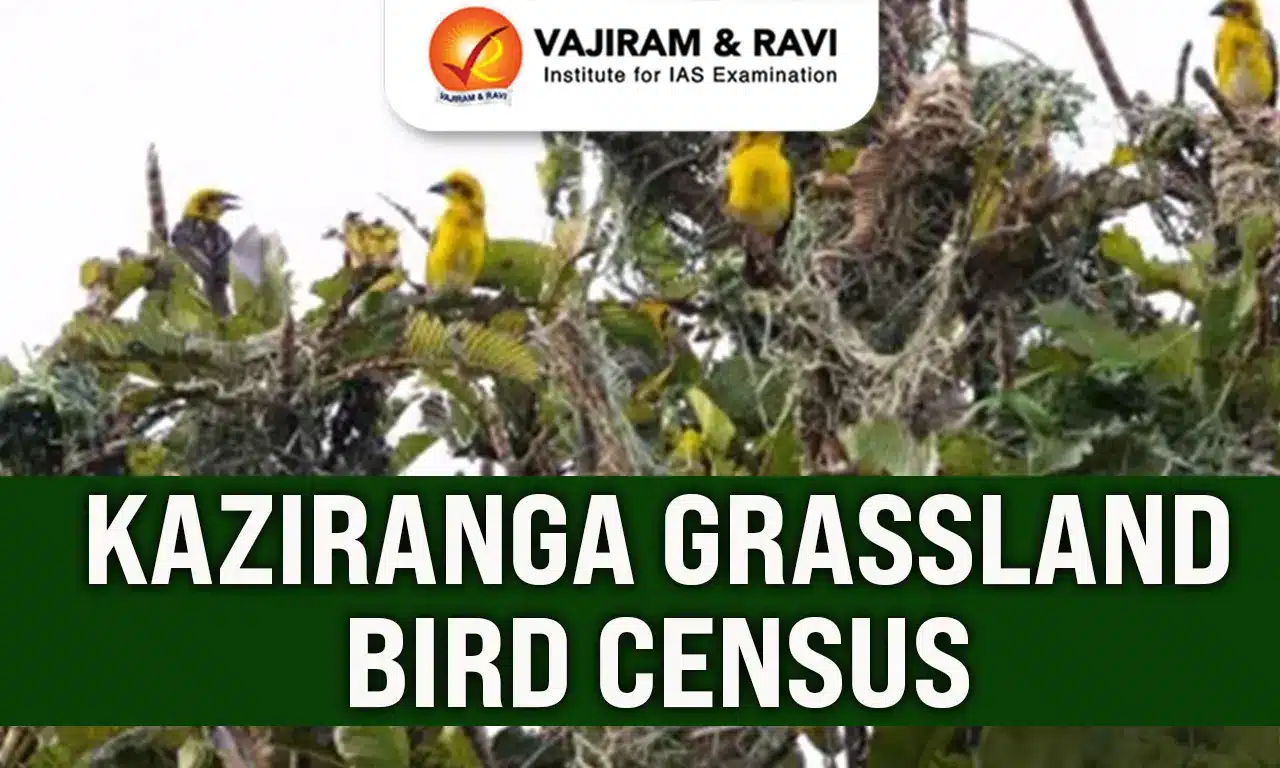

Kaziranga Bird Census: Tracking Grassland Birds Through Acoustic Monitoring

Kaziranga Grassland Bird Census

Kaziranga Grassland Bird Census Latest News

  • Recently, PM Modi, in his Mann ki Baat address, spotlighted the first-ever grassland bird census conducted in Assam’s Kaziranga National Park
  • This unique initiative aimed to assess the presence, diversity, and habitat preferences of grassland bird species—many of which are endangered or declining in number.
  • This article deals with the Kaziranga grassland bird census, its methodology, and the growing conservation concerns around grassland bird species in India.

Grassland Birds

  • Grassland birds in India are a unique group of avian species adapted to live in open, grassy habitats. 
  • These birds play a critical ecological role as indicators of healthy ecosystems, reflecting the overall status of grassland habitats. 
  • Notable examples include the Bengal Florican, Finn’s Weaver, Indian Courser, Great Indian Bustard, and Jerdon’s Babbler.
  • Many grassland bird species are threatened due to rapid habitat loss. Climate change has further intensified these threats.
  • Conservation of grassland birds requires sustained protection of their habitats, scientific monitoring (like acoustic surveys), and strong policy support. 
  • Special attention is needed for species endemic to India’s grasslands, as their extinction would be irreversible on a global scale.

Kaziranga’s Grassland Bird Census: A Conservation Milestone

  • Recently, a collaborative survey was conducted in Assam’s Kaziranga National Park to record its grassland bird population. 
  • The initiative was led by forest officials, scientists, and conservationists, and was sparked by the research of Chiranjib Bora, a doctoral student studying the endangered Black-breasted Parrotbill
    • Funded by the INSPIRE fellowship from the Department of Science & Technology, his project used acoustic monitoring tools to document bird species in Kaziranga, 70% of which is grassland. 
  • The survey aimed to monitor elusive and rapidly declining grassland bird species, many of which are hard to detect due to their small size and camouflaged appearance. 
  • It focused on 10 priority species that are either globally threatened or endemic to the Brahmaputra floodplains, such as the Bengal Florican, Swamp Francolin, and Finn’s Weaver. 
  • In total, 43 species were recorded, including 1 Critically Endangered, 2 Endangered, and 6 Vulnerable species, as per the IUCN Red List.

Innovative Acoustic Monitoring in Kaziranga Bird Survey

  • The Kaziranga grassland bird survey stood out for its use of passive acoustic monitoring. 
  • Traditional visual counting was ineffective for these small and shy birds, so acoustic recorders were strategically placed on tall trees near grasslands during their breeding season (March to May), a time when birds are most vocal. 
  • These devices captured bird songs over three consecutive days at 29 locations using six recorders. 
  • The recorded audio was then analyzed using spectrograms—graphical representations of sound—and a machine learning tool called Birdnet to accurately identify bird species based on their calls. 
  • This method enabled researchers to detect species that might have gone unnoticed using conventional techniques.

Grassland Birds as Ecosystem Health Indicators

  • The survey’s findings underscore the ecological significance of grassland birds, which serve as vital indicators of habitat health. 
  • Their presence confirms that the grasslands of Kaziranga are thriving. 
  • A key highlight was the discovery of a breeding colony of the endangered Finn’s Weaver, a species endemic to the Brahmaputra floodplain. 
  • For the first time, researchers located over 85 nests of this rare bird atop trees in Kaziranga, shedding light on its nesting behavior and strengthening conservation efforts in the region.

Multiple Threats to Grassland Bird Habitats

  • Kaziranga’s grassland birds face serious threats due to both human activities and natural processes
  • Over the past 40 years, Assam has lost around 70% of its grasslands. Key drivers include overgrazing, conversion of grasslands into agricultural land, and ecological succession, where grasslands naturally transition into forests. 
  • This is particularly alarming for species endemic to the Northeast, as their extinction in this region would mean global extinction. 
  • Climate change adds another layer of threat, with some species like the Bengal Florican showing significant declines. 
  • Further research is needed to understand the full impact of these changes.

Source: IE | MB

Kaziranga Grassland Bird Census FAQs

Q1: What was the goal of Kaziranga’s bird census?

Ans: To identify and monitor rare and endangered grassland bird species in Kaziranga National Park.

Q2: Which technology was used in the survey?

Ans: Passive acoustic monitoring and AI-based tools like BirdNet helped identify bird species from their calls.

Q3: Why are grassland birds important?

Ans: They act as ecosystem health indicators, showing habitat quality and biodiversity.

Q4: What species were documented?

Ans: 43 species including Bengal Florican and Finn’s Weaver were recorded, many of them endangered or endemic.

Q5: What are the threats to their habitat?

Ans: Habitat loss, overgrazing, ecological succession, and climate change pose major threats to grassland birds in Assam.

India Rethinks China Blockade to Boost Tech Manufacturing

China Blockade

China Blockade Latest News

  • India is reconsidering its restrictive stance on Chinese investments in electronics manufacturing to boost domestic production and strengthen global supply chain integration.

Introduction

  • Nearly five years after adopting a restrictive stance toward Chinese investments in the wake of the 2020 Galwan Valley clashes, India is signalling a calibrated shift in its ‘China-out’ electronics strategy
  • In light of its ambitious goals to become a global electronics manufacturing hub, India is re-evaluating Foreign Direct Investment (FDI) rules and barriers previously imposed on China-based companies.
  • The move comes amid changing global trade dynamics, evolving geopolitical realities, and India’s realization that Chinese firms remain essential in upstream components critical for high-tech manufacturing.

Background of the Blockade

  • In April 2020, India issued Press Note 3, mandating government approval for all FDI inflows from countries sharing a land border with India, effectively restricting Chinese investments. 
  • The policy was designed to prevent opportunistic takeovers of Indian firms during the COVID-19 pandemic and reflected a broader pushback following border tensions.
  • This led to the exclusion of Chinese entities from key sectors such as telecommunications, electronic hardware, and infrastructure, even as India’s electronics assembly sector began expanding rapidly under the Production Linked Incentive (PLI) schemes.

Emerging Signs of Policy Recalibration

  • Amid rising manufacturing needs and limited domestic capacity for advanced components, India has begun showing pragmatic openness to Chinese participation in select areas.
  • Key Developments:
    • Dixon Technologies, a major Indian contract manufacturer, received approval from the Ministry of Electronics and IT to form a joint venture with China-based Longcheer. The JV will produce smartphones, smartwatches, automotive electronics, and AI-powered PCs.
    • NITI Aayog has recommended easing FDI norms for Chinese companies to attract investment and enhance exports.
    • The Economic Survey 2023–24 also hinted at the need to revisit restrictions on Chinese firms, acknowledging their integral role in the electronics supply chain.

Structural Dependencies on Chinese Components

  • Despite the policy blockade, India has continued to import large volumes of components from China:
    • In FY2023-24, India imported over $12 billion worth of electronic parts from China and another $6 billion from Hong Kong.
    • Together, these regions accounted for over 50% of all component imports, far exceeding inflows from South Korea, Taiwan, Japan, or ASEAN.
  • This underscores a reality: while India has kept finished goods like smartphones from Chinese firms out of its domestic market, it remains reliant on upstream inputs from them to fuel its fast-growing assembly operations.

Policy Drivers Behind the Rethink

  • India’s evolving stance is informed by multiple considerations:
  • Manufacturing Ambitions:
    • The government aims to make India a global electronics manufacturing hub. The Rs. 23,000 crore scheme for electronic components manufacturing envisages foreign collaboration, where Chinese expertise remains unparalleled.
  • Global Supply Chain Realignment:
    • The post-pandemic world, U.S.-China trade tensions, and “China+1” strategies have opened opportunities for India to step in as an alternative hub. 
      • The China+1 strategy is a business tactic where companies diversify their production and supply chains away from China.
    • But that requires deeper integration into global supply chains, where Chinese firms are major stakeholders.
  • Geopolitical Pragmatism:
    • India has resumed issuance of tourist visas to Chinese nationals and facilitated diplomatic visits, including External Affairs Minister S. Jaishankar’s trip to China, where he stressed that competition should not become a conflict.”

Challenges and Repercussions

  • Even as India contemplates easing restrictions:
    • China has retaliated by pulling back workers and making it harder for Indian firms to import capital goods.
    • There have been blockades on rare earth metals and magnets, key to manufacturing electronics, which India has struggled to circumvent.
    • Chinese companies themselves face compliance bottlenecks, procedural delays, and security-related distrust in India.
  • The challenge lies in striking a balance between strategic autonomy and manufacturing dependency.

Source: IE

China Blockade FAQs

Q1: Why did India restrict Chinese investments after 2020?

Ans: India issued Press Note 3 to prevent opportunistic takeovers during the pandemic and amid rising border tensions.

Q2: What has changed in India’s policy towards Chinese firms in 2025?

Ans: India is reconsidering its restrictive stance and allowing selective partnerships in electronics manufacturing.

Q3: Which Indian firm recently partnered with a Chinese company?

Ans: Dixon Technologies received approval to form a joint venture with China-based Longcheer for electronics production.

Q4: How reliant is India on Chinese electronic components?

Ans: China and Hong Kong account for over 50% of India’s electronic component imports, highlighting significant dependence.

Q5: What is the main motivation behind India’s policy shift?

Ans: India aims to boost domestic manufacturing and integrate deeper into global supply chains where China plays a critical role.

Enquire Now