India-U.S. Trade Standoff Escalates – Tariffs, Penalties, and Strategic Dilemmas

India-U.S. Trade Standoff Escalates

India-U.S. Trade Standoff Escalates Latest News

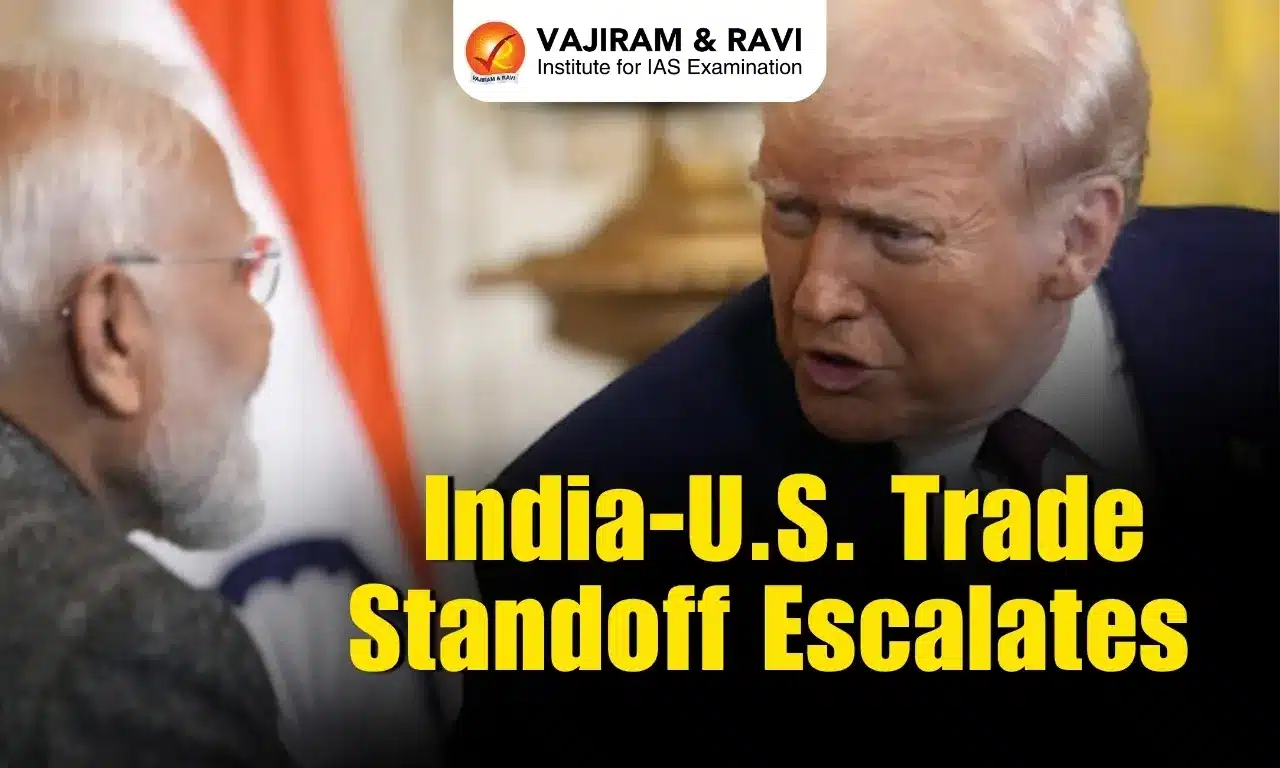
  • U.S. President Donald Trump’s imposition of a 25% tariff on Indian imports, along with a potential 100% penalty for India’s continued purchase of Russian oil and defense equipment, comes just ahead of the August 1 deadline to finalize a bilateral trade deal. 
  • As a result, India-U.S. trade standoff escalates, putting ongoing trade negotiations at risk, and complicating India’s trade positioning vis-à-vis its global competitors, especially China.

Background - U.S.-India Trade Relations

  • Ongoing negotiations: India and the U.S. have been in talks since February 2025 to finalize a Bilateral Trade Agreement (BTA) aimed at establishing a mutually beneficial trade framework.
  • Mini-deal attempts:
    • Alongside the broader BTA, efforts were underway to create a “mini-deal” to roll back retaliatory tariffs. 
    • However, this deal has not materialized before the U.S.-imposed deadline of August 1.

New Tariff Measures

  • Announcement by U.S. President: Trump declared a 25% tariff and an unspecified “penalty” on Indian imports, effective August 1, 2025.
  • Reasons cited:
    • High Indian tariffs and non-tariff barriers.
    • India’s continued defense and energy purchases from Russia (India is the second-largest buyer of Russian oil after China).
    • Geopolitical concerns over India’s ties with Russia during the Ukraine conflict.
    • Penalty tied to Trump’s pressure campaign to force countries to reduce dependence on sanctioned Russian oil and arms.
  • Public statement: Trump criticized India’s trade practices on Truth Social, labeling them “strenuous and obnoxious.”

India’s Response

  • Commerce Ministry reaction: The Indian government is “studying the implications” and reiterated its commitment to a fair and balanced trade agreement.
  • Protection of domestic interests: The ministry emphasized safeguarding the interests of farmers, MSMEs, and entrepreneurs, drawing parallels with its stance during the India-UK Comprehensive Economic and Trade Agreement (CETA) negotiations.

Global Context - Trump’s Retaliatory Trade Policy

  • Liberation day tariffs: In April 2025, Trump imposed blanket tariffs on countries he accused of levying disproportionately high tariffs on U.S. goods.
  • 90-day pause and bilateral deals: A pause was provided to negotiate individual deals. Agreements were reached with -
    • UK: Reduced car tariffs to 10% and removed aerospace tariffs
    • Indonesia & Philippines: 19% tariff
    • Japan & EU: 15% tariff
  • India left out: India’s inability to secure a deal has now subjected it to higher tariffs and potential trade isolation.

Key Concerns for India

  • Strategic autonomy vs. trade realpolitik: The case underscores challenges India faces in balancing strategic autonomy (especially defense and energy ties with Russia) and economic pragmatism in dealing with major powers.
  • China’s first-mover advantage:
    • China has already concluded advanced-stage negotiations and could secure better terms, including waivers on secondary tariffs.
    • China cut tariffs on U.S. goods from 125% to 10%; the U.S. reciprocated by cutting tariffs from 145% to 30%.
  • Impact on MSMEs and agriculture: Heightened tariffs may affect exports from India's MSME sector and agricultural goods, which are highly price-sensitive.
  • Growing trend of bilateralism: This episode highlights the growing trend of bilateralism in global trade and the declining relevance of multilateral platforms like the WTO.

Conclusion

  • India stands at a crossroads where principled trade diplomacy is tested against economic imperatives. 
  • While New Delhi’s refusal to accept a one-sided deal has protected key domestic sectors, the pressure to conclude a deal has intensified due to mounting external tariffs and strategic maneuvering by China. 
  • The final shape of the India-U.S. deal may now hinge on top-level intervention, especially a conversation between PM Modi and President Trump, with the goal of minimizing economic damage while preserving strategic interests.

Source: TH | IE

India-U.S. Trade Standoff Escalates FAQs

Q1: How do U.S. tariffs affect India's strategic autonomy and trade stance?

Ans: They pressure India to alter ties with Russia and trade policies, challenging its strategic autonomy.

Q2: Are India's tariffs and trade practices WTO-compliant?

Ans: Yes, India asserts its tariffs comply with WTO norms and NTBs are globally common.

Q3: What is the likely economic impact of U.S. tariffs on India?

Ans: They may hurt exports and slow GDP growth to around 6.2% in FY2026.

Q4: How do China’s trade talks with the U.S. affect India?

Ans: China's progress weakens India’s position and increases pressure to conclude a deal.

Q5: What may India offer in an interim trade deal with the U.S.?

Ans: Likely concessions include big-ticket purchases like defense and LNG, while protecting key sectors.

Russia’s Kamchatka Hit by 8.8 Earthquake: Causes, Ring of Fire Role, and Global Impact

Kamchatka Earthquake 2025

Kamchatka Earthquake 2025 Latest News

  • A powerful 8.8 magnitude earthquake struck off the coast of Russia’s Kamchatka Peninsula, leading to widespread tsunami warnings across the Pacific. 
  • The quake, centered 119 km southeast of Petropavlovsk-Kamchatsky at a shallow depth of 19.3 km, was initially reported as 8.0 but later upgraded. It was followed by a strong 6.9 aftershock. 
  • This marks the strongest global quake since Japan’s devastating 9.0 magnitude earthquake in March 2011 that triggered the Fukushima nuclear disaster.

Understanding Earthquake Magnitude and Measurement

  • The 8.8 magnitude earthquake off Kamchatka is classified as a great earthquake, a rare event globally. 
  • According to the US Geological Survey (USGS), earthquakes of this scale release immense energy — with each whole-number increase in magnitude corresponding to roughly 31.6 times more seismic energy
  • For instance, the Kamchatka quake released over 30 times more energy than Myanmar’s 7.7 magnitude quake in March 2024. 
  • While “magnitude” refers to the measured energy released by an earthquake, “intensity” describes the perceived shaking at specific locations. 
  • Earthquake movements are recorded using a seismograph, which tracks the relative motion between the Earth’s surface and a suspended mass to determine seismic activity.

Kamchatka: A High-Risk Seismic Zone

  • The Kamchatka Peninsula in Russia’s Far East is one of the world’s most earthquake-prone regions. 
  • This 1,250-km landmass has witnessed several powerful quakes in recent history — including those in 2020, 2006, 1959, 1952, and 1923 — many of which triggered tsunamis. 
  • Historical accounts also mention similar events in 1841 and 1737.

Frequent Earthquakes Fuelled by Tectonic Plate Movements

  • The region’s high seismic activity is due to the subduction of the Pacific Plate beneath the Okhotsk microplate
    • Subduction is a geological process where a denser tectonic plate slides beneath a lighter one, causing stress at plate boundaries. 
    • This stress, when released, results in earthquakes. 
    • The Himalayas were formed by the Indian plate pushing under the Eurasian plate through subduction, making the region highly earthquake-prone.
  • This tectonic interaction forms the Kuril-Kamchatka Trench, which reaches depths of nearly 10 km. 
  • As the Pacific Plate descends at a rate of around 86 mm per year, stress builds up along the megathrust fault line, periodically releasing as massive earthquakes and resulting tsunamis in the North Pacific.

Kamchatka and the Pacific Ring of Fire

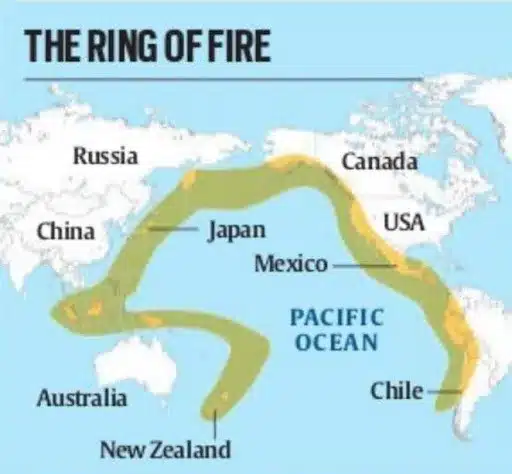
  • The Kamchatka Peninsula is part of the Pacific Ocean’s Ring of Fire, a horseshoe-shaped belt of intense seismic and volcanic activity encircling the Pacific Plate. 
  • Stretching over 40,000 km, this zone marks the boundaries of multiple tectonic plates — including the Eurasian, North American, Indian, Australian, and others — making it one of the most geologically active regions on Earth. 
  • The Ring of Fire spans more than 15 countries, including Russia, Japan, Indonesia, the US, Chile, and the Philippines, all of which frequently experience earthquakes, volcanic eruptions, and tsunamis due to constant tectonic movements.

Tectonic Forces Behind the Ring of Fire

  • The intense seismic and volcanic activity in the Ring of Fire is driven by constant tectonic plate movement. 
  • Plates frequently slide past, collide, or subduct beneath one another. 
  • When rough plate edges get stuck while the rest of the plate continues moving, stress builds up until it suddenly releases, causing an earthquake — as seen in the recent Kamchatka quake and tsunami. 
  • Volcanoes in this zone also form due to subduction, where a denser plate sinks beneath a lighter one, creating deep ocean trenches and magma build-up that fuels eruptions.

Global Earthquake Zones and Their Impact

  • The Circum-Pacific Belt (Ring of Fire) is Earth’s most active seismic zone, generating around 80% of major earthquakes. 
  • The second-most active is the Alpide Belt, stretching from Indonesia through the Himalayas to Turkey, contributing 15–17% of quakes. 
    • Though less active, it runs through densely populated regions, making its quakes more deadly. 
    • E.g., the sparsely populated Kamchatka Peninsula, despite facing a powerful 8.8 quake, saw no casualties, unlike Nepal’s 7.6 magnitude quake in 2015 that killed over 15,000. 
  • The third major zone, the mid-Atlantic ridge, lies deep underwater and causes moderate, less impactful quakes. 
  • Earthquake strength is also influenced by faultline length; a magnitude 9.5 quake is likely the upper limit, as no faultline spans the Earth to enable a stronger quake.

Source: IE | IE | NDTV

Kamchatka Earthquake 2025 FAQs

Q1: What caused the Kamchatka earthquake?

Ans: Subduction of the Pacific Plate under the Okhotsk Plate triggered the massive seismic activity off Kamchatka.

Q2: What is the Ring of Fire?

Ans: A 40,000 km seismically active zone encircling the Pacific, responsible for most of Earth’s major earthquakes.

Q3: Why is Kamchatka vulnerable?

Ans: Its location near a tectonic plate boundary and deep trench makes it prone to frequent quakes and tsunamis.

Q4: What is earthquake magnitude vs. intensity?

Ans: Magnitude measures energy released; intensity describes shaking felt at locations. Both are crucial in assessing earthquakes.

Q5: How are earthquakes measured?

Ans: Using seismographs that track Earth’s movements. A one-point increase in magnitude releases 31.6 times more energy.

Judicial Discretion in POCSO Bail: Legal Grey Zones and Recent Trends

POCSO bail discretion

POCSO Bail Discretion Latest News

  • A special POCSO court in Mumbai recently granted bail to a 40-year-old teacher accused of sexually assaulting a minor, citing consensual relations. 
  • The order has renewed focus on the complexities of bail under the POCSO Act, which is stricter than standard criminal law. 
  • Unlike regular cases where the prosecution must prove guilt, in POCSO cases the burden shifts to the accused to prove innocence. 
  • This reversal makes securing bail—especially in the early stages of investigation—particularly difficult. 

POCSO Act

  • The Protection of Children from Sexual Offences (POCSO) Act, 2012 is a special law enacted to safeguard children (individuals below 18 years of age) from sexual offences. 
  • It provides a comprehensive legal framework to address sexual abuse, harassment, and exploitation of minors.

Key features of the Act

  • Gender-neutral protection: Applies to both boys and girls.
  • Wide range of offences: Covers penetrative and non-penetrative assault, sexual harassment, and pornography involving children.
  • Special courts: Mandates the establishment of child-friendly Special Courts for speedy trial.
  • Mandatory reporting: Any person who has knowledge of child sexual abuse is legally required to report it.
  • Presumption of guilt: The accused must prove innocence, reversing the general legal principle of “innocent until proven guilty.”
  • Confidentiality: Protects the identity of the child during investigation and trial to avoid further trauma.
  • Support for Victims: It provides a framework for supporting and rehabilitating victims of sexual offenses. 
  • Child-Friendly Procedures: The act emphasizes child-friendly procedures for recording statements, medical examinations, and court appearances. 

Judicial Discretion and Bail in POCSO Cases

  • Offences under the POCSO Act are cognizable and non-bailable, meaning arrests can occur without a warrant and bail is not guaranteed
  • However, the Act does not lay down specific bail criteria. 
  • Courts rely on Section 483 of the Bharatiya Nagarik Suraksha Sanhita, 2023 (formerly Section 439 CrPC), which considers factors like the gravity of the offence, potential punishment, flight risk, and risk of evidence tampering. 
  • Over time, courts have introduced additional considerations. 
    • In Dharmander Singh (2020), the Delhi High Court listed factors like the ages of the victim and accused, their age gap, relationship dynamics, coercion, and post-offence conduct—though not binding, they serve as a guide. 
    • In Deshraj @ Musa vs State of Rajasthan (2024), the Supreme Court granted bail to an 18-year-old in a consensual relationship with a 16-year-old, given the minor age gap, time spent in custody, and slow trial progress. 
  • These cases underscore that bail in POCSO matters ultimately depends on judicial discretion balancing individual liberty with victim protection.

Consent and Legal Grey Zones Under POCSO

  • The POCSO Act does not recognise consent from individuals below the age of 18, treating all sexual activity with minors as an offence, regardless of whether it was voluntary. 
  • This creates a legal grey area, particularly in cases involving consensual adolescent relationships that are later criminalised. 
  • While courts have started considering such nuances during bail hearings—especially when the alleged victim confirms the consensual nature of the relationship in a magistrate’s statement—bail remains difficult in the early investigation phase. 
  • Courts often wait for critical evidence and victim testimony before granting relief, leading to prolonged custody for the accused.
  • Due to this, Senior Advocate Indira Jaising has urged the Supreme Court to lower the age of consent to 16, citing infringement of adolescent rights. 
  • However, the Centre opposed this, warning that reducing the age could weaken protections for minors and potentially increase vulnerability to abuse.

Source: IE | NHRC

POCSO Bail Discretion FAQs

Q1: What is the POCSO Act?

Ans: It’s a law to protect children under 18 from sexual abuse with strict procedures and special child-friendly courts.

Q2: Why is bail difficult under POCSO?

Ans: The accused must prove innocence, reversing the usual presumption, making early-stage bail challenging.

Q3: What guides bail decisions under POCSO?

Ans: Courts consider age, coercion, relationship nature, and conduct but use judicial discretion on a case-by-case basis.

Q4: How does POCSO treat adolescent relationships?

Ans: All sexual activity under 18 is illegal, but courts now consider consensual adolescent relations in bail decisions.

Q5: What debate exists on age of consent?

Ans: Advocates want it reduced to 16; the government opposes this, citing risk to child protection norms.

New GDP Series to Enhance Accuracy Using GST, UPI, and E-Commerce Data

New GDP Series

New GDP Series Latest News

  • India will release a new GDP series with 2022-23 as the base year in February 2026, followed by revised IIP and CPI series, to enhance the accuracy and relevance of key economic indicators.

Introduction

  • The Ministry of Statistics and Programme Implementation (MoSPI) is set to overhaul India’s key macroeconomic indicators, beginning with the release of a new GDP series based on the 2022-23 base year on February 27, 2026
  • This will be followed by updated series for the Index of Industrial Production (IIP) and the Consumer Price Index (CPI), which currently use outdated base years from 2011-12 and 2012, respectively.
  • This revision is part of a broader push by the government to ensure more real-time, granular, and representative measurement of India’s dynamic economy, using newer data sources and methodologies.

Updates to National Indicators

  • New GDP Series (Base Year 2022-23)
    • The revised GDP series will offer a more accurate reflection of economic activity by updating the reference period from 2011-12 to 2022-23, incorporating the following improvements:
      • Use of Goods and Services Tax (GST) data for indirect tax estimates
      • Incorporation of UPI transaction data from NPCI
      • Data from the E-Vahan portal for vehicle registrations
      • Administrative records from MCA-21, RBI, and CGA
    • This marks a significant advancement in capturing the informal and formal sectors more comprehensively.
  • Revised IIP Series (Base Year 2022-23)
    • Scheduled for release from April 2026, the new IIP series will reflect current industrial structures and consumption patterns. 
    • The existing 2011-12 base is now considered outdated due to rapid shifts in manufacturing priorities and technologies.
  • Updated CPI Series (Base Year 2024)
    • Expected in early FY2026-27, the new CPI base year will be updated to 2024, capturing recent shifts in household consumption, especially post-pandemic behavioural changes. 
    • The new series will also explore alternative data sources for better accuracy, including:
      • Online airfare and rail fare data
      • OTT subscription prices
      • Fuel prices from administrative records
      • Scanner data and web scraping for real-time e-commerce pricing

Enhancing Measurement Accuracy

  • The upcoming revisions go beyond base year updates and reflect a shift in India’s statistical infrastructure. 
  • MoSPI is adopting technology-driven and data-diverse approaches to capture economic changes more accurately.
  • Key initiatives include:
    • Leveraging e-commerce and digital transactions for consumption tracking
    • Web scraping and online price surveillance for real-time CPI inputs
    • Collaborating with platforms like NPCI for digital payment trends
    • Aligning survey frames with GSTN databases for improved service sector measurement
  • These changes are part of MoSPI’s effort to adapt to a digitally driven, consumption-diverse economy.

Launch of New Statistical Surveys

  • National Household Travel Survey (NHTS)
    • Launched in July 2025, the NHTS will assess travel patterns, choice of transport modes, and price elasticity of demand. The data will support transportation planning and be shared with ministries such as the Railways.
  • Domestic Tourism Expenditure Survey (DTES)
    • Also launched in July 2025, DTES will measure household expenditure on domestic tourism, purpose of travel, choice of transport, and use of tourism-specific services.
  • Annual Survey of Service Sector Enterprises (ASSSE)
    • Beginning January 2026, the ASSSE will systematically track India’s formal services sector, akin to the Annual Survey of Industries for the manufacturing sector. This is expected to bridge long-standing data gaps on:
      • Incorporated service enterprises
      • Revenue and employment metrics
      • Sectoral composition and regional variations
      • MoSPI has already completed a successful pilot study for ASSSE and will use the GSTN database to construct the survey frame.

Implications for Policymaking and Research

  • These statistical upgrades are crucial for:
    • Policy formulation based on real-time and reliable data
    • Private sector and investor decision-making
    • International comparability and credibility of Indian economic data
    • Better understanding of informal and digital economy shifts
  • By diversifying data sources and increasing survey frequency (e.g., Household Consumption Expenditure Survey every three years instead of five), MoSPI is aligning with global best practices in statistical governance.

Source: TH

New GDP Series FAQs

Q1: When will the new GDP series be released?

Ans: The new GDP series with a 2022–23 base year will be released on February 27, 2026.

Q2: What is the base year for the updated CPI series?

Ans: The new Consumer Price Index will use 2024 as its base year.

Q3: What innovative data sources will be used for the new GDP and CPI series?

Ans: GST, UPI, E-Vahan, e-commerce platforms, and web scraping will be used for improved data accuracy.

Q4: What is the Annual Survey of Service Sector Enterprises (ASSSE)?

Ans: It is a new MoSPI survey launching in January 2026 to measure activity in India’s formal services sector.

Q5: What are the goals of the National Household Travel Survey (NHTS)?

Ans: NHTS aims to study travel patterns, transport preferences, and the price sensitivity of Indian households.

Enquire Now