Green Technologies – Why the World Needs It For a Sustainable Future

Green Technologies

Green Technologies Latest News

  • Amid rising energy demands and climate concerns, experts are calling for a shift toward more efficient and scalable green technologies beyond conventional silicon photovoltaics and green hydrogen.

Introduction

  • The world is racing to meet its climate commitments amid the growing urgency of energy self-sufficiency, carbon emission reduction, and geopolitical uncertainty. 
  • While green technologies like silicon photovoltaics and green hydrogen have catalysed a global energy transition, they are no longer sufficient in their current forms. 
  • The future demands not just more renewable deployment, but smarter, more efficient, diverse, and scalable green technologies that better serve a resource-constrained world.

Limitations of Current Green Technologies

  • Silicon Photovoltaics: Dominant Yet Inefficient
    • Invented in 1954 by Bell Labs, silicon photovoltaics (PV) have become the backbone of renewable energy worldwide. However, their limitations are becoming apparent:
      • Typical efficiencies range from 15% to 21%, with lower actual field performance.
      • Land-use intensity is high due to low energy conversion rates; a doubling of efficiency could halve the land required.
      • Over 80% of silicon solar panels come from China, raising strategic and supply chain concerns.
      • India, with ~6 GW of production capacity, is expanding its silicon PV output, but must also prepare to leapfrog toward next-generation solar technologies like gallium arsenide thin-film cells, which have demonstrated up to 47% efficiency in labs.
  • The “Green” in Green Hydrogen is Relative
    • Green hydrogen, produced by electrolysis using renewable energy, is a promising clean fuel. However, it suffers from key drawbacks:
      • Energy inefficiency: Electrolysis consumes more energy than the energy value of the hydrogen it produces.
      • Storage and transportation challenges due to hydrogen’s low density and leakage issues.
      • Conversion losses in creating and later separating hydrogen from green ammonia or methanol.
    • Therefore, while green hydrogen is technically clean, its overall lifecycle efficiency is poor, especially when powered by low-efficiency PV systems.

Rethinking Fuel Production and CO₂ Utilisation

  • To overcome these hurdles, researchers are exploring Artificial Photosynthesis (APS), mimicking plant-based CO₂ recycling to produce fuels like green methanol and green ammonia directly from sunlight, water, and atmospheric gases. 
  • While APS is currently confined to lab research, it represents a breakthrough pathway for truly sustainable fuel production.
  • Meanwhile, Europe is pushing ahead with Renewable Fuels of Non-Biological Origin (RFNBOs), which avoid biomass and use pure renewable inputs. 
  • India, too, must pivot toward such futuristic innovations to reduce its 85% dependence on imported energy, which includes oil, coal, and natural gas.

Land Scarcity and the Efficiency Imperative

  • Land scarcity is becoming a significant constraint:
    • Urbanisation and biodiversity conservation limit the availability of large tracts for solar installations.
    • With rising CO₂ concentrations (from 350 ppm in 1990 to 425 ppm in 2025), current green technologies are not scaling fast enough to reverse climate trends.
  • Thus, doubling down on high-efficiency technologies becomes essential, not just to generate more power per square metre, but also to enable complementary decarbonisation solutions like green hydrogen and RFNBOs to succeed.

Policy and Investment Implications

  • Governments must now shift from deployment to diversified innovation. India’s energy roadmap should include:
    • Increased R&D spending on next-gen energy systems
    • Public-private partnerships to accelerate commercialisation
    • Strategic support for deep-tech innovations like APS and RFNBO
    • Redesign of subsidies and incentives to favour higher efficiency, land-saving, and lifecycle-optimised technologies
  • As geopolitical instability threatens global supply chains, energy independence through innovation is no longer optional; it is urgent and essential.

Source : TH

Green Technologies FAQs

Q1: Why are silicon photovoltaics considered insufficient for future energy needs?

Ans: They have low efficiency (15–21%) and require large land areas, limiting scalability and environmental viability.

Q2: What makes green hydrogen currently inefficient?

Ans: Green hydrogen production consumes more energy than it delivers and is difficult to store and transport.

Q3: What is Artificial Photosynthesis (APS)?

Ans: APS is a lab-stage technology that mimics plant photosynthesis to convert sunlight, water, and CO₂ into green fuels.

Q4: What are RFNBOs in the context of green fuels?

Ans: Renewable Fuels of Non-Biological Origin (RFNBOs) are fuels made using renewable energy without biomass, ensuring lower emissions.

Q5: Why should India invest in next-generation green technologies?

Ans: India imports 85% of its energy needs, and investing in efficient technologies ensures energy independence and climate resilience.
India-U.S. Strategic Partnership under Strain: Causes and Future Outlook

India-U.S. Strategic Partnership

India-U.S. Strategic Partnership Latest News

  • Despite being hailed as a defining partnership of the 21st century, the India-U.S. relationship is currently facing turbulence. 
  • While the U.S. administration insists that ties remain strong and a top priority—citing cooperation across space, defence, energy, trade, and technology—there is growing concern that recent tensions may reflect deeper, structural issues rather than just short-term political shifts under President Trump. 
  • Notwithstanding high-level engagements and initiatives like the COMPACT, doubts have emerged over the long-term trajectory of the partnership.

Turbulence in India-U.S. Ties Amid Trump's Sharp Turn

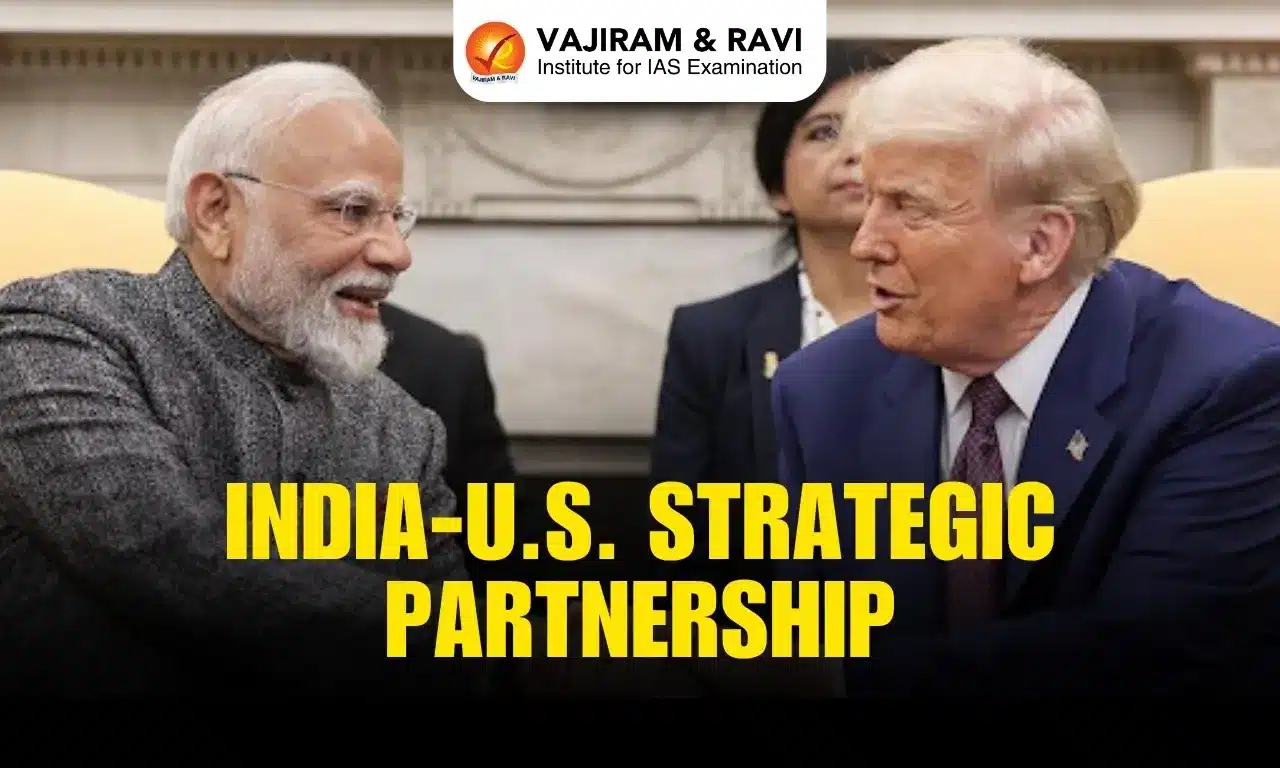
  • The Indian government was left reeling after U.S. President Donald Trump launched a scathing 12-hour tirade targeting India’s trade policies and strategic choices. 
  • Trump announced a 25% tariff hike and an additional “penalty” for India’s trade with Russia, effective August 1.
  • American experts now question India’s global ambitions, calling them delusional and hinting at strategic asymmetry in the partnership. 
  • This shift reflects a broader ideological divide, where nationalism in both countries fuels suspicion and unpredictability
  • America’s internal split between ‘America First’ sceptics and India optimists mirrors the larger tension: India’s assertive global image clashes with the U.S.’s traditional discomfort with power projection by rising nations, even allies
  • As India transitions from a developmental narrative to a power-seeking one, the bilateral relationship faces a critical test of resilience and mutual understanding.

Growing Skepticism and Structural Tensions in India-U.S. Relations

  • A rising group of U.S. sceptics has begun to question India’s trajectory, pointing to concerns over its perceived illiberal turn and assertive foreign policy under PM Modi. 
  • India’s “India First” approach maintains strategic autonomy and includes assertive military responses to terrorism—something that makes the U.S., especially under Trump, uneasy due to fears of nuclear escalation. 
  • The U.S. prides itself on managing relationships with rival nations independently, but it is less comfortable when partners like India do the same. 
  • Washington remains critical of India’s strong ties with Russia and Iran, while expecting Delhi not to challenge its engagement with Pakistan. 
  • India’s broader global engagement strategy—balancing relations across geopolitical divides like Russia-Ukraine and BRICS-QUAD—should be an asset, yet it has become a source of friction. 
  • Additionally, protectionist policies aimed at boosting India’s domestic manufacturing have strained economic ties, with the U.S. frustrated by limited access to Indian markets
  • This complex mix of strategic divergence, geopolitical mistrust, and unmet trade expectations is gradually eroding the sheen of the once-optimistic India-U.S. partnership.

Trump-Pakistan Bonhomie Deepens India’s Worries

  • What further irked New Delhi was Trump’s announcement of a new trade deal with Pakistan, including collaboration on developing the country’s supposed oil reserves. 
  • The U.S.-Pakistan reset, culminating in Trump hosting Pakistan Army Chief Asim Munir at the White House, has deeply unsettled Indian officials.
    • This came on the heels of U.S. strikes on Iran and increased defence cooperation between Washington and Islamabad.

India Suspects Underlying Motives

  • Indian analysts believe Trump’s outburst may be driven by two factors. 
  • First, his negotiating style—known for aggressive tariff impositions to gain leverage—mirrors past tactics with China. 
  • Second, India’s public rebuttal of Trump’s claim that he could broker peace between India and Pakistan likely embarrassed him. 
  • This includes PM Modi’s firm clarification and repeated denials by Indian officials.

Strategic Gains at Risk

  • Indian diplomats fear that Trump’s rhetoric could reverse two decades of strategic progress in India-U.S. ties. 
  • From sanctions post-Pokhran tests to the historic Indo-U.S. nuclear deal, and the elevation of defence cooperation and the Quad, both countries have come a long way. 
  • Trump himself had extended strong support to India in past crises like Pulwama and the China standoff.
  • However, India suspects that its ties with Russia and Iran, combined with Pakistan’s recent outreach to Trump’s inner circle—particularly in the cryptocurrency sector—have soured relations.

Conclusion

  • India is cautiously assessing Trump’s statements and their implications. Experts advise a restrained, calculated diplomatic response. 
  • The challenge lies in three areas: maintaining strategic autonomy while balancing U.S. pressure, rebuilding access to Trump’s close advisors, and repairing long-term trust damaged by recent events
  • As the geopolitical landscape shifts, India must re-evaluate its engagement strategy with a volatile yet important partner.

Source: TH | IE

India-U.S. Strategic Partnership FAQs

Q1: What triggered the latest strain in India-U.S. ties?

Ans: Trump’s tariff hike, criticism of India-Russia trade, and bonhomie with Pakistan.

Q2: Why is the U.S. skeptical of India’s foreign policy?

Ans: India’s strategic autonomy and ties with Russia and Iran concern Washington.

Q3: How does Trump’s Pakistan outreach affect India?

Ans: India fears renewed U.S.-Pakistan defense and trade ties weaken India’s position.

Q4: Are these tensions short-term or structural?

Ans: Experts believe the issues reflect long-term strategic divergence, not just political shifts.

Q5: What should India do moving forward?

Ans: Maintain strategic autonomy, rebuild U.S. access, and diplomatically recalibrate ties amid volatility.

Linguistic Reorganisation of States in India: Unity through Diversity

Linguistic Reorganisation of States

Linguistic Reorganisation of States Latest News

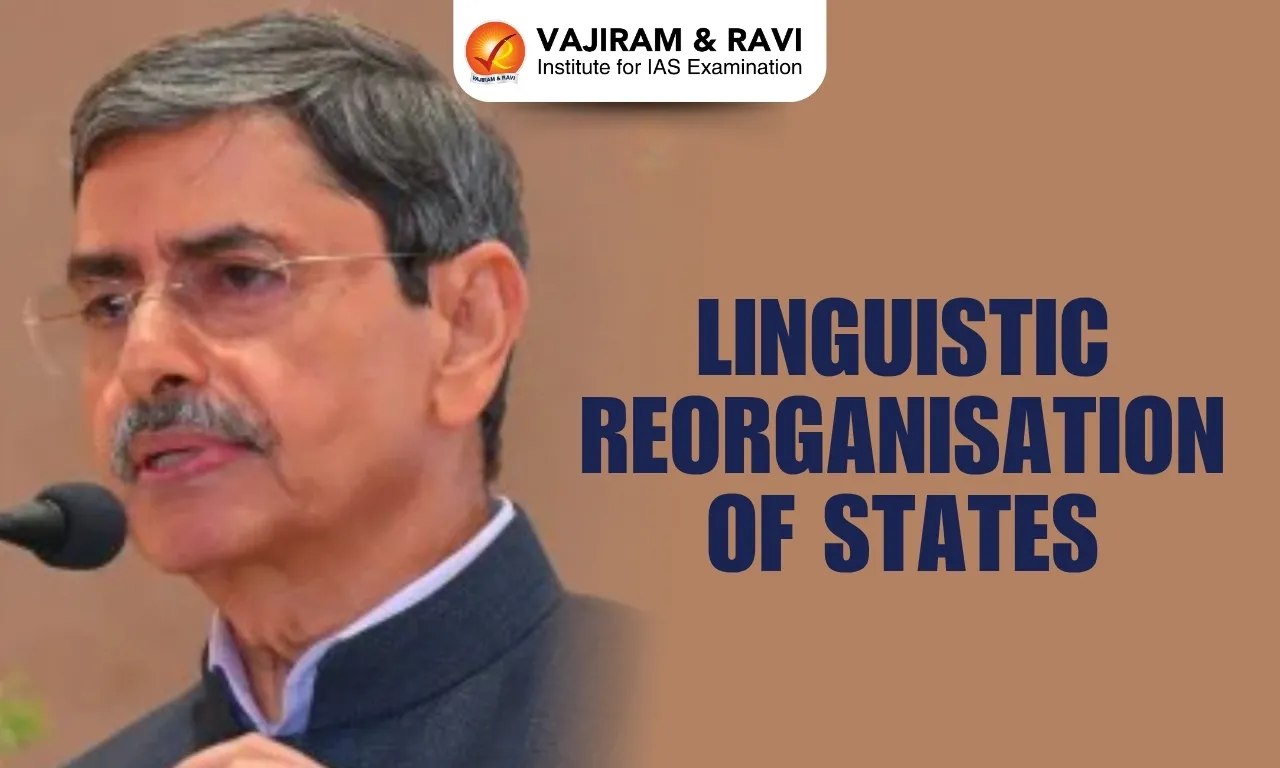
  • Tamil Nadu Governor R N Ravi recently sparked controversy by claiming that the linguistic reorganisation of Indian states turned large sections of people into “second-class citizens”. 
  • Speaking at an event in Gandhinagar, he suggested that the reorganisation, which began within a decade of Independence, undermined national unity.

India’s Political Geography Before Linguistic Reorganisation

  • At the time of Independence in 1947, India inherited a complex administrative setup shaped by British colonial rule. 
  • The British governed India through two parallel systems — direct control in provinces and indirect control over 565 princely states. 
  • The boundaries drawn were dictated largely by administrative convenience rather than cultural or linguistic coherence.

Four-Part Division under the 1950 Constitution

  • When the Constitution came into effect on January 26, 1950, India was described as a “Union of States,” comprising 28 states grouped into four categories:
    • Part A States: These included nine former British governor’s provinces like Bombay, Madras, and Uttar Pradesh, each with an elected legislature and a governor.
    • Part B States: Comprising eight former princely states or their groupings, these were governed by an elected legislature and a rajpramukh (a governor-like figure), and included states like Hyderabad, Jammu & Kashmir, and Rajasthan.
    • Part C States: Ten territories including both former Chief Commissioners’ provinces and some princely states were placed under the direct control of the President through a Chief Commissioner. Examples: Delhi, Himachal Pradesh, and Manipur.
    • Part D State: The sole territory under this category was the Andaman and Nicobar Islands, administered by a Lieutenant Governor appointed by the President.

Linguistic Reorganisation of States in 1956

  • In 1949, the JVP Committee — comprising Prime Minister Jawaharlal Nehru, Sardar Vallabhbhai Patel, and Congress president Pattabhi Sitaramayya — warned that reorganising states based on language might have disintegrative effects on national unity.

Catalyst: Potti Sriramulu’s Martyrdom

  • The turning point came when Potti Sriramulu, a Telugu-speaking Gandhian and former railway engineer, died in December 1952, after a 58-day hunger strike demanding a separate state for Telugu speakers. 
  • His death triggered widespread protests, forcing PM Nehru to announce the creation of Andhra on December 17, 1952. 
  • The state was officially formed on October 1, 1953.

Formation of the States Reorganisation Commission (SRC)

  • The formation of Andhra Pradesh unleashed a wave of demands for linguistic statehood across India. 
  • Recognising the complexity of the issue, the Centre established the SRC in December 1953, under the chairmanship of Justice Fazl Ali, to comprehensively examine the matter.

The 1956 Reorganisation

  • In its report submitted on September 30, 1955, the SRC acknowledged that the growing importance of regional languages and political awareness made linguistic reorganisation inevitable.
  • Following the SRC’s recommendations, the States Reorganisation Act of 1956 was enacted
  • It redrew India’s political map, reducing the existing divisions and reorganising the country into 14 states and six Union Territories, primarily along linguistic lines — marking a turning point in India's federal structure.

Language Was Not the Sole Criterion for State Reorganisation

  • In its December 1953 resolution in Parliament while setting up the SRC, the Centre emphasized that although language and culture reflect a shared way of life in a region, factors such as national unity, security, and administrative, financial, and economic viability were equally critical
  • The final SRC report echoed this balanced approach, stating that relying solely on language or culture was neither possible nor desirable for state reorganisation.
    • Despite strong movements for Marathi- and Gujarati-speaking states, the SRC recommended a bilingual Bombay state covering vast linguistic diversity.
    • Similarly, it advised against dividing Punjab’s Punjabi- and Hindi-speaking areas.
  • During the 1956 debate on the State Reorganisation Bill, Nehru rejected the idea of “unilingualism” as the foundation of India’s federal structure. 
    • He argued that cooperation among different linguistic groups was essential for India’s survival and progress, urging unity in diversity rather than linguistic separatism.

Linguistic Reorganisation: A Story of Unity, Not Division

  • When India undertook the reorganisation of states on linguistic lines, several Western observers predicted it would lead to fragmentation and eventual collapse. 
  • Many thought this "profusion of tongues" would fuel secessionist impulses and create internal disunity. 
  • However, India’s experience defied these fears — linguistic states, rather than dividing the country, became tools for integration and administrative efficiency.

Pluralism That Prevented Secessionism

  • India’s decision to embrace linguistic pluralism “tamed and domesticated secessionist tendencies.” 
  • This approach stands in stark contrast to nations like Pakistan and Sri Lanka, where the imposition of a single official language sparked deep divisions and violent conflicts. 

ARC Recognised Linguistic Reorganisation as a Milestone

  • The Second Administrative Reforms Commission (ARC) in its 2008 report hailed the successful resolution of linguistic conflicts as a major post-independence achievement. 
  • It observed that linguistic states helped ensure administrative unity and effectiveness. 
  • Notably, the few major secessionist movements in India — in Nagaland, Punjab, and Kashmir — were based on issues of ethnicity, religion, or territory, not language. 
  • This demonstrates how linguistic federalism contributed to national cohesion instead of undermining it.

Source: IE

Linguistic Reorganisation of States FAQs

Q1: Why was the linguistic reorganisation of states implemented in India?

Ans: To address growing linguistic demands and ensure administrative coherence after Potti Sriramulu's death.

Q2: What was the outcome of the States Reorganisation Act, 1956?

Ans: It created 14 states and 6 UTs, mostly on linguistic lines, improving federal cohesion.

Q3: Was language the sole factor in state reorganisation?

Ans: No. National unity, economic viability, and administrative efficiency were also considered.

Q4: What did critics fear about linguistic states?

Ans: Critics feared secessionism and disintegration, but India’s experience disproved this.

Q5: What role did linguistic pluralism play in India’s unity?

Ans: It helped tame secessionist tendencies and ensured deeper democratic integration across regions.

SC Reserves Verdict on Age Cap for Surrogacy

Surrogacy (Regulation) Act, 2021

Surrogacy in India Latest News

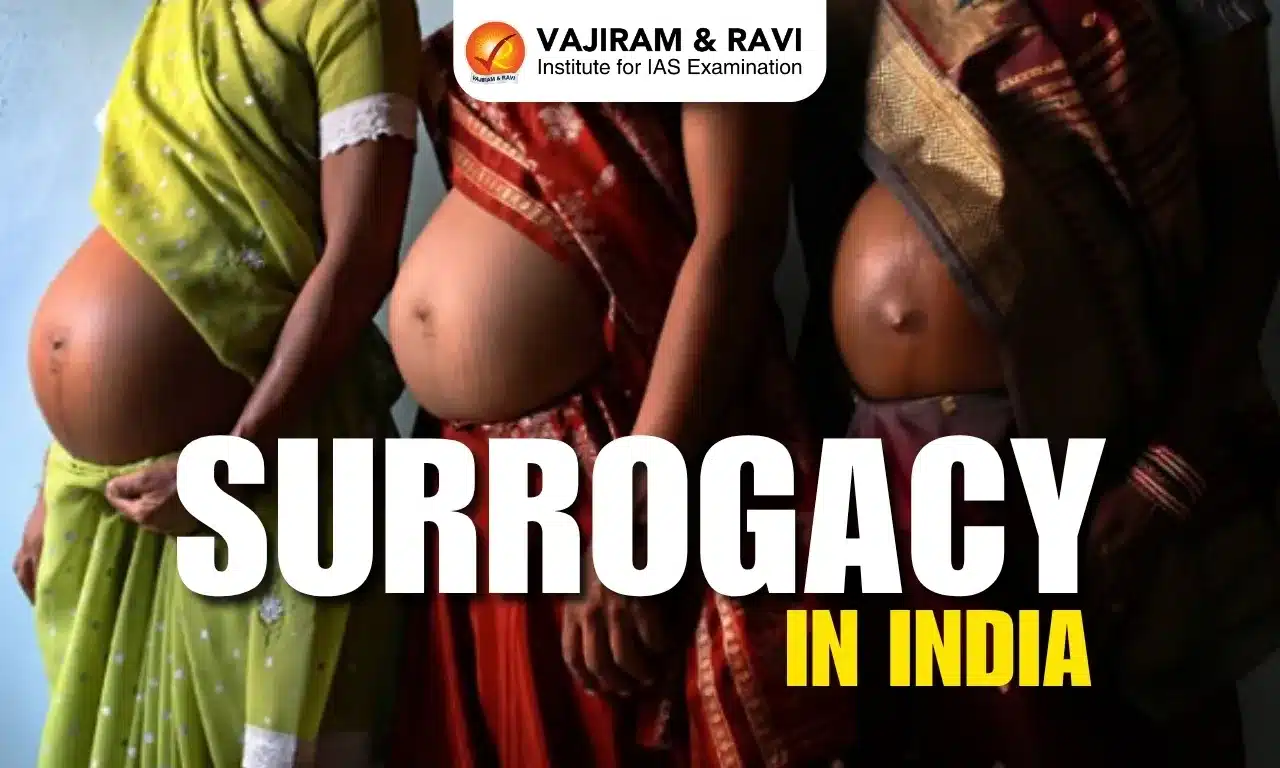
  • The Supreme Court of India has reserved its verdict on multiple petitions challenging the age restrictions imposed by the Surrogacy (Regulation) Act, 2021 and Assisted Reproductive Technology (Regulation) Act, 2021, especially where the surrogacy process was initiated before the enactment of these laws.

Background - Legal Framework Governing Surrogacy in India

  • The Surrogacy and ART Regulation Acts (2021):
    • Objective: Ban commercial surrogacy and promote altruistic surrogacy only.
  • Key provisions: 
    • Age limit for intending couples -
      • Woman: 23–50 years
      • Man: 26–55 years
    • For single women: Only widows/divorcees aged 35–45 eligible.
    • Requirement of certificate of essentiality, including proof of infertility, parentage order, surrogate insurance.
  • Purpose of the law:
    • To prevent commodification of reproductive services.
    • Ensure surrogacy is used only when medically necessary.
    • Based on expert medical advice to safeguard child and mother’s health.

The Case Before the Supreme Court

  • Petitioners’ arguments:
    • Couples began fertility procedures before law came into force (Jan 2022).
    • The age bar retroactively disqualifies them mid-process. For example, a couple aged 62 and 56 lost their child in 2018; failed embryo transfer in 2022; disqualified due to a new age cap.
    • Violation of Article 14 (Right to Equality) – arbitrary classification.
    • Violation of Article 21 – infringement on reproductive autonomy and personal liberty.
    • No grandfather clause for transitional protection in law.
  • Broader issues raised:
    • Exclusion of unmarried single women from eligibility is arbitrary.
    • The law’s narrow definition of “single women” is under constitutional challenge, though not part of current petitions.

Supreme Court’s Observations and Government’s Stand

  • Government's defence:
    • Age limits based on natural reproductive timelines and medical safety.
    • Advanced parental age poses risks to child's health and parenting longevity.
    • Aligns with international best practices.
  • Court's counterpoints:
    • “Why bar surrogacy when natural geriatric pregnancies are allowed?” (Justice Nagarathna)
    • The court -
      • Questioned the rational nexus of age cap with the intent of the Act.
      • Emphasised lack of compassion in the law - “Stop, no children! Look how harsh it is.”
      • Stressed that the law aims to regulate commercial surrogacy, not to deny genuine parenthood.

Key Constitutional and Ethical Dimensions Involved in the Case

  • Article 14: Right to Equality — challenge to arbitrary age-based discrimination.
  • Article 21: Right to Life and Personal Liberty — includes reproductive rights.
  • State vs. individual autonomy: Balancing medical regulation and individual choice.
  • Judicial activism: SC’s proactive role in interpreting personal liberty and family rights.
  • Lack of grandfather clause: Raises concerns on legislative foresight and transitional justice.

Conclusion

  • The Supreme Court's forthcoming verdict will be crucial in determining how laws regulating assisted reproduction balance medical ethics, legislative intent, and individual reproductive rights. 
  • It may also set a precedent for future legal treatment of transitional scenarios and personal autonomy in health-related legislation.

Source: IE

Surrogacy in India FAQs

Q1: Do the age limits in the Surrogacy Act violate Articles 14 and 21?

Ans: Yes, they are alleged to be arbitrary and infringe on reproductive autonomy.

Q2: Why is the absence of a grandfather clause in the Surrogacy Act problematic?

Ans: It denies protection to couples who began treatment before the law came into effect.

Q3: What are the key features of the Surrogacy and ART Acts, 2021?

Ans: They ban commercial surrogacy, allow only altruistic surrogacy, and impose strict eligibility norms.

Q4: Does the Act unfairly exclude unmarried single women from surrogacy?

Ans: Yes, it limits eligibility to widows and divorcees, raising Article 14 concerns.

Q5: How is the judiciary balancing reproductive rights and statutory restrictions?

Ans: By questioning the rationality of age caps and defending individual liberty under Article 21.

Enquire Now