Assam’s Eviction Drives – The Ripple Effect in Northeast India

Assam’s Eviction Drives

Assam’s Eviction Drives Latest News

  • The Assam government’s intensified eviction drive targeting alleged encroachments on forest and government lands, particularly by Bengali-speaking Muslims, has sparked political controversy and raised regional tensions, affecting inter-State relations in Northeast India.

Genesis and Timeline of Eviction Drives

  • State government’s political commitment:
    • The current government came to power in Assam in 2016, with the slogan to protect jaati (community), maati (land), and bheti (hearth).
    • The first eviction drive began in September 2016, following a Gauhati High Court order to reclaim forestlands near Kaziranga National Park.
  • Subsequent developments:
    • A major incident in 2021 at Gorukhuti in Darrang district resulted in two deaths, raising concerns over human rights.
    • The drive resumed in June 2025, coinciding with corruption charges against the current government, including alleged irregularities in a Gir cow distribution scheme at Gorukhuti.

Socio-Political Roots of the Eviction Policy

  • Long-standing narrative:
    • Evictions are part of a broader anti-infiltration narrative targeting Bengali-speaking Muslims — often derogatorily labeled as "Bangladeshi" or “Miya”.
    • The party in government accuses the previous government of allowing illegal settlement for vote-bank politics.
  • Historical backdrop:
    • Assam's political discourse has been shaped by the Assam Agitation (1979–1985).
    • The Assam Accord set March 24, 1971, as the cut-off date for identifying and deporting illegal immigrants.

Intensification and Polarisation

  • Aggressive measures:
    • The eviction has affected not only Muslims but also non-Muslim communities.
    • Silsako Beel - a major wetland in Guwahati, saw demolition of houses of 130 families, including non-Muslims in 2022.
    • Between 2016 and July 2025, at least five people have died during these drives.
  • Rhetoric and data justification: CM Himanta Biswa Sarma refers to “land jihad” and claims that
    • 15,288.52 bighas of satra (Vaishnav monastery) land are encroached by people of doubtful citizenship.
    • 3,620.9 sq km of forestland under encroachment (as of March 2024).
  • Exemptions and resettlements:
    • The Forest Rights Act 2006 protections apply to tribal dwellers before 2005.
    • Ahom families evicted along with Muslims were fast-tracked for resettlement.

Regional Impact and Neighbouring States’ Reaction

  • Northeast States on alert:
    • Neighbouring states—Nagaland, Manipur, Meghalaya, Arunachal Pradesh, and Mizoram—have heightened border vigilance.
    • Nagaland NGOs accused Assam of pushing evictees into their territory.
  • Preventive actions:
    • Nagaland police intercepted 200 vehicles carrying suspected illegal migrants.
    • Some extremist groups in Nagaland formed task forces to patrol borders.
    • Inner Line Permit issuance was made stricter by bordering States.

Evictions and Inter-State Border Disputes

  • Encroachments and claims:
    • The issue ties into unresolved border disputes among NE States, especially where migrants have allegedly settled.
    • 83,000 hectares of Assam’s land reportedly occupied by Arunachal Pradesh, Mizoram, Nagaland, and Meghalaya.
  • Mutual allegations:
    • Other States accuse Assam of using migrants to settle disputed border lands.
    • In turn, they have evicted suspected migrants, pushing them back to Assam.
  • Judicial intervention: On July 30, 2025, the Gauhati High Court ordered all five States to form high-level committees for coordinated eviction from forestlands.

Conclusion

  • The Assam eviction drive is not just an administrative exercise but a highly politicised and regionally sensitive issue with implications for inter-State relations, ethnic tensions, and borderland governance in the Northeast. 
  • It underscores the delicate balance between land rights, environmental conservation, identity politics, and human rights.

Source: TH

Assam’s Eviction Drives FAQs

Q1: What is the historical context behind Assam’s eviction drives?

Ans: Rooted in the Assam Agitation (1979–85), the drives aim to remove alleged illegal immigrants, mostly Bengali-speaking Muslims.

Q2: How have Assam’s eviction drives affected relations with neighbouring States?

Ans: They triggered border tensions and preventive actions by States like Nagaland, Meghalaya, and Mizoram fearing influx of evictees.

Q3: How is the Forest Rights Act, 2006 applied in Assam’s eviction policy?

Ans: It protects pre-2005 tribal dwellers but is applied selectively, raising equity concerns.

Q4: What human rights concerns arise from these eviction drives?

Ans: Mass displacements without rehabilitation or legal recourse have raised serious human rights and internal migration issues.

Q5: How is the term "land jihad" linked to Assam’s political narrative?

Ans: Used politically by the current government to frame evictions as protection of land and culture against illegal settlers.

UK’s Recognition of Palestine: A Diplomatic Turning Point in Global Geopolitics

UK Recognition of Palestine

UK Recognition of Palestine Latest News

  • British Prime Minister Keir Starmer announced that the UK will recognise the State of Palestine at the upcoming UN General Assembly in September unless Israel agrees to a Gaza ceasefire, facilitates more humanitarian aid, and commits to a two-state peace process.

Growing Global Momentum for Palestinian Statehood Recognition

  • Following British Prime Minister Keir Starmer’s announcement, French President Emmanuel Macron declared that France would formally recognise Palestinian statehood in September. 
  • Canada and Portugal have also expressed similar intentions. 
  • As the 21-month-long Gaza conflict continues, Israel faces a mounting diplomatic challenge, with an increasing number of its traditional Western allies shifting towards supporting Palestinian statehood.

Current Palestine Recognition Drive: A Diplomatic Turning Point

  • Out of 193 UN member states, 147 have already recognised Palestine, but major Western powers had long resisted, linking recognition to a final Israel-Palestine peace settlement. 
  • That stance is now shifting. Russia and China, both UN Security Council (UNSC) permanent members, already recognise Palestine. 
  • If France and the UK follow through on their recent pledges, the U.S. will become the only P5 member opposing recognition, isolating itself diplomatically. 
  • The inclusion of France, the UK, and Canada—key G7 members—adds significant weight, potentially influencing others to follow. 
  • Britain’s move is especially historic, given its central role in the Israel-Palestine conflict since the 1917 Balfour Declaration, which endorsed the creation of a Jewish homeland in Palestine.

The Balfour Declaration: Britain’s Endorsement of a Jewish Homeland in Palestine

  • Issued in November 1917, by British Foreign Secretary Sir Arthur Balfour to Zionist leader Lord Lionel Walter Rothschild, the Balfour Declaration marked Britain’s official support for establishing a Jewish national home in Palestine. 
  • At the time, Palestine was under Ottoman rule, with Jews comprising around 9% of its population. 
  • The declaration was driven by Britain’s desire to gain global Jewish support during World War I. 
    • Earlier efforts, like the Uganda Plan of 1903, had proposed alternative Jewish homelands but were abandoned. 
  • The Balfour Declaration, later endorsed by the U.S., became a pivotal moment in Zionist history, legitimising Jewish claims to Palestine and shaping the geopolitical future of the region.

Britain’s Role in Shaping Post-War Palestine and the Birth of Israel

  • After World War I, Britain found itself balancing conflicting promises—supporting both a Jewish homeland in Palestine and Arab independence. 
  • However, the secret Sykes-Picot Agreement with France had already divided Ottoman territories between them. 
  • Britain established a colonial administration in Palestine under a League of Nations Mandate, facilitating increased Jewish migration and the creation of parallel Jewish institutions, including paramilitary groups. 
  • By the end of World War II, Jews constituted 30% of Palestine’s population. Realising the Mandate was unworkable, Britain backed the idea of partition. 
  • In 1947, Britain informed the UN of its intention to end the Mandate by May 15, 1948. 
  • On May 14, 1948, Zionist leaders unilaterally declared the establishment of Israel, which was immediately recognised by the U.S., triggering the First Arab-Israel War.

Britain’s Recognition of Palestine: A Symbolic Shift After a Century

  • Britain’s decision to recognise Palestine, 108 years after the Balfour Declaration, carries profound symbolic weight given its historic role in the Israel-Palestine conflict. 
  • While the recognition may not immediately alter Israel’s occupation, it signifies a major shift in Britain’s policy stance. 
  • With Israel facing global accusations of genocide and harrowing images of Gaza’s devastation circulating, it has become increasingly untenable for Western nations, including the UK, to support Israel unconditionally. 
  • Britain’s move reflects growing international pressure for a more balanced approach towards the Palestinian cause.

Source: TH

UK Recognition of Palestine FAQs

Q1: Why is the UK’s recognition of Palestine significant?

Ans: It marks a historic policy shift, challenging Israel’s global diplomatic support, especially among Western allies.

Q2: Which countries are joining the recognition drive?

Ans: France, Canada, Portugal, Australia, and others have signalled their intention to recognise Palestine alongside the UK.

Q3: How does this impact the UN Security Council dynamics?

Ans: If UK and France proceed, the U.S. will be isolated as the only P5 member opposing Palestine’s recognition.

Q4: What is the New York Declaration?

Ans: A UN-led phased roadmap co-sponsored by France and Saudi Arabia aiming to resolve the Israeli-Palestinian conflict.

Q5: How is Israel responding to the recognition push?

Ans: Israel criticises it, arguing it rewards Hamas and undermines ceasefire negotiations, escalating diplomatic tensions.

Impact of Trump’s Tariffs on India: Sectors Affected, Trade Talks, and Future Prospects

Trump’s Tariffs on India

Trump’s Tariffs on India Latest News

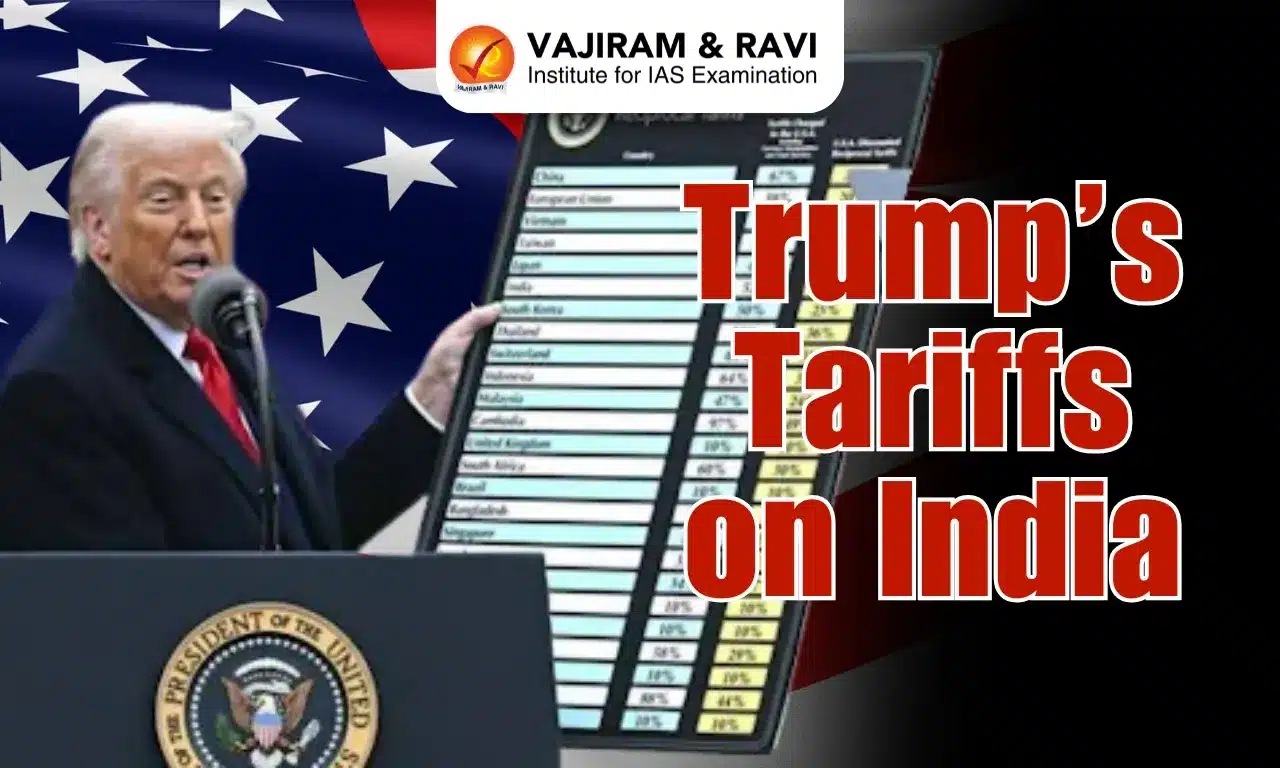
  • U.S. President Donald Trump announced a 25% tariff plus an additional penalty on Indian imports, ending months of speculation. 
  • However, this move has introduced fresh uncertainty over the prospects of a bilateral trade agreement between India and the U.S., complicating future trade negotiations.

Trump Imposes Tariffs on India

  • U.S. President Donald Trump announced a 25% tariff on Indian imports, citing India’s tariff and non-tariff barriers and its energy and defense dealings with Russia as key reasons. 
  • While details of the additional penalty remain unclear, Trump has previously threatened a 10% extra tariff on BRICS nations, which could raise India’s effective tariff rate to 35%
  • Additionally, pending U.S. legislation proposes a 500% tariff on India, China, and Brazil for their continued engagements with Russia, adding further uncertainty to India-U.S. trade relations.

Impact of Trump’s Tariffs on Indian Economy and Key Export Sectors

  • While U.S. importers will bear the direct cost of the new tariffs, Indian goods will become less competitive and more expensive in the U.S. market. 
  • On a macroeconomic level, the tariffs are expected to reduce India’s GDP growth by 0.2%, lowering forecasts from 6.6% to 6.4%, according to Bank of Baroda research. 
  • However, the real impact will be sector-specific, hitting industries like garments, precious stones, auto parts, leather goods, and possibly electronics.
    • These sectors may face pricing disadvantages compared to competitors from Vietnam, South Korea, and Indonesia, who benefit from lower tariffs. 
  • Exporters in these sectors will need to rework their strategies to stay competitive.

The Breakdown of India-U.S. Trade Talks Leading to Tariffs

  • In February 2025, Prime Minister Narendra Modi and President Donald Trump announced plans to finalise the first tranche of a bilateral trade deal by fall, a move seen as a positive commitment to strengthening ties. 
  • This announcement came ahead of Trump’s broader reciprocal tariffs strategy, which pressured other countries to enter negotiations with the U.S. 
  • However, on April 2, Trump launched his Liberation Day tariffs, imposing a 10% baseline tariff globally and additional country-specific tariffs, with India facing a 26% total tariff. 
  • Following backlash, Trump announced a 90-day pause to allow for bilateral negotiations aimed at reducing trade deficits. 
  • The pause, initially set to expire in July, was extended until August 1, but no breakthrough was reached, leading to the imposition of tariffs.

Multiple Frictions Strain India-U.S. Trade Relations

  • While no single incident has soured India-U.S. ties, several points of friction have built up in recent months. 
  • President Trump has consistently criticised India’s tariff and non-tariff barriers and has also raised concerns about India’s continued energy and defense dealings with Russia, accusing it of indirectly financing the Ukraine war. 
  • India, however, has defended its energy security strategy, with Russia supplying 35-40% of its oil imports. 
  • Additionally, India’s refusal to open its agriculture and dairy sectors to foreign competition remains a major sticking point, as it protects vulnerable domestic farmers. 
  • Tensions escalated further when Trump claimed credit for the India-Pakistan ceasefire (Operation Sindoor), a claim firmly rejected by India. 
  • In response to U.S. tariffs on Indian goods like steel and aluminium, India has informed the WTO of its right to impose retaliatory tariffs. 
  • These cumulative issues have set the stage for Trump’s recent tariff imposition, reflecting the growing strains in bilateral ties.

India Faces Imminent Tariffs Amid Uncertain Trade Deal Prospects

  • Despite discussions of a potential “mini-deal” to ease reciprocal tariffs, U.S. President Donald Trump’s recent tariff announcement signals that such a deal is unlikely in the near term. 
  • Both India and the U.S. remain committed to finalising a broader trade agreement by fall 2025, but progress has been complicated by Trump’s decision to link India’s Russia engagements to trade negotiations
  • So far, five rounds of talks have been held, with the next U.S. delegation visit scheduled for late August. 
  • Meanwhile, Trump’s Executive Order, dated July 31, mandates that tariffs on Indian imports will take effect within 7 days, making the imposition of duties imminent and unavoidable for now.

Source: TH

Trump’s tariffs on India FAQs

Q1: Why did Trump impose tariffs on India?

Ans: Due to India’s trade barriers, engagements with Russia, and refusal to open sensitive sectors like agriculture and dairy.

Q2: Which Indian sectors will be hit hardest by tariffs?

Ans: Garments, precious stones, auto parts, leather goods, and possibly electronics will face competitiveness challenges in the U.S. market.

Q3: Will these tariffs significantly impact India’s GDP?

Ans: No, Bank of Baroda estimates India’s GDP growth will fall marginally by 0.2%, but sectoral impacts will be severe.

Q4: Can India and the U.S. still reach a trade deal?

Ans: Both sides are committed to finalising a trade deal by fall 2025, but tensions over Russia complicate negotiations.

Q5: How is India preparing to counter U.S. tariffs?

Ans: India has informed the WTO of its right to impose retaliatory tariffs on American imports like steel and automobiles.

Wind Farms of Thar Desert Record World’s Highest Bird Mortality Rate

Wind Farms

Wind Farms Latest News

  • A new study has found that wind farms in India’s Thar Desert have the world’s highest recorded bird mortality rates, raising concerns over the environmental impact of renewable energy expansion.

Introduction

  • As India accelerates its push towards renewable energy to meet growing climate commitments and power demands, an unintended consequence has emerged in the form of large-scale bird deaths. 
  • A study by the Wildlife Institute of India (WII) reveals that wind farms in the Thar Desert have the highest recorded bird mortality rates in the world, with critically endangered species such as the Great Indian bustard under threat.

Key Findings on Bird Mortality in the Thar Desert

  • The study, published in Nature Scientific Reports, was conducted across 3,000 sq. km of desert landscape in Jaisalmer, Rajasthan, which hosts about 900 wind turbines and over 270 bird species
  • Researchers conducted seven multi-season surveys around 90 randomly selected turbines, identifying 124 bird carcasses within a 150-meter radius.
  • The annual estimated bird mortality was a staggering 4,464 birds per 1,000 sq. km, after accounting for carcass detection challenges such as scavenging and terrain obstacles. 
  • By contrast, control sites, located 500 to 2,000 meters away from turbines, showed zero bird deaths, confirming the turbines as the primary cause.
  • Notably, the study's mortality estimate of 1.24 bird deaths per turbine per month is significantly higher than previous findings from Kutch and Davangere, which reported 0.47 deaths per turbine annually.

Species at Risk and Regional Vulnerability

  • The Thar Desert forms a crucial segment of the Central Asian Flyway, a major migration route for birds across Eurasia, making it an ecologically sensitive zone. 
  • The area also serves as a prominent wintering ground, further amplifying the risk of avian fatalities due to wind power infrastructure.
  • Among the most vulnerable bird species are raptors, which are long-lived and reproduce slowly. 
  • Their soaring flight patterns and altitude bring them directly into the rotating blades of wind turbines, making them especially susceptible to collisions. 
  • These additional mortalities can lead to population-level impacts, particularly for endangered species.

Proposed Mitigation Measures

  • Several mitigation strategies have been proposed globally and domestically to address the issue of bird deaths at wind farms:
    • Blade painting: Painting one turbine blade black to increase visibility for birds.
    • Timed shutdowns: Halting turbine operations during high-risk periods such as migration seasons or early morning hours.
    • Site selection: Most crucially, experts recommend careful pre-installation site assessments to avoid high-avian-sensitivity zones.
  • One key tool in this regard is the Avian Sensitivity Tool for Energy Planning (AVISTEP), an open-source platform developed by BirdLife International. 
  • It helps developers identify zones classified into ‘low’, ‘moderate’, ‘high’, and ‘very high’ sensitivity to bird species. 
  • However, experts stress that AVISTEP must be complemented by detailed ground-level studies.
  • Despite the severity of impacts, onshore wind energy projects in India are currently not mandated to conduct environmental impact assessments (EIAs) before installation, a gap that requires urgent regulatory attention.

Offshore Wind Energy: An Emerging Focus

  • India is now turning its attention to offshore wind energy, considered a less land-intensive alternative. 
  • The country plans to install 30 GW of offshore wind capacity by 2030, with the Ministry of New and Renewable Energy already issuing 4 GW of bids in Gujarat and Tamil Nadu.
  • With 7,600 km of coastline and 2.3 million sq. km of exclusive economic zones, India has immense potential for offshore wind. 
  • According to the Council on Energy, Environment and Water (CEEW), the addition of offshore wind capacity in states like Gujarat can help ensure grid reliability during peak loads.
  • However, experts caution that marine biodiversity impacts must not be overlooked. 
  • Offshore wind projects involve complex infrastructure that can disrupt marine habitats, increase noise levels, and degrade water quality. 
  • The Gulf of Khambhat EIA report documented the presence of sensitive species like dolphins and sharks, with warnings about construction-phase disturbances.
  • Although EIAs are mandatory for offshore wind projects, concerns remain about the accuracy and duration of ecological assessments, especially in high-biodiversity zones such as the Gujarat coast, which lies along both the Central Asian and African-Eurasian flyways.

Source : TH

Wind Farms MCQs

Q1: Which region has recorded the world’s highest bird death rates at wind farms?

Ans: India’s Thar Desert wind farms have the highest recorded bird mortality rates globally.

Q2: Which species are most vulnerable to wind turbine collisions?

Ans: Raptors and the critically endangered great Indian bustard are among the most affected.

Q3: What mitigation tool helps identify high-risk zones for bird collisions?

Ans: The Avian Sensitivity Tool for Energy Planning (AVISTEP) maps avian-sensitive areas.

Q4: Are onshore wind energy projects in India required to conduct EIAs?

Ans: No, onshore wind projects are currently not mandated to undertake environmental impact assessments.

Q5: What is India’s offshore wind energy target for 2030?

Ans: India aims to install 30 GW of offshore wind capacity by 2030.

Enquire Now