
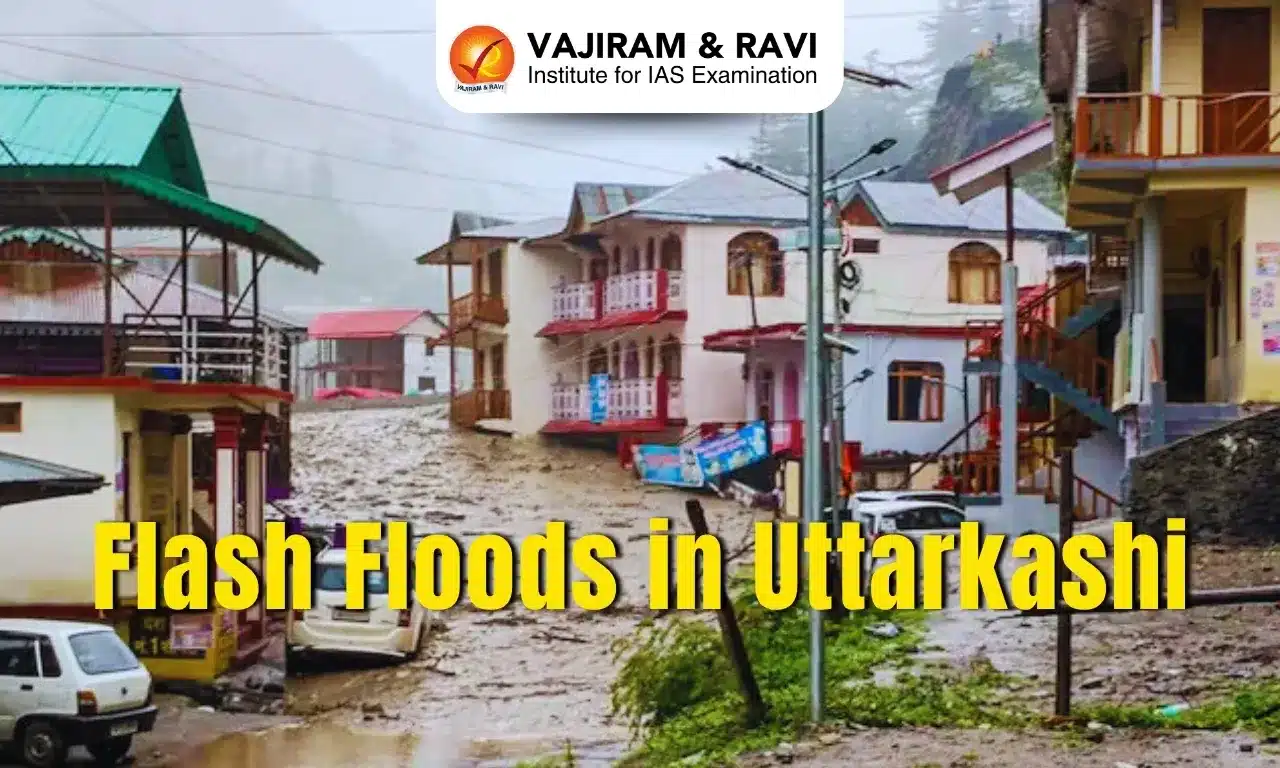
Flash Floods in Uttarkashi: Causes, Topography, and Climate Change Risks Explained

Flash Floods in Uttarkashi

Flash Floods in Uttarkashi Latest News

  • At least four people died as flash floods and mudslides struck Dharali village in Uttarkashi, Uttarakhand, damaging several buildings, shops, and hotels. 
  • While cloudbursts are common triggers of flash floods in Uttarakhand’s hilly regions, the recent incident was not due to a technical cloudburst but rather sustained heavy rainfall over the past three days. 
  • The region’s topography, prone to landslides during intense rains, caused mud and debris to surge into rivers, leading to destructive flash floods downstream.

Topography of Uttarkashi

  • Uttarkashi district ranges from 800 to 6,900 metres above sea level, with vast snow-covered areas and several glaciers. 
  • It houses the source regions of the Ganga (Gangotri) and Yamuna (Yamunotri) rivers. 
  • The terrain is rugged, with high ridges, perennial rivers, narrow valleys, and deep gorges. 
  • Land slopes sharply southwest, with valley drops of up to 800 metres.

Rainfall Pattern in Uttarkashi

  • Uttarkashi receives an average annual rainfall of 1,289 mm, with the southwest monsoon (June-September) bringing maximum rainfall, especially in southern areas. 
  • The highest recorded rainfall was 2,436 mm in 1969. July is the wettest month, averaging 312 mm. 
  • The district is also prone to frequent thunderstorms in its hilly regions.

Flash Flood

  • A flash flood is a sudden, intense flood that occurs within a very short period (usually within 6 hours) of heavy rainfall, dam/levee failure, or sudden release of water (like glacier bursts or cloudbursts). 
  • Flash floods are characterized by:
    • Rapid onset and high intensity.
    • Localized impact, often affecting mountainous or hilly terrains.
    • Triggered by localized heavy rain, cloudbursts, glacial lake outbursts (GLOFs), or infrastructure failures.
  • The distinguishing factor between a flood and a flash flood is the amount of time it takes for the flood to occur.
    • A flash flood occurs within minutes or hours. A flood occurs more gradually.
  • Flash floods are often more dangerous because they occur with little warning. 
  • Their quick nature makes them much more powerful than floods, and they often become raging torrents of water, sweeping away everything in their path.

Factors Behind Uttarkashi Flash Floods

  • Continuous rainfall over the past few days, combined with Uttarkashi’s fragile topography, triggered mudslides, debris flows, and flash floods. 
  • Climate change-induced intense rainfall and accelerated glacier melting further worsened the situation. 
  • Rainfall of any intensity, if continuous, recorded over such high altitudes where Uttarkashi is located, can be disastrous. 
  • That is because this region is built on layers of mudslides over the past several centuries.
  • Uttarkashi district is situated along the southern Himalayan slope, where there is limited vegetation and no significant obstruction. 
  • Mild triggers such as rainfall or earthquakes can cause loose moraine and soil to easily slither downhill, swallowing homes and roads along its path.

Glacial Avalanche or Lake Breach Suspected

  • Satellite imagery confirmed the presence of large glaciers and at least two glacial lakes directly above the affected area. 
  • Experts suspect a sudden release of water from a glacier burst or a GLOF could have unleashed the destructive torrent, similar to the 2021 Raini disaster in Chamoli. 
    • In that incident, a rock-ice avalanche devastated hydropower projects and caused over 200 deaths.
  • According to the Wadia Institute of Himalayan Geology, Uttarakhand has 1,266 glacial lakes, many of which pose severe risks to downstream communities. 
  • The National Disaster Management Authority (NDMA) has identified 13 glacial lakes as high-risk, with five classified as extremely dangerous due to their potential for sudden breaches.

Why Uttarkashi Rainfall Was Not a Cloudburst

  • According to IMD, a cloudburst requires 100 mm rainfall in an hour over a 10x10 km area
  • Uttarkashi recorded only 2.7 mm in 24 hours till 8:30 am on August 5, with rainfall throughout the day remaining below cloudburst thresholds. 
  • Though heavy rains occurred in Uttarakhand, such as 300 mm in Haridwar, Uttarkashi’s event did not meet cloudburst criteria.
  • Cloudbursts cause widespread destruction—collapsing houses, disrupting transport, and leading to significant casualties. 
  • The growing frequency of these events necessitates robust disaster management policies, better infrastructure planning, and proactive global and national intervention, as urged by the 2023 research paper.

Source: IE | ToI | ET

Flash Floods in Uttarkashi FAQs

Q1: What caused the flash floods in Uttarkashi?

Ans: Continuous rainfall, fragile topography, and a suspected glacier burst or glacial lake outburst caused the devastating flash floods.

Q2: Why was it not considered a cloudburst event?

Ans: Rainfall intensity remained below the 100 mm/hour cloudburst threshold defined by IMD, despite sustained heavy rainfall over days.

Q3: What makes Uttarkashi prone to flash floods?

Ans: Steep slopes, loose soil layers from ancient mudslides, and glacier-fed rivers make Uttarkashi vulnerable to sudden flash floods.

Q4: How does climate change worsen such disasters?

Ans: Climate change increases rainfall intensity, accelerates glacier melting, and destabilizes moraine, leading to more frequent flash floods.

Q5: What are glacial lakes, and why are they risky?

Ans: Glacial lakes formed by melting glaciers can suddenly breach, unleashing torrents downstream, causing flash floods and destruction.


Tackling Money Laundering in India: Challenges, PMLA Provisions, and FATF Compliance Explained

Tackling Money Laundering

Tackling Money Laundering Latest News

  • Since 2015, the Enforcement Directorate (ED) has taken up 5,892 cases under the Prevention of Money Laundering Act (PMLA), 2002, but only 15 convictions have been secured so far, according to a report presented by the Finance Minister in the Rajya Sabha. 
  • While the government asserts that investigations and Enforcement Case Information Reports (ECIRs) have been initiated in almost all cases, the low conviction rate highlights the inefficacy in securing prosecutions. 
  • Additionally, the continuous rise in money laundering cases suggests the government's inability to effectively curb such financial crimes.

Laundromats: Financial Vehicles for Money Laundering and Illicit Activities

  • The term “laundromat” originated from organised crime syndicates in the U.S. using laundromats as fronts to disguise illegal earnings. 
  • In financial terms, a laundromat refers to an all-purpose financial vehicle, often set up by banks or financial service companies, which facilitates laundering proceeds of crime.
    • It does so by hiding asset ownership, embezzling funds, evading taxes, bypassing currency restrictions, and moving money offshore. 
  • These entities are used to obscure the true source and ownership of illicit funds under the guise of legitimate financial operations.

The Process and Impact of Money Laundering

  • Money laundering, as defined under Section 3 of the Prevention of Money Laundering Act (PMLA), involves concealing, possessing, acquiring, or using proceeds of crime and projecting them as untainted property. 
  • The laundering process typically unfolds in three stages: 
    • Placement, where illicit money is introduced into the financial system, often broken into smaller sums through "smurfing"; 
    • Layering, where funds are moved through investments and transactions to obscure their origin; and 
    • Integration, where the laundered money re-enters the economy via real estate, businesses, or asset formation. 
  • The Supreme Court, in P. Chidambaram vs. Enforcement Directorate (2019), noted that laundering conceals illegal sources, undermining the financial system and national sovereignty. 
  • Additionally, it disrupts monetary stability, fuels inflation, and distorts trade, as highlighted by the Financial Action Task Force (FATF).

Key Provisions and Challenges of the Prevention of Money Laundering Act (PMLA)

  • The Prevention of Money Laundering Act (PMLA) was enacted in line with the UN Political Declaration and Global Programme of Action (1990) to prevent money laundering and confiscate properties derived from criminal activities. 
  • A notable aspect of the Act is that it shifts the burden of proof onto the accused. 
  • Additionally, an Enforcement Case Information Report (ECIR) is sufficient to initiate proceedings, without the necessity of a First Information Report (FIR).
    • This was upheld by the Supreme Court in Vir Bhadra Singh vs. ED (2017)
  • The only prerequisite is the commission of a scheduled offence, considered an offence against the state. 
  • However, despite the Act's stringent provisions, money laundering remains widespread, posing a serious challenge to law enforcement.

Addressing Implementation Challenges and Misuse of PMLA

  • The rapid rise in money laundering cases raises concerns about the effective implementation and misuse of the Prevention of Money Laundering Act (PMLA). 
  • The Supreme Court, in Vijay Madanlal Chaudhury vs. Union of India (2022), clarified that while prosecution under Section 3 requires a registered scheduled offence, authorities can attach properties under Section 5 without a pre-registered case. 
  • This loophole has often been exploited for politically motivated actions. 
  • To curb such misuse, authorities must adhere to the Financial Action Task Force (FATF) guidelines and handle cases with greater diligence and transparency. 
  • Money laundering’s direct link to terror financing necessitates its serious and impartial enforcement. 
  • Additionally, India’s Double Taxation Avoidance Agreements (DTAA) with around 85 countries facilitate international cooperation in tackling money laundering, but stronger efforts are needed to ensure their effective utilization.

Source: TH | FATF

Tackling Money Laundering FAQs

Q1: What is money laundering under PMLA?

Ans: Money laundering involves concealing proceeds of crime and projecting them as legitimate assets through financial transactions and layering.

Q2: How do laundromats operate in financial crimes?

Ans: Laundromats mask illicit funds, facilitate offshore transfers, evade taxes, and hide asset ownership under legal financial operations facade.

Q3: What are the three stages of money laundering?

Ans: Placement introduces illicit funds, layering disguises origins through transactions, and integration reintroduces laundered money into the legitimate economy.

Q4: Why is PMLA criticised for misuse?

Ans: Authorities exploit PMLA's broad powers for politically motivated actions, using property attachments without pre-registered scheduled offences.

Q5: How can India strengthen money laundering enforcement?

Ans: Strict adherence to FATF recommendations, ensuring transparency, avoiding political misuse, and fostering international cooperation are crucial enforcement measures.

India-Philippines Strategic Partnership: Defence, Trade, and Maritime Cooperation

India-Philippines Strategic Partnership

India-Philippines Strategic Partnership Latest News

  • India and the Philippines have elevated their bilateral ties to a strategic partnership during President Ferdinand Marcos Jr.’s maiden visit to India, focusing on defence, maritime cooperation, and trade.

Historical Background

  • India and the Philippines established diplomatic relations in 1949. 
  • Over the decades, their engagement has evolved steadily, shaped by shared democratic values, anti-colonial legacies, and an increasing convergence in geopolitical interests. 
  • India’s "Look East" and now "Act East" policy has progressively deepened engagement with Southeast Asian countries, with the Philippines playing an increasingly central role.

Trade and Economic Ties

  • India and the Philippines signed a Trade Agreement in 1979, but significant bilateral trade growth began after the late 1990s, spurred by India’s Look East Policy and the 2009 India-ASEAN Trade in Goods Agreement. 
  • Bilateral trade crossed the USD 3 billion mark for the first time in 2022-23 and reached USD 3.53 billion in 2023-24, with India enjoying a trade surplus. 
  • Major Indian exports include engineering goods, pharmaceuticals, chemicals, automotive parts, and rice, while key imports from the Philippines include semiconductors, electrical machinery, ores, and food industry residues
  • The Philippines accounts for nearly 20% of Indian pharma exports to ASEAN.

Development Cooperation

  • India has offered several capacity-building and training programmes to the Philippines under the Indian Technical and Economic Cooperation (ITEC) Programme
  • Both countries cooperate in areas such as disaster relief, humanitarian assistance, and now increasingly in digital infrastructure, with India offering to support the Philippines’ Sovereign Data Cloud pilot project.

Defence and Maritime Cooperation

  • In recent years, defence cooperation has emerged as the most dynamic pillar of India-Philippines relations. 
  • In 2022, India secured a landmark USD 375 million deal to supply BrahMos supersonic cruise missiles to the Philippine Navy, making it India’s first major defence export in Southeast Asia.
  • India and the Philippines have held joint naval exercises and regular dialogues on maritime security, defence logistics, and military training. 
  • The growing alignment comes amid shared concerns over China’s assertiveness in the South China Sea and the need for a rules-based maritime order.

News Summary

  • The bilateral relationship witnessed a transformative moment during the first-ever state visit of Philippine President Ferdinand Marcos Jr. to India recently, at the invitation of Prime Minister Narendra Modi.
  • Key Highlights of the Visit:
    • Strategic Partnership Formalised: India and the Philippines officially elevated their ties to a Strategic Partnership, signalling long-term cooperation in strategic sectors.
    • Maritime Security and Defence Dialogue: Both sides agreed to institutionalise a Ministerial Defence Dialogue and enhance defence industry cooperation.
    • BrahMos Expansion and Joint Production: The Philippines reaffirmed its interest in expanding the BrahMos missile deal and exploring joint production and co-development.
    • Regional Cooperation in the Indo-Pacific: India reiterated its support for ASEAN centrality and upheld the 2016 Arbitral Tribunal ruling on the South China Sea, aligning with the Philippines’ territorial position.
    • Trade and Economic Commitments: Both leaders pledged to double bilateral trade by 2030 and signed MOUs in pharmaceuticals, digital payments, and green energy.
    • People-to-People Engagement: India announced additional ITEC scholarships for Filipino professionals and new youth exchange programs.
  • President Marcos described India as an “indispensable partner” in ensuring regional peace, stability, and prosperity, while PM Modi lauded the Philippines’ trust in Indian defence capabilities and commitment to a free Indo-Pacific.

Source: TH | IE

India-Philippines Strategic Partnership FAQs

Q1: When did India and the Philippines establish formal diplomatic relations?

Ans: India and the Philippines established diplomatic ties in 1949.

Q2: What is the current status of India-Philippines relations?

Ans: In July 2025, India and the Philippines elevated their ties to a Strategic Partnership.

Q3: What defence system has India exported to the Philippines?

Ans: India has exported the BrahMos supersonic cruise missile system to the Philippines.

Q4: What are key areas of cooperation between India and the Philippines?

Ans: Defence, maritime security, trade, digital payments, and education are major areas of cooperation.

Q5: What was a major outcome of President Marcos Jr.'s 2025 visit to India?

Ans: The visit led to the formal upgrade of bilateral ties to a Strategic Partnership.

Enquire Now